1 Dec 2015 | Campaigns, Mapping Media Freedom, Statements, Turkey, Turkey Statements
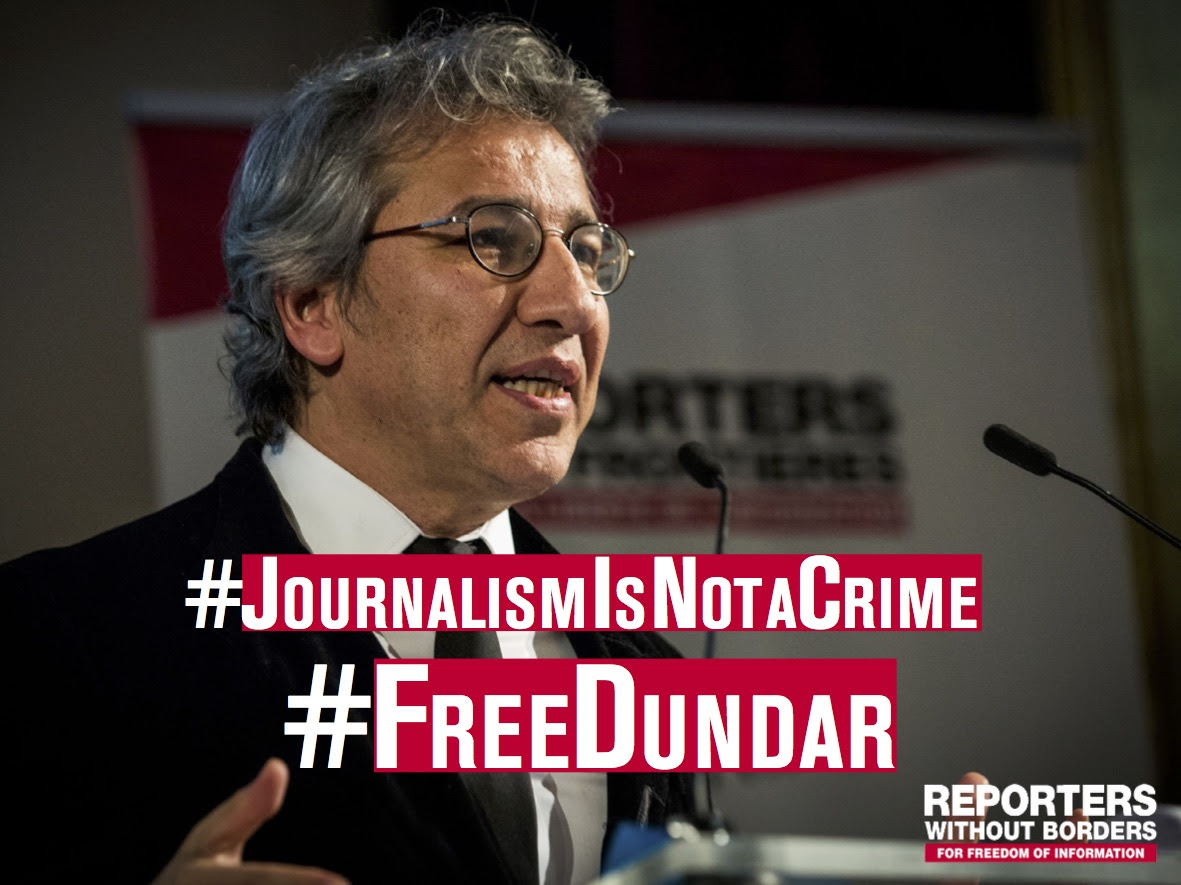
First as prime minister and now as president, Recep Tayyip Erdogan has been waging a methodical crackdown on the media in Turkey for years. Erdogan is persecuting journalists of all colours in an increasingly ferocious manner in the name of combatting terrorism and defending state security. The Erdogan regime’s arrests, threats and intimidation are unworthy of a democracy.
Can Dündar, the editor-in-chief of the Turkish daily Cumhuriyet, and his Ankara bureau chief, Erdem Gül, have been held since the evening of 26 November. They are charged with spying and terrorism because last May they published evidence of arms deliveries by the Turkish intelligence services to Islamist groups in Syria. Both are exemplars of journalism, the search for truth and the defence of freedoms. President Erdogan publicly said that Dündar “will pay for this.” But Cumhuriyet’s journalists just did their job, publishing information that was in the public interest.
At a time when international terrorism is at the centre of everyone’s concerns, it is unacceptable that political prosecutions are used to suppress investigative reporting and exposés. The arrest of these two journalists is the latest extreme to which political use of the Turkish judicial system has been taken. Many journalists have been detained on spurious charges of terrorist propaganda and insulting President Erdogan. The regime has also been using economic levers to put growing pressure on the media, while draconian laws have been passed.
We, public figures, media freedom NGOs and unions, reject the blatant erosion of media freedom in Turkey. The country is ranked 149th out of 180 countries in the Reporters Without Borders press freedom index. Index’s Mapping Media Freedom project has recorded 178 verified reports of media violations since May 2014.
We appeal to the Turkish authorities to free Can Dündar and Erdem Gül without delay, to drop all charges against them, and to free all other journalists who are currently detained in connection with their journalism or the opinions they have expressed.
We also urge the institutions and governments of democratic countries to face up to their responsibilities to respond to President Erdogan’s increasingly authoritarian excesses.
SIGNATORIES
Public figures
Günter Wallraff, journalist, Germany
Noam Chomsky, linguist, USA
Edgar Morin, sociologist, France
Carl Bernstein, journalist, USA
Zülfü Livaneli, writer, Turkey
Ali Dilem, cartoonist, Algeria
Thomas Piketty, economist, France
Claudia Roth, politician, Germany
Paul Steiger, journalist, United States
Kamel Labidi, journalist, Tunisia
John R McArthur, media executive, USA
Fazil Say, pianist, Turkey
Peter Price, media executive, USA
Edwy Plenel, media executive, France
Jim Hoagland, journalist, USA
Ahmet İnsel, political analyst, Turkey
Eric Chol, newspaper editor, France
Nedim Gürsel, writer, Turkey
Cem Özdemir, Green Party copresident, Germany
Hakan Günday, writer, Turkey
Mikis Theodorakis, composer, Greece
Per Westberg, writer, Sweden
Louise Belfrage, journalist, Sweden
Ali Anouzla, journalist, Morocco
Omar Bellouchet, journalist, Algeria
Jack Lang, former government minister, France
Omar Brouksy, journalist, Morocco
Pierre Haski, journalist, France
Jay Weissberg, cinema critic, USA
NGOs
Reporters Without Borders (RSF)
Committee to Project Journalists, (CPJ)
PEN International
International Press Institute (IPI)
World Association of Newspapers and News Publishers (WANIFRA)
Index on Censorship
World Press Freedom Committee (WPFC)
International Federation of Journalists (IFJ)
European Federation of Journalists (EFJ)
Ethical Journalism Network (EJN)
Global Editors Network (GEN)
Turkish Association of Journalists (TGC)
Turkish Union of Journalists (TGS)
DISK Basinİş
Take action: Support the appeal by signing the petition in English, Turkish or French
Mapping Media Freedom
Click on the bubbles to view reports or double-click to zoom in on specific regions. The full site can be accessed at https://mappingmediafreedom.org/
|
25 Sep 2015 | Bahrain Statements, Campaigns, mobile, Statements
The Bahrain Institute for Rights and Democracy, alongside 16 NGOs including Index on Censorship, today voiced support for the UN joint-statement on human rights in Bahrain. The statement, delivered by Switzerland at the 30th session of the UN Human Rights Council, was co-signed by 33 countries, including 19 EU states and the United States of America.
The statement remains open for additional signatories until the end of the Human Rights Council session on 2 October 2015. The NGOs invite states who have not signed to do so and call on those who have to continue exerting collective pressure for human rights progress in Bahrain.
Letter
To the Governments of: Albania, Argentina, Bosnia and Herzegovina, Brazil, Canada, Croatia, Cyprus, Finland, Greece, Hungary, Italy, Malta, Mexico, Republic of Korea, Serbia, Slovak Republic, and Spain
24 September 2015
Excellencies,
We, the undersigned non-governmental organisations, write to voice our support for the joint statement on the human rights situation in Bahrain delivered by Switzerland at the 30th Session of the Human Rights Council (HRC).
Since the last joint statement on Bahrain in June 2014, the government has continued to curtail the rights to freedom of expression, association and peaceful assembly. Human rights defenders, political opposition leaders, members of the media, and youth have faced intimidation, arrest, arbitrary detention, unfair trials and acts of reprisal by the authorities. Furthermore, negotiations of the Office of the High Commissioner for Human Rights’ (OHCHR) for a programme of technical capacity building in Bahrain have stalled in the period since the June 2014 joint statement.
We urge your government, therefore, to sign the joint statement on Bahrain delivered by Switzerland at the HRC’s 30th session in order to refocus international attention on human rights in Bahrain and encourage the government of Bahrain to constructively address its ongoing violations.
International pressure on Bahrain continues to assist in addressing human rights violations in Bahrain, as reflected by the decision of the King of Bahrain to release prominent human rights defender Nabeel Rajab under a royal pardon after he spent over four months in prison for a tweet criticising the government.
It is critical, therefore, to take action now to reaffirm the high level of international concern over human rights conditions in Bahrain. To abandon collective pressure on Bahrain at a time when the situation is continuing to deteriorate would send an entirely wrong message to the Bahraini government, and undermine both internal and external efforts to foster genuine reform.
Switzerland has indicated that this joint statement will be open for additional signatories throughout the session. We therefore call on your government to recommit to supporting human rights in Bahrain, and to add your endorsement to this joint statement.
Sincerely,
Americans for Democracy & Human Rights in Bahrain (ADHRB)
Amnesty International
ARTICLE 19
Bahrain Centre for Human Rights (BCHR)
Bahrain Institute of Rights and Democracy (BIRD)
Cairo Institute for Human Rights Studies (CIHRS)
CIVICUS: World Alliance for Citizen Participation
English Pen
European Center for Constitutional and Human Rights (ECCHR)
European Centre for Democracy and Human Rights (ECDHR)
Human Rights Watch
Index on Censorship
International Service for Human Rights (ISHR)
Pen International
Rafto Foundation
The International Federation for Human Rights (FIDH)
World Organization Against Torture (OMCT)
11 Aug 2015 | Academic Freedom, Magazine, mobile, Student Reading Lists
Articles from this list explore the topic of how minority groups are both being censored and also evade censorship. Includes Kerry Brown on the censored minorities of China at the time of the 2008 Olympic Games and Akeel Bilgrami on the plight of India’s Muslims after 9/11.
Students and academics can browse the Index magazine archive in thousands of university libraries via Sage Journals.
Minority groups and censorship articles
Minorities and the media by Anthony Smith
Anthony Smith, March 1975; vol. 4, 1: pp. 105-106
A study in the use of media by the Mexican Chicano Movement
Enemies Within by Kerry Brown
Kerry Brown, May 2008; vol. 37, 2: pp. 152-161
Kerry Brown on the censored minorities of China
Speaking in Tongues by Lambros Baltsiotis, Leonidas Embiricos
Lambros Baltsiotis, Leonidas Embiricos, March 2001, vol. 30, 2: pp. 145-151
A deconstruction of minority languages in Greece and a look at the battle to keep these languages alive
Just a Question of Money? By Moussa Awuonda
Moussa Awuonda, April 2003, vol. 32 no. 2 187-191
Kenyan journalist Moussa Awuonda details the report pressing the Swedish government to pay more attention to its minority presses
India’s Muslims Post 9/11 by Akeel Bilgrami
Akeel Bilgrami, November 2006, vol. 35, 4: pp. 15-21
Akeel Bilgrami delivers an explosive narrative on how India’s Muslim minority has responded to the aggressive ideology of the majority Hindus
Silencing the disabled: Only the state may help the disabled; others who try are repressed by Steven Marc Glick
Steven Marc Glick, October 1981, vol. 10, 5: pp. 32-33
Author Steven Marc Glick reports from the former Soviet Union on the plight of disabled individuals and new attempts by some to help them
Down The Welsh Road by George Jones
George Jones, July 2001, vol. 30, 3: pp. 206-211
George Jones on the linguistic rights of the Welsh-speaking minority in Wales
Speaking in Tongues by Ayer Neier
Ayer Neier, March 1996, vol. 25, 2: pp. 139-141
The ex-executive director of Human Rights Watch on the danger of suppressing minority languages worldwide
Daring to speak one’s name: A reflection on gay censorship by Alberto Manguel
Alberto Manguel, January 1995, vol. 24, 1: pp. 14-31
As Russian law relaxes and allows homosexual writers a voice, Alberto Manguel reflects on gay censorship in the country
The landscape for religious freedom in the new Egypt by Shahira Amin
Shahira Amin, June 2013, vol. 42, 2: pp. 102-109
Two years after the revolution in Egypt, Shahira Amin reflects on the minority communities who are still trying to get their voices heard
The reading list for minority groups and censorship can be found on the Sage website
21 Jul 2015 | Art and the Law Case Studies, Artistic Freedom Case Studies
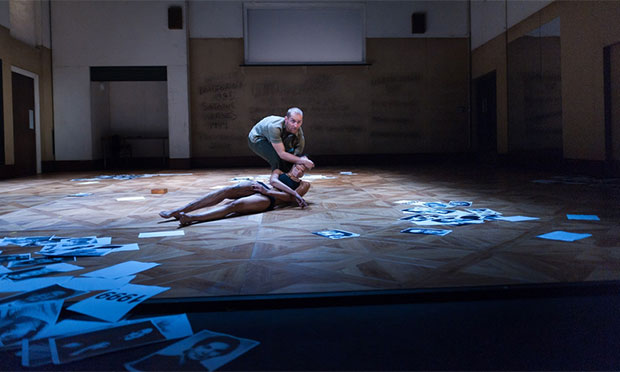
A scene from Can We Talk About This? (Photo: Matt Nettheim for DV8)
As part of our work on art, offence and the law, Julia Farrington, associate arts producer, Index on Censorship, interviewed Eva Pepper, DV8’s executive producer about how she prepared for potential hostility that the show Can We Talk About This? might provoke as it went on tour around the world in 2011-12.
Background
Can We Talk About This?, created by DV8’s Artistic Director Lloyd Newson, deals with freedom of speech, censorship and Islam. The production premiered in August 2011 at Sydney Opera House, followed by an international tour of 15 countries — Sweden, Australia, Hong Kong, France, Italy, Austria, Germany, Greece, Slovenia, Hungry, Spain, Norway, Taiwan and Korea and the UK between August 2011 and June 2012 — and was seen by a 60,000 people.
Extract from publicity of the show:
“From the 1989 book burnings of Salman Rushdie’s The Satanic Verses, to the murder of filmmaker Theo Van Gogh and the controversy of the ‘Muhammad cartoons’ in 2005, DV8’s production examined how these events have reflected and influenced multicultural policies, press freedom and artistic censorship. In the follow up to the critically acclaimed To Be Straight With You, this documentary-style dance-theatre production used real-life interviews and archive footage. Contributors include a number of high profile writers, campaigners and politicians.”
Q&A
Farrington: How did you set about working with the police for this tour?
Pepper: We focused on the UK with policing; I didn’t speak to any police forces in other countries at all, just in the UK cities we toured to: West Yorkshire Playhouse in Leeds; Warwick Arts Centre; Brighton Corn Exchange; The Lowry in Manchester and the National Theatre in London. But we did have a risk assessment and risk protocol that we shared with every venue we went to. We let them know the subject matter and the potential risks: security, safety of the audiences, media storms, safety of the people who were working on the show. They dealt either with their in-house security, or, in the UK, they would often alert the police as well.
Farrington: How did your preparations with police vary around the UK?
Pepper: We started with the Metropolitan Police, about six months before and told them our plans and that we would also contact other police forces. The National Theatre had their own contacts with the police who were already on standby. We still kept the MET events unit informed, but they [National Theatre] dealt with the police themselves. They were much more clued up, they had a head of security whom I briefed; we talked quite a lot. I made sure that he was copied in when anything a bit weird came up on the internet.
Our first venue was Leeds and we approached them about six weeks before the UK premiere. There was a bit of nervousness around Leeds, because of the larger Muslim population in the area. But we were only just beginning our liaison with the police and it took a little time to get a response. In the end we approached senior officers, but they often didn’t engage personally, just put us in touch with the appropriate unit to deal with.
Farrington: They didn’t see it as that important?
Pepper: They liked to be alerted that something might happen and they assured us that they were preparing. The venues also had their own police liaison; sometimes there was a bit of conflict if they had their own. I probably ruffled a few feathers when I went to a more senior officer.
Our starting point to the police was a very carefully worded letter which set out who we were. We didn’t ask permission to put it on we just alerted them that we might need police involvement. I did have some calls and a couple of meetings with officers, where they reiterated what is often said, which is that the police’s mandate is to keep the peace. It was made clear that they have as much of a duty to those people who want to protest or potentially might want to protest, as they have to allow us to exercise our freedom of expression. In Leeds nothing happened but there was a certain amount of nervousness around it.
Farrington: Where – at the venue?
Pepper: I think we were probably a bit nervous, and the police took it seriously enough. We had contact numbers to call. They were very much in the loop of the risk assessment.
Farrington: Was there a police presence on the night?
Pepper: I don’t remember seeing anybody. There was security of the venue of course, but regional venues only go so far with security. With some venues we were a little insistent that they get somebody upstairs and downstairs for example.
Farrington: And search bags, that kind of thing?
Pepper: We insisted people check in bags. The risk protocols weren’t invented for Can We Talk About This? They were really invented for To Be Straight With You [DV8’s previous show] and just tightened up for Can We Talk About This?. The risk protocols are just bullet points to get people thinking through scenarios.
Farrington: In general how would you describe your dealings with the police?
Pepper: I think generally supportive but we came to alert them that we might need them – there wasn’t a crisis. They said ‘thanks for letting us know let us deal with it.’ We would have quite liked to go through their risk assessments, but that didn’t happen. I think we were a little bit on their radar. They offered to send round liaison people to discuss practicalities around the office – stuff we hadn’t really thought about. It was a little bit tricky to get their attention.
The things we asked them to look out for were internet activity, if there was something brewing; sounds terribly paranoid. If there were issues around our London office or tour venues like hate mail, suspicious packages and then protests. So protest was just one thing our board was concerned about.
Farrington: Did you do anything else with the venue to prepare them for a possible hostile response from the media or a member of the public?
Pepper: I asked every venue artistic director or chief executive to prepare a statement. Lloyd would have been the main spokesperson for us if anything went wrong, but for a regional venue it is important that you are ready with a response and they all did that.
Farrington: What kind of thing did they say?
Pepper: We have supported this artist for the last 20 years. Lloyd has always been challenging in one way or another. This time he is challenging about this and we are going with him.
Farrington: Did you have any contact with lawyers?
Pepper: We looked carefully at the contents of the show. We had used interviews with real people and we wanted to be sure that nothing said was libellous or factually incorrect. So we had things looked at. The lawyer would say have you thought about that, did you get a release for this, are you using this from the BBC, do you have permission, have you spoken to this person, does he know you are doing it? And sometimes it is yes and sometimes it was a no.
Farrington: They pointed out some bases you hadn’t covered?
Pepper: Maybe one. We were really good and a bit obsessive. Sometimes we thought we didn’t have to ask because the information was in the public domain anyway, based on an interview that has been online for ten years for example. And the lawyer would or wouldn’t agree with that. It was good for peace of mind. That’s the thing with legal advice it doesn’t mean that nobody comes after you, because the law isn’t black and white.
Farrington: Were there some venues that you took the show to that didn’t think it was necessary to make special preparations?
Pepper: We always made them aware and we let them handle it. There are certain things that we always did. We asked them to consider security, and certainly PR. I was quite concerned that it would be a big PR story and then out of the PR story, as we saw with Exhibit B, comes the police. The protests don’t come from nowhere usually, somebody comes and stirs things up.
Farrington: Did you prepare the venue press departments?
Pepper: Yes we did, and we quite consciously had interviews, preview pieces before hand, where Lloyd could give candid interviews about the show. Almost to take the wind out of people’s sails, to put it out in the open so nobody could say they were surprised.
Farrington: How did you prepare with the performers for potential hostility?
Pepper: We talked through the risk procedure with them. We also got some advice from a security specialist, about being more vigilant than usual, noticing things that are out of the ordinary; if somebody picks a fight in the bar after the show, find a way to alert the others. So yes, the security specialist had a meeting with us here in the office, but also came up to Leeds to talk to the performers.
Farrington: Did it create a difficult atmosphere?
Pepper: It did yes, it got a bit edgy. Next time I would not do it around the UK premiere. It took a long time to set all of this up. To find the right people, to get people to take it seriously, to have meetings scheduled.
Farrington: It took time to find the right kind of security specialist?
Pepper: It also took a little while to get straight what we needed. We probably tried to figure it out for ourselves for a long time. And then got somebody in after all, just as maybe we, or the board got a bit more nervous. When you talk about protests you always worry about the general public, but as an employer there are the people who you send on tour who have to defend the show in the bar afterwards, potentially they are the targets.
Farrington: But they were behind the show?
Pepper: Yes, undoubtedly. But it’s an uncomfortable debate. There were so many voices in that show and you didn’t agree with every voice and it was never really said what really is Lloyd’s or DV8’s line. I would say that all the dancers were fine, but sometimes if somebody corners you in a bar it gets squirmy. No one is comfortable with everything.
Farrington: Can you summarise the response to the show?
Pepper: We had everything from 1 to 5 stars. We had people that loved the dance and hated the politics, who loved the politics and hated the dance. Occasionally somebody liked both. Occasionally somebody hated both. The show was discussed in the dance pages, in the theatre pages and in the comments pages. So in terms of the breadth and depth of the discussion we couldn’t have been more thrilled. Then we had dozens of blogs written about the show. For us Twitter really started with Can We Talk About This? and it was a great instrument for us. Social media was largely positive, though some people were picking a fight on Facebook at some point. It was very, very broad and very widely discussed.
Farrington: And did you interact with Twitter or did you let it roll?
Pepper: Mostly we let it roll. As part of the risk strategy we had a prepared statement from Lloyd which was very similar to the forward in the programme and anybody who had any beef would be redirected to the statement.
Farrington: Did the venues take this performance as an opportunity to have post show discussion and debate?
Pepper: Lloyd prefers preshow talks because he doesn’t like people to tell him what they thought of the shows. Quite often there is a quick Q&A before. In UK, we had one in Brighton [organised by Index] and one at the National. We had fantastic ones in Norway after the Breivik killings. In Norway they weren’t sure it was relevant and then the killings happened and then I got the call to say now we need to talk about it.
But having pre-show talks is certainly how we decided to deal with it. There is a conflict with having a white middle-aged atheist put on a show about Islam. But the majority of voices in the show were Muslim voices of all shades of opinion. It wasn’t fiction. It was based on his research and based on people’s stories – writers, intellectuals, journalists, politicians and who had a personal story to tell
Farrington: How did you prepare work with the board regarding potential controversies?
Pepper: Really the work with the board started with the previous show To Be Straight With You that already dealt with homosexuality and religion and culture; how different communities and religious groups make the life of gay people quite unbearable, internationally and in this country. And even then, we started to say, ‘can we say this? are we allowed to criticise these people like this?’ and out of that grew the ‘yes, I do want to talk about this’ because if we don’t a chill develops. Can We Talk About This? was a history about people who had spoken out about aspects of Islam that they were uncomfortable with or against and what happened to them.
Farrington: What kind of board do you need if you are going to be an organisation that explores taboos like this?
Pepper: We have got a fantastic board; it is incredibly responsible and so is Lloyd. There is a very strong element of trust in Lloyd’s work. They wouldn’t be on the board if they didn’t support him. But, as employers, they are aware of their responsibilities to everyone who works for us. As a company we have to be prepared in the eventuality that there is a PR or security disaster. What we were really trying to do was avoid that eventuality. We will never know. Maybe nothing bad would have happened. I think that Lloyd now wishes more people had seen it, that a film had been made, that it was more accessible to study by those who want to. He thinks that maybe we were a bit too careful. But as an organisation, as DV8, as an employer I think that we did the right thing by looking after people.
Farrington: What advice could you give to prepare the ground for doing work that you know will divide opinion and you know could provoke hostility?
Pepper:
E: If you can anticipate this you already have an advantage, but it’s not always possible to second-guess who might find what offensive. But if you know, I would suggest you ask yourself what buttons you are likely to push; you have to be confident why you are pushing them – usually in order to make an important point. It’s a good idea to articulate this reasoning very well in your head and on paper. Then you have got to be brave and get on with your project. Strong partners are invaluable, so try to get support. But in the end it is about standing up and being able to defend what you do.
Farrington: So you think you could have gone a bit further?
Pepper: I think if you prepare well you could go a bit further. I don’t think there is a law in this country that would stop you from being more offensive than we were. Every artist has to decide for themselves what they want to say and why they are saying it, and if they can justify it they can go for it.
