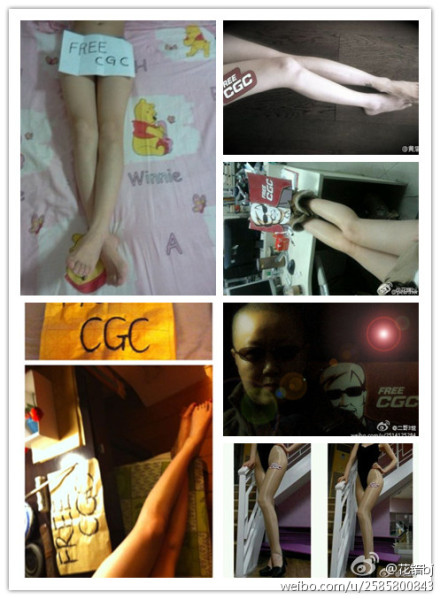
The twists and turns in the fate of “barefoot lawyer” Chen Guangcheng have held all in its thrall. Despite the vigilance of web censors, China’s netizens — particularly its social media users — have found inventive new ways of discussing the case.
China’s web nannies have been on high alert ever since Chen fled his home in his native Shandong province. To bypass the censors, netizens concocted nicknames for Chen, including “Shawshank” (a reference to the film, The Shawshank Redemption) and “Sunglasses” (denoting Chen’s trademark black sunglasses). But within days, these search terms were also blocked .
Tea Leaf Nation, a blog that “makes sense of China through social meda”, rounded up the memes and graphics that people used to express their support for Chen, including photos of girls on Weibo with “Free CGC” tacked onto their bare legs. The pictures are now likely to be deleted.
Blocking on Sina Weibo (China’s hugely popular version of Twitter) has been systematic in the Chen case. “Chaoyang Hospital” the facility where Chen received treatment, is now an illegal term. When you search for it, Weibo tells you that “according to the relevant regulations, search results cannot be shown.”
The authorities are also using soft blocking – Beijing-based film-maker and writer Charles Custer explored how Weibo hides content from users. For Tech in Asia Custer wrote:
What we found is that while Sina did not block “left of his own volition” as a search term … the company clearly took steps to smother discussion of the term by disabling the indexing of new posts containing the term. … While you can still search for posts with “left of his own volition,” you will only see results from before 16:50 this afternoon, which is approximately when Sina blocked the indexing.
Hong Kong University’s China Media Project, has been, as always, the most reliable source of information on what’s been censored. A post by Xiong Peiyun, a journalist and fellow of the centre, is on the Weibo ban list. Links to Xiong’s piece which criticised China for asking for an apology from the US for sheltering Chen in its embassy have been deleted.
Although overtaken by Chen case, China’s crackdown on “rumour-mongering” in the sensitive Bo Xilai affair continues. On 24 April it was reported that the Chinese government shut down at least four Sina Weibo accounts — “Li Delin,” “Guangzhou Wu Guanchong,” “Yangguang de yuanshi” and “Longyitian—945″ — and several reports claim people running these Weibo handles have disappeared.
The Financial Times report that Wu Guanchong was an entrepreneur and avid internet user based in Guangzhou who allegedly used Weibo to circulate rumors about a coup in Beijing. He has been missing for about a month, it is being claimed he was taken away at the end of March by officials from the capital.
Meanwhile, when one searches on Weibo in Chinese for Li Delin, a financial journalist who also blogged extensively on the case, the following notice appears:
Recently, some lawless individuals have used Sina microblog to make up and spread rumors for no reason, which has had a bad effect. They are now being dealt with by Public Security according to the law.
There were a few comments on Weibo about these notices. A student called Zhang Shaoyan wrote:
This [notice] made me think of how our textbooks had described the Kuomintang [Chinese Nationalist Party]. It’s been eighty years, but now the mountains are on our own heads.
Zhang’s comparison of the tactics of the ruling party with the Kuomintang (defeated by the Communist Party during the Chinese civil war) is hardly original. There was a reason he felt so strongly: one of his microblogs had just been deleted.
Update: the Associated Press has spoken via Skype to a close friend of Chen, Zeng Jinyan, who claims that Chinese officials forced the activist to choose between going into exile alone or staying in China with his family. More details as we get them.
Chinese dissident activist Chen Guangcheng has left the US Embassy in Beijing, been treated at a hospital in the city and reunited with his wife, reports said today.
In the first confirmation that the blind legal activist had been housed under US diplomatic protection following his escape from house arrest last week, US ambassador Gary Locke called the Washington Post to say he was with Chen en route to Chaoyang Hospital in east Beijing. Chen is also said to have spoken to US secretary of state Hillary Clinton, who is due to arrive in Beijing today for bilateral talks, with whom he “shared a mutual admiration”.
State news agency Xinhua said that 40-year-old Chen, a prolific human rights activist known for his campaign against forced abortions in China’s Shandong province, left the embassy “of his own volition” after staying there for six days.
China’s foreign ministry spokesman Liu Weimin has demanded an apology from the United States, accusing the country of taking a Chinese citizen “via abnormal means” into its embassy and of having “interfered in the domestic affairs of China”.
US officials told Reuters that “this was an extraordinary case involving exceptional circumstances, and we do not anticipate that it will be repeated.” They added that Chen plans to remain in China to continue his work, and that the Chinese government had given them assurances of his safety.
Today’s developments come after several days of sensitive negotiations designed to resolve the activist’s fate ahead of Clinton’s arrival in Beijing. US president Barack Obama signalled his support for Chen yesterday, noting that China would “be stronger” if it were to improve its human rights record. Clinton said that a “constructive relationship includes talking very frankly about those areas where we do not agree, including human rights”.
Chen spent four years in prison on charges of disturbing public order before being placed under house arrest in the village of Dongshigu in September 2010. He fled to the Chinese capital last week and a video was released online in which he claimed he and his family had been tortured by officials.
Whether or not Chen is indeed “a free man”, as one of his lawyers Li Jingsong was quoted as saying today, remains to be seen. “I am highly sceptical in terms of promises about the rule of law,” Beijing-based writer and documentary film-maker Charlie Custer told Index, noting that the government has “virtually a zero per cent track record” of treating Chen according to Chinese law.
He added: “I highly doubt Chen will be allowed to be entirely free; I suspect he’ll be sent back to where he was before. He won’t be allowed to operate as a regular Chinese citizen would and should be.”
“He should have been a free man 18 months ago when he should’ve been released from prison,” said Joshua Rosenzweig, a human rights researcher based in Hong Kong, adding that the Chinese government had a long time to protect the activist.
“They only gave these assurances because of the actions of Chen to escape and because this became a high-profile diplomatic incident,” he said.
The safety of several of Chen’s supporters, such as activist He Peirong (@pearlher) also remains uncertain. He, a Nanjing-based activist and one of Chen’s most prolific supporters, is thought to still be detained after police took her from her home on 27 April for having helped Chen escape house arrest. Chen’s nephew, Chen Kegui, is understood to be in hiding.
“If China was serious about assuring Chen’s safety then they’d release them [his supporters],” Beijing-based writer and documentary film-maker Charlie Custer told Index. “The fact that they’ve not done that speaks volumes as to China’s intentions of how they’ll treat Chen.
“All He Peirong did was drive him to Beijing, why is she being held by police?” Custer added.
Meanwhile, security was tight at the hospital where Chen was being treated. Tom Lasseter, Beijing bureau chief for McClatchy Newspapers, tweeted from the scene:
Today’s developments need to be monitored closely to ensure the guarantees promised to Chen are not a one-off, Rosenzweig added. If China does not fulfill its promises, he said, “there is not much in the way of progress.”
“Serious questions need to be asked about nature of political system that places a high priority on maintaining stability above all else, and how that kind of a system makes it possible for local agents to carry out egregious infringements on individual rights for such a long time without intervention,” he said.
Marta Cooper is an editorial researcher at Index. She tweets at @martaruco
Politicians would make better decisions if they were not so influenced by the front pages, BBC Trust chairman Lord Patten told the Leveson Inquiry today.
Patten said that politicians have allowed themselves to be “kidded” by editors and proprietors that newspapers have more power and sway with the public than they in fact do.
“The question is how seemly it is for politicians to behave in a certain way or appear to be manipulated by papers,” Patten said.
He accused major political parties and their leaders of having “demeaned themselves” by courting the press over the last 25 years, adding that he was not a fan of “grovelling” to the press.
He said he would need a “lot of persuading to organise sleepovers for newspaper proprietors”.
Taking a mischievous dig at Rupert Murdoch, Patten said: “I’d have expected to meet the prime minister and other party leaders more times if I was a News International executive.” He told the Inquiry he had seen culture secretary Jeremy Hunt two or three times, and met David Cameron once.
When asked about his relationship with the media mogul, Patten told the Inquiry he sued publisher HarperCollins after Murdoch — its owner — tried to block the publication of a book Patten had written that was critical of his dealings with the Chinese authorities. Patten, the last governor of Hong Kong, said Murdoch had intervened to “curry favour with the Chinese leadership”, fearful that the book would “harm” his prospects in China.
But Patten went on to say he did not have a vendetta against the News International chief, adding that ” it is probably the case that certain papers exist in this country because of him.” He also described Sky News as a “terrific success”.
He also reiterated his view made last November at the Society of Editors that broadcasting regulation could not be applied to the press.
“It would be preferable not to have any statutory backup because we should be able to exercise self-discipline in our plural society,” he said, “which doesn’t involve politicians getting involved in determining matters of free speech.”
Follow Index on Censorship’s coverage of the Leveson Inquiry on Twitter – @IndexLeveson
The defection of Chinese writer and dissident Yu Jie last week revealed shocking allegations of torture and beatings more usually associated with rogue American troops in Iraq.
Yu, a close friend of imprisoned Chinese writer Liu Xiaobo, is most famous for his mocking attack on the country’s premier, China’s Best Actor: Wen Jiabao, published in Hong Kong in late 2010.
Yu fled with his family to the US on 11 January. Shortly after, he held a press conference in Washington and released a written statement on why he had chosen to defect. Below we pick out the most shocking of these claims.
Though I was physically in China, I became an ‘exile at heart’ and a ‘non-existent person’ in the public space.
Illegal house arrests, torture, surveillance, tracking, and being taken on ‘trips’ became part of my everyday life.
Several of the plainclothes officials came at me again and began beating me in the head and the face without explanation. They stripped off all my clothes and pushed me, naked, to the ground, and kicked me maniacally. They also had a camera and were taking pictures as I was being beaten, saying with glee that they would post the naked photos online.
They forced me to kneel and slapped me over a hundred times in the face. They even forced me to slap myself. They would be satisfied only when they heard the slapping sound, and laughed madly. They also kicked me in the chest and then stood on me after I had fallen to the ground.
The head state security officer told him:
If the order comes from above, we can dig a pit to bury you alive in half an hour, and no one on earth would know… If the central authorities think that their rule is facing a crisis, they can capture [all China’s dissidents] in one night and bury them alive.
While the post-Tiananmen Square period was a time when Chinese dissidents defected in their droves, there is still a steady trickle of Chinese who seek refugee status overseas. Some of them leave legally, while others, who are denied passports or the right to leave smuggle themselves out, usually via Vietnam. They include fellow writer Liao Yiwu, who has been living in Germany since 2011; Chinese diplomat, Chen Yonglin, who fled to Australia in 2005; and AIDS activist Wan Yanhai, who left for the United States in 2010. The wife of Chinese dissident human rights lawyer Gao Zhisheng, Geng He, has also been living in the US for the past two years. Her husband is currently serving a three-year prison sentence for violating probation rules, having been missing for more than a year.