14 May 2020 | Covid 19 and freedom of expression, News
[vc_row][vc_column][vc_column_text]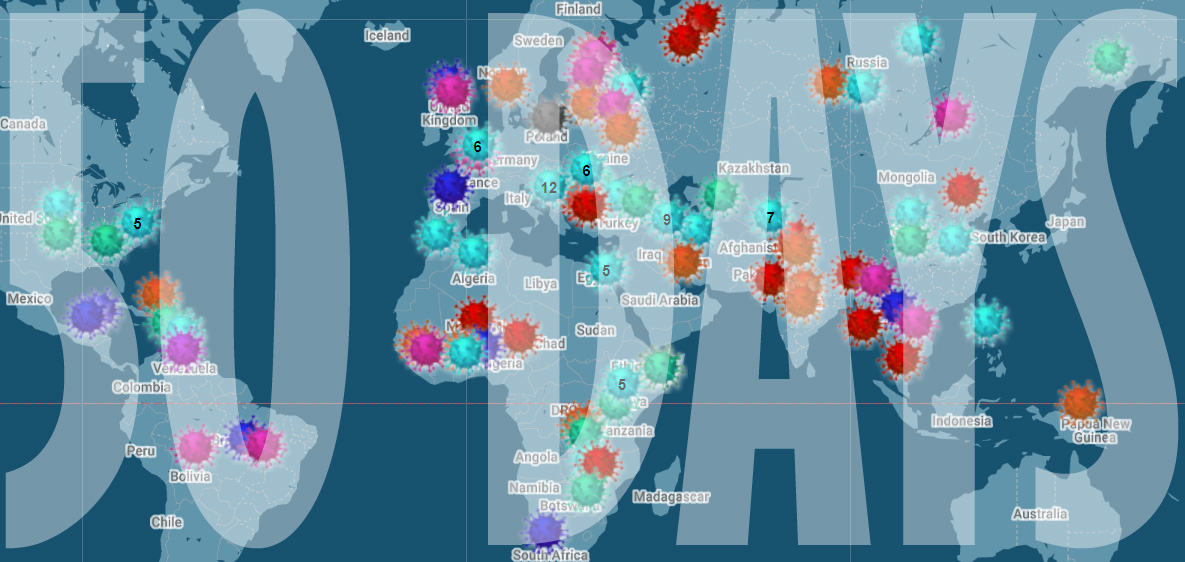
As we mark 50 days since we first started collating attacks on media freedom related to the coronavirus crisis, we’re horrified by the number of attacks we have mapped – over 150 in what is ultimately a short period of time.
We know that in times of crisis media attacks often increase – just look at what happened to journalists after the military coup in Egypt in 2013 and the failed coup against Recep Tayyip Erdogan in Turkey in 2016. The extent of the current attacks, in democratic as well as authoritarian countries, has been a shock.
Our network of readers, correspondents, Index staff and our partners at the Justice for Journalists Foundation have helped collect the more than 150 reports media attacks.
But these incidents are likely to be the very tip of the iceberg. When the world is in lockdown, finding out about abuses of power is harder than ever. Journalists are struggling to do their job even before harassment. How many more attacks are happening that we don’t yet know about? It’s a scary thought.
Rachael Jolley, editor-in-chief of Index on Censorship, said: “We are alarmed at the ferocity of some of the attacks on media freedom we are seeing being unveiled. In some states journalists are threatened with prison sentences for reporting on shortages of vital hospital equipment. The public need to know this kind of life-saving information, not have it kept from them. Our reporting is highlighting that governments around the world are tempted to use different tactics to stop the public knowing what they need to know.”
Index is alarmed that the attacks are not coming from the usual suspects. Yes, there have been plenty of incidents reported in Russia and the former Soviet Union, Turkey, Hungary and Brazil. At the same time there have been many incidents in countries you would not expect to see – Spain, New Zealand, Germany and the UK.
The most common incident we have recorded on the map are attacks on journalists – whether physical or verbal – and cases where reporters have been detained or arrested. There have been more than 30 attacks on journalists, with the source of many of these being the US President Donald Trump. He has a history of being combative with the press and decrying fake news even where the opposite is the case and the crisis has seen a ramped up attempt at excluding the media. During the crisis, he has refused to answer journalists’ questions, attacked the credentials of reporters and walked out from press conferences when he doesn’t like the direction they are taking.
We have also seen reporters and broadcasters detained and charged just for trying to tell the story of the crisis, including Dhaval Patel, editor of the online news portal Face of Nation in Gujarat, Mushtaq Ahmed in Bangladesh and award-winning investigative journalist Wan Noor Hayati Wan Alias in Malaysia.
Since we started the mapping project, we have highlighted other specific trends. Orna Herr has written about how coronavirus is providing pretext for Indian prime minister Narendra Modi to increase attacks on the press and Muslims. Jemimah Steinfeld wrote about how certain leaders are dodging questions while we have also looked at how freedom of information laws are being suspended or deadlines for information extended.
Although the map does not tell the whole story it does act as a record of these attacks. When this crisis is finally all over, it will allow us to ask questions about why these attacks happened and to make sure that any restrictions that have been introduced are reversed, giving us back our freedom.[/vc_column_text][/vc_column][/vc_row][vc_row][vc_column][vc_btn title=”Report an incident” shape=”round” color=”danger” link=”url:https%3A%2F%2Fforms.gle%2Fhptj5F6ZvxjcaGLa7|||” css=”.vc_custom_1589455005016{border-radius: 5px !important;}”][/vc_column][/vc_row]
29 Apr 2020 | News
[vc_row][vc_column][vc_column_text]Attacks on press freedom in Europe are at serious risk of becoming a new normal, 14 international press freedom groups and journalists’ organisations including Index on Censorship warn today as they launch the 2020 annual report of the Council of Europe Platform to Promote the Protection of Journalism and the Safety of Journalists. The fresh assault on media freedom amid the Covid-19 pandemic has worsened an already gloomy outlook.
 The report analyses alerts submitted to the platform in 2019 and shows a growing pattern of intimidation to silence journalists in Europe. The past weeks have accelerated this trend, with the pandemic producing a new wave of serious threats and attacks on press freedom in several Council of Europe member states. In response to the health crisis, governments have detained journalists for critical reporting, vastly expanded surveillance and passed new laws to punish “fake news” even as they decide themselves what is allowable and what is false without the oversight of appropriate independent bodies.
These threats risk a tipping point in the fight to preserve a free media in Europe. They underscore the report’s urgent wake-up call on Council of Europe member states to act quickly and resolutely to end the assault against press freedom, so that journalists and other media actors can report without fear.
Although the overall response rate by member states to the platform rose slightly to 60 % in 2019, Russia, Turkey, and Azerbaijan – three of the biggest media freedom violators – continue to ignore alerts, together with Bosnia and Herzegovina.
2019 was already an intense and often dangerous battleground for press freedom and freedom of expression in Europe. The platform recorded 142 serious threats to media freedom, including 33 physical attacks against journalists, 17 new cases of detention and imprisonment and 43 cases of harassment and intimidation.
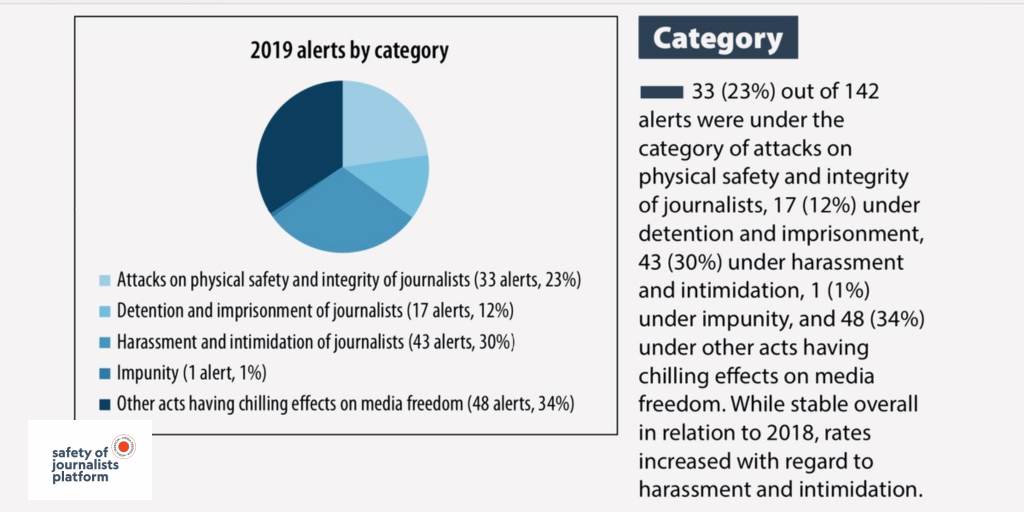
The physical attacks tragically included two killings of journalists: Lyra McKee in Northern Ireland and Vadym Komarov in Ukraine. Meanwhile, the platform officially declared the murders of Daphne Caruana Galizia (2017) in Malta and Martin O’Hagan (2001) in Northern Ireland as impunity cases, highlighting authorities’ failure to bring those responsible to justice. Only Slovakia showed concrete progress in the fight against impunity, indicting the alleged mastermind and four others accused of murdering journalist Ján Kuciak and his fiancée, Martina Kušnírová.
At the end of 2019, the platform recorded 105 cases of journalists behind bars in the Council of Europe region, including 91 in Turkey alone. The situation has not improved in 2020. Despite the acute health threat, Turkey excluded journalists from a mass release of inmates in April 2020, and second-biggest jailer Azerbaijan has made new arrests over critical coverage of the country’s coronavirus response.
2019 saw a clear increase in judicial or administrative harassment against journalists, including meritless SLAPP cases, and spurious and politically motivated legal threats. Prominent examples were the false drug charges filed against Russian investigative journalist Ivan Golunov and the continued imprisonment of journalists in Ukraine’s Russia-controlled Crimea. The Covid-19 crisis has strengthened officials’ tools to harass journalists, with dangerous new “fake news” laws in countries such as Hungary and Russia that threaten journalists with jail for contravening the official line.
Other serious issues identified by 2019 alerts included expanded surveillance measures threatening journalists’ ability to protect their sources, including in France, Poland and Switzerland, as well political attempts to “capture” media through ownership and market manipulation, most conspicuously of all in Hungary. These threats, too, are exacerbated by the actions taken by several governments under the health crisis, which further include arbitrary limitations on independent reporting and on journalists’ access to official information about the pandemic.
Jessica Ní Mhainín, Index’s policy research and advocacy officer, says, “There is a growing pattern of intimidation aimed at silencing journalists in Europe. The situation in Eastern Europe – especially in Hungary, Poland, and Bulgaria – is particularly concerning. But the killing of Lyra McKee shows that we cannot take the safety of journalists for granted anywhere – not even in countries that are seen to be safe for journalists. This report provides an opportunity for us all to come to grips with the serious situation that is facing European media and to remind ourselves of the vital role that the media play in holding power to account.”
Index and the other platform partners call for urgent scrutiny of action taken by governments to claim extraordinary powers related to freedom of expression and media freedom under emergency legislation that are not strictly necessary and proportionate in response to the pandemic. Uncontrolled and unlimited state of emergency laws are open to abuse and have already had a severe chilling effect on the ability of the media to report and scrutinise the actions of state authorities.
While the platform welcomes an increased focus on press freedom by European institutions, including both the Council of Europe and European Union institutions, the ongoing crisis demands more urgent and stringent responses to protect media freedom and freedom of expression and information, and to support the financial sustainability of independent professional journalism. In the age of emergency rule, protecting the press as the watchdog of democracy cannot wait.[/vc_column_text][/vc_column][/vc_row]
16 Apr 2020 | Awards, Fellowship, Fellowship 2020
[vc_row][vc_column][vc_video link=”https://youtu.be/CHeaC4lQRjI”][vc_column_text]OKO Press is the one of the first free investigative journalism and fact-checking websites in Poland.
They investigate and evaluate statements made by politicians, monitor public spending, and fight for access to public information. Their work also supports grassroots activism; crucial in an environment sliding further and further into authoritarianism and censorship.
OKO Press have paved the way for other news sources to follow suit. This has contributed to a safer and stronger public sphere, fighting for immunity from government propaganda.
The environment in which they work is becoming increasingly hostile. Political polarisation, lack of transparency, suspicion, threats and withholding of information are common. In the face of this, OKO Press shows resilience and determination.
“Ladies and Gentlemen, we are OKO.press. “Oko” means “eye” in Polish.
Since 2016, we keep an eye on what is happening in the EU and the world, but most importantly in Poland. Our country is going through a tough trial under the government of the populist right that invokes the worst nationalist traditions.
As journalists, we check whether those in power are not misleading us. We shine a light on the things they are trying to hide.
We are a participatory medium. We give a voice to all kinds of community initiatives. Which — like us — believe in the values of constitutional democracy, truth and transparency, human rights, including gender equality, the rights of LGBT+ people, as well as animal rights, environmentalism, and protecting the planet from climate change.
We are honoured to receive the award, but also humbled but the fact that other nominees, from Hong Kong, Venezuela of Burundi are acting in much harder circumstances. Friends, we admire your courage, determination and quality of work.
Kaczyński is no Maduro, Nkurunziza, Putin, or Erdogan, but apparently he takes his inspiration from them. We are not a dictatorship yet, though we are close to the so-called electoral authoritarianism, where all forms of public scrutiny, besides the elections, are being suppressed.
The prize is a great distinction for us, but also proof that the world is interested in what is happening in Poland. And justly so, because the virus in one EU country will spread further [until] there are no countries left free of infection. It is short-sighted and arrogant to think that Poland or Hungary are irrelevant because they are merely Eastern Europe.
Index on Censorship is the organisation which prevents us from silencing our consciences. In many places of the world we face political violence, laws being broken, and a wave of authoritarian right-wing populism.
Truth is the weapon of the civilised society. The pandemic has show that truth is ever more important, as the lack of the feeling of safety can lead to mass retreat from freedom. But catastrophes and crises also give rise to what is best and change the world. The Covid-9 crisis can come out for the better as well.
We promise to continue the fight against the anti-democratic virus which is taking over the world. We have one humble measure: the word. But as Vaclav Havel said, this is and always has been Power of the Powerless.
We believe the danger will wane, both epidemic and political. We will wake up in a healthier world.
Please help us to keep going. Read and support OKO.press.
Thank you for the award! “[/vc_column_text][/vc_column][/vc_row]
31 Mar 2020 | Covid 19 and freedom of expression, News
[vc_row][vc_column][vc_single_image image=”60471″ img_size=”full” add_caption=”yes”][vc_column_text]As coronavirus spreads across Europe so too do issues surrounding the transparency and accuracy of information on it. This is deeply troubling given the importance of reliable information about the pandemic. So what exactly are the main roadblocks to accurate facts? Here are the key trends when it comes to coronavirus and free expression in Europe.
Scapegoating
Scapegoating, an unhelpful habit historically used by Russian propagandists to foist blame onto their Cold War opponents, is now being used to suggest that coronavirus may have been brewed in a lab by the Americans in order to cripple the Chinese economy. This is one of many bizarre theories that were spread among the Russian population in a bid to confuse and distract.
Another form of scapegoating has reared its head in France, in particular, in the form of racism against people with Asian heritage. There have been reports of French-Asians suffering racist abuse on the streets, public transport and in school. This has also been an issue in the USA, where President Donald Trump angered Chinese authorities by referring to coronavirus as the “Chinese Virus”.
Criminalisation of “fake news”
In the USA, the term “fake news” can easily be used to discredit accurate reporting that Trump doesn’t like, which is why the criminalisation of news designated as “fake” by world leaders generally is so dangerous. Hungary’s parliament has passed a law to let Prime Minister Viktor Orban rule by decree for an indefinite period of time, and the state has the power to imprison people considered to have spread false information – aka “fake news” – about coronavirus.
This trend is present elsewhere in Europe as governments attempt to control information on coronavirus. Patrick Sensburg, a member of the ruling party in Germany, said in an interview that the government should consider “ratcheting up statutory offenses” to penalise those spreading news considered fake by the state.
Republika Srpska, one of the two entities of Bosnia and Herzegovina, has also introduced fines for publishing false news and allegations that “cause panic and fear among citizens” in the mainstream press and social media.
Opaque about the figures
While high numbers of recorded cases and deaths from coronavirus are something every country would rather avoid, transparency is key to members of the public being fully informed and understanding the risks. According to the Financial Times, Kim Jong Un has publicly denied any cases in North Korea while at the same time quietly soliciting aid from abroad. In Europe, Turkey has displayed signs of being unwilling to disclose accurate figures. On 23 March, after data showed fewer and fewer people were being tested over successive days, possibly to reduce the number of cases on record, the Turkish Medical Association urged the Turkish government to test more people. They believe the government figures may be propaganda, designed to flatter the state’s control of the situation, which a doctor, speaking anonymously, claimed was in fact “out of control”.
Ill-informed leaders
At a time of a global pandemic, world leaders would serve their citizens best by bowing to the greater wisdom of medical experts. Unfortunately, some European leaders have appointed themselves as “experts” in the field of cures for coronavirus, an unfortunate echo of leaders who made false claims about cures for Aids when it swept through Africa. Speaking on state television for instance, President Alexander Lukashenko of Belarus claimed that people in the countryside should continue working: “The tractor will heal everyone. The fields heal everyone”. Serbia’s president, Aleksandar Vucic, said he had found a reason to have an extra drink every day, after he claimed health specialists had told him that coronavirus “doesn’t grow wherever you put alcohol”. Please note: there is no scientific evidence to suggest that drinking alcohol has any effect on coronavirus.
We have previously reported on how censorship in China was impacting the way news about coronavirus was being reported, and vital information being distributed. We are also mapping all of the attacks on the media right now, which are growing sharply by the day. This represents one of the most worrying attacks on free speech in Europe right now.
The incidents on the map are collated by our staff, contributors and readers as well as our partners at the Justice for Journalists Foundation and verified by our team before pubication. Please check out the map here and do notify us via the map of any attacks we might have missed.[/vc_column_text][/vc_column][/vc_row][vc_row][vc_column][/vc_column][/vc_row]
