12 Jun 2014 | Europe and Central Asia, Magazine
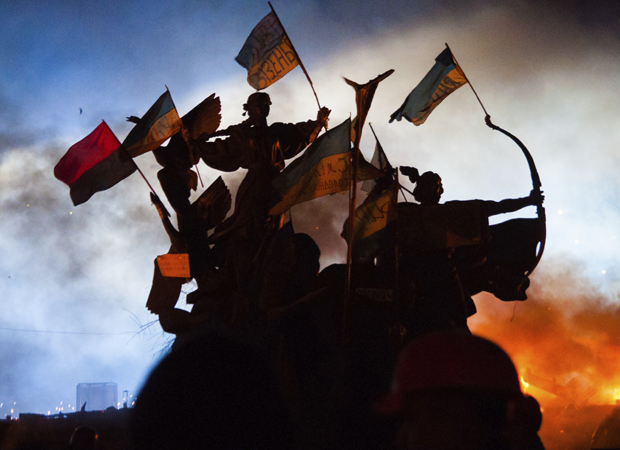
Twenty five years ago this autumn the Berlin Wall was pulled down and a wave of euphoria swept not just across that city, but across Europe, and then the world. When, also in 1989, Francis Fukuyama wrote we were seeing the “end of history” it seemed to make sense. His essay suggested not that history was over, but a new era was coming, one in which liberal democracy had defeated authoritarianism and the world would now inevitably become more free.
In the wake of the fall, eastern European nations swapped authoritarian regimes for democratic governments. And people who lived behind that wall were now able to travel more easily, read news that had previously been censored, and listen to music that had been forbidden. Many got the chance to vote in their first free election, with a choice of parties, and even had the option not to vote at all.
Bricks were falling and barriers were coming down as that long line of wire and sentry posts that had divided a continent was dismantled.
A quarter of a century on and the bubble of optimism is deflating. The two world superpowers of the 1980s, the US and Russia, are squaring up again, with presidents Putin and Obama exchanging threats and counter threats. In parts of the former Soviet Union little appears to have changed for the better with attacks on gay people, anti-gay legislation and the introduction of blasphemy and anti-swearing laws. In Belarus and Azerbaijan the hope for freedom still exists, but an atmosphere of fear prevails. Journalists there still live in fear of being beaten up, imprisoned or put under house arrest for writing articles that report problems that dictators would rather not have reported. Internet restrictions stop news being distributed, and samizdat, the opposition’s underground newspapers of the Soviet era, continues to exist in Belarus. Further west of Moscow things are better than they were. Freedom to travel, write and read what you want came with the new era. But there are ominous signs. In Hungary there has been a rise in discrimination against minority groups such as the Roma, swastikas painted on Jewish gravestones, and a rise in support for fascist groups. In Poland there are similar reports of upsurges in extremism and homophobia. That initial post-wall swell of enthusiasm for change has been replaced by cynicism and anxiety.
Across Europe a strand of nasty nationalism is striding into the political arena. And weeks after Russia occupied Crimea, and continues to stand at the redrawn borders of Ukraine, the European landscape looks almost as anxious and divided as it did in the days of presidents Reagan and Brezhnev. Fears about a new Cold War feel well founded. If history teaches us anything, it should teach us to expect situations to repeat themselves, and to learn from the past.
History is certainly playing a part in these cycles. The narratives of hate often use a rewriting of history to make their case. “Those people hated us, so now we can hate them,” argues one set. “They supported the Nazis in the war,” argues one more. “The Jews might have had it bad, but it was just as bad for the non-Jewish Poles,” argues another.
A new memorial to a pro-Nazi leader in Hungary has been erected, and writers with far-right connections are now on the country’s school curriculum. Austerity has given the nasty nationalists an opportunity to tell a new story about Europe. It’s too open; it’s too competitive for jobs; our young people don’t have enough opportunities; it’s all the fault of (a group can be named here). And all this creates distant echoes of German voices in the 1930s. Austerity and high levels of unemployment open up an angry fear of a troubled future where people will have less than they have now, often an excuse for popular support for repressive legislation. Politicians and wannabe politicians are drawing out emotional memories of Russia’s fight against the Nazis; WWII victories; and myths of Russia resplendent in centuries past or Hungary split and defeated, then mixing with nostalgia, a cupful of anger and a return to religiosity, in some cases, to present the case for tighter drawn laws that ban free speech or allow states to clampdown on groups they don’t like.
The past is being rewritten.
So, have the expected gains been as nought? In her article for this issue, Irena Maryniak argues that the dividing line in Europe still exists, but it has now shifted further east, along the eastern border of the Baltic states and down the western border of Belarus. To the east there is a greater expectation of conformity and that the group is greater than the individual. There are fault lines where tensions explode and where the push and pull from decades and where arguments about national identity and geo-political pressures result in sudden uprisings and anger. Meanwhile, Konstanty Gebert, who was a leading Solidarity journalist and continues to work as a writer, charts the public’s disillusionment with the “free” press in Poland. He explores why the newly independent media was not as willing to investigate stories as objectively as it should have done, and how people’s trust in the media has dissolved.
Our three German writers on the post-wall era explore different themes. Crime writer Regula Venske looks at the expectation that Germany would have a cohesive national identity by now, but her exploration through crime novels of the country’s image of itself shows a nation more comfortable with itself as regional rather than national. Matthias Biskupek looks back at theatre and literature censored in the former East Germany; while academic and writer Thomas Rothschild has felt his optimism ebb away. Meanwhile Generation Wall, our panel of under 25-year-olds from eastern Europe, speak to their parents’ generation about the past and talk about their present.
Clearly it’s not all bad news. Those members of Generation Wall are mentally and physically well travelled in a way that the older generation was not able to enjoy. They have experienced a life mostly uncensored. Freedom House’s influential Freedom in the World report shows that the number of countries rated as “free” has swept from 61 to 88, and four more than 1989 are rated “partly free”.
And as this year’s Eurovision Song Contest showed there are protests across Europe at the heavy handed tactics of Russian authorities, and at their attitudes to minorities. While a Eurovision audience booing at the Russian contestants or Russia’s neighbours reducing their traditional 12 votes won’t have a long-term effect, it is a sign of an airing of opinions from traditional Russian allies. Bloc voting, so long a tradition in Eurovision, appeared to be breaking down. The end of history has not happened, but learning from the past should never go away.
This article was published in the Summer 2014 issue of Index on Censorship magazine.
5 Jun 2014 | News, Religion and Culture, United Kingdom
Poets, we all agree, are terribly misunderstood and undervalued. If it were not for poets, how would we know what things were like other things. How would we live! How would we love! How would we die! They are a priestly class, helping us to mark out our minutes with prayers in pentameter.
But as with any priestly class, they deal in mystery. And demands to decode that mystery are heretical.
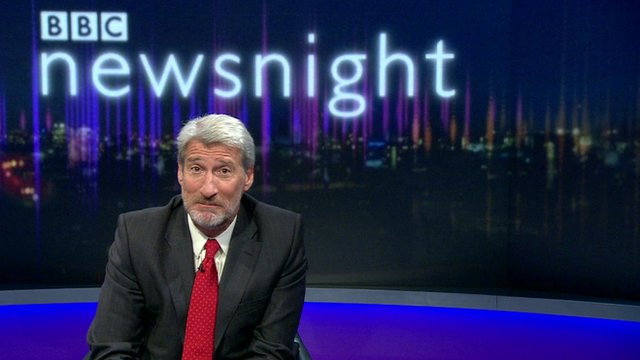
This is certainly the impression one would get judging from the reaction to Jeremy Paxman’s comments on poetry and public engagement this week.
Launching the shortlist for the Forward Prizes for poetry, the judging panel of which he chaired, Paxman, with a nod and a wink so heavy that he would have been in serious trouble if the wind changed, suggested that contemporary poetry had “connived in its own irrelevance” by failing to engage with the everyday lives of “ordinary people”. “It’s the general public that poets have to start engaging with,” said Paxman. “And that, I’m, sure, is why the people at Forward said ‘will you join the judging panel’”.
Translation: “The people at Forward knew that me saying something even slightly controversial about poetry would get their prize column inches, and I’m happy to oblige.”
Paxman went on to suggest, whimsically, a public inquisition where poets would explain their work to members of the public, rather than just to other poets.
Frankly, good on Paxman for recognising his use to the Forward Prize. That is not to say he is an man with little to say about poetry; indeed, he’s contributed greatly to the cause of poetry by wheeling out his “Jeremy Paxman” act free of charge for it. He was also, of course, in very careful to praise contemporary poetry and the marvellous books he’d read as a judge.
But that praise was as naught to some poets, who instead chose to pick up on his idea of a people’s panel to judge poetry, and his naughty use of the word “inquisition”.
For people who deal mostly in metaphor, the poets who rose to the bait took the Newsnight presenter’s words remarkably literally.
Todd Swift, a poetry publisher who runs the Eyewear Imprint, wrote that an inquisition was “a strange thing to ask for in an anti-clerical democracy – the idea of burning unrepentant poets at the stake after torturing them is only barely witty in a world where in many many nations, poets really are tortured and silenced.”
Oh Todd. He didn’t mean an actual inquisition.
Swift goes on to say, with an apparent lack of irony that would have horrified the more famous poet of his name: “Only in middle-class (upper class?) London could a white man think interrogating and potentially killing poets was a clever and useful corrective trope. It smacks of easy intellectual arrogance. I find many journalists despise, or fear, or dislike poetry, mainly because poetry is the best-written and most compressed form of language, and is smarter than journalism.”
You tell those journos and their easy intellectual arrogance, Todd!
Swift finishes off by saying “it becomes clear [Paxman] didn’t really read any of the 175 books he was meant to judge”, a statement that is almost certainly defamatory, as any journalist would have told him if he’d asked.
George Szirtes, a poet well respected by his peers, went down a slightly different route. Szirtes, a refugee from the Soviet tanks that rolled over his native Hungary in 1956, compared Paxman’s suggestion to Stalin’s demands for socialist realism from the USSR’s artists.
Szirtes makes some good points writing for the Guardian, but unfortunately they all follow from a sly trick he plays writing that Paxman’s fanciful inquisition would be a place where “poets would be required to explain themselves and, presumably, answer for their failure to be simpler.”
That “presumably” appears to give Szirtes a license to put words in Paxman’s mouth. Suggesting people explain their work is not at all the same as demanding it be simpler, merely that they be capable of (and interested in) talking about their work to non poets.
As another poet, Katy Evans-Bush, put it, writing about the furious condemnations of Paxman on Facebook (Facebook is where poets go to fight; no one is quite sure why). “Heaven forfend that someone from the wider world should look into your ‘cave of making’, see your ‘pellety nest’, and remark on it. ”
This all matters because poetry matters. Poetry is where we learn to play with words, to deal in metaphor, wordplay, the non-literal, the non-prosaic. How often have you heard someone say they’re “not into” or “don’t get” poetry. It’s frustrating, but poets should see that as a challenge, rather than turning in on themselves. That’s not a call to dumb down; it’s a call to act up. When you’re egged on to do so, it’s simply not enough to cry “Stalin!” and retreat further. That’s exactly the hyperbole and self regard that puts people off. If you care about an art form, you should want people to know about it. Otherwise it is youv-vnot Jeremy Paxman or the Forward prize or anyone else – who is censoring poetry.
This article was published on June 5, 2014 at indexoncensorship.org
30 Apr 2014 | About Index, Campaigns, Press Releases
VIENNA, April 30, 2014 – The European Commission’s support for projects addressing violations of media freedom and pluralism, and providing practical support to journalists, gives European Union countries reason to celebrate this year on May 3, World Press Freedom Day, media freedom watchdogs said today.
However, new research into defamation law and practice – one of four, one-year projects launched in February under a Commission-funded grant programme focusing on the 28 EU member and five candidate countries – has shed light on one big elephant in the room, the Vienna-based International Press Institute (IPI) said. Preliminary results of a study by IPI and the Center for Media and Communications Studies (CMCS) at Budapest’s Central European University reveal that criminal laws in the EU addressing libel, slander, and insult remain rife and, in many cases, contravene international and European standards.
Furthermore, as another project, “Safety Net for European Journalists”, registered, attacks on journalists continue to represent a major challenge to press freedom in Europe. Research and field work by the Osservatorio Balcani e Caucaso, IPI affiliate the South East Europe Media Organisation (SEEMO), Ossigeno per l’Informazione and Dr. Eugenia Siapera of Dublin City University have shown that journalists across Southeast Europe, Turkey and Italy often face common threats and pressure, highlighting a crucial need for transnational support.
“Media freedom and pluralism can unfortunately not be taken for granted in Europe,” Neelie Kroes, vice-president of the European Commission responsible for the Digital Agenda, said. “We all, governments, NGOs, the media, and the EU institutions have a role to play in standing firmly to defend these principles, in Europe and beyond, now and tomorrow, on and off-line. I am interested to see what the outcome of the independent projects will be.”
The European Commission grant programme, the “European Centre for Press and Media Freedom”, is funding two projects in addition to IPI’s project researching the effects of defamation laws on journalism in Europe and raising awareness of the same, and the “Safety Net” project establishing a transnational support network for journalists in Southeast Europe, Turkey and Italy. Index on Censorship has created a project to map media freedom violations, and the Florence-based Centre for Media Pluralism and Media Freedom (CMPF), also working in conjunction with CMCS, is creating tools and networks to strengthen journalism in Europe.
The grantees’ work, combating violations of the fundamental right to press and media freedom, is intended to play a critical role in protecting both the fundamental human right of free expression, as guaranteed by Article 11 of the EU’s Charter of Fundamental Rights, as well as the media’s instrumental role in safeguarding democratic order.
Some of the grantees will also collaborate to establish an intra-European network of legal assistance for media outlets facing legal proceedings.
IPI and CMCS plan to launch a comprehensive report in early June on the status of criminal and civil defamation law in EU member and candidate countries, intended to help identify states where engagement is required most urgently. The report will evaluate each country across a number of categories, including the types of defences and punishments available and the existence of provisions shielding public officials, heads of state, or national symbols from criticism. It will also include a first-of-its-kind “perception index” to gauge the subjective effect that criminal and civil defamation proceedings have on press freedom.
Preliminary research shows that, in nearly all EU member states, libel and insult remain criminal offences punishable with imprisonment – up to five years in some cases – and that journalists continue to face prosecutions in numerous countries, particularly Croatia, Greece, Hungary, Italy, Malta and Portugal. While some countries have seen movement toward decriminalisation, only a small minority of states have fully abolished criminal libel and insult provisions, among them Ireland, Romania and Britain.
A key finding so far is that while national courts in many cases apply European Court of Human Rights precedents on protection of freedom of expression, few EU member states have adopted legislation that meets these standards. This is particularly true with regard to defences available to journalists in libel proceedings. In IPI’s view, the lack of modern legislation clearly establishing defences of truth, public interest, fair comment and honest opinion contributes to an atmosphere of uncertainty and potential self-censorship on matters of public interest.
Additionally, the research so far has shown that legal protections shielding public officials from scrutiny are prevalent in many countries, and that such provisions often are found in tandem with increased punishments for journalists and media outlets that publish content that could be deemed defamatory. The combination of these two instruments – present in the laws of many EU member states – significantly weakens legal safeguards that enable journalists and media outlets to perform their necessary watchdog roles. Such barriers pose undue restrictions on freedom of expression rights and the public’s right to know, as established by international and EU conventions and treaties.
Despite clear challenges, however, the research has also found several important positive movements, including the enactment of modern civil defamation legislation in Ireland in 2009 and in England and Wales in 2013, as well as the full repeal of criminal libel in those jurisdictions. The removal, for the most part, of prison sentences as a punishment for libel in Finland, new discussions among Italian lawmakers to end imprisonment for criminal defamation and the repeal of a French law punishing insults to the president all indicate a growing, if slow, willingness to tackle archaic legislation.
If you would like more information or to schedule an interview with IPI Senior Press Freedom Adviser Steven M. Ellis, please call +43 (1) 512 9011 or email [email protected].
21 Mar 2014 | Europe and Central Asia, News
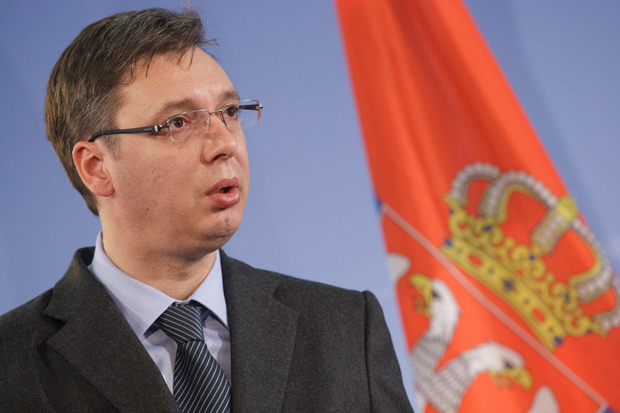
(Image: Theo Schneider/Demotix)
Serbia is in the process of forming a new government. Following the Progressive Party ‘s (SNS) landslide victory in Sunday’s elections — securing 48% of the votes and 156 of 250 parliamentary seats — one man in particular holds the keys to the country’s future. Leader Aleksandar Vucic, Deputy Prime Minister in the previous coalition, is dropping the prefix and taking the top spot this time around.
While at 44, he would be a relatively young leader, he has had plenty of experience in high politics. Indeed, back in the 90s, he served as Minister of Information under Slobodan Milosevic. Many people spend their twenties trying figure out what to do with their lives. Vucic, meanwhile, was busy introducing a notoriously hardhanded media law, among other things, introducing fines to punish journalists and banning foreign media. As he now prepares to take office, should Serbia’s press be worried?
On the one hand, Vucic has worked hard to shift his image from hardline nationalist, to pro-EU reformer, his focus firmly fixed on Serbia’s struggling economy. He has gone after some of the country’s biggest financial criminals in a high-profile anti-corruption campaign. He has pushed for normalisation in the strained relationship with Kosovo, to put EU accession on track. On election night, the Foreign Minister of the United Arab Emirates, Sheikh Abdullah bin Zayed al Nahyan, could be found celebrating with Vucic at the SNS headquarters. The man who once said that 100 Muslims should be killed for every Serb, is securing loans in the billions from the UAE to help fund ambitious regeneration projects in Belgrade.
Yet, despite this apparent commitment to transparency, and despite claiming freedom of the media as one of his “five priorities” — his own personal regeneration, if you will — big words have not really translated into action when it comes to Serbian press freedom.
The country’s journalists have long been working under less than ideal conditions. From the direct, physical threats suffered under the Milosevic regime, to repressive legislation, free expression has been well and truly chilled. But the biggest challenge today is soft censorship, according to the Balkan Investigative Reporting Network (BIRN).
“Press freedom in Serbia is mostly endangered by soft censorship meaning that it is mostly endangered by discriminatory and un-transparent allocation of state funding towards media outlets. This money is usually used to reward those who are in favor of the government and to punish those who oppose it. As opposed to direct threats, soft censorship is much harder to detect,” BIRN’s Tanja Maksic told Index.
“In [the] last year and a half of the Vucic and [former Prime Minister] Dacic government, we haven’t witnessed much of the determination to stop this undemocratic practice,” she adds.
Indeed, evidence points to the Prime Minister to-be doing the exact opposite. A recent report analysing election content on TV showed that the Progressive Party, and Vucic specifically, were favoured in the, overall strikingly positive, coverage. And back in February, a video adding satirical subtitles to genuine footage showing Vucic rescuing a boy from a snowstorm, was taken down. The video, originally from public broadcaster RTS, was removed over copyright infringement claims, despite campaigners arguing it did not break copyright laws. Authorities are widely believed to have played a part in the removal. A number of websites that had published it were blocked or attacked from within the country, while individuals behind the sites saw their social media profiles hacked. The claims made in the subtitles — that the whole report was staged to paint Vucic in a favourable light ahead of the elections — might have cut too close to the bone.
Vucic’s alleged control over sections of the Serbian media is perhaps most evident in the case of former Economy Minister Sasa Radulovic. Following his resignation, not long before the eventual collapse of the previous government, he was, without explanation, dumped from a popular TV talk show. The last-minute replacement? Aleksandar Vucic. Radulovic soon tweeted that he couldn’t wait to tune in to the evening’s show “to figure out why I resigned”. He followed this up by publishing an explosive resignation letter, accusing the government, including the anti-corruption crusading deputy prime minister himself, of corruption. He added that he’d been subjected to a “media lynching” by tabloids friendly to the government, that self-censorship is rife in Serbian media and that “news is being smothered”. The letter was covered by state-funded news agency Tanjug, but the report was removed within minutes and only republished following complaints.
Lily Lynch is the co-founder and editor of Balkanist, an independent online magazine covering, as the name suggests, the Balkan region. They have first-hand experience of Serbia’s restrictive media environment, once having their power cut for three days after publishing government leaks. She says Vucic has been “disastrous” for Serbian media, and believes that with his newfound, unchecked power they will see “more censorship”.
“I think that self-censorship will likely get even worse than it already is, as compliance with the status quo is often the only way to keep a job in Serbia,” she explains to Index. “Independent media outlets like Pescanik will be allowed to work because their audience is small and marginal, and their existence actually benefits Vucic because he can cite them as evidence that there is media freedom in Serbia. Meanwhile, the media that the majority of the country reads or watches will continue to depict Vucic as the savior of the nation.”
This depiction seems to have made an impact beyond Serbia’s borders too. Vucic’s pro-EU stance, and especially his perceived pragmatism regarding Kosovo, has boosted his international profile. He’s been labelled “the man bringing Belgrade in from the cold”, and American ambassador Michael Kirby has even praised Serbia’s media freedom.
It is, however, also worth noting certain cracks in this image within Serbia. The turnout figures of 53.2% — following the downward trend of previous elections — would suggest the adulation among the population is not as widespread as on first glance. The Facebook group “I did not vote for Vucic”, set up on election day, with its some 2,400 likes and counting, might point to the same.
Tanja Maksic says the real test for the Vucic government will come with adoption of much needed laws prescribing stricter control of media funding from public budget. If these are passed and implemented it “will be a clear demonstration of a new political will to pass the reforms in media sector,” she adds.
Lynch is not optimistic. She says there is a real danger Serbia could go the way of Hungary, a country that under the leadership of Victor Orban has witnessed the state of media freedom nosedive. She is not the only one to make the link. A recent Radio Free Europe/Radio Liberty asks if Serbia “is headed for Orbanization”?
“Vucic has used the media as mouthpieces to denounce opponents, smearing them and accusing them of crimes without evidence. I definitely think this will continue. Others say “everything is up to Vucic now, he has no one to excuses anymore” but he has attained this level of power and will not let it go so easily. Anything that goes wrong will be the fault of some minister or other, who will be sacked and humiliated in the press so that Vucic is not viewed as responsible in the eyes of the public,” Lynch says.
“Vucic’s arrests and “anti-crime crusade” has made many public persons, including journalists, very afraid.”
This article was posted on 21 March 2014 at indexoncensorship.org
