19 Jun 2019 | Magazine, Magazine Contents, Volume 48.02 Summer 2019
[vc_row][vc_column][vc_custom_heading text=”With contributions from Xinran, Ahmet Altan, Stephen Woodman, Karoline Kan, Conor Foley, Robert Harris, Stefano Pozzebon and Melanio Escobar”][/vc_column][/vc_row][vc_row][vc_column][vc_column_text]
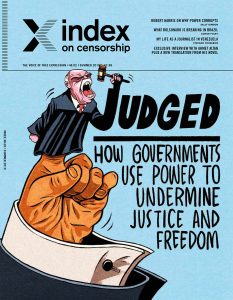
Judged: How governments use power to undermine justice and freedom. The summer 2019 edition of Index on Censorship magazine
The summer 2019 Index on Censorship magazine looks at the narrowing gap between a nation’s leader and its judges and lawyers. What happens when the independence of the justice system is gone and lawyers are no longer willing to stand up with journalists and activists to fight for freedom of expression?
In this issue Stephen Woodman reports from Mexico about its new government’s promise to start rebuilding the pillars of democracy; Sally Gimson speaks to best-selling novelist Robert Harris to discuss why democracy and freedom of expression must continue to prevail; Conor Foley investigates the macho politics of President Jair Bolsonaro and how he’s using the judicial system for political ends; Jan Fox examines the impact of President Trump on US institutions; and Viktória Serdült digs into why the media and justice system in Hungary are facing increasing pressure from the government. In the rest of the magazine a short story from award-winning author Claudia Pineiro; Xinran reflects on China’s controversial social credit rating system; actor Neil Pearson speaks out against theatre censorship; and an interview with the imprisoned best-selling Turkish author Ahmet Altan.
[/vc_column_text][/vc_column][/vc_row][vc_row][vc_column][vc_custom_heading text=”Special Report: Judged: How governments use power to undermine justice and freedom”][/vc_column][/vc_row][vc_row][vc_column][vc_column_text]Law and the new world order by Rachael Jolley on why the independence of the justice system is in play globally, and why it must be protected
Turkey’s rule of one by Kaya Genc President Erdogan’s government is challenging the result of Istanbul’s mayoral elections. This could test further whether separation of powers exists
England, my England (and the Romans) by Sally Gimson Best-selling novelist Robert Harris on how democracy and freedom of expression are about a lot more than one person, one vote
“It’s not me, it’s the people” by Stephen Woodman Mexico’s new government promised to start rebuilding the pillars of democracy, but old habits die hard. Has anything changed?
When political debate becomes nasty, brutish and short by Jan Fox President Donald Trump has been trampling over democratic norms in the USA. How are US institutions holding up?
The party is the law by Karoline Kan In China, hundreds of human rights lawyers have been detained over the past years, leaving government critics exposed
Balls in the air by Conor Foley The macho politics of Brazil’s new president plus ex-president Dilma Rousseff’s thoughts on constitutional problems
Power and Glory by Silvia Nortes The Catholic church still wields enormous power in Spain despite the population becoming more secular
Stripsearch by Martin Rowson In Freedonia
What next for Viktor Orbán’s Hungary? Viktoria Serdult looks at what happens now that Hungary’s prime minister is pressurising the judiciary, press, parliament and electoral system
When justice goes rogue by Melanio Escobar and Stefano Pozzebon Venezuela is the worst country in the world for abuse of judicial power. With the economy in freefall, journalists struggle to bear witness
“If you can keep your head, when all about you are losing theirs…” by Caroline Muscat It’s lonely and dangerous running an independent news website in Malta, but some lawyers are still willing to stand up to help
Failing to face up to the past by Ryan McChrystal argues that belief in Northern Ireland’s institutions is low, in part because details of its history are still secret
[/vc_column_text][/vc_column][/vc_row][vc_row][vc_column][vc_custom_heading text=”Global View”][vc_column_text]Small victories do count by Jodie Ginsberg The kind of individual support Index gives people living under oppressive regimes is a vital step towards wider change[/vc_column_text][/vc_column][/vc_row][vc_row][vc_column][vc_custom_heading text=”In Focus”][vc_column_text]Sending out a message in a bottle by Rachael Jolley Actor Neil Pearson, who shot to international fame as the sexist boss in the Bridget Jones’ films, talks about book banning and how the fight against theatre censorship still goes on
Remnants of war by Zehra Dogan Photographs from the 2019 Freedom of Expression Arts Award fellow Zehra Doğan’s installation at Tate Modern in London
Six ways to remember Weimar by Regula Venske The name of this small town has mythic resonances for Germans. It was the home of many of the country’s greatest classical writers and gave its name to the Weimar Republic, which was founded 100 years ago
“Media attacks are highest since 1989” by Natasha Joseph Politicians in South Africa were issuing threats to journalists in the run-up to the recent elections. Now editors have built a tracking tool to fight back
Big Brother’s regional ripple effect by Kirsten Han Singapore’s recent “fake news” law which gives ministers the right to ban content they do not like, may encourage other regimes in south-east Asia to follow suit
Who guards the writers? Irene Caselli reports on journalists who write about the Mafia and extremist movements in Italy need round-the-clock protection. They are worried Italy’s deputy prime minister Matteo Salvini will take their protection away
China in their hands by Xinran The social credit system in China risks creating an all-controlling society where young people will, like generations before them, live in fear
Playing out injustice by Lewis Jennings Ugandan songwriter and politician Bobi Wine talks about how his lyrics have inspired young people to stand up against injustice and how the government has tried to silence him[/vc_column_text][/vc_column][/vc_row][vc_row][vc_column][vc_custom_heading text=”Culture”][vc_column_text]“Watch out we’re going to disappear you” by Claudia Pineiro The horrors of DIY abortion in a country where it is still not legal are laid bare in this story from Argentina, translated into English for the first time
“Knowing that they are there, helps me keep smiling in my cell” by Ahmet Altan The best-selling Turkish author and journalist gives us a poignant interview from prison and we publish an extract from his 2005 novel The Longest Night
A rebel writer by Eman Abdelrahim An exclusive extract from a short story by a new Egyptian writer. The story deals with difficult themes of mental illness set against the violence taking place during the uprising in Cairo’s Tahrir Square[/vc_column_text][/vc_column][/vc_row][vc_row][vc_column][vc_custom_heading text=”Column”][vc_column_text]Index around the world – Speak out, shut out by Lewis Jennings Index welcomed four new fellows to our 2019 programme. We were also out and about advocating for free expression around the world[/vc_column_text][/vc_column][/vc_row][vc_row][vc_column][vc_custom_heading text=”Endnote”][vc_column_text]
[/vc_column_text][/vc_column][/vc_row][vc_row][vc_column width=”1/3″][vc_custom_heading text=”Subscribe”][vc_column_text]In print, online, in your mailbox, on your iPad.
Subscription options from £18 or just £1.49 in the App Store for a digital issue.
Every subscriber helps support Index on Censorship’s projects around the world.
 SUBSCRIBE NOW[/vc_column_text][/vc_column][vc_column width=”1/3″][vc_custom_heading text=”Listen”][vc_column_text]Music has long been a form of popular rebellion, especially in the 21st century. These songs, provide a theme tune to the new magazine and give insight into everything from the nationalism in Viktor Orban’s Hungary to the role of government-controlled social media in China to poverty in Venezuela
LISTEN HERE[/vc_column_text][/vc_column][vc_column width=”1/3″][vc_custom_heading text=”Listen”][vc_column_text]The summer 2019 magazine podcast, featuring interviews with best-selling author Xinran; Italian journalist and contributor to the latest issue, Stefano Pozzebon; and Steve Levitsky, the author of the New York Times best-seller How Democracies Die.
LISTEN HERE[/vc_column_text][/vc_column][/vc_row]
5 Jun 2019 | Australia, Campaigns -- Featured, Media Freedom, Statements
[vc_row][vc_column][vc_single_image image=”107111″ img_size=”full”][vc_column_text]Index on Censorship condemns the raid by Australian federal police on the offices of public broadcaster ABC over a 2017 article it ran in on operations of Australian special forces in Afghanistan.
The search warrant named three ABC journalists — news director Gaven Morris, Daniel Oakes, Samuel Clark — and gives police wide-ranging powers, including the power to “add, copy, delete or alter” material in the ABC’s computers. Thousands of documents are being sought by police in the raid.
“The power of this warrant is terrifying,” said Index chief executive Jodie Ginsberg. “Protection of journalistic sources is one of the basic conditions for press freedom – and the huge scope of this warrant puts that at risk.”
The federal police said it was investigating “allegations of publishing classified material, contrary to provisions of the Crimes Act”.
The raid comes a day after the federal police searched the home of Annika Smethurst, a News Corp political editor, over articles she published on plans to expand Australia’s domestic surveillance capabilities.
Last week, the High Court in Belfast, Northern Ireland ruled that warrants against two Northern Irish journalists whose homes and office were raided by police last year were “inappropriate”. Three days later, the criminal investigation into Trevor Birney and Barry McCaffrey was dropped.
Birney and McCaffrey produced a documentary No Stone Unturned, which examines claims of state collusion in the murders of six men. During the Northern Irish raid, police seized documents, personal computers and USB sticks belonging to family members and copied a computer server that contained years of sensitive reporting by the documentary makers, risking endangering confidential sources unrelated to the film.
Index on Censorship and colleagues English PEN intervened in the judicial review of the case, noting the “chilling effect” of such orders, which were “likely to have the effect of intimidating journalists throughout Northern Ireland and further afield.”[/vc_column_text][vc_basic_grid post_type=”post” max_items=”4″ element_width=”6″ grid_id=”vc_gid:1559725317075-72546647-22cf-1″ taxonomies=”6534″][/vc_column][/vc_row]
15 May 2019 | Artistic Freedom Case Studies
[vc_row][vc_column][vc_column_text]Name of Art Work: Exhibit B
Artist/s: Brett Bailey
Date: September 2014
Venue: The Vaults, presented by The Barbican Centre
Brief description of the artwork/project: The Barbican’s publicity material described Exhibit B as: “a human installation that charts the colonial histories of various European countries during the nineteenth and twentieth centuries when scientists formulated pseudo-scientific racial theories that continue to warp perceptions with horrific consequences.”[/vc_column_text][vc_single_image image=”94431″ img_size=”full” add_caption=”yes”][/vc_column][/vc_row][vc_row][vc_column][vc_custom_heading text=”Why was it challenged? ” font_container=”tag:h3|text_align:left” use_theme_fonts=”yes”][vc_column_text]A campaign is formed in response to Exhibit B: Boycott the Human Zoo is a coalition of anti-racism activists, trade unions, artists, arts organisations and community groups. They set up an online petition which is signed by over 22,000 people, calling on the Barbican to decommission the work and withdraw it from their programme. The key objections named in the petition are:
- “[It] is deeply offensive to recreate ‘the Maafa – great suffering’ of African People’s ancestors for a social experiment/process.
- Offers no tangible positive social outcome to challenge racism and oppression.
- Reinforces the negative imagery of African Peoples
- Is not a piece for African Peoples, it is about African Peoples, however it was created with no consultation with African Peoples”
[/vc_column_text][vc_custom_heading text=”What action was taken?” font_container=”tag:h3|text_align:left” use_theme_fonts=”yes”][vc_column_text]The Barbican issues a response to the petition, acknowledging that Exhibit B “has raised significant issues” but commenting that this is not a reason to cancel the performance. They accept the campaigners right to peaceful protest but ask that they “fully respect our performers’ right to perform and our audiences’ right to attend.” Campaigners are in communication with senior management at the Barbican, and they contact the police about their plan to picket the venue. Kieron Vanstone, the director of the Vaults also contacts the British Transport Police – as they have jurisdiction over the Vaults – about the possibility of needing additional policing on the night. nitroBEAT, who had cast the show in London and took a leading role in mediating between the two ‘sides’ organises a debate at Theatre Royal Stratford East the night before the opening.[/vc_column_text][vc_custom_heading text=”What happened next?” font_container=”tag:h3|text_align:left” use_theme_fonts=”yes”][vc_column_text]On the opening night of the installation, just one of the two BTP PCs allocated to the picket attends. Protesters breach the barriers and block the doors to the venue. The PC on duty calls for backup officers. ACC Thomas reports “that ‘about’ 12 BTP officers and 50 Metropolitan Police Service Officers respond to these calls.” Vanstone describes a huge police presence, including riot police, dogs and helicopters overhead. When Inspector Nick Brandon, the BTP senior officer in charge asks what the campaign organisers want, they respond that they want the show to be closed down, or they will picket it every evening. Sara Myers of Boycott the Human Zoo reports that Brandon says “‘we need to be out fighting crime. This is much ado about nothing, and we haven’t got the resources to police it.” The Inspector recommends that Vanstone closes the show. In partnership with the Barbican, Vanstone agrees to do so. When the campaigners request written confirmation, the police officer ensures that the venue provides this. The installation is cancelled.[/vc_column_text][vc_custom_heading text=”Reflections” font_container=”tag:h3|text_align:left” use_theme_fonts=”yes”][vc_column_text]Louise Jeffreys – Artistic Director, Barbican
The Barbican’s experience of Exhibit B was a catalyst for a significant amount of change within the organisation. The protests and eventual cancellations of performances led to us thinking deeply about a number of areas of our work, looking at how we could learn from this situation so we could continue to present challenging work and ensuring the experience we had didn’t contribute to an environment where organisations felt they couldn’t programme artists whose work deals with difficult subjects.
Our starting point was the belief that it was important that we remained an organisation willing to take risks and that we didn’t want to shy away from putting on work that invites discussion and debate. To do this we felt we needed to have the planning processes in place to ensure this kind of work could be presented safely, that we were confident about how it fitted into our wider programme, that we contextualise it in the right way and that we have clear, artistic reasons for programming it.
This work has included formalising our risk review process for our artistic programme; it involved us contributing to the development of What Next’s practical guidance for arts organisations on meeting ethical and reputational challenges; and it continued with the development of the Barbican’s first ethics policy, which we now use as a basis for making ethical decisions across areas such as programming, fundraising and partnerships.
Combined, these measures have all contributed to us becoming more confident in the work we present, encouraging a collaborative, organisation-wide approach to making difficult decisions, dealing with risk and investing in artists and works that deal with potentially controversial issues.
The Exhibit B experience also led to us further interrogating our approach to equality and inclusion. This led to positive changes such as the development of a new Equality and Inclusion strategy and the building of relationships with artists and companies who have added to the creative richness and relevance of our programme as we look to try and represent the widest possible range of human experiences on our stages, in our galleries and on our screens.
The cancellation also led us to think about how we work with the police, and the importance of their role in protecting free expression. At the time of the Exhibit B protests we felt we had no choice but to follow their advice when they recommended we cancel all future performances. I feel we’d question this kind of decision-making more now, with the work we’ve done since the closure making us much better informed on the legal framework around freedom of expression.
Sara Myers – Boycott The Human Zoo Campaign lead
At the time the black community was campaigning against so many things – deaths in police custody, acts of racism – and there never seemed to be any victory. I think the legacy of Exhibit B is that it gave a monumental landmark victory which we hadn’t had. In the last 30 years, this was the one thing that we won, the one time that our voices were heard and taken seriously. I know a lot of people were talking about censorship and not having an understanding of art, and I think all of that is irrelevant. It was about not taking that narrative of our history, that slave narrative and keeping us boxed in there; we are more than that, and you will listen to us.
There were two camps, one called me a reincarnation of Stalin and the other thought I was going to be the new speaker for all things black. But what people failed to realise was [while] I was the face of the campaign, I started the petition and led the campaign it was owned by the whole black community – pan-African, Christian, Muslim, LGBT, young, old, celebrities.
A lot more people began to speak out. In fact it went a bit crazy after Exhibt B, there were petitions about everything and everybody was calling everybody out and we got a lot of things taken down. It birthed a lot of new activists and Exhibit B became a movement. The way [we used] social media, institutions don’t want that, they don’t want to be tagged and dragged for days on social media. Brett was challenged in Paris [where] people were tear-gassed and water-cannoned which was terrible. It went to Ireland, very much on the quiet, but there was not a very large black of mixed race community [where it went]. He tried to take it to Brazil and that got shut down. He tried to take it to Toronto, but it was [challenged} and it didn’t go there.]
Another legacy was that academics were talking about the whole campaign, whether positively or negatively. It was a very controversial campaign and it opened up conversation about so many things – about racism, institutional racism, how an emerging black artist might not get a platform, but a potentially racist guy from South Africa might. Who is censoring what? Who is at the helm of censorship? What about all the exhibitions that they haven’t put on? Is it us campaigning, peacefully protesting. Who owns the story? Also how the media reported it as a violent, angry mob, and yet there wasn’t one arrest. How the Barbican didn’t take responsibility for the whole part they played in this.
For me personally – my claim to fame will be Exhibit B and that’s monumental. To know that I’m part of Black British History. Maybe in Black History Month, they’ll have my picture and talk about what I did. And that’s great because I’ve got grandchildren and they’ll be able to see that.
I’m not saying that Brett isn’t a talented artist. It was the imagery was traumatic for a community because it was not part of [our] ancient history. This is something we live every day, down to deportations – in fact that there was one today people who have lived here all their lives deported back to Jamaica. We are still living the ramifications of that, whereas Brett is quite removed from his colonial past. It also brought up a massive discussion about colonialism and the effects of colonialism today.
A detailed case study of the policing of the picket of Exhibit B is available here.
Stella Odunlami – actor, director, performer in Exhibit B (London, Ireland, South Korea and Estonia)
The piece arrived at a time of change. Those tensions around the idea of race and representation had always been there, but the squeeze of the government cuts to a lot of provision, particularly to black and minority backgrounds, were being felt. The rhetoric around our wonderful multi-cultural society was starting to fall away. It landed on a sore spot, places were pus had been building up under the surface. All these conversations and interactions around the legacy and inherited histories that we are being forced to deal with at the moment – [it] brought all of that to the surface.
It has made me hyper aware of the lack of space and opportunity to have these conversations and how desperately we need them. We don’t speak of what the West did in Africa as a form of genocide. Within the black community, whatever that may mean, people find it really hard to engage with conversations around race in public forums because the conversation always feels dishonest, because the ground zero hasn’t been reached. So when people talk about who makes art, access to art, access to funding and education we are never going back to the beginning to understand why that is.
I still think it’s a beautiful, powerful piece. It opened up conversations; everybody who sees it is automatically implicated in some way or another. You have to begin to confront your own relation to history, and that is something that we don’t do very often. I’m still trying to unpack my ideas around the existing theatre model and what theatres as cultural spaces are aiming to do. Very often the places that present this work are only interested in an economic model and don’t recognise or feel the wider responsibility. It comes down to what are we demanding of our arts and cultural spaces, what we want from them.
Having taken the show to Ireland, to South Korea and Estonia, it surprised me how my concept of the show being linked explicitly to the European history of colonisation, was being refracted through different prisms. At around the time we were in Ireland, the story broke about many women in the early 1900s who had fallen pregnant to black men, had been held, and had their children taken away. Mass burial sites uncovered these children who had been treated appallingly and had passed. This history had been repressed by the state and the church, echoes of that were only starting to be discussed. I was nervous before going to [Tallinn] because I had heard about incidents of violence against black African bodies there. There were a lot of students coming from Africa because there seem to be more scholarships and migration for education seems to be easier. They are having to think about migration, without following the western European model which hasn’t really worked. South Korea’s history with Japan brought those conversations to the fore. They had no idea about what had happened in these parts of the world and people came back with notepads, to take down the names, the places, the dates.
The last performance was in Tallinn, it was very hard, really sad. We all felt such a responsibility for these stories, for them being shared and acknowledged. Whose stories are remembered, whose stories are told. The weight of that responsibility, and the personal investment we all had in that, is huge.[/vc_column_text][three_column_post title=”Case Studies” full_width_heading=”true” category_id=”15471″][/vc_column][/vc_row][vc_row][vc_column][/vc_column][/vc_row]
