13 Feb 2018 | News, Press Releases
- Annual event celebrating the freedom to read takes place 23-29 September
- Libraries, bookshops and schools nationwide urged to get involved
- National organisations encouraging everyone to read a “banned” book
- Slate of events will explore the censorship of ideas
UK-based organisations will host events across Britain this year to mark Banned Books Week: bringing the internationally-celebrated event to a UK-wide audience for the first time.
Mirroring a similar initiative in the United States, the organisations – including the British Library, Index on Censorship, Royal Society of Literature and English PEN – are encouraging libraries, book shops, schools and reading groups to hold events that celebrate the freedom to read and challenge the silencing of voices and ideas.
“This year marks 50 years since we abolished government censorship of the theatre in this country,” said Jodie Ginsberg, chief executive of Index on Censorship, one of the groups spearheading Banned Books Week UK. “It’s a good time to think about what is getting published today and why – and who are the modern censors.”
Celebrated works of literature that have experienced bans or censorship worldwide in recent years include the Harry Potter books, Harper Lee’s To Kill a Mockingbird, Stephenie Meyer’s Twilight series and John Green’s The Fault in Our Stars.
Banned Books Week will take place from September 23 to 29 2018. Events will include a special evening at the British Library marking the Theatres Act 1968, which abolished theatre censorship in the United Kingdom, as well as readings and talks across the country.
“The British Library is delighted to be a partner in Banned Books Week 2018” said Roly Keating, Chief Executive of the British Library. “We are looking forward to events in the autumn in which we’ll be holding conversations about theatrical censorship past and present, and encourage libraries, bookshops and schools across the country to join in by hosting their own events and getting everyone involved in debating this vital issue.”
Previous Banned Books Week events have included discussions on The Satanic Verses controversy; a talk on the “unsayable” with cartoonist Martin Rowson; and David Aaronovitch and guests exploring tactics used to censor voices around the world. Anyone interested in hosting their own event is urged to do so under the Banned Books Banner and resources will be made available for schools and libraries later in the year.
Islington Libraries will produce a list of some of the world’s best-known banned books for the occasion and everyone is encouraged to pick up a banned book.
For more information, please contact Jodie Ginsberg at [email protected].
Notes to editors
- Banned Books Week was launched in the United States in 1982 in response to a sudden surge in attempts to have books removed or otherwise restricted in schools, bookstores and libraries. More than 11,300 books have been challenged since 1982 according to the American Library Association, a key member of the Banned Books Week coalition.
- The British Library is the national library of the United Kingdom holding more than 170 million items from many countries, in many languages and formats, both print and digital. The British Library seeks to preserve, store and make available our intellectual heritage to everyone, for research, inspiration and enjoyment.
- English PEN is the founding centre of a global literary network that promotes the freedom to write and the freedom to read. English PEN campaigns to defend freedom of expression in the UK and around the world; holds public events to showcase the best in contemporary literature; supports literary translation by awarding grants to publishers and works with communities across the UK.
- Free Word explores the power and politics of words. We bring together a rich variety of the most exciting writers and thinkers – the new and the established. We spark critical conversations about society, culture and politics, and we amplify voices that often go unheard. In our distinctive building in Clerkenwell, we host dynamic public events and provide a home and hub to other organisations that champion freedom of expression by nourishing writers, readers, speakers and listeners.
- Index on Censorship is a London-based non-profit organisation that publishes work by censored writers and artists and campaigns against censorship worldwide. Since its founding in 1972, Index on Censorship has published some of the greatest names in literature in its award-winning quarterly magazine, including Samuel Beckett, Nadine Gordimer, Mario Vargas Llosa, Arthur Miller and Kurt Vonnegut. It also has published some of the world’s best campaigning writers from Vaclav Havel to Elif Shafik. In 2017, Index became the first international member of the US-based Banned Books Week Coalition.
- Islington Council’s Library Service is based in London and has a key role in enabling access to knowledge, skills and information. It has been part of a Banned Books Week coalition for the past two years and celebrates the Right to Read with events, booklists and book promotions, working in partnership with the British Library, Royal Society of Literature, Free Word, Spread the Word and Index on Censorship.
- The Royal Society of Literature is Britain’s national charity for the advancement of literature. We encourage and honour writers, engage people in appreciating literature, and act as a voice for its value.
- The Society of Chief Librarians (SCL) is a local government association made up of the chief librarian of each library authority in England, Wales and Northern Ireland. SCL takes a leading role in the development of public libraries, through sharing best practices, advocating for continuous improvement on behalf of local people, and leading the debate on the future of the public library service.
- Spread the Word is London’s writer development agency, which means we are here to help London’s writers make their mark – on the page, the screen and in the world. We do this by kick starting the careers of London’s best new writers, and energetically campaigning to ensure that publishing truly reflects the diversity of the city. We support the creative and professional development of writing talent, by engaging those already interested in literature and those who will be, and by advocating on behalf of both.
- The Publishers Association represents book, journal, audio and electronic publishers in the UK, spanning fiction and non-fiction, academic and educational publishing. Our members include global companies such as Elsevier, Wiley, Pearson, Penguin Random House, Hachette and the University presses, as well as many independent publishing houses. Our objective as an association is to provide our members with the influence, insight and services necessary to compete and prosper.
20 Dec 2017 | Mapping Media Freedom, Media Freedom, media freedom featured, News
[vc_row][vc_column][vc_column_text]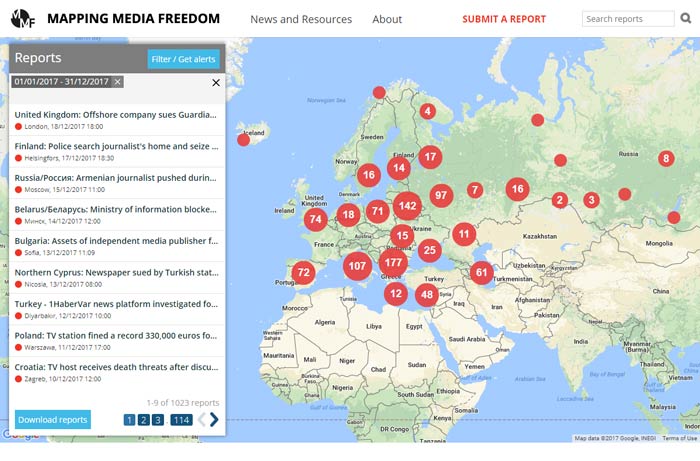 This year saw 1,035 media freedom violations reported to Index on Censorship’s Mapping Media Freedom, a project that monitors media freedom in 42 countries, including all EU member states. To highlight the most pressing concerns for press freedom in Europe, Index’s MMF correspondents discuss the violations that stood out most.
Russia / 197 verified reports in 2017
“In November Russia adopted a new restrictive law against foreign media. It allows recognising foreign media as foreign agents, which makes them subjects of numerous additional checks and obliges them to mark the content as produced by a foreign agent. The vague and ambiguous wording means it applies to many outlets – from established media to email newsletters. Which media will be recognised as foreign agents will be decided by Russian Ministry of justice. However, US media such as Voice of America or Radio Free Europe/Radio Liberty have already received warnings about possible restrictions on their work in Russia.” — Ekaterina Buchneva
Turkey / 132 verified reports in 2017
“Although 155 journalists are currently imprisoned in Turkey — almost all of them on trumped-up charges — the trial of journalist Nedim Türfent, who reported on security operations in Turkey’s Kurdish regions, is by far the worst violation as open experiences of torture at the hands of police officers were recounted by at least a dozen people in the case. This violation shows that torture is making a comeback in Turkey.” — Barış Altıntaş
More on Nedim Türfent’s case.
Belarus / 92 verified reports in 2017
“The mass detention of journalists on Freedom Day in March was indicative of the Belarusian authorities’ campaign launched in 2017 on preventing journalists from performing their professional duties. The situation was provoked by mass protests across Belarus against introducing presidential decree on “social parasites”, which imposes a tax on the unemployed amid increasing economic crisis. The authorities have shown their real attitude to freedom of speech through real hunting on independent journalists and bloggers that are blocked from access to information, detained, jailed, and fined.” — Volha Siakovich
Spain / 66 verified reports in 2017
“The referendum on the independence of Catalonia, north-east of Spain, provoked an avalanche of incidents against reporters. On 1 October 2017, on the day of referendum considered illegal by the Spanish Constitutional Court, various journalists were assaulted during police intervention in polling stations. Spanish public television RTVE was biased in favour of Spanish unity while Catalan public television TV3 was biased in favour of the independence. In the aftermath of the referendum, many reporters on the ground suffered insults and assaults usually during street rallies. Unionist protesters used to insult and assault Catalan media. Catalunya Radio glass door was smashed and TV3 car window broken. Catalan protesters chanted “Spanish press manipulators” during Spanish televisions live coverage and Crònica Global website headquarters vandalised with spray paints and posters. The Catalan political question brought a wave of intimidation against journalists, never seen in such numbers and scale in recent years.” — Miho Dobrasin
Italy / 57 verified reports in 2017
“In 2017 Italian journalists experienced a high level of conflict with the judiciary. Journalists are constantly possible targets of law enforcement raids, also in breaching the privacy of journalists’ sources. In July, Il Fatto Quotidiano journalist Marco Lillo’s house was searched because he published a scoop concerning the investigation on people close to Matteo Renzi, prime minister at time time, for a case of corruption at the most important contracting authority in Italy: Consip. Last but not least, Il Sole 24 Ore journalist Nicola Borzi had seized his computer and archives by the law enforcement because he revealed a “secret of State”, without any formal charge against the journalist. These events show how hard is making scoops in Italy. Moreover, journalists are constantly targeted with lawsuits, frequently used as threats against freelancers. Nowadays the big unsolved issue for Italian journalism is at court.” — Lorenzo Bagnoli
France / 54 verified reports in 2017
“In February, presidential candidate Fillon smeared media outlets who covered alleged corruption case. This was an important moment in the treatment of the media in France. When accused of corruption, conservative presidential candidate François Fillon refused to step down and chose to attack the media and journalists. Journalists covering his campaign saw their working conditions deteriorate and had supporters insulting and attacking them.” — Valeria Costa-Kostritsky
Azerbaijan / 47 reports in 2017
“While there on-going violations of press freedom in Azerbaijan such as the jailing of journalists, office raids, bogus charges and other forms of persecution of journalists, I chose the blocking of opposition and independent news websites in March because it is a sign of further deterioration of media freedom in Azerbaijan. If before there were deliberate slowdowns or DDoS attacks, changes in legislation give full authority to the government institutions wanting to shut down or limit access to the flow of independent and alternative news.” — Arzu Geybullayeva
Croatia / 33 verified reports in 2017
“In September, around 20 members of the Autochthonous Croatian Party of Rights (A-HSP), a far-right political party, which is led by Drazen Keleminec, burned a copy of weekly newspaper Novosti, regional broadcaster N1 reported. This is another example where nationalistic and conservative narratives are endangering media freedom. In this particular case a right-wing political party is targeting the others, in this case the others is an ethnically and linguistically minority weekly, describing them as enemies of the state. The widespread narrative that has resulted in several severe media freedom infringements in this EU country.” — Ilcho Cvetanoski
Macedonia / 27 verified reports in 2017
“During the April’s storming of the Assembly building in the capital Skopje, 23 media workers were physically assaulted, threatened or barred from reporting at the scene. This case perfectly exemplifies what happens when political elites intentionally demonize and dehumanize media workers that are critically observing theirs work by describing them as traitors and foreign mercenaries. In the eyes of the common people, they instantly became a legitimate target. This is a widespread trend in Southeast Europe.” — Ilcho Cvetanoski
Bosnia and Herzegovina / 21 verified reports in 2017
“The case of Dragan Bursac is one of the many cases in Southeast Europe where journalists/media workers are threatened/attacked for challenging the mainstream nationalistic narrative. Namely, he was critical on the fact that a military leader, accused of committing war crimes, crimes against humanity and genocide by the International Criminal Tribunal for the former Yugoslavia (ICTY), is celebrated as a hero by the politicians and media.” — Ilcho Cvetanoski
Germany / 20 verified reports in 2017
“It is extremely concerning that journalists were assaulted and intimidated when reporting on protests in Hamburg. Journalists are there to do their job and it is important that they are able to tell the world what is happening at protests such as the ones in Hamburg.” – Joy Hyvarinen
Hungary / 20 verified reports in 2017
“There is an important change of tactics regarding censorship and defaming independent media in Hungary: instead of attacking the outlets critical to the government, the vast pro-government media started smearing individual journalists, trying to intimidate and discredit the few critical voices who are left in Hungary.” — Zoltan Sipos
Romania / 16 verified reports in 2017
“The national news agency AGERPRES might lose its independence after a draft law enabling the political majority to dismiss the director-general was passed by the chamber of deputies in Romania. If passed in the senate as well, such a provision would have the same impact as on the management of the Romanian Radio Broadcasting Corporation (SRR) and the Romanian National Television Corporation (SRTV): following each election, the SRR and SRTV administration boards can be dismissed before the end of their mandates to reflect the new political forces.” — Zoltan Sipos
United Kingdom / 17 verified reports in 2017
“In the United Kingdom, after the Grenfell tower fire, which claimed 71 deaths, Kensington and Chelsea council tried to ban journalists from attending their first council meeting. Five media organisations had to challenge this legally to gain access. This was a very important case illustrating how difficult it was to gain access and to expect accountability from the organisation which ran the council block.” — Valeria Costa-Kostritsky
Sweden / 15 verified reports in 2017
“The systematic campaign to smear and misrepresent journalists by Granskning Sverige was symptomatic of a wider attack on the legitimacy of liberal and left media by Sweden’s far-right movement, but the campaign detailed by the reporters at the Eskilstuna-kuriren newspaper was orchestrated and unlike anything seen before in the country.” — Dominic Hinde
Greece / 13 verified reports in 2017
“In February 2017, two journalists were harassed by far-right wing protesters, preventing refugee children from attending classes. This is very important, because it shows that although Greece’s economic and refugee crisis seem to have calmed down in the last year, the support for far-right wing organisations doesn’t show any sign of shrinking. This also concerns journalists in Greece, whose safety is in danger every day.” — Christina Vasilaki
The Netherlands / 12 verified reports in 2017
“The Netherlands is considered to be one of the countries where media freedom is widely protected. However, cases like the rape threats levelled at a journalist in May show that media workers are subjected to all sorts of threats. In this case it were rape threats by a popular right-wing weblog. This creates an atmosphere in which it’s conceived normal to use comments and social media to discredit and threaten a journalist. It also highlights the dangers and risks that female journalists face.” — Mitra Nazar
Bulgaria / 11 verified reports in 2017
“In November, it became known that members of an organised crime group from Vratsa planned to murder Zov News website publisher Georgi Ezekiev. The increase of violent incidents and serious threats towards journalists in 2017 is alarming in Bulgaria, a country that already has the worst press freedom status in the European Union.” — Zoltan Sipos
Serbia / 11 verified reports in 2017
“Serbia’s free media had a dark year with many incidents, threats and violence coming towards them. In May, journalists were assaulted during clashes at the presidential inauguration. This is just one of many cases, but it clearly demonstrates just how critical the state of the media is because they happened during the presidential inauguration. The assaults were committed by supporters of the government with a lot of police around. The impunity these assaulters meet is worrying for the lack of condemnation by authorities and the message they clearly want to send to critical journalists.” — Mitra Nazar
Malta / 8 verified reports in 2017
“The most worrying incident regards the murder of anti-corruption, investigative journalist Daphne Caruana Galizia. While this murder gripped the attention of international media and European authorities including the European Commission and Parliament, it is still shocking for every journalist that in a democratic, EU country, journalists’ lives could be in danger because they are doing their job, exposing high-level corruption in political, business and criminal elites.” — Christina Vasilaki
Kosovo / 6 verified reports in 2017|
“Kosovo’s media have been shaken up by two attacks on Insajderi investigative journalists. Insajderi is home to the best investigative journalists in the country, covering corruption and crime topics that nobody else dares to touch. Journalist Parim Olluri was beaten up outside his home in Pristina on 16 August. He needed medical assistance in a hospital. Nobody has been held responsible for the attack. Two months later, his colleague Vehbi Kajtazi was hit on the head in a cafe in downtown Pristina on 13 October. One person was arrested on the spot. We are talking about two violent incidents to Insajderi journalists within a period of three months. This shows that Kosovo’s journalists continue to face violence, even in very public places like cafe’s and neighbourhoods they live. For this reason there are just a few brave journalists who dare to touch sensitive topics, which is a worrying sign for the future of journalism and truth finding in the youngest country in Europe.” — Mitra Nazar
Montenegro / 6 verified reports in 2017
“Attack on journalist’s property is one of most common ways of intimidation. This is not only case for Montenegro, but also for all other countries in the region. What is striking is that intentional setting on fire of journalist’s vehicles is one of most common ways of limitation of media freedom in Montenegro. In recent years there have been several burnt vehicle in this small EU candidate country.” — Ilcho Cvetanoski
Portugal / 5 verified reports in 2017
“Similarly to what’s happening in other countries, Portugal has seen a rise of questioning towards journalism, those who work in the media industry and their work. Besides motivating a new and stimulating debate between journalists and their readers/viewers/listeners, this has also opened the gates to instances of abuse, cyberbullying and slander. The most significant example of that is that of Público’s journalist Margarida Gomes, whose work ethic was put in question by Facebook groups and public officials, who both used false information regarding her personal life to denigrate her work.” — João de Almeida Dias
Latvia / 3 verified reports in 2017
“In Latvia it was a quiet year for press freedom. However, the sudden and swift dismissal of Sigita Roķe, the head of public service Latvian Radio for alleged economic irregularities was seen as a pretext for dismissing her for efforts to disengage the radio from sponsorship agreements with the city of Ventspils, whose politically influential mayor has is on trial for money laundering and corruption. The dismissal raised questions about the political neutrality of Latvia’s media watchdog, the National Electronic Mass Media Council.” — Juris Kaza
Ireland / 3 verified reports in 2017
“Compared to the long list of countries in Europe where it is getting progressively dangerous for reporters to do their work, the situation in Ireland is relatively benign. There are renewed concerns over source protection, and the strict libel regime. However, the most serious concern is regarding media ownership. Index on Censorship published a detailed report on this in August 2017. One significant media takeover – Independent News and Media buying up Celtic Media – fell through after the Government ordered a statutory investigation following objections.” — Flor Mac Carthy
Estonia / 3 verified reports in 2017
“In March, journalists for Estonia’s largest daily in circulation Postimees, sent a letter to the owners and managers to complain about interference with editorial freedom. This event is a disturbing example of the interference attempts from media owners and advertisement department that had grown to the level that journalists of a daily, that prides itself with a long history and high-quality content, had to resort to an unprecedented united protest letter to fight it. Interference in journalistic decision making and content from outside or inside sources is in general the worrisome threat.” — Helle Tiikmaa
Belgium / 2 verified reports in 2017
“In Belgium, a journalist who had published a story on surveillance in Bruxelles’ metro was interrogated on her sources by the police, in clear breach of the principle of sources confidentiality. The case also reminds us of the risk for journalists covering surveillance.” — Valeria Costa-Kostritsky
Denmark / 2 verified reports in 2017
“The killing of Kim Wall by the inventor and entrepreneur Peter Madsen was a headline news event around the world. Stabbed to death and dumped at sea whilst interviewing Madsen on board his home-built submarine, her body was recovered after an extensive marine search. Although not typical of any wider trend, her murder was so brutal it raised significant questions about the safety and ethics of female freelancers working alone without support or safeguards.” — Dominic Hinde
Finland / 2 verified reports in 2017
“In March the Finnish government introduced restrictive changes to the functioning of the public broadcasting company Yle, which entailed putting the state-owned company more firmly under politicians’ decision-making power. The proposal was driven by the True Finns, a nationalist party that have repeatedly complained about Yle’s liberal views and non-sceptical approach to ‘multicultural Finland’. In the official briefing, stated the following: “The proposal is to strengthen the role of the Administrative Council so that they can decide on Yle’s journalistic strategy and regulate the permanent expert consultation process”. The council referred is mainly composed of politicians. — Katariina Salomäki
Iceland / 1 verified report in 2017
“Iceland has been rocked by political scandals and collapsing governments twice in the space of a year. In October it came to light that the prime minister had used financial confidentiality legislation to stop the investigative newspaper Stundin from publishing details of his offshore financial dealings in the run-up to the 2008 financial crash. Iceand’s main newspaper Morgunbladid is controlled by another former Prime Minister, also a member of the powerful Icelandic independence party, and Stundin has consistently sought to expose the Icelandic financial and political elite where other titles have remained silent.” — Dominic Hinde[/vc_column_text][/vc_column][/vc_row][vc_row][vc_column][vc_custom_heading text=”Mapping Media Freedom” use_theme_fonts=”yes” link=”url:https%3A%2F%2Fmappingmediafreedom.org%2F%23%2F|||”][vc_row_inner][vc_column_inner width=”1/4″][vc_icon icon_fontawesome=”fa fa-times-circle” color=”black” background_style=”rounded” size=”xl” align=”right”][/vc_column_inner][vc_column_inner width=”3/4″][vc_column_text]
Since 24 May 2014, Mapping Media Freedom’s team of correspondents and partners have recorded and verified more than 3,700 violations against journalists and media outlets.
Index campaigns to protect journalists and media freedom. You can help us by submitting reports to Mapping Media Freedom.[/vc_column_text][/vc_column_inner][/vc_row_inner][vc_separator color=”black”][/vc_column][/vc_row][vc_row][vc_column][vc_custom_heading text=”Don’t lose your voice. Stay informed.” use_theme_fonts=”yes”][vc_separator color=”black”][vc_row_inner][vc_column_inner width=”1/2″][vc_column_text]Index on Censorship is a nonprofit that campaigns for and defends free expression worldwide. We publish work by censored writers and artists, promote debate, and monitor threats to free speech. We believe that everyone should be free to express themselves without fear of harm or persecution – no matter what their views.
Join our mailing list (or follow us on Twitter or Facebook) and we’ll send you our weekly newsletter about our activities defending free speech. We won’t share your personal information with anyone outside Index.[/vc_column_text][/vc_column_inner][vc_column_inner width=”1/2″][gravityform id=”20″ title=”false” description=”false” ajax=”false”][/vc_column_inner][/vc_row_inner][vc_separator color=”black”][/vc_column][/vc_row]
30 Nov 2017 | Campaigns -- Featured
Dear President Juncker,
Dear President Tajani,
Dear Prime Minister Ratas,
Dear Prime Minister Borissov,
Dear Ministers,
Dear MEP Voss,
We write to you to share our respectful but serious concerns that discussions in the Council and European Commission on the Copyright Directive are on the verge of causing irreparable damage to our fundamental rights and freedoms, our economy and competitiveness, our education and research, our innovation and competition, our creativity and our culture.
We refer you to the numerous letters and analyses sent previously from a broad spectrum of European stakeholders and experts for more details (see attached).
On behalf of the signatories,
Caroline De Coc
The over 80 signatories below represent human and digital rights organisations, media freedom organisations, publishers, journalists, libraries, scientific and research institutions, educational institutions including universities, creator representatives, consumers, software developers, start-ups, technology businesses and Internet service providers.
1 Access Info Europe – Europe
2 ActiveWatch – Romania
3 Allied for Startups – Europe
4 ARTICLE 19 – Global
5 Asociación de Internautas – Spain
6 Asociación Española de Startups – Spain
7 Associação D3 – Defesa dos Direitos Digitais (D³) – Portugal
8 Associação Nacional para o Software Livre (ANSOL) – Portugal
9 Association for Progressive Communications (APC) – Global
10 Association for Technology and Internet (ApTI) – Romania
11 Association of European Research Libraries (LIBER) – Europe
12 Association of Publishers of Periodical Publications (AEEPP) – Spain
13 Association of the Defence of Human Rights in Romania (APADOR-CH) – Romania
14 Association of the Internet Industry (eco) – Germany
15 Austrian Startups – Austria
16 Bits of Freedom (BoF) – Netherlands
17 BlueLink Civic Action Network – Bulgaria
18 Brand24 – Poland
19 Bulgarian Helsinki Committee – Bulgaria
20 Center for Democracy & Technology (CDT) – Global
21 Centrum Cyfrowe – Poland
22 Civil Liberties Union for Europe (Liberties) – Europe
23 Communia Association – Global
24 Computer and Communications Industry Association (CCIA) – Global
25 Copyright for Creativity (C4C) – Europe
26 Create Refresh Campaign – Europe
27 Creative Commons – Global
28 DIGITALEUROPE – Europe
29 Dutch Association of Public Libraries (VOB) – Netherlands
30 EDiMA – Europe
31 Electronic Frontier Foundation (EFF) – Global
32 epicenter.works – Austria
33 Estonian Association of Information Technology and Telecommunications (ITL) – Estonia
34 Estonian Startup Leaders Club – Estonia
35 European Bureau of Library, Information & Documentation Associations (EBLIDA) – Europe
36 European Digital Rights (EDRi) – Europe
37 European Innovative Media Publishers – Europe
38 European Internet Services Providers Association (EuroISPA) – Europe
39 European University Association (EUA) – Europe
40 Factory Berlin – Europe
41 Federation of Hellenic Information Technology & Communications Enterprises (SEPE) – Greece
42 France Digitale – France
43 Free Knowledge Advocacy Group EU (FKAGEU) – Europe
44 Free Software Foundation Europe (FSFE) – Europe
45 Frënn vun der Ënn – Luxemburg
46 German Library Association (dbv) – Germany
47 Hermes Center for Transparency and Digital Human Rights – Italy
48 Human Rights Without Frontiers (HRWF) – Global
49 Hungarian Civil Liberties Union (HCLU) – Hungary
50 Index on Censorship – Global
51 Initiative gegen ein Leistungsschutzrecht (IGEL) – Germany
52 International Federation of Library Associations and Institutions (IFLA) – Global
53 ISPA Austria – Austria
54 Italian Coalition for Civil Liberties and Rights (CILD) – Italy
55 Italian Internet Service Providers Association (AIIP) – Italy
56 Justice & Peace – Netherlands
57 Kennisland – Netherlands
58 l’Association des Services Internet Communautaires (ASIC) – France
59 League of European Research Universities (LERU) – Europe
60 Libraries and Archives Copyright Alliance (LACA) – UK
61 Media Development Center – Bulgaria
62 Mind the Bridge – Global
63 Modern Poland Foundation – Poland
64 National Online Printing Association (ANSO) – Italy
65 Netherlands Helsinki Committee (NHC) – Netherlands
66 Open Knowledge International (OKI) – Global
67 Open Rights Group (ORG) – UK
68 OpenMedia – Global
69 Platform for the Defence of Free Expression (PDLI) – Spain
70 Portuguese Association for Free Education (AEL) – Portugal
71 Public Libraries 2020 – Europe
72 Robotex – Estonia
73 Roma Startup – Italy
74 SA&S – Partnership for Copyright & Society – Belgium
75 Science Europe – Europe
76 SentiOne – Poland
77 Silicon Allee – Germany
78 SPARC Europe – Europe
79 Startup Poland – Poland
80 Ubermetrics – Germany
81 Wikimedia Deutschland – Germany
82 Xnet – Spain
83 ZIPSEE – Poland
84 Technology Ireland – Ireland
22 Nov 2017 | Bahrain, Bahrain Statements, Campaigns -- Featured, Statements
[vc_row][vc_column][vc_column_text]
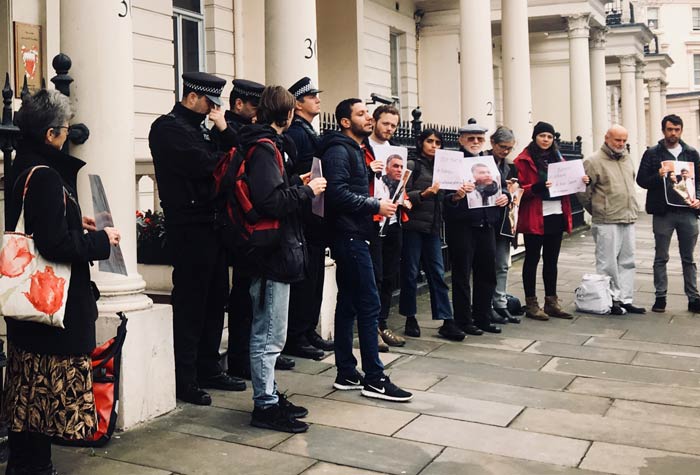
Protesters call for freedom for Nabeel Rajab outside the Bahraini embassy in London.
Nabeel Rajab’s sentence to two years in prison for speaking to journalists was upheld on 22 November 2017 by a Bahraini appeals court at the conclusion of a long-running, unfair trial.
Rajab will serve his sentence at notorious Jau Prison until December 2018, by which time he will have actually spent two and a half years in prison. He faces up to 15 years in prison in a second case related to his comments on Twitter, with the next hearing on 31 December. Index on Censorship and the Bahrain Institute for Rights and Democracy (BIRD) condemns Rajab’s imprisonment, which is a reprisal against his work as a human rights defender, and calls for his immediate and unconditional release.
Rajab was sentenced in absentia on 10 July 2017 on charges of “publishing and broadcasting fake news that undermines the prestige of the state” under article 134 of Bahrain’s Penal Code. This is in relation to statements he has made to media that:
-
International Journalists and researchers are barred from entering the country
-
The courts lack independence and controlled by the government. Use judiciary as a tool to crush dissidents.
-
Foreign mercenaries are employed in the security forces to repress citizens
-
Torture is systematic in Bahrain.
In the last appeal court hearing on 8 November, the judge refused to allow the defence’s evidence, which included testimonies of high-profile journalists and researchers who had been banned from entering Bahrain.
Sayed Ahmed Alwadaei, Director of Advocacy, BIRD: “This is a slap in the face of free expression and tragically proves Nabeel’s point that the justice system is corrupt. Bahrain’s rulers are fearful of the truth and have lashed out against it once again. This Bahraini repression has been enabled by their western allies in the US and UK.”
Jodie Ginsberg, CEO, Index on Censorship: “This is an outrageous decision. Nabeel has committed no crime. Bahrain needs to end this injustice and its harassment of Nabeel.”
The Bahraini courts have failed to provide Rajab, the president of the Bahrain Center for Human Rights (BCHR), a fair trial at every turn. He has been prosecuted for his expression, as protected under article 19 of the Universal Declaration of Human Rights and International Covenant on Civil and Political Rights. During his hospitalisation earlier this year, multiple court hearings were held in Rajab’s absence, including his sentencing in July.
Rajab had a separate hearing on 19 November 2017 in a concurrent case relating to his tweets about torture in Bahrain’s notorious Jau Prison and the Saudi-led coalition’s war in Yemen, for which he faces up to 15 additional years in prison. The court heard a prosecution witness, who had already appeared in a previous hearing last year, and who was not able to provide any evidence against Rajab. The trial was adjourned to 31 December 2017, when the security officer who confiscated Rajab’s electronic devices for another case will be brought as a prosecution witness. The next court hearing will be the eighteenth since the trial began.
Rajab also has been charged with “spreading false news” in relation to a letter he wrote to the New York Times in September 2016. A new set of charges were brought against Rajab in September 2017 in relation to social media posts made in January 2017, when he was already in detention and without internet access.
The human rights defender was transferred to Jau Prison on 25 October 2017, having been hospitalised the previous six months, since April, after a serious deterioration of his health resulting from the authorities’ denial of adequate medical care and unhygienic conditions of detention.
Rajab was subjected to humiliating treatment on arrival at the prison, when guards immediately searched him in a degrading manner and shaved his hair by force. Prison authorities have singled him out by confiscating his books, toiletries and clothes, and raiding his cell at night. Rajab is isolated from other prisoners convicted for speech-related crimes and is instead detained in a three-by-three meter cell with five inmates. Prison officers have threatened him with punishment if he speaks with other inmates, and he is not allowed out of his cell for more than one hour a day.
One of Rajab’s outstanding charges is that he spoke out about the degrading treatment in Jau Prison.The evidence he and BCHR gathered proving torture in the prison was exposed in a joint-NGO report, Inside Jau, in 2015. Human Rights Watch also reported on the same incidents of torture.
The upholding of the sentence means Rajab will be imprisoned at least until December 2018, by which time he will have spent 30 months in prison. This itself reflects the unfair court procedures: Rajab was first arrested in June 2016 and charged with spreading fake news in media interviews. However, the prosecution did not begin investigating his charges until six months into his detention, in December 2016.
International Positions
The UK Foreign and Commonwealth Office has avoided expressing concern over Nabeel Rajab’s sentencing in its answers to four parliamentary questions since July. In their latest statement, they stated: “We continue to closely monitor the case of Nabeel Rajab and have frequently raised it with the Bahraini Government at the highest levels.”
25 British MPs have condemned the sentence.
Following Rajab’s sentencing on 10 July, the United States, European Union and Norway all called for Rajab’s release. Germany deplored his sentence. The UN High Commissioner for Human Rights’ office called for his unconditional release.
In September 2017, the UN condemned the increasing number of Bahraini human rights defenders facing reprisals, naming nine affected individuals, Rajab among them. The UN Committee Against Torture has called for Rajab’s release.
Yesterday, fifteen international and local NGOs wrote to states including the UK, US, EU, Norway, Germany, France, Italy, Denmark, Sweden, Ireland and Canada urging them to call for Nabeel Rajab’s immediate and unconditional release. Their voices were joined by protesters in London. In Washington D.C., a petition signed by 15,000 people calling for Rajab’s release was delivered to the Bahrain embassy.
[/vc_column_text][/vc_column][/vc_row][vc_row][vc_column][vc_basic_grid post_type=”post” max_items=”12″ style=”load-more” items_per_page=”4″ element_width=”6″ grid_id=”vc_gid:1511346172721-094fe208-2d84-9″ taxonomies=”716, 3368″][/vc_column][/vc_row]
