26 Apr 2017 | Mapping Media Freedom, News, United Kingdom
[vc_row][vc_column][vc_column_text]
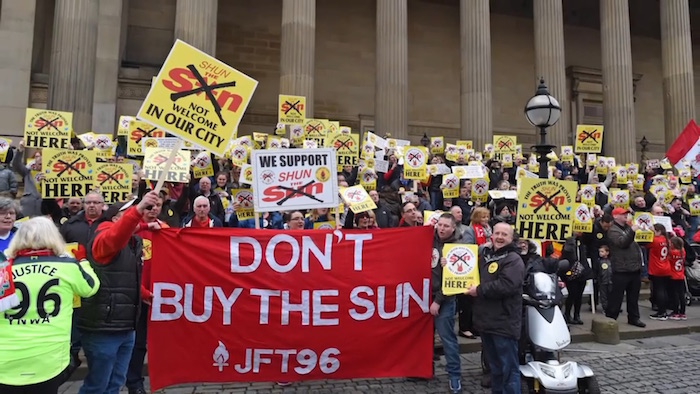
Supporters of Shun the S*n during a demonstration in Liverpool City Centre in February 2017. Credit: Shun the S*n
On 26 April 2016, the people of Liverpool got the moment they had been fighting for nearly three decades, as the jury at an independent inquest found that fans of Liverpool Football Club were in no way to blame for the 1989 Hillsborough stadium disaster in which 96 died.
After two years in court, the inquest revealed that South Yorkshire Police had failed to responsibly manage the crowd of 54,000, as the then all-standing stadium in Sheffield filled up for an FA Cup semi-final between Liverpool and Nottingham Forest, resulting in a crush in one end of the stadium. Among the dead were dozens of children and teenagers. The new inquest found that the police had then deliberately attempted to shift blame onto the fans, covering up their mistakes and claiming the deaths had been caused by drunken misbehaviour.
For 27 years the Hillsborough Justice Campaign, composed largely of families of the victims, rejected the official version of events, and “Justice for the 96” became a rallying cry for the whole city.
But one year on from the exonerating inquest verdict, a parallel campaign has only gathered momentum. Though rarely as centralised as the HJC, its message is simple: “Don’t Buy The Sun”.
On 19 April 1989, four days after the disaster, The Sun splashed its front page with the now infamous headline “The Truth”, under which it accused that Liverpool fans at the stadium had picked the pockets of the dead, beaten up a police officer attempting to resuscitate a victim, and even “urinated on the brave cops”. Later revealed to be part of a concerted smear campaign, this was taken as a deeply hurtful insult not just to the dead, but to the entire city of Liverpool, and a three-decade boycott against the UK’s highest-selling newspaper began.
The boycott became a unifying cause for the city. Most newsagents refused to continue selling The Sun, leaving only supermarket chains to display it on less visible shelves. Fans share videos on social media mischievously throwing copies they do find into the trash or covering them up with other papers. Footballers from Liverpool and their local rivals Everton are applauded for refusing to engage with its journalists, even long after they have moved on to other teams. Even its name is treated as a dirty word, with the Liverpool Echo newspaper and several campaign groups referring to it as “The S*n”, and locals calling it “the rag”.
In 2017, with the real truth now finally out in the open, the movement is more active than ever. Taxis roam Liverpool freshly wrapped in liveries declaring “The S*n – Not Welcome In Our City”. In February Liverpool Football Club revoked The Sun’s press credentials from all club facilities and activities, including home games at their Anfield stadium, effectively banning them.
One newsagent, who gave his name as Manoz, recently moved to Liverpool from London and set up shop, unaware of the history of the boycott. He decided to stop selling The Sun in February after receiving complaints from customers.
“We don’t want to hurt their feelings or anything,” he told Index. “I know it’s a long time ago but the people here are not forgetting about it. They were coming in and saying why, and that’s why we stopped it. It’s part of living in this city.”
Gary Gaze is the founder of the largest anti-Sun campaign group on Merseyside, Shun the S*n. An avid follower of Liverpool FC for most of his life, the 1989 FA Cup semi-final was the only away game he missed that season. Amidst the modern panic over so-called “fake news”, Gaze is certain that The Sun’s misleading Hillsborough coverage had long-term material effects, making the HJC’s task more difficult by turning public opinion against the victims.
“I’ve got an open mind, I know some people don’t like football or whatever, but it’s not all about football. It’s about people from Liverpool being tarred with a brush,” he told Index. “They were lies, and people have been affected by it for a long, long time.”
On asking newsagents to stop selling The Sun, Gaze, who was inspired to become an activist by the determination of the HJC’s fight for the truth, said: “We just have to educate people and let them know why people don’t read it, and I think people realise that if they continue to sell it, it’s going to affect their profits. People aren’t going to want to go into shops that sell it.”
[/vc_column_text][vc_row_inner][vc_column_inner width=”1/4″][vc_icon icon_fontawesome=”fa fa-globe” color=”black” background_style=”rounded” size=”lg” align=”right” css_animation=”fadeIn” link=”url:https%3A%2F%2Fwww.indexoncensorship.org%2Fcampaigns%2Fpress-regulation%2F|||”][/vc_column_inner][vc_column_inner width=”3/4″][vc_column_text]This article is part of an ongoing series exploring media freedom in the UK.
Index on Censorship monitors media freedom around the world. Find out more.
[/vc_column_text][/vc_column_inner][/vc_row_inner][vc_column_text]New developments during the weekend of the disaster’s 28th anniversary saw Kelvin MacKenzie, the editor who oversaw The Sun’s Hillsborough coverage, make new derogatory comments about the city in his column in the newspaper, also comparing Everton player Ross Barkley to a gorilla after he was punched in an unprovoked attack in a nightclub. The club responded by following their neighbours in banning The Sun from all club premises and Liverpool mayor Joe Anderson reported MacKenzie to the police over what he called “racial slurs” and hate speech, on account of Barkley’s Nigerian heritage. Responding to the outrage, The Sun suspended MacKenzie.
The day before The Sun published MacKenzie’s comments, Gaze had told Index that he thought a genuine attempt by The Sun to make amends would have been received well by the city, but that they had shown their true colours through years of half-hearted apologies and omissions. After the latest controversy, he believes the boat has sailed.
“Right around the time people are remembering and mourning the 96, they do this,” he said. “It might just be bad timing but I think they know exactly what they are doing. Any apology now is sort of induced. They’ve been forced to make an apology but it’s not genuine, and it’s entirely too late.”
The most remarkable thing about recent anti-Sun activity is that it is no longer confined to Merseyside. Petitions have sprung up from football fans around the UK calling on their clubs, or even the entire Premier League, to join Liverpool and Everton’s ban in solidarity, and semi-professional club Sutton United was criticised for accepting sponsorship from The Sun’s betting platform, SunBets, for their FA Cup tie against Arsenal.
Gaze was supportive, but diplomatic, on the spread of the Don’t Buy The Sun mantra. “As far as I’m concerned people should all hate the rag. But I don’t think we’ve got a right to say to say to other cities ‘don’t buy it, don’t read it’. That’s out of our hands.” Referring to other more recent controversies such as the phone-hacking scandal, he added: “A boycott is what they deserve.”
Of course, all this talk of preventing the sale of a newspaper has led to accusations of press censorship. The Spectator’s Roger Alton wrote that Liverpool FC being allowed to ban The Sun’s reporters would have “savage implications” for freedom of the press, and claimed it was impossible to hold “even a sliver of a divergent view” of the disaster.
Locals do not care for the suggestion. Richie O’Brien, a taxi driver, wrote in an open response on Facebook: “Making stuff up and publishing pictures of semi-naked teenagers then passing it off as news is clearly not breaking any laws in this country, and it is entirely down to the individual consumer whether they buy into their poisonous drivel or not. Just as The S*n is totally within its legal rights to do and say the nasty things that it does, it is also everybody’s right to suggest that you don’t buy their product.”
However, the line between refusing to support, and refusing to allow The Sun’s presence is a point of contention. When Merseytravel, the public body that operates trains and buses on Merseyside, asked its vendors to join the boycott in September 2016, it was condemned by the Society of Editors’ Bob Satchwell who told the BBC: “No public organisation should be seeking to restrict a perfectly legitimate newspaper.” Liverpool city council unanimously voted to back the boycott, and similar council motions passed in Derry City and Strabane in Northern Ireland, and St Helens, a small town outside Liverpool.
After Liverpool FC instituted its ban in February, Trevor Hicks, president of the Hillsborough Families Support Group and father of two of the younger victims, told The Guardian of the “enormous damage” and distress caused by The Sun since 1989. The club made no statement, but on joining them in April Everton said: “the newspaper has to know that any attack on this city, either against a much-respected community or individual, is not acceptable.”
To the people of Liverpool, and a growing number of people around the UK, the movement against The Sun is symbolic of local pride, solidarity and standing up to an abusive establishment. Activists deny pressuring vendors and readers – Gary Gaze stressed that his interactions were always polite and cordial and that he preferred to support shops that joined the boycott than punish those that didn’t. He was also skeptical of politicians becoming involved.
The Sun remains the best-selling newspaper in the UK, but its near-total absence from a major city is a warning that the right to free press does not guarantee a right to a willing readership.[/vc_column_text][/vc_column][/vc_row][vc_row][vc_column][vc_basic_grid post_type=”post” max_items=”12″ style=”load-more” items_per_page=”4″ element_width=”6″ grid_id=”vc_gid:1493713944624-132ff556-5cc2-2″ taxonomies=”6564″][/vc_column][/vc_row]
18 Apr 2017 | Awards, Awards Update, News, Youth Board
[vc_row][vc_column][vc_column_text]
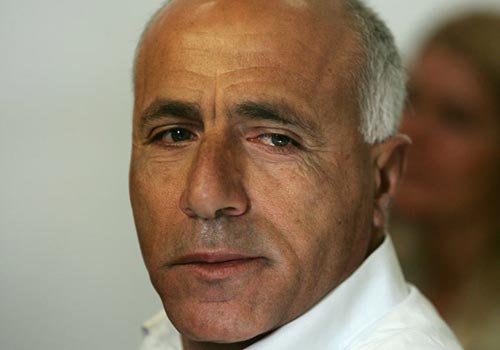
Mordechai Vanunu
Mordechai Vanunu was granted Index on Censorship’s Special Award in 2004 for his work as a whistleblower on Israel’s nuclear programme. While working as a nuclear technician for the Israeli government in the 1980s he was sentenced to 18 years in prison for exposing their possession of nuclear weapons to the Sunday Times.
In April 2004 he was released and has since been fighting for his right to leave Israel – the foundational condition of Vanunu’s release from prison was a prohibition on leaving the country. In addition, he is prohibited from contacting embassies or having any interaction with foreigners that has not been pre-approved by Israeli officials. Shortly after his release he unsuccessfully applied for asylum in Norway, Ireland and Sweden. He has been rejected asylum status numerous times since it is not legally possible to apply for asylum in a country without physically being there. Essentially, so long as the prohibition on leaving Israel remains, he cannot meaningfully seek asylum.
Israel’s High Court has had a central role in determining Vanunu’s fate since 2004. In 2008 24 influential Norwegian lawyers signed the “Norwegian Lawyer’s Petition for Vanunu”. In September of the same year the eighth petition calling for Vanunu’s conditions to be lifted was rejected by the High Court. And less than 2 months ago Vanunu was convicted of violating the terms of his release by meeting with two US citizens in 2013 without permission from the authorities. He is to appear in court for sentencing this month.
This is only the latest struggle in the past 30 years of Vanunu’s life, after he first leaked photos of Isreali nuclear production plants to the Sunday Times in 1986. Vanunu’s struggle for freedom has not gone unnoticed by the world. He has been nominated for the Nobel Peace Prize every year since 1987. In 2010 the International League for Human Rights sent open letters to Benjamin Netanyahu seeking Vanunu’s free release. In 2015 Vanunu said that he had no desire nor even any means of spilling more secrets on Israel’s nuclear programme. He stated that he simply wants to join his wife, theology professor Kristin Joachimsen, in Norway. In the same year the Campaign for Nuclear Disarmament wrote to the Guardian calling for a vigil to be held outside of the Israeli Embassy in London in honour of Vanunu’s birthday.
However, there may be hope. In October 2015 Vanunu appealed the terms of his release to the Israeli Supreme Court, and in January this year he shared on Facebook that the Supreme Court would rule on his appeal in the coming month. On March 3, 2017, Vanunu wrote: “We are now waiting for the Supreme Court decision, it could be anytime soon. And it could be good or nothing, I am used to all this for 31 years, 1986-2017. Freedom must come.”
Fionnuala McRedmond is a member of Index on Censorship’s Youth Advisory Board. She graduated last June from the University of Cambridge with a degree in Classics. She is now studying for a MSc in Political Theory at the London School of Economics.[/vc_column_text][/vc_column][/vc_row][vc_row][vc_column width=”1/2″][vc_single_image image=”85476″ img_size=”full” alignment=”center” onclick=”custom_link” link=”https://www.indexoncensorship.org/2016/11/awards-2017/”][/vc_column][vc_column width=”1/2″][vc_column_text]
Index on Censorship Freedom of Expression Awards
Seventeen years of celebrating the courage and creativity of some of the world’s greatest journalists, artists, campaigners and digital activists
2001 | 2002 | 2003 | 2004 | 2005 | 2006 | 2007 | 2008 | 2009 | 2010 | 2011 | 2012 | 2013 | 2014 | 2015 | 2016 | 2017[/vc_column_text][/vc_column][/vc_row][vc_row][vc_column][vc_basic_grid post_type=”post” max_items=”12″ style=”load-more” items_per_page=”4″ element_width=”6″ grid_id=”vc_gid:1492506170040-ab008603-fefe-8″ taxonomies=”2329, 180″][/vc_column][/vc_row]
18 Apr 2017 | Awards, Awards Update, Digital Freedom, News, Youth Board
[vc_row][vc_column][vc_column_text]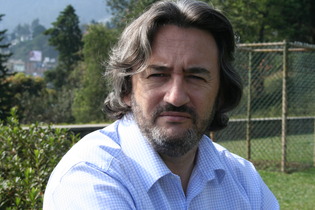
Fergal Keane is a journalist who made his name as a war reporter at the end of millennium, covering conflicts from Congo and Rwanda to Kosovo. In 2003, the Index on Censorship recognised his efforts with their award for Outstanding Commitment to Journalism Integrity. It wasn’t Keane’s first award, and it wasn’t his last either. On top of his Orwell Prize (1996) and Amnesty International Press Award (1993) and Television Prize (1994), his OBE and his BAFTA (both from 1997), Keane has since added a Sony Gold award in 2009, for his inspiring Radio 4 series ‘Taking a Stand’, and the Ireland Funds Literary Award in 2015.
In 2004, following decades in the profession, Keane made the decision to stop entering active war zones. “I couldn’t justify potentially robbing my children of a father,” he told the Daily Telegraph in 2010. “I couldn’t do it anymore.” But despite a slight career shift, Keene continues his commitment to journalism and justice just as fervently. He is now a special correspondent for the BBC, still writing and broadcasting on topics like the refugee crisis, the Yemen conflict and the South Sudan civil war – though sometimes from afar – as well as often being dispatched to the latest scenes of terrorism in Europe, whether France, Belgium or Germany. Wherever he is, he retains an insight and awareness of historical context that few can match.
Beyond the BBC, he is also the author of several well-received books and in 2011 he received an honorary degree from the University of Liverpool, where he is now three years into a Professorial Fellowship. He is part of the university’s Institute of Irish Studies, teaching students on the Understanding Conflict masters programme.
Speaking to the university’s website in 2015, Fergal criticised the “endlessly reductive” mainstream press and urged his students to “always challenge your opinions with facts, every day of your life. You will only know what your opinions are worth if they are taken out of the box and subjected to the most severe tests. Facts, facts, facts.”
Not all Keane’s work is confined to journalism, however. In 2005, he founded Msaada, an NGO dedicated to assisting Rwandans – and Rwandan society – to recover from the 1994 genocide, through meaningful, income-generating projects. It continues to support such projects today.
Samuel Earle is a member of Index on Censorship’s Youth Advisory Board. He is a freelance writer and recent masters graduate from the London School of Economics and Political Science, where he studied Political Theory. He lives in Paris.[/vc_column_text][/vc_column][/vc_row][vc_row][vc_column width=”1/2″][vc_single_image image=”85476″ img_size=”full” alignment=”center” onclick=”custom_link” link=”https://www.indexoncensorship.org/2016/11/awards-2017/”][/vc_column][vc_column width=”1/2″][vc_column_text]
Index on Censorship Freedom of Expression Awards
Seventeen years of celebrating the courage and creativity of some of the world’s greatest journalists, artists, campaigners and digital activists
2001 | 2002 | 2003 | 2004 | 2005 | 2006 | 2007 | 2008 | 2009 | 2010 | 2011 | 2012 | 2013 | 2014 | 2015 | 2016 | 2017[/vc_column_text][/vc_column][/vc_row][vc_row][vc_column][vc_basic_grid post_type=”post” max_items=”12″ style=”load-more” items_per_page=”4″ element_width=”6″ grid_id=”vc_gid:1492505799978-a5ad6490-9f12-5″ taxonomies=”4881, 8935″][/vc_column][/vc_row]
20 Feb 2017 | News, Youth Board
[vc_row][vc_column][vc_column_text]Index on Censorship has recruited a new youth board to sit until June 2017. The group is made up of young students, journalists and legal professionals from countries including India, Hungary and the Republic of Ireland.
Each month, board members meet online to discuss freedom of expression issues around the world and complete an assignment that grows from that discussion. For their first task the board were asked to write a short bio and take a photo of themselves holding a quote that reflects their belief in free speech.
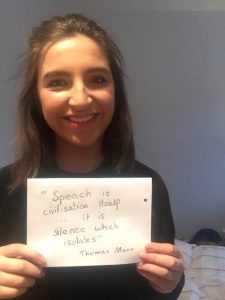 Fionnuala McRedmond – Dublin
I graduated last June from the University of Cambridge with a degree in classics. I am now studying for a MSc in political theory at the London School of Economics. I was an active student journalist during my time at Cambridge, and it was there that I first developed an interest in the struggles of censorship and speech across the globe. The propensity for governments to censor speech and ideas is not a modern phenomenon. In ancient Rome book burning was not unheard of, and Cicero once expressed the all too familiar idea: “it is not permitted to say what one thinks… it is obviously permitted to keep silent.” Then, as much as now, free speech was the cornerstone of a healthy society. And then, as much as now, speech was censored by tyrannical power. I am particularly interested in the relationship between censorship and identity. In the past, and even more so now, people have been denied the right to share their words and ideas on the basis of ethnic, religious and political identity. Work by groups like Index on Censorship is crucial in protecting people’s right to speak, no matter who they are. I hope to better understand and develop these ideas with the Index on Censorship youth board.
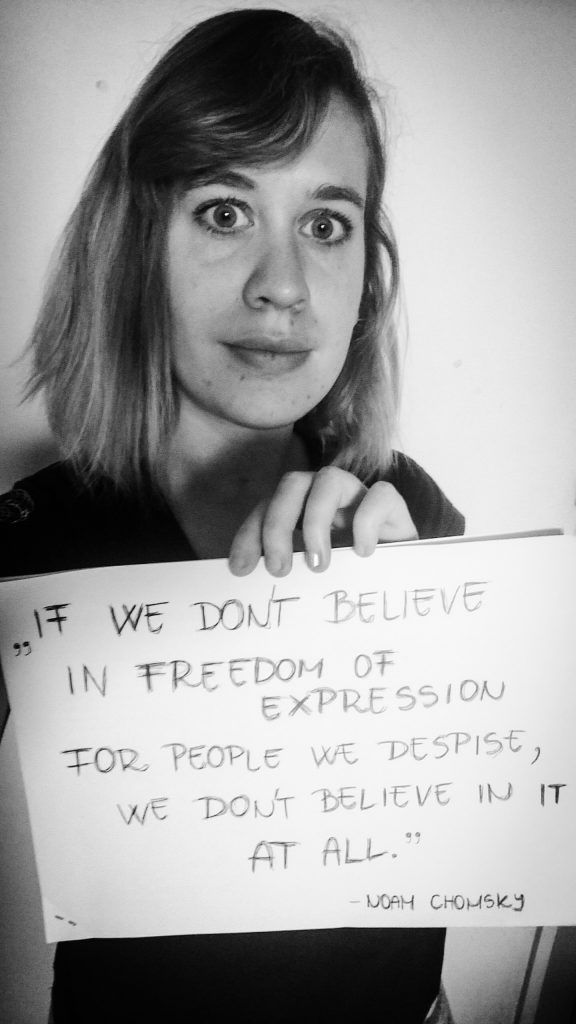 Júlia Bakó – Budapest
I am a Hungarian journalist, student and activist currently living in Budapest. After finishing my first degree in journalism, I have started studying international relations.
As a journalist and as someone who is deeply committed to human rights I am naturally drawn to freedom of expression and freedom of press issues. During the last couple of years I have worked with several NGOs and other organisations like Transparency International, Amnesty International, OSCE and Atlatszo.hu. I have dealt with corruption cases as an investigative journalist, I have studied human rights monitoring and – partly because of my studies, but mostly because of my personal interest and commitment – I have tried to explore freedom of expression and other issues not just in my own country, but all over the world, to find patterns, similarities and possible measures that could be taken either on a national or international level.
The quote I chose about freedom of expression says something what we sometimes tend to forget about. Being able to express our own opinions, however right they may seem to us, should never stop us from fighting for the rights of others to be able to act the same way, even though their opinions seem fundamentally different sometimes. Granting the chance to express opinions we do not agree with is what is able to create the diversity of thought, the debate about social issues and with that democracy itself.
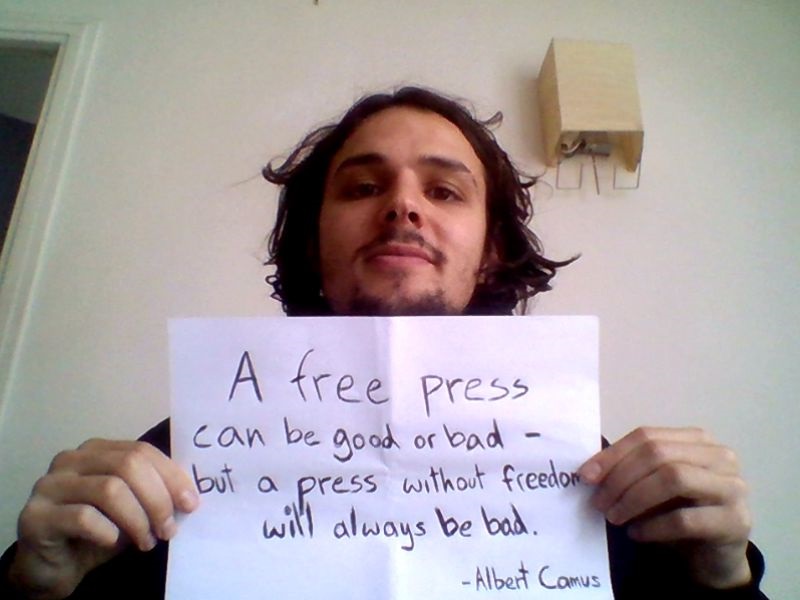 Samuel Earle – Paris
I currently live in Paris, where I am a freelance writer and English teacher.
I became interested in freedom of expression while studying politics at university – first at undergraduate and then at MSc level – and that continues today through my interest in journalism. What’s clear to me is that although freedom of expression is always valuable, the challenges it faces globally are never the same.
In the west, I think there is a complacency concerning freedom of expression: that stopping censorship is assumed to be enough. But I believe that in societies as unequal as our own, and where market forces reign, the value of freedom of expression can be diminished – as shown, for example, by the fake-news phenomenon.
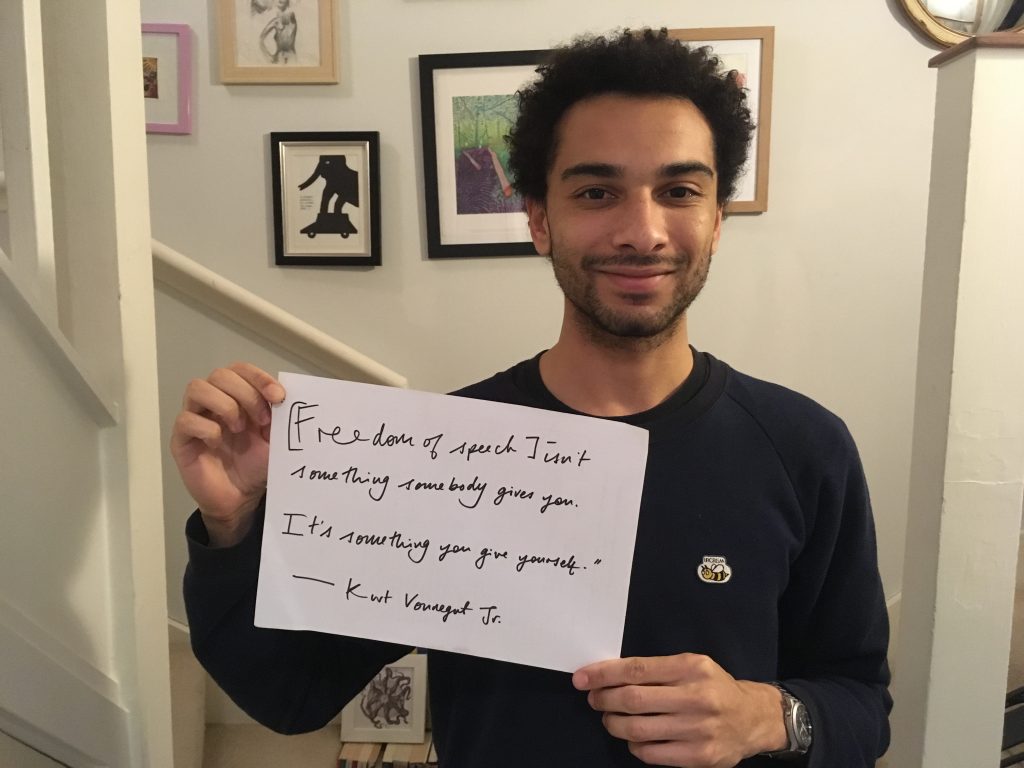 Samuel Rowe – London
I am currently a postgraduate law student, having studied literature as an undergraduate in the UK and the USA. I hope to become a public law barrister, specialising in media and information law and human rights. Like the character in Kurt Vonnegut’s Hocus Pocus, I believe that the right to freedom of speech is innate. It is not a commodity; it is not something to be bargained with. My interest in issues surrounding freedom of speech directed my undergraduate dissertation, which focused on the western surveillance state. This sort of covert action can have the effect of creating an environment of self-censorship, and often has a disproportionate impact on marginalised communities. I looked at methods of resistance (of which there are many) to see how groups maintained freedom of speech under the gaze of the state. The suppression of freedom of speech is hardly a novel phenomenon and mass surveillance is just one way in which it is currently under threat. From White House officials calling disagreeable information “fake news” to irresponsible no platforming in universities, this is an era in which the limits and value of freedom of speech are being questioned. I believe that without freedom of speech, there can be no full interrogation of the evils which face us. And without interrogation, we risk losing sight of the full scope those evils might pose.
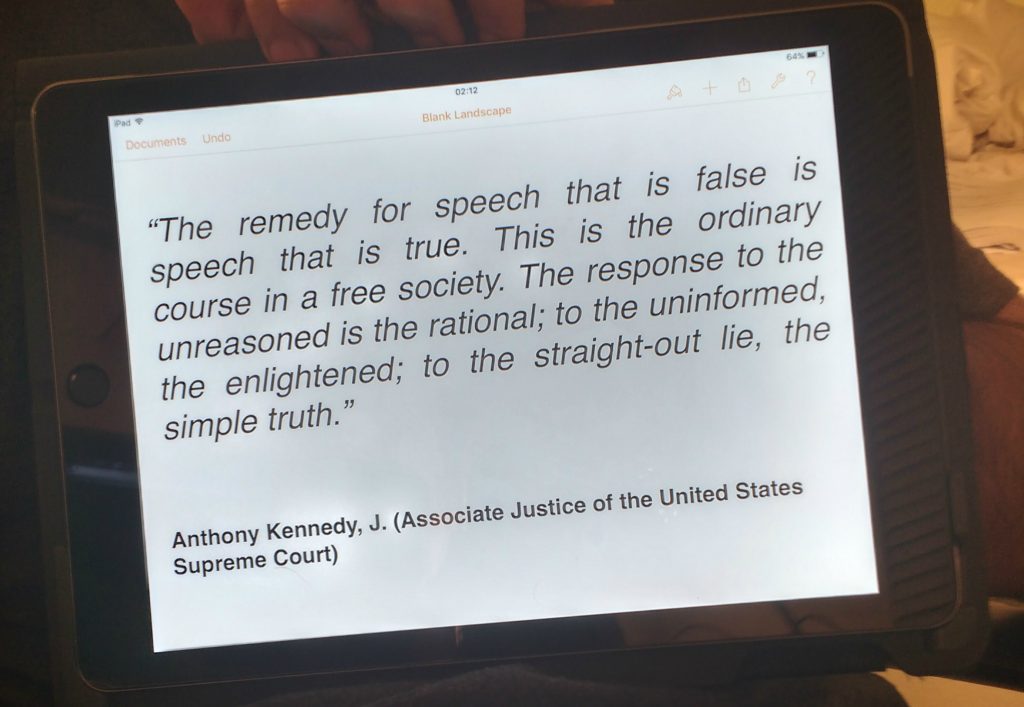 Tarun Krishnakumar – New Delhi
In recent times, there has been much concern expressed about the proliferation of “fake” news online and the impact it can have on democratic processes, politics and the public at large. These concerns have stirred various stakeholders – including governments, news media and internet intermediaries – into action. For instance, the German government recently declared fake news from Russia to be a significant threat to its upcoming elections. In a similar vein, internet giants like Google and Facebook – likely in the wake of unfavourable political outcomes – have been clamouring to show that they are willing to clamp down on content that is false or misleading.
In response to these developments, the quote I’ve selected manifests what, I feel, should be the appropriate response to fake speech: more “non-fake” speech – and not more regulation. While many justifications to clamp down on fake news may be well-intentioned, the history of regulating speech has shown us that inserting an intermediary into a conversation creates unintended and harmful consequences for free speech. Often this manifests as overt censorship while, in other cases, it is the creation of private arbiters of what may or may not be said on a platform – a more covert and creeping harm. Given the subjectivity in judging what news is “fake”, the debate also presents an excuse for regimes to tighten existing censorship controls or establish new ones.
The internet has given everyone an opportunity to have an equal say. This must be preserved at all costs. Fake news must be countered not through bans, blocking or regulation but by targeting the societal information asymmetries that allow it to flourish and creating conditions that facilitate society to produce more speech that is not “fake”. Policy efforts should focus on educating readers and providing them the tools to judge content for themselves – thereby minimising the effect of false or misleading content. For this, what is necessary is a culture of being exposed to a balanced diet of diverse content. When governments peddle nationalistic, religious, or political rhetoric in educational curricula and skew facts, little do they realise that they are creating the very conditions that allow “fake” news to flourish and have the harmful impacts that they complain of.
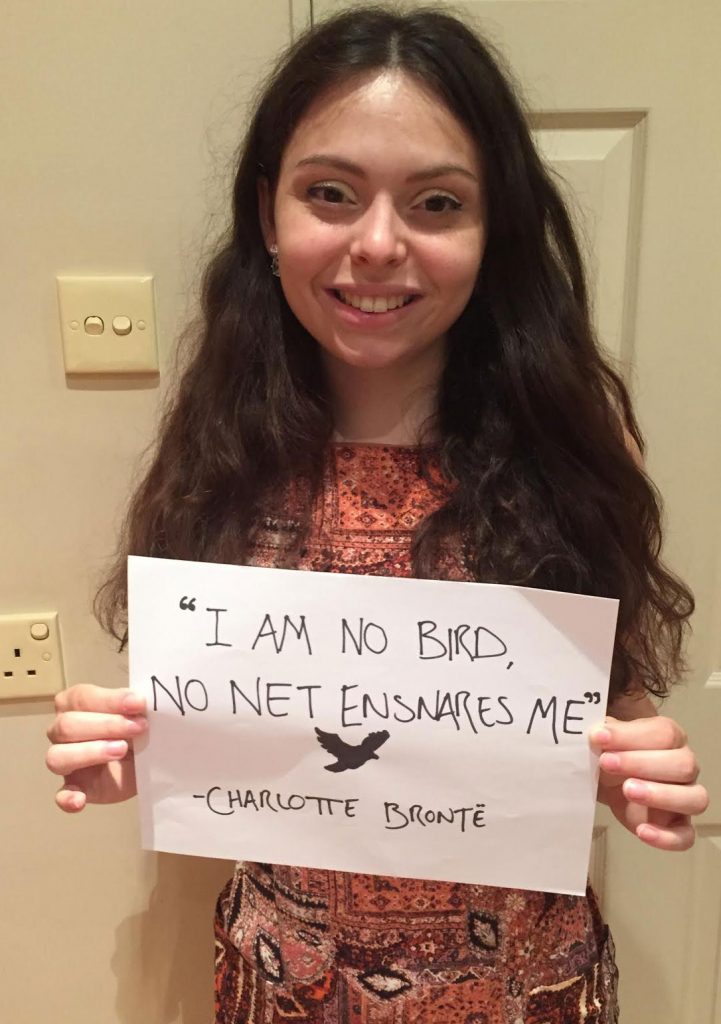 Sophia Smith-Galer – London
I’m a MA student studying broadcast journalism at City University in London. I studied Spanish and Arabic previously at Durham University and I’m particularly interested in how artists and writers overcome challenges to their freedom of expression in Latin America and the Middle East. As a singer I have always been intrigued by the imagery of a caged bird that sings despite its entrapment; Charlotte Bronte instead uses this metaphor to show how independent Jane Eyre has become by the end of the eponymous novel. Humans have always connected birds with freedom, or lack of – just look at Twitter’s logo – and so the quote really resonated with me.
Freedom of expression is particularly important to me as several countries that speak both of the languages I have dedicated years of study to continue to be plagued by tyrants and censors. I’m particularly interested addressing censorship in Latin America and the Middle East, especially with regard to the arts, as I’m also a classical singer and keen art historian.
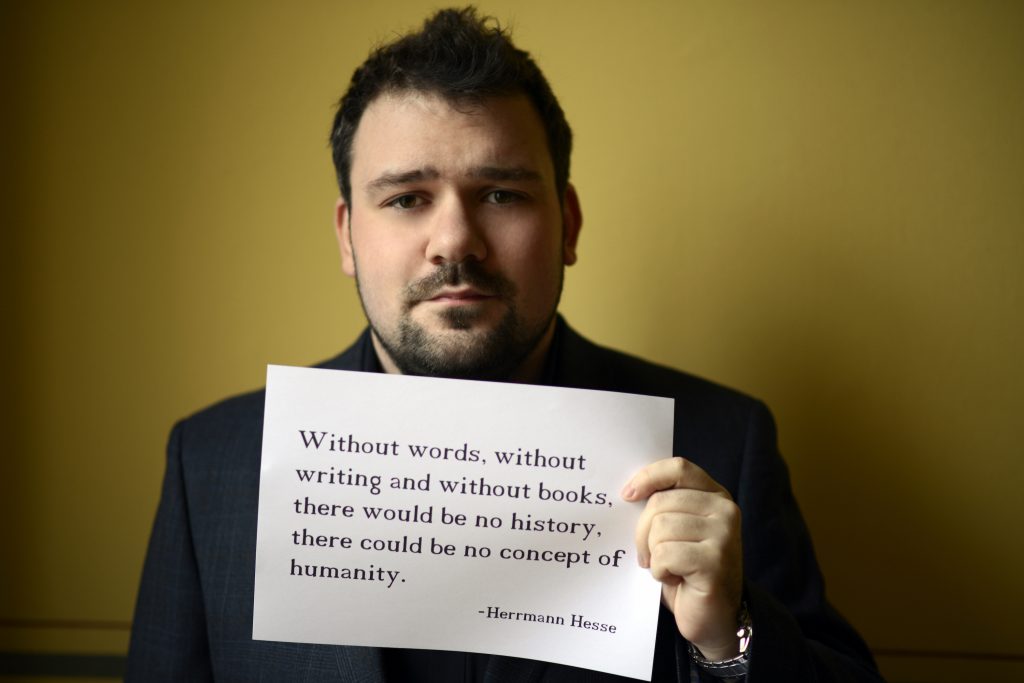 Constantin Eckner – St Andrews
I am originally from Germany. I graduated from University of St Andrews with an MA degree in modern history. Currently, I am a PhD candidate specialising in human rights, asylum policy and the history of migration. Moreover, I have worked as a writer and journalist since I was 17 years old, covering a variety of topics over the years. Longer stays in cities like Budapest and Istanbul have raised my awareness for pressures exerted upon freedom of expression.
I chose this particular quote, because Hermann Hesse emphasised the importance of the written word and how it had an impact on the concept of humanity. In his time, Hesse was conscious that without writing it was not possible to express thoughts and spread ideas. Therefore, all those who fought the existence of the written word threatened humanity which was a frightening thought for a humanist like Hesse.
In a perfect world, every human being would live without fear of state censorship and potentially facing repercussions for the words they write—or for the pictures they draw, for the photos they shoot, for music they play.
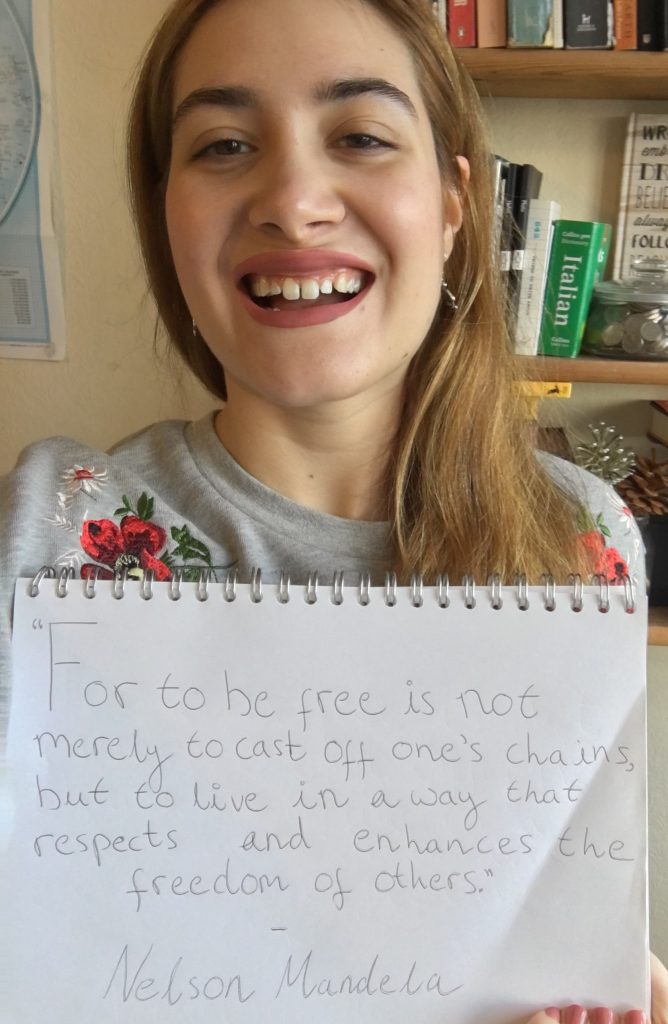 Isabela Vrba Neves – Stockholm
I’m half Brazilian and half Czech, raised in Sweden, but currently living in London where I work in communications for a mental health charity. I‘m also a Latin America correspondent for the International Press Foundation (IPF), a platform where young journalists get to write about stories that matter the most to them. It was during my time at Kingston University, studying journalism and French, when my interest in censorship and freedom of expression first emerged.
During my undergraduate studies I learned how important a free press is for a working democracy. It is a platform bringing together multiple voices, by sharing news, ideas and holding those in power to account. However, many journalists around the world suffer repression for simply doing their job and for using their right to free speech.
For me, Nelson Mandela‘s quote represents the importance of respecting and listening to each other, even with different views, but also highlighting the voices of those who are forced into silence.
Interviewing journalists from Venezuela and Pakistan, who face these types of constraints, has made me more engaged in sharing stories concerning freedom of expression, not only by journalists, but also by artists and activists. In the future, as a journalist, I want to focus on freedom of expression and by being part of the youth advisory board, I will be able to expand my knowledge and have great conversations with other young people who are passionate for justice and social change.[/vc_column_text][/vc_column][/vc_row][vc_row full_width=”stretch_row_content”][vc_column][three_column_post title=”More from the youth advisory board” category_id=”6514″][/vc_column][/vc_row]
