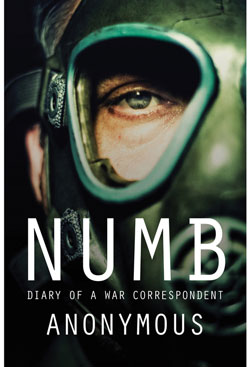
Who is Alan Buckby? According to Liberties Press, publishers of Numb: Diary of a War Correspondent, Buckby is the pseudonym of a 55-year old British foreign correspondent who was killed on assignment in 2014.
“A war correspondent for more than two decades, he led a double life, appearing to be a regular family man while at home in London, but immersed in sadism and depravity while on overseas assignments. He didn’t just document the violence – he became directly involved in it.”, the Liberties website blurb tells us excitedly.
Fun stuff, if you’re into that sort of thing. The ghostwriter, Louis La Roc, claimed that the materials for the book had come via a mutual friend from “Kay Buckby”, the wife of the deceased reporter.
Earlier this month, “Louis La Roc” appeared on two national radio stations in Ireland, luridly describing the contents of the book, to much criticism from Irish journalists. RTE’s Fergal Keane (not to be confused with the BBC’s Fergal Keane) dismissed the La Roc interview on the station’s John Murray show as “the biggest load of crap I have ever heard”, while the Irish Times’s Hugh Linehan called the interview (and by extension the book) “torture porn”.
Linehan invited Louis La Roc on the Irish Times’s Off Topic podcast on 18 April, where he and fellow Irish Times writer Patrick Freyne questioned him on the veracity of the details in the book. The timeline was, to put it mildly, all over the place. To give one example, in the book it is claimed that Buckby went to Northern Ireland in the early 80s because he was fascinated by British broadcasters’ ban on the broadcast of the voices of Sinn Fein and IRA spokespeople. In fact, that ban was only introduced in 1988. The author claimed that the various discrepancies in detail were introduced to protect the innocent, and that he had used a “cinematic jumpcut” technique to help the narrative along. Moreover, no one could find any evidence of a 55 year-old British foreign correspondent who died in late 2014.
The journalists questioned how long it had taken La Roc to write the book, from receiving the raw material to delivering to the publishers. Three months, apparently. When Freyne expressed surprise at this, La Roc suggested that it was about the same length of time as it took Siobhan Curham to work up Girl Online, the novel published under the name of vlogger Zoella that was one of last year’s best selling books, as if they were identical projects.
After the podcast, in which La Roc was openly accused of peddling fiction as fact, Freyne kept digging, and discovered that La Roc was more than likely the pen name of Colin Carroll, a self-promoter who had in the past, among other things, set up something called The Paddy Games and a website called Irish Empire. At one point he even had a joint BBC/RTE TV show, Colin And Graham’s Excellent Adventures (in the blurb for which, Colin and Graham are described as “sporting hoaxers”).
The coup de grace was delivered when another writer, Donal O’Keeffe, dug up a 2010 interview with Colin Carroll in a local newspaper, the Avondhu Press, in which he had said he was working on a novel with a war journalist as protagonist.
All in all, a very satisfactory bit of sleuthing for all concerned.
What happened next was interesting. Because what happened next was absolutely nothing. Numb is still out there, still listed under the non-fiction section of the Liberties Press website. The blurb still makes the same claims as it always has about the genesis of the book. The publisher is standing by the book, despite confirming that he made no attempt to verify the inflammatory information contained within. Perhaps defiantly, a quote from Oscar Wilde hovers at the top of the page: “There is no such thing as a moral or immoral book. Books are well written or badly written. That is all.”
It is as if…it is as if this is the kind of story that only journalists really care about (and you, dear reader, considering you’ve made it nearly 700 words into this piece. But you’re probably a hack too, aren’t you?).
And that is something that should give journalists pause for thought. Do people see us as we see ourselves? And do people put the same value on accuracy and truthfulness as we claim to?
Think of the great journalistic scandals of the past few years: when the story broke of Johann Hari’s fabrications and sockpupetting back in the summer of 2011, journalists talked about little else among themselves. Really, seriously, nothing else for about a month. But were Hari’s Independent readers camped outside Northcliffe House, furiously demanding apologies and clarifications from the paper and Hari himself? No. Non journalists I spoke to about the issue didn’t really understand what the fuss was about.
Or think of Jonah Lehrer, who made up quotes. Sure, like Hari, he was eventually dropped by employers, but did his readers really care that he’d put words in Bob Dylan’s mouth?
Meanwhile, online activists (not naming any names) spread all sorts of nonsense that gets more shares than many social media managers could dream of, because it contains that magical element of “truthiness”, to borrow a phrase from Stephen Colbert: it tells people what they want to hear. Just last week, lots of left wingers got terribly excited about a headline for a column in the Times which said that the Conservatives had got the economy wrong. “Wow ! The Times newspaper nails the Tory Lib Dem lie about the deficit & the financial crisis.” tweeted Michael H, with an accompanying picture of the headline “It’s a lie to say the Tories rescued the economy”. The tweet spread like wildfire, with the subcurrent being that EVEN THE MURDOCH PRESS was backing Labour now. The fact that the headline accompanied a guest column by a Labour peer seemed not to matter. The people sharing wanted it to be an attack on the Conservatives by the Murdoch press, and so it was.
It was the same desire for truthiness that fed the likes of Hari, and to an extent, feeds the publishers of Numb. It was what led Piers Morgan to publish photographs allegedly showing British soldiers torturing Iraqis, even though they were obviously false.
And I suspect it was behind Liberties Press decision to publish the “torture porn” of Numb: it felt like the kind of thing that might just be real.
It is important that journalism realises its duty to entertain and not just hector (not all journalism is, or should be, the “investigative journalism” so lionised by Royal Charter-waving groupies as the true untainted thing). But journalism should at least, be against truthiness, if only out of self interest. If anyone can make stuff up and get 1,000 shares on Twitter, why pay people for deep digging or elegant writing?
But consumers of media have a role to play in this too: everyone should be actively alert to the difference between stuff that is true and stuff that merely feels right, and not encourage the latter. As George Orwell wrote: “We shall have a serious and truthful and popular press when public opinion actively demands it.”
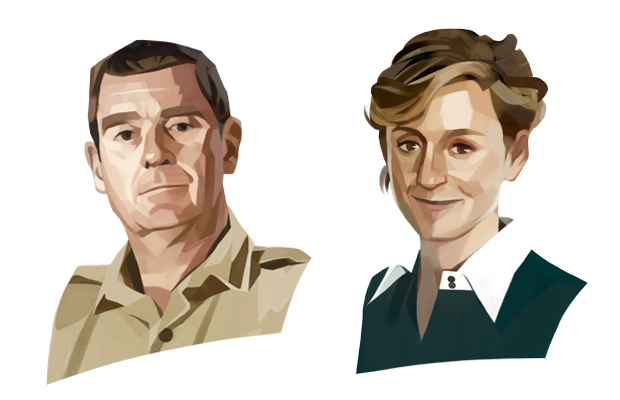
Tim Cross and Martha Lane Fox, credit: Mark Boardman
Martha Lane Fox and retired Major General Tim Cross debate how far governments go when balancing individual rights and safeguarding the nation. This is an extract from a longer feature in the latest issue of Index on Censorship magazine.
Martha Lane Fox
When it comes to balancing national security and personal privacy, I believe that your personal data should be your personal data, and that action should be taken based on a case that can be proven, as opposed to looking at everyone in society’s movements and then targeting those who stand out. I am not a fan of the world we seem to be ending up in, and I don’t necessarily believe that it is because of anything malicious. I think it would be better to have a system where your data is your personal property, and there then have to be the same restrictions applied as would be the case if someone wanted to enter your home and go through your belongings or intercept your post.
Tim Cross
Like fighting terrorism, governments have to “fight” with one hand tied behind their backs, but they cannot fight with both hands tied as some would clearly prefer. Individuals will understandably not want governments interfering with, or prying into, their personal privacy, but no one will thank any government if the banking system or consumer supply chains were to collapse. Monitoring cyberspace now forms a key part of any government responsibilities, and is (or should be) included in any national security strategy.
This said, if people fear the state is holding too much data on them unnecessarily and (rightly) demand some semblance of control over what happens with that data, then government is the least of their worries. Leaving aside the fact that government resources are scarce, the idea that some government employee is sitting in a room somewhere carefully sifting through everyone’s email is fanciful. Intelligence and law enforcement have to meet certain criteria including necessity, proportionality and justification. This is absolutely the way it should be. But private firms have no such restrictions in place. Government intelligence and law enforcement agencies are rightly burdened by layers of legality, including authorisations, justifications and audit trails, but big corporations, particularly those whose primary public interface is through cyber means, use and exploit personal details for a wide variety of reasons. While these may sometimes include improving their services, more unpalatably they sell details on to third parties. This is absolutely endemic. Many companies will not allow customers to use their service unless they agree to terms and conditions that essentially mean losing control of their personal details and allowing them to be sold on to the highest bidders. The primary concern of business is making money. Not so with governments, whose intelligence and law enforcement agencies are about deterring/catching enemies and protecting the public.
To read the rest of the debate, click here to subscribe to Index on Censorship magazine. Or buy an individual issue. Or subscribe to the app (free 30-day trial).
Major General (Rtd) Tim Cross (CBE) was commissioned into the British Army in 1971. He served in Northern Ireland, Macedonia, Albania and Kosovo. He was also the British deputy to the US-led Office of Reconstruction and Humanitarian Affairs, later re-titled the Coalition Provisional Authority. He is chair of the think-tank Theos
Martha Lane Fox is chair of Go On UK, a digital skills charity which helps people to get online. She co-founded travel website lastminute.com, and in 2013 became a crossbench peer in the House of Lords
Rory O’Neill is a Dublin-based stand-up comedian and self-described accidental activist for gay rights, who sees his duty as “to say the unsayable”.
O’Neill had been performing a comedy drag act under the name “Panti Bliss” for more than two decades when, over the course of one conversation in January 2014, he was thrust onto an international stage. While guest-starring on the Saturday night talk show of Ireland’s premier TV channel, he made reference to observable homophobia among certain Irish news figures. Pressed for names, he identified columnists John Waters and Breda O’Brien, as well as the Iona Institute, a socially conservative Catholic think tank campaigning against gay marriage, as examples of anti-gay attitudes.
RTÉ One and O’Neill were immediately threatened with legal action for alleged defamation. The TV company issued a full apology and paid six individuals €85,000 – with €40,000 allegedly going to Waters – of public money to settle the dispute. It also edited out the offending segment of the episode on its online player. The apology prompted almost a thousand complaints to the TV station and Pantigate, as the controversy came to be called, triggered countrywide debate.
The incident was brought up in both the Irish and European parliaments amid discussions of homophobia in Europe. Paul Murphy, a Socialist Party MEP for Dublin, used parliamentary privilege to denounce O’Neill’s detractors as homophobic, and to criticise RTÉ One’s attempts at appeasement.
The voices of columnists such as Waters, who called same-sex marriage a “satire of marriage”, and O’Brien, who has said that “equality must take second place to the common good”, have become more insistent as Ireland gears up for its referendum on gay marriage in May 2015. Early poll results suggest that the majority of voters will support the resolution for equal marriage rights.
Three weeks after the RTÉ One appearance, Panti appeared after a show at the Abbey Theatre in Dublin to deliver an impassioned ten-minute speech about pervasive low-level homophobia in Ireland. The speech rapidly garnered hundreds of thousands of views on YouTube, and attracted the support of Stephen Fry and Madonna, among others. Columnist Fintan O’Toole called it “the most eloquent Irish speech since Daniel O’Connell [a 19th-century Irish political leader] was in his prime”.
O’Neill channelled the events of early 2014 into his new stand-up set High Heels in Low Places, which was highly praised in reviews for fusing incisive political commentary and down-to-earth, traditonal drag-act humour. During anecdote-based performances, O’Neill has spoken about the difficulties he faced coming out in the late ’80s in a country where homosexuality was still a criminal act, as well as the emotional turmoil of being diagnosed with HIV in the mid-90s.
O’Neill becomes Panti Bliss every Saturday night at his Dublin-based LGBT-friendly bar, PantiBar. This year he has published a memoir, called Woman in the Making, and has been named one of Rehab’s People of the Year. After a successful indiegogo campaign raised €50,000, director Conor Horgan has begun work on a film about Panti, The Queen of Ireland, to be released in 2015.
Index is delighted to be launching a new project, based on its past work on art and offence, that will offer artists, producers and curators help in negotiating controversial issues and free expression.
In partnership with advocacy group Vivarta, Index will produce a series of information packs examining the impact of current UK laws on the arts sector and its freedom to present creative works.
The packs build on work initiated by Index associate arts producer Julia Farrington, who led the 2013 Taking the Offensive conference at the Southbank at which senior arts practitioners addressed questions of self-censorship and offence.
“Arts professionals rarely get any training in legal issues that impact on freedom of artistic expression,” said Farrington, who will manage the project for Index and advocacy group Vivarta. “These guides will should give people more confidence in making decisions, with greater awareness of their legal rights and the role of the police.”
The new guides will be launched in May, with input from professionals working in the arts, civil liberties and legal sectors. They are produced with support from the Arts Council.
The guides come at a time when there is renewed focus on the role of the arts community in promoting and staging challenging works. In 2014, Index led a series of workshops exploring this question with arts professionals in Wales and Northern Ireland. A final such workshop will held in Scotland later this year.
“The shutting down last year of performances like Exhibit B at The Barbican and Israeli hip hop opera The City in Edinburgh demonstrate that artists and venues continue to walk a delicate path when putting on challenging work,” said Index CEO Jodie Ginsberg. “Often fear of opposition or protest forces groups to self-censor. We hope clearer guidance on tackling these issues can help to reverse that trend.”