6 Nov 2014 | News, Politics and Society
![People taking part in the funeral procession of Lasantha Wickrematunge (By Indi Samarajiva [CC-BY-2.0 (http://creativecommons.org/licenses/by/2.0)], via Wikimedia Commons](https://www.indexoncensorship.org/wp-content/uploads/2014/11/Lasantha_Wickrematunge_funeral_banners_1.jpg)
People taking part in the funeral procession of murdered journalist Lasantha Wickrematunge (Photo by: Indi Samarajiva [CC-BY-2.0], via Wikimedia Commons)
This would be no defence for Lasantha. President Mahinda Rajapaksa repeatedly referred to him as a “terrorist journalist” and “Kotiyek” (a Tiger).
According to exiled journalist Uvindu Kurukulasuriya, shortly before Lasantha was killed, the president offered to buy the Sunday Leader, with the intention of muting its voice. Lasantha declined the generous offer. On 8 January 2009, he was shot dead.
Days later, an astonishing editorial, written by Lasantha before his death, appeared in the Sunday Leader, and subsequently in newspapers throughout the world. After describing his pride in the Sunday Leader’s journalism, Wickrematunge wrote chillingly: “When finally I am killed, it will be the government that kills me.”
Lasantha’s murder was shocking. As was the murder of Hrant Dink, the Armenian editor who “insulted Turkishness” by daring to speak of the genocide of his people; as was the murder of Anastasia Barburova, the young Novaya Gazeta reporter who investigated the Russian far right; as was the murder of Martin O’Hagan, who took on the criminality of Northern Ireland’s loyalist gangs. As were the murders of the dozens of Filipino journalists killed in the Maguindanao massacre in 2009, too numerous to name, caught up in a ruthless turf war.
Then there are the reporters killed in war zones. The conflict in Syria has been a killing field for journalists. Where once the media were seen as protected, even potential allies, now they are seen as targets. The killings of Steven Sotloff and James Foley by ISIS in Iraq brought back memories of the beheading of Daniel Pearl in Pakistan in 2002. As Joel Simon of Committee to Protect Journalists relates in his forthcoming book, the New Censorship, that crime marked a turning point. In the Pearl case, even Osama bin Laden, who viewed the media as a potential tool in his global war, was shocked by the tactic employed by his lieutenant Khalid Sheikh Mohammed, who claimed to have carried out the murder himself. From that point on, journalists were not just fair game, but trophies.
As money is drained from news, many organisations choose not to send correspondents to areas where reporters are needed most. Too dangerous, too expensive. As a result, freelancers, local journalists and fixers take ever greater risks. Under-resourced, undersupported and out on a limb, they are picked off.
Regional journalists covering tough domestic beats are easy prey. In Mexico, drug cartels boast of their ability to murder reporters. In Burma, the army kills a reporter who dares report its activities.
The numbers are horrifying: over 1,000 media workers have been killed because of their work since 1992.
Every single time, the message is sent: don’t get involved; don’t ask questions; don’t do your job. No journalism here. No inconvenient truths, no dissenting voices.
With rare exceptions, those responsible for these crimes act with impunity. Sometimes, as in the case of Anna Politkovskaya, outspoken on war crimes in Chechnya, the man who pulled the trigger is traced but those who gave the orders remain untouched. In over 90 per cent of cases of attacks on journalists, there are no convictions.
There is no greater infringement of human rights than to deliberately take an innocent life. The killing of a journalist also signals contempt for the concept of free expression as a right. As the United Nation’s Plan of Action on the Safety of Journalists and the Issue of Impunity, states, violent attacks on journalists and free expression do not happen in a vacuum: “[T]he existence of laws that curtail freedom of expression (e.g. overly restrictive defamation laws), must be addressed. The media industry also must deal with low wages and improving journalistic skills. To whatever extent possible, the public must be made aware of these challenges in the public and private spheres and the consequences from a failure to act.”
In that famous final editorial, Lasantha Wickrematunge wrote: “In the course of the last few years, the independent media have increasingly come under attack. Electronic and print institutions have been burned, bombed, sealed and coerced. Countless journalists have been harassed, threatened and killed. It has been my honour to belong to all those categories.”
Like many journalists, Lasantha prided himself on bravery: there is no higher compliment in the profession than to call a colleague “courageous”.
But there is a danger in this that we create martyrs: that we become enamoured of the idea that a good journalist should die for the cause. That persecution and suffering are marks of valour.
They are not. Journalism should be intrepid, of course, but we shouldn’t accept the idea that intrepid journalism comes with a price. Journalism, the exercise of free expression, is a basic right both for practitioners and for the readers, viewers and listeners who benifit from it. They should be able to practice this right without fear of persecution from states, criminals or terrorists. If they are to suffer, their oppressors must face justice.
Correction 10:02, 10 November: An earlier version of this article stated that a government minister offered to buy the Sunday Leader.
Index on Censorship is mapping harassment and violence against journalists across the European Union and candidate countries at mediafreedom.ushahidi.com.
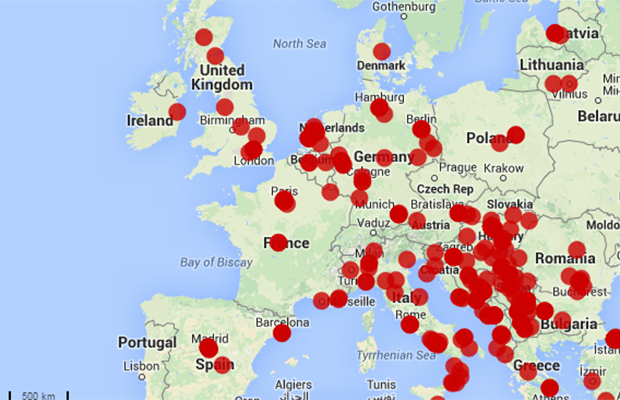
This article was posted on 6 November 2014 at indexoncensorship.org
4 Nov 2014 | Belarus, Campaigns, Statements
Ambassador Extraordinary and Plenipotentiary of the Republic of Belarus
to the United Kingdom of Great Britain and Northern Ireland
Ambassador Extraordinary and Plenipotentiary of the Republic of Belarus
to Ireland with concurrent accreditation
Mr. Sergei Aleinik
6 Kensington Court, London W8 5DL
3 November 2014
APPEAL
Dear Mr. Aleinik,
Index on Censorship is alarmed by the news that a well-known human rights defender, Elena Tonkacheva, has had her permit to reside in Belarus canceled and may be deported from the country.
Elena Tonkacheva, Chairperson of the Board of the Legal Transformation Center, although being a citizen of the Russian Federation has permanently resided in Belarus since 1985, and for years has been engaged in educational, analytical and research work in the field of human rights. Ms Tonkacheva is a highly qualified expert in law and human rights; the organisation headed by her is one of the leading human rights NGOs in Belarus.
On 30 October 2014, Ms Tonkacheva was notified about the cancelation of her residence permit and on 5 November 2014 a decision will be made as to whether she is to be deported from Belarus. The formal reason for that are administrative breaches (insignificantly exceeding speed limit when driving).
However, the disproportionate measures used by the Belarusian authorities in this case give grounds to believe that these minor breaches are used solely as a pretext to punish Ms Tonkacheva for her principled position and long-term human rights work and either to stop or create considerable obstacles in her human rights activities.
In this connection, we appeal to the Belarusian authorities to:
− Repeal the decision to cancel Ms Tonkacheva’s residence permit and not to deport her from Belarus;
− Take effective measures to protect human rights defenders and provide them with a possibility to carry out their human rights activities without any obstacles, as stipulated in the UN Declaration on the Right and Responsibility of Individuals, Groups and Organs of Society to Promote and Protect Universally Recognized Human Rights and Fundamental Freedoms from 9 December 1998;
− Be guided by the recommendation of the UN Special Rapporteur on the situation of human rights in Belarus to “recognize the important role of human rights defenders, whether individuals or members of civil society organizations, and guarantee the independence of civil society organizations and human rights defenders, enabling them to operate without
the fear of reprisal.”1
Sincerely,
Index on Censorship
1 A/69/307 Report of the Special Rapporteur on the situation of human rights in Belarus
CC.
President of the Republic of Belarus
Aliaksandr Lukashenka
Belarus, 220016, Minsk, K.Marks Str., 38
Fax + 375 17 226 06 10
E-mail: [email protected]
Minister of Internal Affairs of the Republic of Belarus
Ihar Shunevich
Belarus, 220030, Minsk, Gorodskoy Val Str., 4
Fax + 375-17-218-76-02
E-mail: [email protected]
Office of Citizenship and Migration Affairs
Main Internal Affairs Directorate of Minsk Municipal Executive Committee
Belarus, Minsk, Nezavisimost Ave, 48Б
Fax +375-17 331-81-6
E-mail: [email protected]
Department of Citizenship and Migration
Pervomajski District Office of Internal Affairs of Minsk
Belarus, Minsk, Belinski Str., 10
Fax+375-17-280-01-62
4 Nov 2014 | ArtFreedomWales, Events
At the end of Index on Censorship’s ArtFreedomWales’ second online discussion (watch it in full above) there was a general consensus that they were just scratching the surface of a huge, important subject.
Hosted by Bethan Jones Parry (Broadcaster, Journalist and Writer), the following met online to discuss the opportunities and obstacles to expression for artists working in Welsh:
- Mari Emlyn (Artistic Director Galeri, Caernarfon)
- Arwel Gruffydd (Artistic Director Theatr Genedlaethol Cymru)
- Bethan Marlow (Playwright and Storyteller)
- Iwan Williams (Independent Creative Producer and Creative Development Officer for Mentrau Iaith Cymru)
The live broadcast opened with Jones Parry asking what censorship meant to each individual? Williams kicked off by saying he felt that culture in Wales isn’t censored from the outside but rather from the inside – self-censorship. Emlyn agreed that self-censorship is what she is most aware of despite there being examples of censorship in everyday life. To her censorship is stopping or restricting opinion and the spreading of that opinion. Marlow expressed, although not sure if it is censorship entirely, that when writing in Welsh there is a pressure and an awareness that the whole audience must be taken in to consideration and that you must please the whole audience. It is not confined to the theatre alone. Working within the Welsh language and trying to appeal to everyone can affect the work that is created and dilute it in some way. Jones Parry asked Gruffydd if he had a free voice as Artistic Director of Theatr Genedlaethol Cymru or is his voice censored. Gruffydd answered by saying that he hopes the company is giving writers and artist an uncensored voice however that there is a sense of self-censorship amongst writers and artists when working in Welsh especially with those who work bi-lingually. He noted two examples. One writer saying he didn’t want to write for the Welsh theatre because he had nothing to say about Wales – leading to the question must writing in Welsh be about writing about identity? The other example, a playwright who didn’t want to express themselves in Welsh because they had too much respect for the Welsh audience. They didn’t want to offend by disclosing some of the things lurking in their head! “Something’s are more difficult to share in Welsh.” Jones Parry concluded from the initial response that censorship is a very interesting mixture but what is apparent, despite there being an inherent censorship by any state regarding culture, in Wales, censorship mostly comes from self-censorship.
Jones Parry moved on by quoting David Anderson, Director General of National Museum Wales. “We are in the second decade of the twenty first century, but we still retain the highly centralized, nineteenth century, semi-colonial model that the arts should be concentrated in London, and that funding London is synonymous with serving the English regions and the nations of the UK. For Wales, Scotland and Northern Ireland this undermines the principle, embedded in law, that culture is a devolved responsibility. It is a constitutional tension that remains unresolved.” The panel were asked to respond. Williams agreed that the funding model is centred on London and Cardiff and that there is always a pull towards the cities but that it was up to the companies and artists to change things – the ethos being to create the quality of work created in London in small rural areas of Wales. Jones Parry asked if the budget is less is it possible to achieve and offer the same quality? Williams agreed that budget is a huge factor but that confidence is a factor too. “We need to be ambitious and take big strides with our projects. By being ambitious, and if the will is there, we can create something that is of the same quality as anywhere else in the world.”
Responding to the question ‘Do Welsh speakers suffer, budget wise, because there are fewer Welsh speakers than English speakers?’ Gruffydd expressed “If you want to explore and experiment and strive towards new things with work and text – in a larger environment, with more people aware and more people buying a ticket that funds the work then a momentum is created. It is very difficult to express yourself in Welsh if your ideas are a little leftfield because we are a small audience when we are a full audience. If we break it down again to experimental work, certain texts, creating projects that appeal due to their nature then we are performing to two people and their dog. It’s difficult to fund that work.”
Marlow was asked how her work is perceived away from Wales to which she noted that the same recognition did not exist. Work away from Wales for her has always been an invitation from a company and not bringing previously performed work in Wales to England. She shared her frustration on searching for an agent that despite having many Welsh language credits including productions for high profile companies such as Theatr Genedlaethol Cymru, Sherman Cymru and TV companies, it was difficult to gain interest away from Wales. She believes the same gravitas for these big companies in Wales did not translate away from Wales. However, she believes “ as artists we don’t treat our companies with the same gravitas either. It’s important we have that pride of working in Wales and change our attitudes to see that a play produced by Theatr Genedlaethol Cymru is just as impressive as having work produced in London.” Jones Parry questioned that as a nation working in Welsh did our insecurity lead to self-censorship? Williams stated “Historically the language has been trampled on over the years. Our confidence as a nation is low. Since devolution there is a new sense of confidence and pride but a lot of work to be done still for us to believe in ourselves. It takes time and it’s not done overnight but we need to share big ideas and say big things.” Williams notes too that the creative sector in Wales is small and everyone knows each other. The critique of the work that happens in larger cultures doesn’t exist in Wales. “We censor the work we create as well as censor what we say about other people’s work.” Emlyn agrees. “As a small nation we are all afraid to offend. We all know each other. “ She believes that we must reach a point where we overcome the fear of offending. “There is a tendency to write safe things that doesn’t cause a stir or uproar. Conversation and interest is good. It gives us the drive to push boundaries and create something a bit more daring. Criticism is a problem in Wales. Either the fear of insulting or reviews become extremely personal.” Emlyn believes that there isn’t enough theatrical and historical background by theatre reviewers in Wales. She claims poetry and literature reviews are much stronger within the Welsh language.
Leading on from this, Gruffydd was asked as a director if he censors himself and compromises his principles by producing work that is popular and provides bums on seats. Gruffydd stated it is difficult to rate how much he censors himself. He has his own view and leaning as a director that reflects his personal artistic leaning, opinion and politics despite trying to remain impartial. During his tenure as Artistic Director of Theatr Genedlaethol Cymru he has chosen plays and texts that have pushed the boundaries for example ‘Llwyth’ (Tribe – about a group of gay male friends in Cardiff). Marlow rejected Jones Parry’s assumption that there are times she has wanted to express something but didn’t as it wouldn’t allow her to make a living. As a writer she has always said what she wanted. She can’t write if it is fueled by a fee alone. Marlow feels lucky to have been supported by companies that have allowed her to be open and to share what she wants to express. She believes nurturing a relationship is important. “Wales is different to the rest of Britain. The work is different and what is being said is different and that people in Europe can identify with the work.” Gruffydd believes that the English censor Welsh language work more than other cultures, due to, in his opinion old preconceptions. He notes that English culture needs to check on their perspective of Welsh work and Welsh culture. As a company it was easier for Theatr Genedlaethol to attract an audience in Taipei than London. “There is a lack of preconception abroad. It would be difficult to sell a production in Welsh to a non-Welsh audience in Cardiff let alone London and yet in Taipei the play ‘Llwyth’ attracted an audience of 1000.”
Emlyn was asked if it was difficult to attract work from across the border and overseas to Galeri in Caernarfon, North Wales suggesting that geography takes a practical hand in censorship. Emlyn didn’t believe so. Galeri has established itself as a strong centre with a mixed programme. Work from elsewhere has inspired local performers. As an example Emlyn explained how a visit from Sadler Wells company, ‘Company of Elders’ inspired a collective of women over sixty, who felt they had no platform to express themselves, to create a dance piece at Galeri. Emlyn notes it is not just geography but age, illness and so on that can lead to censorship and people feeling frustrated and restricted and therefore censored. Remaining on the subject of geographical censorship Gruffydd stated that ‘every road does not lead to Cardiff.’ As a National company he feels it’s important to invest in communities and supply them with important and substantial productions and not focus specifically on the main centers alone. The company’s latest production ‘Chwalfa’ will only play at Bangor. “It is up for the audience to travel to experience the story of that specific community.”
Jones Parry was interested to know if the story of the non-Welsh speaking Welsh was being heard within the arts and if it was balanced with the Welsh language Welsh story. Marlow’s opinion was that having two National Theatre Companies proves the output is balanced and her experience of working extensively with Welsh speaking and non-Welsh speaking communities in Wales also proved that. She believes both have a strong presence and voice. Emlyn noted that Welsh language productions sell out at Galeri but it is very difficult to attract an audience to English language theatre if the productions are from Wales or beyond. She believes that a Welsh language audience trust what they will get from Welsh language companies and play it safe. She was unsure why as if someone had a genuine interest in theatre surely they would attend productions in any language?
Bringing the discussion to a close Jones Parry asked all panellists for their final word. Gruffydd finalised his thoughts by stating that every culture censor themselves. “Culture on the whole has always favoured the middleclass and educated. People who do not fit in to this assumption or norm don’t feel as secure expressing themselves because of fear. It is a challenge for us in the arts to help overcome this and give a wider geographic the voice to express themselves artistically. The arts should belong and be beneficial to everyone’s everyday life.” Marlow ended her contribution by urging Wales to be brave and stop comparing themselves to any other country. Williams concluded by saying that culture and the arts need to be taken to the communities in order for attitudes to change. “Attitude needs to change and will change by sharing towards culture and the language.” He strongly believes communities are the key and to invest in public work beyond the usual paths of theatre and TV. Emlyn ended by stressing that Wales shouldn’t be scared of venturing. “The arts are there for us to express ourselves. If we can’t express ourselves in the arts where can we? We have the right to fail. Only by failing do we learn. We shouldn’t be afraid.”
Follow and participate in the discussions @artfreedomwales.
Find out more about Index’s UK arts programme.
This article was posted on November 01, 2014 at indexoncensorship.org
29 Oct 2014 | Bahrain, News, Statements
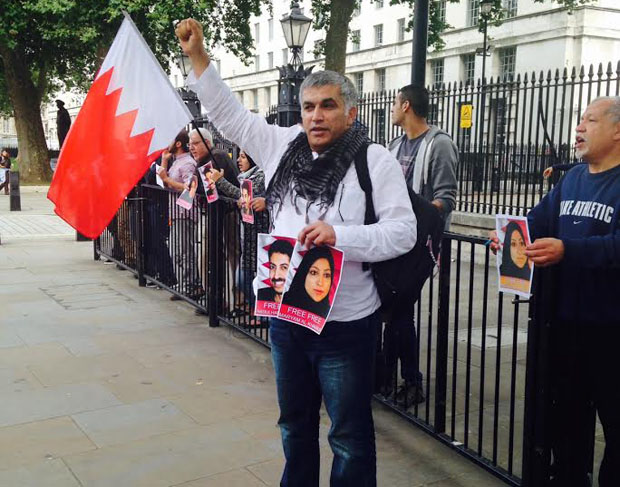
Nabeel Rajab during a protest in London in September (Photo: Milana Knezevic)
Nabeel Rajab has been freed without bail as a court postponed his trail until 20 January.
A Bahraini court had ruled last week that Nabeel Rajab would face criminal charges stemming from a single tweet in which both the Ministry of Interior and the Ministry of Defense allege that he “denigrated government institutions.” The court had postponed the trial until Sunday, 2 November. If convicted, Rajab could face up to six years in prison.
Americans for Democracy & Human Rights in Bahrain (ADHRB), the Bahrain Center for Human Rights (BCHR), the Bahrain Institute for Rights and Democracy (BIRD), and Index on Censorship condemn the criminal prosecution brought against Rajab, denounce his continued detention on charges related to his right to free speech and call for his immediate and unconditional release.
Rajab, President of BCHR and Co-Director of the Gulf Center for Human Rights (GCHR), was summoned to the Cyber Crimes Unit of the Central Investigations Directorate’s (CID) for interrogation and promptly arrested on 1 October after spending months advocating for human rights in Bahrain throughout Europe. After 19 days in pre-trial detention, Mr. Rajab appeared in front of a judge on 19 October, where the court postponed sentencing until 29 October and denied him release on bail.
The international community has been outspoken in condemning the arrest of Rajab and calling for his immediate and unconditional release. The United Nations called his detention “chilling” and argued that it sends a “disturbing message.” The governments of the United States, Norway, France, and Ireland, as well as the President of the European Parliament, United States Ambassador Samantha Power, United States Congressman James McGovern, 13 members of the UK Parliament and 40 members of the European Parliament also called for Mr. Rajab’s release. While the UK government claims to be following the situation closely, it has yet to call for Rajab’s release.
This is not the first time Rajab has faced arbitrary detention. From July 2012 to May 2014, he was detained after calling for and participating in peaceful protests in Bahrain’s capital of Manama. Rajab was also previously sentenced to 3 months imprisonment for allegedly defaming citizens of Muharraq via Twitter. Despite his eventual acquittal by the Court of Appeal, Rajab served most of his sentence.
We, the undersigned human rights organizations, call on the United States, the United Kingdom, the European Union, and other national and international bodies to actively engage the Government of Bahrain to:
- Immediately and unconditionally release Nabeel Rajab;
- drop all charges against him in relation to or retaliation for his work and his exercise of the right to freedom of expression; and
- ensure that all civil society organizations and human rights defenders in Bahrain are able to conduct their work without fear of retaliation or reprisal.
Americans for Democracy & Human Rights in Bahrain (ADHRB)
Bahrain Center for Human Rights (BCHR)
Bahrain Institute for Rights and Democracy (BIRD)
Index on Censorship
This article was originally posted on Wednesday Oct 29 2014 and updated on Sunday Nov 1 2014 at indexoncensorship.org
