12 Jun 2014 | Americas, Brazil, News
(Image: Ksenia Ragozina/Shutterstock)
World Cup time! Hurray! An entire month of football! Rejoice as the pubs stay open late for weirdly timed matches! Gasp at your workmates’ expertise on Iran’s deployment of a false 9! Repeatedly smash yourself in the face with your iPad as you read yet another article by a broadsheet columnist complaining that people don’t pay as much attention to literary fiction as they do to sport!
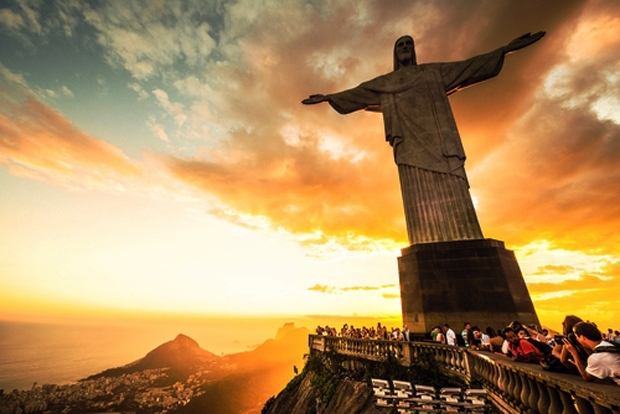
While the competition officially kicks off tonight, the Brazilians, or, specifically, the archdiocese of Rio have dived in with an early tackle, reportedly threatening to sue Italian broadcaster RAI for an advert showing Rio’s famous Christ The Redeemer statue wearing the Jersey of Italy’s Azzurri.
Suing for what, exactly, is not clear. The church’s lawyer, Rodrigo Grazioli, has been quoted as saying “The Archdiocese is deeply offended. It’s as if Brazilian TV were to make a commercial in which mulatto girls engaged in lewd behaviour with the gladiators of the Colosseum.”
Leaving aside the bizarrely specific and racist mention of “mulatto girls”, and the fact that people involved with churches have to make absolutely everything, ever, about “lewd behaviour”, it’s still not clear what the exact complaint is. Is it the suggestion that the colossal statue might support Italy? That Jesus himself might support Italy? Is this about putting any jersey at all on Jesus, or specifically an Italian one? Is there something specifically blasphemous about suggesting that the Son of God is a catenaccio man?
Or is it something rather more prosaic, such as, say, the church claiming to hold copyright over the image of the statue?
If it is that, as the original O Globo newspaper report suggests, then Grazioli and his clients are being more than a little disingenuous in their outrage. If the issue is simply an objection to commercial usage of the image, than that’s what the complaint should be about.
So why the offended line? Why the suggestion of an insult to religion? Because, put simply, it works. Who wants to be offensive?
In Ireland this week, national broadcaster RTE refused to show a sketch as part of the Savage Eye sketch show. The sketch, now leaked on the web features a group of “wild nuns” ogling a muscular Jesus, in a spoof of Diet Coke ads of old. Comic David McSavage, the man responsible for the skit, has said the broadcaster is afraid of Ireland’s blasphemy laws; RTE says its own guidelines will not allow for “undue offence”.
I’m not even sure that, even if one was a supporter of laws against blasphemy, images of hunky Jesus, or Azzurri Jesus would necessarily count as blasphemous, at least not for Catholics.
On a panel on religious art a few years ago, I found myself simultaneously playing the role of token secularist and token Roman Catholic. The other panelists – art critics and Anglicans – were quite keen on abstraction in religious art. I found myself defending the more visceral, more Roman depictions of Jesus and God on the basis that the entire point of Jesus was his manifestation as human.
To ascribe certain human possibilities to him, such as lust, or even supporting a particular sports team, should not be considered transgressive; indeed I recall, in my youth, our parish priest would often offer up prayers for the local Gaelic football club, suggesting at least the possibility of partisanship. And the very fact that nuns are “brides of Christ” is suggestive of, well…
Catholicism doesn’t really have a problem with idolatry either. Catholics complaining about depictions of Christ do not have the same theological basis as Orthodox Sunni Muslims, who at least can point to some rules on portrayals (which is not to suggest that everyone should follow those rules). Catholics, with our brightly painted statues, sacred medals and all the rest, don’t really have a leg to stand on this one.
These squeals of “offence” are really demands for “respect”, in the Corleone sense. And since the Danish Muhammad cartoons, religions have been in a respect-based arms war. Every time you hear a conservative Christian moan that this or that comic or writer “wouldn’t say that about the Muslims”, remember, they are not praising their own faith’s humility, but condemning its timidity. The archdiocese of Rio is playing a version of this game with its claim to be offended by a Photoshopped football jersey. There’s no reason we should play along.
This article was published on June 12, 2014 at indexoncensorship.org
30 May 2014 | News, Religion and Culture, United Kingdom
 For the last two decades the stubborn, powerful myth that the creative arts and the Protestant working class in Northern Ireland do not go together has been regularly proclaimed.
Closer reading reveals a plethora of Protestant dramatists including, but not limited to: Sam Thompson, Stewart Parker, Ron Hutchinson, Christina Reid, Graham Reid, Marie Jones, and Gary Mitchell. This is of course a typically unfortunate sectarian head-count, but a necessary one in light of matter-of-fact declarations from Irish Republicans that Ulster Protestants have ‘no culture’, and – perhaps more damagingly – the identical conviction of a large number of working class Protestants themselves.
With this is mind it is worth distinguishing between ‘loyalist’ and ‘Protestant working class’ voices. The phrases have become interchangeable (despite the way the Protestant electorate has long given loyalists the cold shoulder), and many local and international commentators in the media and academia continue to refuse the distinction. On the other hand, with the exception of the lively 1982 community play This is It!, loyalists are indeed without any real lineage in the theatre.
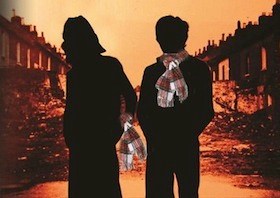
It is therefore vital that Ulster loyalists take their place on the stage, a process which began on 1 May when Bobby Niblock’s play Tartan opened in East Belfast’s Skainos Centre before going on to close the city’s Cathedral Quarter Arts Festival. A production of the recently-formed Et Cetera theatre company, this was an avowedly loyalist exercise in the sense that Niblock is an ex-prisoner depicting one of its stories. Initially the Tartans fought other gangs from within the same community but many went on to join loyalist paramilitary groups, a difference and tension the play explores.
At an Index on Censorship symposium held in the University of Ulster’s Belfast campus on 3 May, I was charged with leading one of four breakout sessions exploring why loyalist voices are under-represented in the theatre. The challenge facing the Et Cetera group was brought home when only one person from this comfortable set showed up, perfectly encapsulating part the problem. The one major complaint of loyalists in post-Troubles Northern Ireland is that their voice is simply ignored. I was initially apprehensive about spearheading a discussion even mentioning ‘loyalism’, as it is now a pejorative term of abuse. The way the conference attendees reacted typically reflects the complete unwillingness to engage with this disillusioned section.
Many loyalists have hitherto been convinced that the best way they can make their voices heard is to block roads and intimidate. They feel the ‘peace process dividend’ has nothing to offer them, while report after report pitches the Protestant working class male right at the bottom of the educational attainment table (only just in front of Irish traveller and Gypsy/Roma, according to the latest Peace Monitoring Report). These are the men who find themselves languishing in the back of police vans and holding cells at the end of an evening of rioting, as well as being the first target for the paramilitaries.
No-one would be so naïve as to believe that a play alone could stop violence, but seeing a play – like all art – can soften human beings as well as advance understanding. The late Seamus Heaney once said of his own medium that ‘It can eventually make new feelings, or feelings about feelings, happen’, and the creative process often leads to self-examination. In Tartan two young men reflect while they assemble a crate of petrol bombs: it’s their future they’re on the verge of hurling away along with the incendiaries. A diversity of viewpoints are similarly on show. Some of the boys are already hard-liners; others remind us that most Catholics don’t support the IRA. While empathetic to its young, exploited protagonists, it is also upfront about their mistakes and prejudices.
Tartan has flaws – including a noticeably stronger second half – but it is one hell of an opening salvo. The energy of these young males reverberates off the stage, giving speech and form to a violence which continues to scar the North’s streets, as well as highlighting the essence of the Et Cetera group itself: as an outlet for new stories and energies previously untapped.
The dangers of a loyalist underclass are unlikely to be apparent to an English or international audience. They remain rather less deadly than dissident republicans, but Tartan’s relevance – anchored in the perspective of misled young Protestant men – becomes especially resonant in the wake of the increased recruiting and activities of the most serious loyalist paramilitaries.
The Man Who Swallowed a Dictionary, a play about David Ervine – another ex-prisoner who died prematurely of a heart attack in January 2007 – is Niblock’s follow-up project. Earning this (provisional) title in real life for being articulate in a culture which does not value articulacy, Ervine served his sentence in the same prison as Niblock and had represented one of the few political voices for disempowered loyalists. The loss was enormous, but the return of this voice is next.
This article was originally posted on May 30, 2014 at indexoncensorship.org
29 May 2014 | News, Religion and Culture, United Kingdom
Pastor James McConnell
Belfast’s Whitewell Metropolitan Tabernacle is one of those things that makes a soft Southern Irish atheist Catholic like me think I’ll never truly understand Northern Ireland.
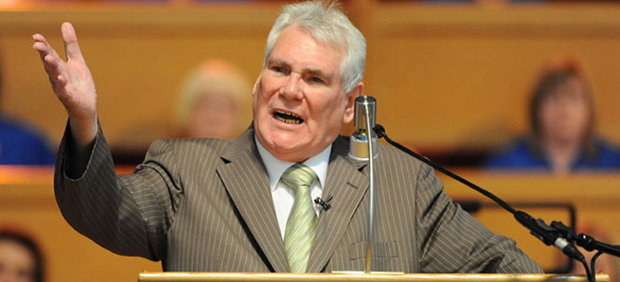
Every week, Ulster Christians flock from across the province to the 3,000-seater auditorium, there to hear Pastor James McConnell preach his Christian message. Not the Christian message of the BBC’s Thought For The Day, however; you may hear Beatitudes at Whitewell, but it’s not a place for platitudes. This is the real deal, fire and brimstone; damnation and salvation. If you’re not going to Whitewell, you’re going to Hell.
It is a comforting message, and actually, a very modern one. Think of how many politicians these days talk about how they work for hard-working-families-that-play-by-the-rules. Hardline evangelical Christianity is the epitome of that idea. We don’t refer to the “Protestant Work Ethic” for nothing.
But what we tend to forget when discussing hardliners from the outside is that there is a strong apocalyptic element in orthodox monotheistic religion. This is particularly true of Christianity. The closer to the core you get, the more you find Jesus’s teachings are essentially about the end of the world, not some vague being-nice-to-one-another schtick.
For some time, Christians have fretted over Matthew 24, in which Jesus apparently tells of the signs of his second coming, that is, to, say, the end of the world. What worries them particularly is Matthew 24:34: “Verily I say unto you, This generation shall not pass, till all these things be fulfilled.”
Does this mean Jesus was telling his apostles that the world would end in their lifetime? CS Lewis, in his work The World’s Last Night, seemed to believe so, and went so far as to call the Messiah’s assertion “embarrassing”. Lewis wrote:
“‘Say what you like,’ we shall be told, ‘the apocalyptic beliefs of the first Christians have been proved to be false. It is clear from the New Testament that they all expected the Second Coming in their own lifetime. And, worse still, they had a reason, and one which you will find very embarrassing. Their Master had told them so. He shared, and indeed created, their delusion. He said in so many words, ‘This generation shall not pass till all these things be done.’ And he was wrong. He clearly knew no more about the end of the world than anyone else.”
“It is certainly the most embarrassing verse in the Bible. Yet how teasing, also, that within fourteen words of it should come the statement ‘But of that day and that hour knoweth no man, no, not the angels which are in heaven, neither the Son, but the Father.’ The one exhibition of error and the one confession of ignorance grow side by side.”
Lewis, though himself a Northern Irish Protestant, was clearly not of the same cloth as Pastor McConnnell, Ian Paisley, and the other preachers of their ilk. Orwell disdained Lewis for his efforts to “persuade the suspicious reader, or listener, that one can be a Christian and a ‘jolly good chap’ at the same time.” The booming pastors of Northern Ireland, and other Christian strongholds such as the US’s Bible Belt, are very firmly convinced that the end is imminent. And thus, they do not have time to be “jolly nice chaps”. There are souls to be saved, right now.
It’s this attitude that has got Pastor McConnell into trouble in the past week. Recently, at Whitewell, inspired by the story of Meriam Yehya Ibrahim, a Sudanese woman reportedly sentenced to death for converting to Christianity, McConnell told the thousands assembled at his temple that “”Islam is heathen, Islam is Satanic, Islam is a doctrine spawned in Hell.”
In an interview with the BBC’s Stephen Nolan, McConnell refused to back down, claiming that all Muslims had a duty to impose Sharia law on the world, and suggesting they were all merely waiting for a signal to go to Holy War. A subtle examination of modern Islamist and jihadist politics this was not.
The PSNI is now investigating McConnell for hate speech. Northern Ireland’s politcians have been quick to comment. First Minister Peter Robinson backed McConnell, first saying that the preacher did not have an ounce of hate in his body, and then managing to make the situation worse by saying he would not trust Muslims on spiritual issues, but would trust a Muslim to “go down the shops for him”.
Insensitive and patronising that may be, but Robinson also touched on something more relevant to this publication when he said that Christian preachers had a responsibility to speak out on “false doctrines”.
The issue raised is this: if we genuinely believe something to be untrue, no matter how misguided we may be, do we not have a right to challenge it in robust terms? In politics we often bemoan the fact that leaders will not call things as they, or we, see them: indeed, Tony Blair, the bete noire of pretty much every political faction in Britain (a bete noire who oddly managed to win three election) has found grudging praise from across the spectrum this week for suggesting that rather than “listening to” or “understanding” the xenophobic United Kingdom Independence Party, politicians should tackle their arguments head on.
But in religion, we tend to hope that no one will upset anyone too much, in spite of the fact that, for true believers, theological issues are far more important than taxation or anything else.
When Blair’s government proposed (and eventually passed) a law against incitement to religious hatred in Britain, the opposition came from a coalition of secularists and some evangelical Christians, both groups realising, for different reasons, that being able to call an ideology false or untrue – and in the process criticise and question its adherents – was a fundamental right. The trade off in that is acknowledging others’ right to question your truths, something I suspect, judging by the recent controversy in Northern Ireland over a satirical revue based on the Bible, Pastor McConnell and his supporters may not quite excel at.
This article was originally posted on May 29, 2014 at indexoncensorship.org
30 Apr 2014 | About Index, Campaigns, Press Releases
VIENNA, April 30, 2014 – The European Commission’s support for projects addressing violations of media freedom and pluralism, and providing practical support to journalists, gives European Union countries reason to celebrate this year on May 3, World Press Freedom Day, media freedom watchdogs said today.
However, new research into defamation law and practice – one of four, one-year projects launched in February under a Commission-funded grant programme focusing on the 28 EU member and five candidate countries – has shed light on one big elephant in the room, the Vienna-based International Press Institute (IPI) said. Preliminary results of a study by IPI and the Center for Media and Communications Studies (CMCS) at Budapest’s Central European University reveal that criminal laws in the EU addressing libel, slander, and insult remain rife and, in many cases, contravene international and European standards.
Furthermore, as another project, “Safety Net for European Journalists”, registered, attacks on journalists continue to represent a major challenge to press freedom in Europe. Research and field work by the Osservatorio Balcani e Caucaso, IPI affiliate the South East Europe Media Organisation (SEEMO), Ossigeno per l’Informazione and Dr. Eugenia Siapera of Dublin City University have shown that journalists across Southeast Europe, Turkey and Italy often face common threats and pressure, highlighting a crucial need for transnational support.
“Media freedom and pluralism can unfortunately not be taken for granted in Europe,” Neelie Kroes, vice-president of the European Commission responsible for the Digital Agenda, said. “We all, governments, NGOs, the media, and the EU institutions have a role to play in standing firmly to defend these principles, in Europe and beyond, now and tomorrow, on and off-line. I am interested to see what the outcome of the independent projects will be.”
The European Commission grant programme, the “European Centre for Press and Media Freedom”, is funding two projects in addition to IPI’s project researching the effects of defamation laws on journalism in Europe and raising awareness of the same, and the “Safety Net” project establishing a transnational support network for journalists in Southeast Europe, Turkey and Italy. Index on Censorship has created a project to map media freedom violations, and the Florence-based Centre for Media Pluralism and Media Freedom (CMPF), also working in conjunction with CMCS, is creating tools and networks to strengthen journalism in Europe.
The grantees’ work, combating violations of the fundamental right to press and media freedom, is intended to play a critical role in protecting both the fundamental human right of free expression, as guaranteed by Article 11 of the EU’s Charter of Fundamental Rights, as well as the media’s instrumental role in safeguarding democratic order.
Some of the grantees will also collaborate to establish an intra-European network of legal assistance for media outlets facing legal proceedings.
IPI and CMCS plan to launch a comprehensive report in early June on the status of criminal and civil defamation law in EU member and candidate countries, intended to help identify states where engagement is required most urgently. The report will evaluate each country across a number of categories, including the types of defences and punishments available and the existence of provisions shielding public officials, heads of state, or national symbols from criticism. It will also include a first-of-its-kind “perception index” to gauge the subjective effect that criminal and civil defamation proceedings have on press freedom.
Preliminary research shows that, in nearly all EU member states, libel and insult remain criminal offences punishable with imprisonment – up to five years in some cases – and that journalists continue to face prosecutions in numerous countries, particularly Croatia, Greece, Hungary, Italy, Malta and Portugal. While some countries have seen movement toward decriminalisation, only a small minority of states have fully abolished criminal libel and insult provisions, among them Ireland, Romania and Britain.
A key finding so far is that while national courts in many cases apply European Court of Human Rights precedents on protection of freedom of expression, few EU member states have adopted legislation that meets these standards. This is particularly true with regard to defences available to journalists in libel proceedings. In IPI’s view, the lack of modern legislation clearly establishing defences of truth, public interest, fair comment and honest opinion contributes to an atmosphere of uncertainty and potential self-censorship on matters of public interest.
Additionally, the research so far has shown that legal protections shielding public officials from scrutiny are prevalent in many countries, and that such provisions often are found in tandem with increased punishments for journalists and media outlets that publish content that could be deemed defamatory. The combination of these two instruments – present in the laws of many EU member states – significantly weakens legal safeguards that enable journalists and media outlets to perform their necessary watchdog roles. Such barriers pose undue restrictions on freedom of expression rights and the public’s right to know, as established by international and EU conventions and treaties.
Despite clear challenges, however, the research has also found several important positive movements, including the enactment of modern civil defamation legislation in Ireland in 2009 and in England and Wales in 2013, as well as the full repeal of criminal libel in those jurisdictions. The removal, for the most part, of prison sentences as a punishment for libel in Finland, new discussions among Italian lawmakers to end imprisonment for criminal defamation and the repeal of a French law punishing insults to the president all indicate a growing, if slow, willingness to tackle archaic legislation.
If you would like more information or to schedule an interview with IPI Senior Press Freedom Adviser Steven M. Ellis, please call +43 (1) 512 9011 or email [email protected].
