15 Jul 2013 | Europe and Central Asia, News
German chancellor Angela Merkel has called for more stringent EU data protection rules, after allegations that US surveillance programmes have also impacted EU citizens. Sara Yasin reports
In an interview with ARD television yesterday, the German leader called for privacy rules that apply to all member states, as online companies are currently only required to follow legislation where they are registered. Facebook, for example, is registered in Ireland and is only required to follow Irish privacy laws.
Merkel also told ARD that she expects the United States to abide by Germany’s privacy laws in the future.
While Merkel has claimed that she learned of US mass surveillance from the media, German daily Bild reported that the country’s foreign intelligence agency (BND) knew about the programme as well as storage of German data for many years now. Bild also reported that data stored was also used by German intelligence to locate citizens kidnapped abroad.
Index, along with English PEN, Open Rights Group, and Article 19 have called on the European Parliament “to support a Data Protection Regulation that helps people regain control of their personal data.”
In a letter sent to Sarah Ludford MEP, a shadow rapporteur on the European Parliament’s data protection dossier, the organisations stressed the importance of control over personal data:
Too often, people do not know how their information will be used, where it will be processed or who will have access to it. This is partly because the principles of the current data protection laws are insufficiently implemented. We believe the new Data Protection Regulation could give people more control over what happens to their information, and ensure those that collect and use data adhere to the rules.
The European Parliament has ordered a probe into allegations that the United States has spied on EU citizens and diplomats. The Civil Liberties Committee will hold an inquiry, and plans to release a report by the end of this year.
Sara Yasin is an Editorial Assistant at Index. She tweets from @missyasin
4 Jul 2013 | In the News
INDEX MAGAZINE
Index magazine: The Multipolar Challenge to Free Expression
Coming up in the next issue of Index on Censorship magazine, out Monday, is a special report on the shifting world power balance and the implications for freedom of expression.
(Index on Censorship)
BELARUS
Freedom of Expression in 2013: What Would Thomas Jefferson Do?
In 1787, Thomas Jefferson wrote, “Were it left to me to decide whether we should have a government without newspapers, or newspapers without government, I should not hesitate a moment to prefer the latter.”
(German Marshall Fund
BRAZIL
Demonstrators move Brazil’s lethargic politicians to action
Brazil’s mass protests represent a new force in the country’s politics. The wave of demonstrations —sparked by increasing transit fares — have shaken the country’s lethargic leaders, Rafael Spuldar reports
(Index on Censorship)
CHINA
Why China’s Internet Censors Can’t Get Enough of Edward Snowden
These are good days for China. Not so much for the United States — or Sino-American relations.
(World Crunch)
China censorship makes U.S. press freedom shine
Back in the late 1980s a purchaser of the English version of the China Daily, an approved Chinese newspaper, eventually would become baffled. It had a status among some foreigners as a glimpse of daily life among 1.5 billion Chinese citizens. What was amazing about it was the absence of any mention of bad news in its pages. There were no reports of divorces, frauds, robberies, rapes, crashes, murders, executions, the usual grist of some local newspapers in the States. It did, however, contain the recent scores of the Cubs.
(Illinois Times)
EUROPEAN UNION
Index on Censorship calls on the EU to protect whistleblowers’ right to freedom of expression
Following reports that some European countries have prevented a plane carrying the Bolivian President Evo Morales into their airspace, Index on Censorship calls on EU members to honour their commitments to freedom of expression.
(Index on Censorship)
IRELAND
Former Army ranger sues ‘Sunday World’
Seamus Griffin claims newspaper defamed him by suggesting he was involved in illegal purchase of arms and that he trained Seychelles police to become assassins
(Irish Times)
GLOBAL
Defending a free and open internet
In just the last decade, broadband Internet revolutionized every form of communication for 2.5 billion people across the globe. The transition from clunky 20th century technologies like landlines, fax machines and the printing press to mobile computing and e-commerce produced explosive economic growth, new frontiers in health and education and unlimited ways for people to connect, share and express themselves.
(Al Arabiya)
55 Charts That Prove Governments Are Increasingly Censoring Your Internet
Since 2009, Google has been lauded for publishing “transparency reports” on government requests to take information offline. Each time a government official asks for a search result to be blocked or a YouTube video to be removed, Google marks down the request and discloses the number of such takedowns each nation has asked for every six months or so.
(Huffington Post)
UNITED KINGDOM
Stormont must give us a libel law fit for modern age
MLAs will today be told that reform of Northern Ireland’s outdated law is needed or else the province will lose out on investment, writes Mike Harris
(Index on Censorship)
Shepreth village newsletter ‘freedom of speech’ row
A row has broken out over a village newsletter after a council said it wanted to check letters and emails from the public before they were published.
(BBC)
UNITED STATES
WE’RE PROTESTING TO RESTORE THE FOURTH AMENDMENT
“The right of the people to be secure in their persons, houses, papers, and effects, against unreasonable searches and seizures, shall not be violated…” JOIN A PROTEST IN YOUR AREA JULY 4TH
(Restore the Fourth)
McCain Slams Efforts To Curb Rampant Campus Sexual Harassment As Violating Free Speech
Over the past month, conservatives and libertarians have criticized efforts to curb sexual harassment on college campuses as “de-eroticizing universities” and claimed they violate free speech. Now, Sen. John McCain has jumped on the bandwagon in a letter to Attorney General Eric Holder.
(Think Progress)
EU trade talks expected, despite spying allegations
The European Union confirmed Tuesday that free-trade negotiations with the United States would kick off as planned next week, despite widespread concerns about alleged US eavesdropping that targeted EU diplomats.
(Boston Globe)
Previous Free Expression in the News posts
July 3 | July 2 | July 1 | June 28 | June 27 | June 26 | June 25 | June 24 | June 21 | June 20
3 Jul 2013 | United Kingdom
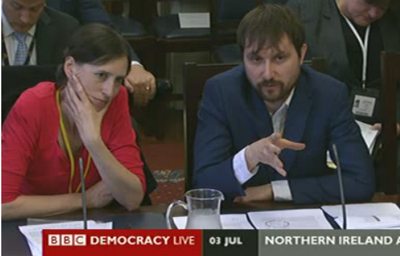
Mike Harris, Head of Advocacy at Index on Censorship, and Jo Glanville give evidence before the finance committee of the Northern Ireland Assembly on Wednesday.
MLAs will today be told that reform of Northern Ireland’s outdated law is needed or else the province will lose out on investment, writes Mike Harris in the Belfast Telegraph
In 2008, the United Nations Human Rights Committee condemned the libel law of England, Wales and Northern Ireland for having a chilling effect on free speech across the world.
Not only did important elements of the law pre-date the invention of the light bulb, let alone the internet, but corporations and oligarchs could bully their critics with near-impunity, silencing freedom of expression both here but also abroad.
The courts heard cases with no connection at all to this jurisdiction. One Ukrainian oligarch sued a local Ukrainian paper and a disgraced Saudi businessman, Sheikh Khalid bin Mahfouz, sued a US academic for a book not even published here.
To protect free speech, US President Barack Obama signed into law the US Speech Act to protect US citizens from the effect of English, Welsh and Northern Irish libel law, an act described as a “national embarrassment” by MPs.
Now Northern Ireland is alone with its embarrassing libel law. The law of England and Wales has been substantially reformed after the Libel Reform Campaign won support from 60,000 members of the public and over 100 charities and campaigning groups and in response the Government passed the Defamation Act.
Meanwhile in the Republic of Ireland, the Defamation Act of 2009 made modest changes to update the law to reflect the internet age and improve the defences available to those sued.
It is extremely unfortunate that Sammy Wilson, the Minister of Finance and Personnel, personally vetoed adoption of the Defamation Bill without scrutiny by either the Assembly or the Executive.
The worry is that “libel tourists” such as corrupt businessmen, powerful vested interests and global corporations may begin to use the High Court in Belfast to silence their critics using Northern Ireland’s unreformed law.
When we started our campaign, we asked people to tell us what had been censored using the libel laws. The results were startling.
Half of GPs surveyed said libel laws were stifling debate about the safety of drug treatments. Which? told us it went through lengthy legal proceedings by a manufacturer after they lab tested child safety seats.
Mumsnet faced legal action for humorous posts on its forum. Those who spoke out on the dumping of toxic waste in Africa and the funding of terrorism were taken to court.
Chillingly, cardiologist Dr Pete Wilmshurst told us how he was being sued by a US corporation for pointing out possible problems with heart devices.
In the four years he fought his case, patients continued to have these devices implanted in their hearts. Some then needed extensive surgery to have them removed because of the fault. If his concerns hadn’t been silenced by his four-year libel case, doctors may not have recommended this treatment.
Dr Wilmshurst will be joining me, English PEN and Sense About Science to give testimony to the Finance and Personnel Committee of the Northern Ireland Assembly today after the Chair Daithi McKay personally intervened to ensure Northern Ireland has a debate about these laws.
Mike Nesbitt MLA is also working with lawyers to prepare a Defamation Bill to bring to the Assembly later this year.
While Sammy Wilson thinks there is no need for reform, other politicians beg to differ.
If Northern Ireland gets this right, it will have a law fit for the internet age that protects ordinary people and GPs, scientists and academics speaking out in the public interest.
If it fails to reform the law, it’s hard to see how it will attract internet companies with a publication rule from 1849; how it will attract academics with no public interest defence for their work, or ensure books don’t get pulped (as they have done) with little protection for comment or opinion.
England and Wales have enacted wholesale libel reform for the first time in 170 years, Northern Ireland cannot afford to miss this opportunity.
This article originally appeared at the Belfast Telegraph.
3 Jul 2013 | In the News
INDEX MAGAZINE
Index magazine: The Multipolar Challenge to Free Expression
Coming up in the next issue of Index on Censorship magazine, out Monday, is a special report on the shifting world power balance and the implications for freedom of expression.
(Index on Censorship)
AUSTRALIA
Police Monitor Vagina Art Exhibition, Make Censorship Suggestions
Police in Sydney, Australia, repeatedly turned up at an art exhibition titled “101 Vagina” to make censorship suggestions to photographer Philip Werner.
(Opposing Views)
BAHRAIN
The cost of tweeting in Bahrain
A Bahraini teenager has been given jail time for a tweet. Sara Yasin looks at how the country has pursued users of the popular social networking site
(Index on Censorship)
BRAZIL
Protesters give president a tenuous truce, as she says their voices are being heard
Cristiano Gulias took a deep drag from his mini-cigar and did the unthinkable — he started a political discussion in a coffee shop the morning after Brazil’s national soccer team won a major championship, rather than a debate on the team’s performance.
(Washington Post)
GHANA
Three Persons Has Been Cited For Contempt Over Scandalizing Supreme Court
Well, taking on the Supreme Court of Ghana has landed some disgruntled political pugilists in the dock. In something of a legal novelty, these persons have been cited for contempt by “scandalizing the Court after publicly criticizing and bringing into disrepute the Supreme Court Judges and their decisions”.
(Vibe Ghana)
Free Speech, Cheap Or Can Be Expensive?
Freedom of speech is said to be political freedom or right to express one’s thought or opinion. Article 19 of the Universal Declaration of Human Right and International Human Right Law recognise this right.
(Spy Ghana)
GREECE
Far-right publishing in Greece: Stories that ‘teach’ people a lesson
Taking their cue from the neo-nazi Golden Dawn, Greece’s far-right newspapers have recently been targeting alternative opinions. While hardly breaking news, the language and symbolism of the campaign is of vital importance because it represents just the tip of the iceberg, Christos Syllas writes
(Index on Censorship)
IRAN
Iran’s president signals softer line on web censorship and Islamic dress code
Newly elected Hassan Rouhani, an opponent of segregation by gender, says Iranians’ freedoms and rights have been ignored
(The Guardian)
PHILIPPINES
Solons to de-criminalize libel in cybercrime law
Two senators are moving to delete certain provisions of the Cybercrime Prevention Act of 2012, which was signed into law by President Aquino in September last year but its implementation was deferred by the Supreme Court on the strength of a temporary restraining order.
(Manila Standard Today)
TUNISIA
Rapper Weld El 15 walks free
Tunisian rapper Weld El 15 (real name Alaa Yaacoubi) walked free from Tunis’s Court of Appeal today after his jail sentence for “insulting” police was reduced from two years to a six month suspended sentence, Padraig Reidy writes
(Index on Censorship)
UNITED KINGDOM
Stormont must give us a libel law fit for modern age
MLAs will today be told that reform of Northern Ireland’s outdated law is needed or else the province will lose out on investment, writes Mike Harris
(Belfast Telegraph)
Defamation Reform – New Law For A New Era?
The Defamation Act 2013 (“the Act”) received Royal Assent last month – it has not yet come into force, but is expected to do so soon. The Act has been long in the making and provoked much debate among practitioners, but in essence it is designed to modernise the law of defamation and also make it fit for purpose in the digital age. We shall examine how this is to happen by describing some of the major changes the Act will introduce.
(Mondaq)
Are Islam and Islamists taking over Britain?
Lee Rigby was a British soldier who was attacked, murdered, butchered and beheaded in broad daylight on a busy street near his barracks in London last month. He was attacked, murdered, butchered and beheaded by Islamists acting in the name of Islam.
(American Thinker)
UNITED STATES
Tennessee to appeal Occupy Nashville free speech ruling
Since when is free speech controversial? In the article “Director of Jihad Watch blog stirs controversy” (June 30) the largely one-sided article distorts a reality that is pretty clear to everyone not infected by an increasingly corrupt press.
(Times Free Press)
Free speech at stake as scandals break
Over the course of the past few months there has been cause for growing concern as we have learned about the Administration apparently violating law abiding citizens’ right to free speech and assembly.
(Chillicothe Gazette)
Daily Mail’s Martosko Cleared of Libel Claim
In mid-March, Mother Jones jabbed then-Daily Caller‘s Executive Editor and current Daily Mail U.S. Political Editor David Martosko with news of a libel lawsuit. Well, today the good folks over at MJ can read the following ruling and weep as the case has been dismissed by a unanimous 5-0 ruling in New York.
(Fishbowl DC)
North Carolina’s Anti-Sharia Bill is Now Also Anti-Abortion
The North Carolina Senate is not only considering an anti-Sharia (or Islamic law) bill passed in the state’s House earlier this year, they’ve tricked it out with a whole new issue. House Bill 695, which began as a cookie-cutter ban on the use of foreign law in family law and custody cases, now would implement several restrictions on abortion services in the state.
(The Atlantic)
Previous Free Expression in the News posts
July 2 | July 1 | June 28 | July 1 | June 28 | June 27 | June 26 | June 25 | June 24 | June 21 | June 20 | June 19