22 Jan 2018 | Argentina, Global Journalist, Media Freedom, media freedom featured, News
[vc_row][vc_column][vc_row_inner][vc_column_inner][vc_column_text]This article is part of Index on Censorship partner Global Journalist’s Project Exile series, which has published 52 interviews with exiled journalists from 31 different countries.[/vc_column_text][vc_single_image image=”97517″ img_size=”full” add_caption=”yes” alignment=”center”][/vc_column_inner][/vc_row_inner][vc_column_text]It was a story that shook Argentine politics. For the journalist who broke the news, it upended his life.
On January 18, 2015, Argentine prosecutor Alberto Nisman was found dead of a gunshot wound in his apartment just days after releasing a 289-page report accusing then president Cristina Fernandez de Kirchner and her foreign minister of covering up Iran’s involvement in the 1994 bombing of Asociación Mutual Israelita Argentina (AMIA), a Jewish community center. The explosion killed 85 people and was the deadliest terrorist attack in the country’s history.
The journalist who broke the story of Nisman’s death on Twitter was Damian Pachter, a young Argentine-Israeli reporter for the English-language Buenos Aires Herald.
“Prosecutor Alberto Nisman was found in the bathroom of his house at Puerto Madero. He was not breathing. The doctors are there,” Pachter wrote.
That tweet set off a chain of events that led both to an investigation of Kirchner and to Pachter fleeing Argentina for Israel.
Kirchner’s government, which had been seeking to undermine Nisman’s allegations, immediately labeled his death a suicide, as Nisman’s body had been discovered with a handgun nearby. “What led a person to make the terrible decision to take his own life?” she wrote on Facebook, soon afterwards.
Nisman’s death and Kirchner’s move to call it a suicide triggered a massive protest in Buenos Aires. The Argentine government was later forced back away from its claims that Nisman had committed suicide, and Kirchner’s Front for Victory narrowly lost presidential elections later that year. An investigation into Nisman’s death concluded earlier this year that it was a homicide.
Pachter, who had been working on a freelance story for an Israeli newspaper about Nisman’s investigation of the bombing and the government’s efforts cover up Iran’s role, was soon targeted by the government.
Six days after Nisman’s body was found, he fled to Israel with nothing but a backpack.
Pachter, 33, now works as a producer for Israel’s i24 News and as a host for Ñews24 in Tel Aviv. As for Kirchner, she has consistently denied any role in Nisman’s death or covering up Iran’s role in the AMIA bombing. In October, she won election to the Argentine senate, a position that gives her legal immunity from prosecutor’s efforts to charge her with treason and covering up the government’s role in Nisman’s death.
Pachter spoke with Global Journalist’s Maria F. Callejon about the strange days after Nisman’s death and his flight from Argentina. Below, an edited version of their conversation, translated from Spanish:
Global Journalist: Tell us about the night of Nisman’s death.
Pachter: I was in the living room when I received the news of Nisman’s death from a source at approximately 11 p.m. For 35 minutes I talked to my source to try to verify it. At 11:35 p.m. I sent the first tweet: “I have been informed of an incident at Prosecutor Nisman’s house.”
I already knew what had happened, but I took the time to talk to my source, to check there were no mistakes and to get as much detail as I could. At 12:08 a.m. I tweeted: “Prosecutor Alberto Nisman was found in his bathroom at his house in Puerto Madero. He wasn’t breathing. The doctors are there.”
[/vc_column_text][vc_single_image image=”97522″ img_size=”full” alignment=”center” onclick=”custom_link” link=”https://twitter.com/damianpachter/status/557011746855321600″][vc_column_text]GJ: What were your first thoughts after receiving the information?
Pachter: I was very robotic. Immediately, I started fact-checking. Pretty much like a machine: at first, it was shocking, but I was the one who got it and I had to make sure that everything was true to then publish it. That was it. I thought I was going to be fired for tweeting first. But I told myself that if I was going to be fired for something, it might as well be this, but I had to publish it.
GJ: Did you think the government would try to cover up the incident?
Pachter: I can’t say that I didn’t, but I didn’t imagine anything precise. Knowing the government and how they treated journalists critical of them, I thought that they would create a media campaign against me. I had delivered news that affected their power, I had to have the [courage] to endure what came after. It’s part of the job. I got into journalism for this kind of thing. There are ups and downs, but you have to do your job and that is to publish what they want to hide. The investigation of Nisman’s death took two years and a new government. The previous government almost shut it down. A couple months ago, the police determined it was a homicide. Think about what would’ve happened if nobody had said anything.
GJ: What happened the day after you reported this?
Pachter: We were all in shock, nobody could believe what was happening. There was an atmosphere of fear. I interpreted that as the government making a show of their power. They had ordered the killing of the prosecutor that had accused them, and I think they didn’t consider the consequences. They didn’t think that this would be important nor that it would have the popular response it had.
GJ: How was the rest of the week?
Pachter: People were calling me, I swear, they wouldn’t stop calling from all over the world. We started doing some appearances on some big networks like CNN. In the meantime, I tried to do my job as normally as I could, but the emotion was so overwhelming, that didn’t work. I had too much adrenaline. In the days afterwards, a source of mine started messaging me to come visit. That source lived out of the city, so I didn’t pay too much attention. In the meantime, I was preparing to face further attacks from the government. I knew I was going to be targeted for being Israeli and Jewish. So I thought I would go on TV and set the record straight. I knew that they would attack me for that. I was used to the government. Any journalists that confronted them would suffer the consequences.
GJ: Were you attacked for being Jewish?
Pachter: They will do anything to discredit you. Instead of saying that I was a journalist doing my job, they said that I was working for the Israeli intelligence services, that I was an undercover agent. The government took pictures from my Facebook account of me in the Israeli army, something that I’d already talked about publicly. They marked my face with a yellow circle and sent it to pro-government groups. While this was happening, my source kept insisting that I visit. On Thursday [five days after Nisman’s body was discovered], I got an email from a colleague. The link in the mail showed that Télam, Argentina’s government news agency, had published some information about me. My name was misspelled, my workplace was incorrect and they had changed my tweets [about Nisman’s death]. This disturbed me and I thought something was going on. I sent that information to my source, who again said I should come visit. That’s when it hit me, after four days. My source was saying too that something was going on.
GJ: What did you do then?
Pachter: I left the newsroom and left my car parked there. I took a taxi back to my apartment. There, I packed a backpack with clothes for three days. That was my plan, to go and hide for three days until it all calmed down. For whatever reason, I grabbed my Israeli passport and my identity card. Then I took a bus out of town to meet with my source. While I was waiting at the cafe of a gas station, I realized a man had come into the cafe and there was something strange about him, his body language and his presence. I sat still in my seat. Time passed and this man was still there, not asking for anything to drink or eat. My source called me and told me to stay wait for him. Twenty minutes later, he was there. He came in through the back door, so he saw the man sitting behind me. My source approached me and said: “Don’t turn around. You have an intelligence officer behind you. Look at my camera and smile.” We pretended as if he were taking my picture, but he really took one of the man. When he realized what we were doing, he left. Right then I knew I had nothing else to do in the country. I was leaving. I was sure they were going to kill me, taking into account what happened to Nisman.
GJ: How did you plan your trip?
Pachter: At the cafe I did what I could to book a flight as soon as possible. The soonest one was with Argentina Airlines, from Buenos Aires to Montevideo to Madrid to Tel Aviv. I went straight to the airport to catch my flight on Saturday [six days after Nisman’s body was found]. I met my mom and said goodbye. I told her what was happening and she understood what was at stake. I also met with two colleagues of mine who were there to document it all. And then I left. During my flight, the Pink House [Argentina’s presidential residence and office] published on its official Twitter account the details of my flight. There it was clearly, just what I had thought: this was official persecution.
GJ: How did you feel when you got to Israel?
Pachter: Some friends and journalists from international media and local media met me there. Once I was there, it felt like a weight off my back. Once we landed, I felt safe.
GJ: Since you went into exile, Kirchner’s government lost the election and she was replaced by opposition candidate Mauricio Macri. Have you considered going back?
Pachter: For now, I don’t want to go back, as much as people tell me everything is fine. I have many feelings that discourage me from going. I was expelled, in a way, from Argentina. I was forced to go into exile because of my job.
GJ: Was it worth it?
Pachter: Yes, of course. I would do it a thousand times.[/vc_column_text][/vc_column][/vc_row][vc_row][vc_column width=”1/2″][vc_video link=”https://youtu.be/tOxGaGKy6fo”][/vc_column][vc_column width=”1/2″][vc_column_text]Index on Censorship partner Global Journalist is a website that features global press freedom and international news stories as well as a weekly radio program that airs on KBIA, mid-Missouri’s NPR affiliate, and partner stations in six other states. The website and radio show are produced jointly by professional staff and student journalists at the University of Missouri’s School of Journalism, the oldest school of journalism in the United States. [/vc_column_text][/vc_column][/vc_row]
12 Jan 2018 | Journalism Toolbox Spanish
[vc_row][vc_column][vc_custom_heading text=”Con ocasión de las elecciones mexicanas del año que viene, Duncan Tucker repasa en este reportaje de investigación para Index las amenazas que han sufrido los periodistas de este país durante la última década.”][vc_row_inner][vc_column_inner][vc_column_text]
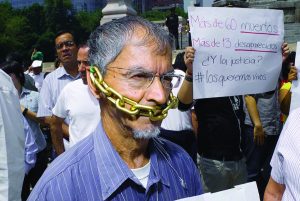
Un periodista mexicano sujeta una cadena alrededor de su boca durante una marcha silenciosa de 2010 en protesta contra los secuestros, asesinatos y violencia que sufren los periodistas del país, John S. and James L. Knight/Flickr
[/vc_column_text][/vc_column_inner][/vc_row_inner][/vc_column][/vc_row][vc_row][vc_column][vc_column_text]
Pablo Pérez, periodista independiente de Ciudad de México, atravesaba en coche el estado sin ley de Guerrero con dos colegas de la capital y cuatro reporteros locales cuando los detuvo una horda de hombres armados. Pérez estaba trabajando en un reportaje sobre los lugareños a los que la violencia del narcotráfico había desplazado de la región.
«Acabábamos de dejar la zona más peligrosa y pasamos por un puesto de control del ejército, lo cual nos hizo creer que estábamos en una zona segura», narra Pérez, poco después del incidente del 13 de mayo. «Pero no: a kilómetro y medio de allí nos detuvo un grupo de 80 a 100 hombres jóvenes; muchos de ellos, armados. Registraron nuestros vehículos y nos robaron todo el equipo, el dinero y los documentos de identificación. Se llevaron uno de nuestros autos y nos dejaron con el otro. Nos dijeron que tenían informadores en el puesto de control y que nos quemarían vivos si se lo contábamos a los soldados», relata.
Pérez y sus compañeros sobrevivieron, conmocionados, pero ilesos. Otros no han tenido tanta suerte. 2016 batió el récord con 11 periodistas asesinados, y 2017 va camino de superar ese cómputo nefasto.
Los medios impresos han comenzado a introducir modestos protocolos de seguridad en una apuesta por proteger a sus empleados, mientras que el gobierno ha anunciado recompensas para quienes faciliten información sobre los responsables de asesinar a periodistas. Pese a todo, lo más probable es que estas medidas no tengan un gran impacto frente a la violencia desenfrenada, la corrupción y la ausencia de justicia imperante en el país. La narcoguerra de México ha dado cifras récord de muertes en 2017 y, con la posibilidad de que las elecciones del año que viene provoquen aún más inestabilidad, no parece que los ataques a periodistas vayan a desaparecer próximamente.
El nivel de peligrosidad varía considerablemente según la región de México a la que nos refiramos. Los ataques a corresponsales extranjeros son raros, probablemente porque acarrearían una presión internacional indeseada. Los mexicanos que trabajan en publicaciones nacionales o metropolitanas también están protegidos de la violencia, hasta cierto punto. Son los reporteros locales los que se enfrentan a los mayores peligros. Según el Comité para la Protección de los Periodistas, el 95% de las víctimas de asesinato como respuesta directa a su trabajo son normalmente reporteros de publicaciones de regiones remotas, donde el crimen y la corrupción rampantes minan el peso de la ley. Los estados sureños de Guerrero, Veracruz y Oaxaca comprenden actualmente los lugares más mortíferos, sumando al menos 31 periodistas asesinados desde 2010 en el territorio.
Pese a los riesgos a los que se expone la profesión, el periodista mexicano medio gana menos de 650 dólares al mes y recibe pocas ventajas.
«No tenemos seguro médico ni de vida. Somos vulnerables a esta violencia», dice Pérez. «Aunque los que vivimos en grandes ciudades estamos mucho más seguros que los que están en lugares como Guerrero».
Cuando visitan zonas en conflicto, reconoce Pérez, no hay mucho que puedan hacer salvo adoptar algún que otro protocolo básico de seguridad. «Todos tratábamos de mantener contacto constante con colegas en la ciudad, cosa que no era nada fácil, ya que a menudo perdíamos la cobertura del teléfono. El protocolo era no separarnos, seguir en contacto con periodistas locales y mantenernos alerta a cualquier señal de peligro».
[/vc_column_text][/vc_column][/vc_row][vc_row][vc_column width=”1/4″][/vc_column][vc_column width=”3/4″][/vc_column][/vc_row][vc_row][vc_column][vc_column_text]
Mientras que los periodistas de la capital pueden refugiarse en lugares relativamente seguros después de trabajar en zonas peligrosas, los reporteros locales están permanentemente expuestos a las consecuencias de su trabajo. Una brutal ilustración de ello fue el asesinato el 15 de mayo de Javier Valdez, uno de los periodistas más afamados y respetados de México, en su Sinaloa natal. Valdez acababa de salir de su oficina de Ríodoce, un semanal de noticias fundado por él mismo, cuando unos hombres armados lo bajaron a la fuerza de su coche y lo obligaron a arrodillarse. Le dispararon 12 veces a quemarropa y acto seguido huyeron con su teléfono y portátil, abandonándolo boca abajo en la carretera. Su característico sombrero panamá estaba manchado de sangre.
Valdez era una autoridad en el campo de los bajos fondos de Sinaloa, la cuna del narcotráfico mexicano. También era el periodista más prominente asesinado en años. En una entrevista con Index unos meses antes de su asesinato, habló de amenazas contra su periódico y lamentaba la falta de protección por parte del gobierno. Afirmaba: «Lo mejor sería llevarme a mi familia y abandonar el país».
En las semanas anteriores a su muerte, Valdez había estado involucrado en las consecuencias de un sangriento forcejeo por el poder dentro del poderoso cártel mexicano de Sinaloa. La violencia en la región se ha disparado desde que el líder Joaquín «El Chapo» Guzmán, de terrible fama, fuera extraditado a EE.UU. el pasado año, dejando a sus hijos Iván y Alfredo luchando por el control del cártel contra Dámaso López, su ex-mano derecha.
Cuando Valdez entrevistó a un intermediario enviado por López en febrero de 2017, los hijos de Guzmán llamaron a la sala de redacción de Ríodoce y les advirtieron acerca de publicar el artículo. Ofrecieron comprar toda la tirada, pero Valdez se mantuvo en sus trece. Cuando el periódico salió en distribución, miembros armados del cártel siguieron a los camiones de reparto por Culiacán y compraron todos los ejemplares. Los colegas de Valdez sospechan que fue su decisión de publicar la entrevista lo que le costó la vida.
Adrián López, editor de Noroeste, otro periódico de Sinaloa, contó a Index que la muerte de Valdez causó «mucha indignación, rabia y miedo» en la comunidad local. Según él, el haber puesto en el blanco a una figura tan conocida envía un mensaje contundente a los periodistas y activistas de México, así como a la sociedad al completo: «Si somos capaces de matar a Javier, somos capaces de matar a cualquiera».
López también ha vivido la interferencia editorial de los cárteles. En 2010, varios hombres armados dispararon 64 veces contra las oficinas de Noroeste, en la ciudad costera de Mazatlán. Los asaltantes habían amenazado a los empleados por teléfono horas antes, instándolos a atribuir los casos recientes de violencia a un cártel rival. «Decidimos no publicar lo que ellos querían porque nuestra postura es que no se puede decir que sí a semejantes exigendias», dijo López. «Si dices que sí una vez, después nunca podrás decir que no».
López sufrió unas circunstancias similares a las de Valdez en 2014, cuando unos hombres armados bloquearon su coche en la capital estatal de Culiacán. Los asaltantes le robaron el coche, la cartera, el teléfono y el portátil y le dispararon en la pierna. Semanas antes, varios reporteros de Noroeste habían recibido amenazas y palizas mientras cubrían el caso de Guzmán y el cártel de Sinaloa.
Según López, su periódico trabaja continuamente para mejorar sus protocolos de seguridad. Noroeste emplea a abogados para denunciar todas las amenazas contra ellos a las autoridades pertinentes, y han contratado a terapeutas que faciliten ayuda psicológica a los trabajadores. «La violencia con la que tratamos día tras día no es normal», explica López. «Necesitamos ayuda profesional para entender y hablar más sobre estas cosas, sobre el trauma que la violencia nos podría ocasionar».
Más de 100 periodistas mexicanos han sido asesinados desde 2000, y hay al menos otros 23 desaparecidos. En estos últimos tres años, cada año ha superado al anterior en cuestión de asesinatos, y este podría ser el más mortífero hasta la fecha, tras los 10 periodistas asesinados en los primeros ocho meses de 2017 (hasta agosto de 23). Las autoridades mexicanas a menudo están implicadas en los ataques. Artículo 19, organismo de control de la libertad de prensa, documentó 426 ataques contra medios de comunicación el pasado año; un incremento del 7% desde 2015. El 53% de esos ataques se atribuyen a ocupantes de cargos públicos o a las fuerzas de seguridad.
Alejandro Hope, analista de seguridad, contó a Index: «Las autoridades federales no han investigado ni procesado estos casos en condiciones. Han creado un entorno de impunidad que ha permitido que prosperen los ataques a la prensa».
En julio de 2010, el gobierno fundó la Fiscalía Especializada para la Atención de Delitos contra la Libertad de Expresión (Feadle) con la intención de investigar los delitos cometidos contra los medios de comunicación. La agencia, que no respondió a la petición de Index de una entrevista, ha facilitado botones de alarma a los periodistas en peligro, les ha instalado cámaras de seguridad en casa y, en casos extremos, les ha asignado guardaespaldas. Pero hacia finales de 2016, de un total de 798 investigaciones, tan solo había logrado condenar tres autores de agresiones a periodistas.
En vista del empeoramiento de la violencia contra la prensa, el presidente Enrique Peña Nieto nombró en mayo de 2017 a un nuevo director que pudiese revigorizar Feadle. Al mes siguiente, su gobierno anunció recompensas de hasta un millón y medio de pesos (83.000 dólares) a cambio de información sobre los responsables de matar a periodistas.
Hope añadió que México ha progresado en cierta medida en lo que respecta a la libertad de prensa en décadas recientes, gracias a la proliferación de webs informativas críticas e independientes y la mejora del acceso público a información sobre el gobierno. Sin embargo, añadió, estas mejorías se han dado sobre todo en lo nacional, mientras que los periodistas de ciertas regiones operan «en un entorno mucho más difícil» a día de hoy.
Las mayores dificultades las entraña el tener que lidiar con las relaciones fluctuantes entre las autoridades locales y las bandas de narcos, dijo Hope. Citó el caso de Miroslava Breach, una respetada reportera asesinada en Chihuahua en abril de 2017 después de que investigara el vínculo entre políticos locales y el crimen organizado.
Hay poco motivo para el optimismo. México se prepara para las elecciones generales del año que viene, pero algunas campañas recientes ya se han visto perjudicadas por acusaciones de fraude electoral e intimidación. Hope advirtió de que las elecciones podrían perturbar la estabilidad de pactos existentes entre criminales y políticos, dificultando aún más el trabajo de los periodistas locales y haciéndolo más peligroso. Vaticina que la actual ola de violencia continuará durante las elecciones «porque va a haber más gente en el terreno informando sobre regiones conflictivas».
Pérez cree que la situación no va a mejorar mientras el país no aborde su cultura de corrupción e impunidad. Puso como ejemplo el caso de Javier Duarte, exgobernador de Veracruz y amigo del presidente, arrestado en Guatemala en abril de 2017 tras seis meses a la fuga. Al menos 17 periodistas locales fueron asesinados y tres más desaparecieron durante los seis años de su mandato; sin embargo, no fue sujeto a escrutinio alguno hasta que se reveló su malversación de aproximadamente tres mil millones de dólares de fondos públicos.
«¿A cuántos de nuestros colegas han asesinado sin que la fiscalía haga nada?» pregunta Pérez. «Lo más importante es apresar a todos nuestros políticos corruptos. Si el robo de fondos públicos no tiene repercusiones, ¿cómo vamos a esperar que aquellos que minan la libertad de expresión se preocupen por las consecuencias?».
[/vc_column_text][/vc_column][/vc_row][vc_row][vc_column][vc_column_text]
UN «WATERGATE» MEXICANO
Una investigación de Citizen Lab y The New York Times este verano ha revelado la presencia del spyware Pegasus, desarrollado por una compañía de ciberarmas israelí llamada NSO Group, en mensajes enviados a periodistas y otros objetivos. Algunos periódicos lo han bautizado como «el Watergate mexicano».
Uno de los objetivos del spyware era Rafael Cabrera, miembro de un equipo de periodistas de investigación dirigidos por Carmen Aristegui. Estos perdieron su empleo en una emisora nacional de radio tras destapar un escándalo de corrupción en el que estaban envueltos el presidente Enrique Peña Nieto y su mujer, Angélica Rivera.
Index habló con él dos años antes acerca de su cobertura del escándalo. En aquel entonces, Cabrera había comenzado a recibir unos misteriosos mensajes de texto en los que lo advertían de que tanto a él como a sus colegas podían demandarlos o encarcelarlos a causa de su investigación.
Los mensajes venían con enlaces que prometían más información, pero Cabrera, sospechando que podían contener algún virus, no los abrió.
Y estaba en lo cierto. Como se descubrió más adelante, abrir el enlace habría permitido a sus remitentes acceder a los datos de Cabrera, ver todo lo que tecleaba en su teléfono y utilizar su cámara y micrófono sin ser detectados.
NSO Group afirma que vende spyware a gobiernos exclusivamente, con la condición de que se use solamente para investigar a criminales y terroristas. Pero la investigación descubrió que Aristegui y su hijo adolescente también habían sido objetivos del spyware, además de otros periodistas, líderes de la oposición, activistas anticorrupción y por la salud pública.
Peña Nieto respondió diciendo que la ley se aplicaría contra aquellos que estaban «haciendo acusaciones falsas contra el gobierno». Más adelante, en una entrevista con The New York Times, un portavoz afirmaba: «El presidente no trató en ningún momento de amenazar ni a The New York Times ni a ninguno de estos grupos. El presidente cometió se explicó mal».
El gobierno, sin embargo, ha admitido el uso de spyware contra bandas criminales, si bien niega haber espiado a civiles. Las autoridades han prometido investigarlo.
Cabrera le contó a Index que tenía poca fe en la credibilidad de una investigación del gobierno de sus propios programas de vigilancia. También expresó su alarma ante la reacción inicial de Peña Nieto. «No está nada bien que el presidente diga que va a tomar acción penal contra ti», afirmaba Cabrera. «Se salió del guion y por un momento nos mostró al dictador que lleva dentro». DT
[/vc_column_text][/vc_column][/vc_row][vc_row][vc_column][vc_column_text]
PLATA O PLOMO
Los periodistas mexicanos se las ven con todo tipo de amenazas y presiones económicas, desde los cárteles del narcotráfico hasta agentes del estado. Article 19 documentó 426 ataques contra la prensa mexicana en 2016, incluyendo 11 asesinatos, 81 agresiones, 79 actos de intimidación, 76 amenazas directas, 58 secuestros y 43 casos de acoso.
Los cárteles se han infiltrado en las salas de prensa de áreas asoladas por el crimen, y normalmente ofrecen a los reporteros a elegir entre «plata o plomo»; es decir, entre un soborno o una bala. Como el aclamado periodista Javier Valdez declaraba para Index meses antes de su asesinato, esto genera miedo y desconfianza dentro de los equipos informativos y fomenta la autocensura.
Muchas publicaciones también temen criticar al estado porque dependen en gran medida de la publicidad contratada por el gobierno. Tanto el gobierno federal como los gobiernos estatales mexicanos se gastaron aproximadamente 1.240 millones de dólares en publicidad en 2015. Las voces críticas afirman que se trata de una forma de «censura blanda», ya que las publicaciones deben vivir con la amenaza implícita de que el gobierno castigará todo tipo de cobertura desfavorable retirando su financiación. DT
[/vc_column_text][/vc_column][/vc_row][vc_row][vc_column][vc_column_text]
CIFRAS CRIMINALES
-
Al menos 107 periodistas han sido asesinados en México desde 2000. Del total, 99 son hombres y 8, mujeres.
-
Han desaparecido 23 periodistas en México desde mayo de 2003 hasta mayo de 2017.
-
En 2016, el 53% de los ataques contra la prensa tuvo a cargos públicos involucrados. Entre 2010 y 2016, las autoridades investigaron 798 ataques a periodistas. Solo los autores de tres de esos ataques han recibido condena.
-
Son más de 200.000 las personas asesinadas o desaparecidas desde que comenzó la guerra antinarco en diciembre de 2006. DT
[/vc_column_text][/vc_column][/vc_row][vc_row][vc_column][vc_column_text]
Investigación realizada para Index por Duncan Tucker, periodista afincado en Guadalajara, México.
Este artículo fue publicado en la revista Index on Censorship en otoño de 2017.
Traducción de Arrate Hidalgo.
[/vc_column_text][/vc_column][/vc_row][vc_row content_placement=”top”][vc_column width=”1/3″][vc_custom_heading text=”Free to air” font_container=”tag:p|font_size:24|text_align:left” link=”url:https%3A%2F%2Fwww.indexoncensorship.org%2F2017%2F12%2Fwhat-price-protest%2F|||”][vc_column_text]Through a range of in-depth reporting, interviews and illustrations, the autumn 2017 issue of Index on Censorship magazine explores how radio has been reborn and is innovating ways to deliver news in war zones, developing countries and online
With: Ismail Einashe, Peter Bazalgette, Wana Udobang[/vc_column_text][/vc_column][vc_column width=”1/3″][vc_single_image image=”95458″ img_size=”medium” alignment=”center” onclick=”custom_link” link=”https://www.indexoncensorship.org/2017/12/what-price-protest/”][/vc_column][vc_column width=”1/3″ css=”.vc_custom_1481888488328{padding-bottom: 50px !important;}”][vc_custom_heading text=”Subscribe” font_container=”tag:p|font_size:24|text_align:left” link=”url:https%3A%2F%2Fwww.indexoncensorship.org%2Fsubscribe%2F|||”][vc_column_text]In print, online. In your mailbox, on your iPad.
Subscription options from £18 or just £1.49 in the App Store for a digital issue.
Every subscriber helps support Index on Censorship’s projects around the world.
 SUBSCRIBE NOW[/vc_column_text][/vc_column][/vc_row]
