21 Jan 2015 | News, United Kingdom
Cressida Brown is the artistic director of Offstage Theatre. The views presented in this guest post are the author’s own.
I have been asked to write about why I decided to initiate Walking the Tightrope, and explain why I think a project exploring how politics and art interact is important and urgent now.
The answers to both those questions lie in the very experience I have had in putting on this festival of strongly opinionated plays which touch on art censorship, cultural boycott, offensive art, and accusations of racism. Throughout I have genuinely felt as if I am walking a tightrope. And now, in the wake of the Charlie Hebdo attacks, this feels more so than ever.
Nerve racking questions have stayed unanswered; Should I censor a play about art censorship if it is offensive? Might it offend people? How can I make sure we get a balanced sense of opinions? Is it possible to be neutral hosting these explosive plays? How can I get a debate going but avoid a backlash? How do I make sure I don’t get anyone in trouble, including myself?
The fact freedom of expression seems so complicated to negotiate at the moment is exactly why I think we should raise it.
Last summer I did not feel so cautious when I posted the question “How can this be seen as anti-Semitic?” on to my Facebook timeline. I was referring about the Tricycle Theatre offering to replace Israeli funding of the Jewish Film Festival. I assumed that everyone I was friends with, especially those who were in the arts, would agree with me.
A couple of hours later my page had exploded in over 60 warring comments about the Tricycle but also about the Underbelly decision to cancel an Israeli government funded show.
And then I did something that triggered my eventual decision to initiate this festival. I deleted the entire 60 strong thread from my wall. I had worried how my opinions might be regarded by others. Or whether my politics were going to affect my relationships in the art community. I had self-censored.
Hot on the heels of the Tricycle came the Exhibit B affair. It suddenly started to seem very unwise to post a political view online about what an art venue should or shouldn’t do.
Why was I so worried about others seeing my opinions? Shouldn’t this be what art is about, passionately asserting an opinion? Why had I never found out what my peers opinions were on these topics before? How had I never realised what a thorny and perhaps paradoxical thing Freedom of Expression can be? Why was it that it took 3 controversies hot on the heels of one another for me to begin to ask these questions to myself? Why should it only be in the heat of the moment that I debate these issues with my peers? Why did that debate initiate online and not in person?
I am well aware how explosive this subject can be, and also that it may explode in a very bad way directly back onto me. However I have dedicated my life to this industry, I need to unpack what happened. I can’t have this debate by myself. Now, with some distance from the events of last year, I have decided to do this the only way I know how: theatre.
During this event’s shared experience, the audience responses are just as important as the artists’ vigorous plays. The post show discussions are geared towards replacing a fury of warring tweets with facilitated conversation on Freedom of Expression. The plays are meant to offer a springboard for the post show discussions to leap from. By the end of these festivals I want all of the audience to have listened and experienced greater understanding of their opponents, and considered positions they had never perhaps done before.
Several months have passed since those particular triggering events. I had wondered at times whether the conversation would still be relevant at the beginning of 2015, which seems now like a ridiculous concern. As I write the Charlie Hebdo attack has created solidarity across the world in the defense of free expression and society is left with a mine field of explosive commentary and grief. In other recent news American director Ari Roth has been fired for ‘insubordination’, BP have been told to reveal their funding of the Tate, and Sajid Javid announced his opposition to cultural boycott.
Who knows how these other controversies will have unfolded by the time we are actually performing these plays in front of you…
My hope however is, is that we will continue to meet these controversies with a renaissance in political theatre, discussing liberty through live, tangible art and conversation.
This guest posted was published on 21 January 2015 at indexoncensorship.org
24 Nov 2014 | Egypt, News, Politics and Society
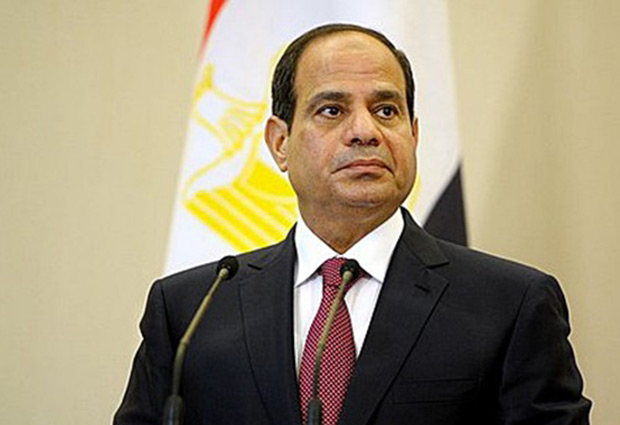
Egyptian President Abdel Fattah El Sisi has tightened the screws of the country’s journalists. (Photo: Wikipedia)
In a rare show of defiance, hundreds of Egyptian journalists have objected to a “statement of allegiance” to the government signed by editors-in-chief of the main state-owned and independent newspapers.
More than 600 Egyptian journalists signed an online petition defending press freedom and rejecting censorship in all its forms. The move came in response to a loyalty pledge by 17 editors-in-chief of newspapers to refrain from criticizing the police, the military and the judiciary at this sensitive time when Egypt was “at war with terrorism.”
The journalists dismissed the editors’ statement as “a futile attempt to create a one-voice media,” arguing that “fighting terrorism had nothing to do with voluntary abandonment of freedom of speech.”
“The editors’ statement is not worth the ink used in writing it,” Dina Samak, deputy editor-in-chief of the English language semi-official Ahram Online and one of the journalists who signed the petition, told Index on Censorship.
“The terrorists will win when they can control the media, and the state will fall when it agrees on the same goal,” said Khaled El Balshi, a journalist and board member of the Journalists Syndicate, who helped draw up the petition for press freedom.
In a show of solidarity with Egypt’s military-backed regime, the editors had gathered at El Wafd newspaper headquarters on 26 October to forge “a united front against terrorism”, expressing their “rejection of attempts to cast doubt on state institutions.” They also vowed to take measures to halt what they called the “infiltration by elements supporting terrorism” in their publications — a reference to supporters of the outlawed Muslim Brotherhood, designated as a terrorist group by Egypt last year.
While the move did not come as a surprise to many — as it was already clear that the majority of media outlets had aligned themselves closely with the government since the military takeover of the country in July 2013 — the “loyalty pledge” by the editors was nevertheless unusual even in a country where the media was in lockstep with the regime.
The signatories to the declaration — the editors-in-chief of the three main state-owned dailies Al Ahram, Al Akhbar, Al Gomhouria and those of the independent Al Masry Al Youm, Al Watan, Al Shorouq, El Tahrir, El Ahali, Al Fajr , El Messa, El Esboo, El Youm el Sabe and El Gamaheer newspapers — argued however that “crisis situations” required “exceptional measures”.
Defending the editors’ statement, Emad El Din, editor-in-chief of the independent Al Shorouk denied that the editors’ loyalty declaration gave journalists the green light to practice self censorship.
“We wanted to deliver a message to citizens that the media is with the state in fighting terrorism,” he told NPR Radio shortly after signing the statement.
“At this time of heightened nationalism, the climate does not allow for any criticism of the government,” he added.
The move came in response to a call by President Abdel Fattah El Sisi for Egyptians to rally behind him in his fight against terrorism following two deadly militant attacks on an army checkpoint in North Sinai on 24 October that killed 33 army soldiers and injured at least a dozen others. The militant assaults were the latest in a string of attacks targeting mainly security forces — but at times, also civilians — since the overthrow of Islamist President Mohamed Morsi in July 2013. The attacks have prompted a surge in nationalism and a heralding of a so-called “war on terrorism” waged by the military against suspect-militants in the Sinai Peninsula. The violence has also resulted in a massive government crackdown on dissent that has targeted all opposition including journalists critical of regime policies.
Six journalists have been killed and dozens detained since the military took power in July 2013, according to the New York-based Committee for the Protection of Journalists. While most have been released, at least 11 journalists remain behind bars for no crime other than being at — or near — Muslim Brotherhood protest sites. Among the detained are three journalists working for the Al Jazeera English news network who have been sentenced to between seven and 10 years in jail on charges of “threatening national security, fabricating news and aiding a terror group”.
The crackdown on the media has led many journalists to practice self-censorship for fear of being imprisoned, killed or labeled “unpatriotic” by an unsympathising Egyptian public. Meanwhile, the statement released by the editors has fueled fears among press freedom advocates of a further shrinking in the already-dwindling space for freedom of expression in Egypt.
Adel Hamouda, an Egyptian journalist and former editor-in-chief of Al Fajr, meanwhile, criticised the editors’ statement as “uncalled for“.
“It is an attempt by the editors to win favour with the regime for the sake of personal gains,” he told Index. He explained that all Egyptians — except those supporting the Muslim Brotherhood — support the state in its war on terror so it is “meaningless” to publicly assert their support. He further noted that all media organisations were required to seek approval from the Armed Forces Morale Affairs Department before publishing or broadcasting any news about the military.
The majority of the independent media outlets that signed the statement belong to wealthy businessmen with close links to the ruling military-backed regime. They are fully aware that publishing any criticism of government policies would ruffle feathers and likely jeopardize their business interests. All top editors were appointed by the Higher Press Council shortly after Morsi’s overthrow in July 2013. Their selection was clearly based on their willingness to cooperate with the regime rather than their merits. Shortly after Morsi’s ouster, a leaked video on YouTube showed then-Defence Minister Abdel Fattah El Sisi asking senior generals to “establish partnerships with media outlets to curb any criticism of the military”. An independent journalist who spoke on condition of anonymity told Index that days before Morsi’s ouster, she had been approached by security officials who promised her “fruitful rewards” if she joined the “winning side” — a clear reference to the country’s powerful security apparatus that drove the uprising against the democratically-elected president.
In the coup’s aftermath, most editors and TV talk show hosts have persistently lionised Sisi and cheered on the military while demonising the Muslim Brotherhood, the Islamist group from which former President Mohamed Morsi hailed.
The media in Egypt has traditionally been a propaganda tool for whoever is in power. Various successive regimes have used the state media as a mouthpiece to further their political gains. Under Mubarak, all editors-in-chief of the state-owned newspapers were handpicked by his powerful Minister of Information Safwat El Sherif who presented the list of chosen candidates to the Shoura or Consultative Council, the upper house of parliament dominated by members of the then-ruling party, the National Democratic Party, for ratification.
In the months following the fall of Mubarak, there was a brief period of free expression and a loosening up of restrictions on the media. Press freedom — one of the major gains of the 2011 mass uprising — was short-lived however as the Supreme Council of the Armed Forces (SCAF) which replaced Mubarak, quickly moved to exercise control over the media. During its one year in office, the SCAF confiscated newspapers, ransacked the offices of foreign news networks and investigated journalists critical of the military. Shortly after Morsi won the elections — becoming the country’s first democratically elected president — he too reneged on his election promises to promote freedom of speech, appointing a Muslim Brotherhood member as minister of information. The Muslim Brotherhood-dominated Shoura appointed regime loyalists as senior editors of state-owned dailies, repeating the Mubarak-era practice that allows tight government control over the media. The move provoked an outcry from non-Islamist journalists who held protest rallies and threatened to resign their posts.
Almost immediately after Morsi’s overthrow, all Islamist-leaning newspapers and TV channels were shut down by the new authorities — a move that sent a message to journalists that there was little tolerance for dissent in Egypt, post-3 July. The last sixteen months have seen a return of the media censorship reminiscent of that which prevailed under Mubarak. Newspapers that published articles deemed “controversial” by the authorities, have been pulled off newsstands and confiscated. In October 2014, a print edition of the independent Al Masry Al Youm was confiscated by government censors for publishing an interview with former national security intelligence chief Mohamed Gebril in which he was quoted as saying that “no Israeli spy has ever been executed in Egypt”. The paper later appeared on newsstands, albeit without the interview. Months earlier, columnist and screenwriter Belal Fadl resigned from the independent Al Shorouk after the paper’s management allegedly refused to publish his column ridiculing the promotion of Sisi (who was defence minister at the time) to the rank of field marshal. Fadl was accused by pro-military commentators of being a “traitor” and “a fifth columnist plotting to destroy the country”.
Several editors who signed the statement of support to the government are also known to be part of a fake opposition created by Mubarak to give a semblance of free speech and democracy. Like other pro-regime editors, they too have persistently glorified the military and vilified the Muslim Brotherhood. And they have gone a step further, slandering the January 25 Revolution as a “foreign conspiracy” and labelling the secular opposition activists who mobilised public support for the 2011 mass protests “traitors” and “foreign agents.”
Mostafa Bakri, editor-in-chief of Al Osbou — and one of the editors who signed the loyalty pledge — has recently been summoned by the public prosecutor after several legal complaints were filed against him by private citizens for “fabricating news” and “slandering the January 25 Revolution”.
Meanwhile, the journalists behind the online petition for press freedom are planning to form an independent association to advocate freedom of expression. While this is a step in the right direction, press freedom advocates fear the negative effects of the editors’ pledge of allegiance are already being felt.
“Their statement was perceived as a warning message by the younger, less skilled journalists, many of whom are now practicing self-censorship for fear of losing their jobs or in a bid to win favour with the management and get promoted,” lamented Dina Samak.
Despite the setback, the battle for press freedom is on.
“It is a battle pitting the younger, pro-reform journalists against the old regime loyalists, resisting change,” Amany Kamal, a former radio presenter told Index. Kamal was forced to quit her job as a broadcaster with a state-run radio channel after being accused by the management of sympathising with the Muslim Brotherhood. “But we shall win,” she said.
This article was published on 24 November 2014 at indexoncensorship.org
14 Nov 2014 | Europe and Central Asia, Events, News, United Kingdom
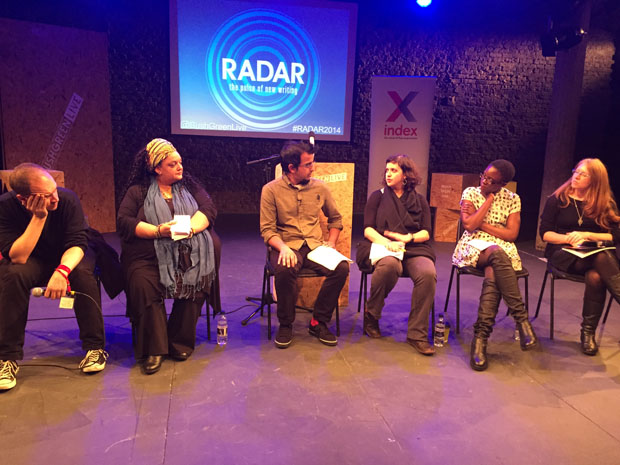
(Photo: Melody Patry)
Should there ever be censorship of the arts was the subject of an Index/Bush Theatre debate, held last night. The event was provoked by the cancellation of Exhibit B in London, and Israeli play The City at this year’s Edinburgh Festival Fringe as well as controversy around this year’s Jewish Film Festival, all in the past few months.
Taking part in the debate were, among others: Stella Odunlami, artist and a cast member of Exhibit B; Zita Holbourne, artist, activist and co-organiser of the campaign to boycott the show; and Arik Eshet, artistic director of Incubator Theatre, which produced The City.
An Exhibit B performer Stella Odunlami told the audience: “We, a group of intelligent and informed actors and performers, have been censored and silenced by protestors, who truly have an ill-informed and misguided perspective of this significant and informative piece of work.
We are appalled, outraged, angry…extremely angry as artists, as human beings. We cannot believe that this is London in 2014. We are appalled that Exhibit B has been cancelled because of the actions of some of the demonstrators.”
Protester Zita Holbourne put her point of view as a poem, she said: “We said to them, Barbican please take that down, 2014 and you want to put black people in a cage? Then telling us you don’t understand our outrage!”
Read their full statements, made to the audience, below.
Stella Odunlami read the statement from the London cast of Exhibit B
It is with utter disappointment that we write these words.
Exhibit B is an important work that has given us an education into the lives of other human beings. We believe everybody has the right to their specific story being told, and this work provided that platform, through the medium of art – living and breathing. It is a shame that these stories will no longer be heard, seen, nor felt. An even greater shame that those who were open and brave enough to purchase a ticket, have now been robbed of that experience.
Exhibit B afforded us the opportunity to explore and engage with our past, while reminding and reawakening us to its impact on the present.
To the 23,000 petitioners who complained that Exhibit B objectified human beings – you missed the point.
This is the 21st Century and we believe that everyone has a choice, a right, an entitlement, to do or say whatever they deem to be right for them. We can accept someone seeing the piece and not liking it-that’s fine. What we cannot accept about the events of Tuesday evening and the subsequent cancellation of Exhibit B, is the physical action that was taken outside of the Vaults, by a minority of the demonstrators who would not even entertain the thought of seeing the piece.
We, a group of intelligent and informed actors and performers, have been censored and silenced by protestors, who truly have an ill-informed and misguided perspective of this significant and informative piece of work.
We are appalled, outraged, angry…extremely angry as artists, as human beings. We cannot believe that this is London in 2014. We are appalled that Exhibit B has been cancelled because of the actions of some of the demonstrators.
We are artists who, after thoughtful and careful deliberation, decide what projects we want to work on. Grown men and women who decided that our contribution to Exhibit B would be worthwhile and important. Who, on Tuesday, were told, by way of the protestor’s force, that we couldn’t make creative and life decisions for ourselves.
That complete strangers knew what was best for us.
For all of us.
Our voices and ideas were deemed not worthy of being shared with the world. This is exactly what Exhibit B is about: we want to denounce oppression, racism and bigotry. We want to denounce actions like this. And the fact that this is still happening in London in 2014, proves even more why this piece is necessary.
The anger and vitriol and hysteria which the protestors have and continue to level at the company of Exhibit B, astounds us.
It doesn’t feel rational. It doesn’ t feel measured. There simply has not been room for an exchange of ideas.
There’s such vulnerability in holding a mirror up to humanity. No one wants to see a representation of themselves oppressed, but it doesn’t mean that we shouldn’t look.
We welcome protest, but surely it’s best to have as much information beforehand, so your opinion is truly informed. Surely as a protestor, you have a duty to ensure your ‘peaceful protest’ really is peaceful. And, surely your right to protest should not impact another person’s freedom of thought and speech.
We are actors and performers who believe that art should be meaningful. Challenging. Provoking.
Not only for us, as participating collaborators in the work, but also for the audience who witness the work.
This project afforded us the opportunity to be the most vulnerable, most on display, silently engaging and being engaged, while exploring themes around other, sex, race, and gender.
Exhibit B was created with love and sensitivity. We are intelligent creatives who made a brave choice to be part of a thought provoking piece of work. As Londoners, we are embarrassed that this has happened in our city, as the show has already been seen by 25,000 people from all over the world, and will continue to tour.
We would like to thank the Barbican for their immense support and Brett Bailey for his inspired work.
Zita Holbourne read Prejudice, Privilege, Power: A Poem for the Barbican (listen to it here)
Barbican announced a human zoo in town
We said to them, Barbican please take that down
2014 and you want to put black people in a cage?
Then telling us you don’t understand our outrage!
Strapped to plane seats, placed in iron masks
And nobody in a whole arts institution thought to ask
Our views before taking a decision to host
Then you have the bare faced audacity to boast
That you’ve placed black people in a human zoo
Going around talking about the good it can do
In challenging racist attitudes and views
But to listen to our concerns you refuse
Shackles and cages at £20 per ticket
But you don’t get why we organised a picket
We don’t need to see a black woman shackled to a bed
To know that racism is rearing its ugly head
We’re forced to battle daily with modern day enslavement
Power and privilege versus our self-empowerment
You are arrogant telling those of us that live with racism every day
What is or is not racist, like we don’t have a say
Let’s make clear that a boycott campaign is not censorship
For your actions and failures you must take ownership
We don’t need a lecture on what it is to be banned
We’re treated like third class citizens in this land
Blocked by institutions, so take a moment, pause
Think about the anger and pain you cause
By insulting our ancestors, our histories
Adding insult to our multiple injuries
If anything is censored it’s the art we produce
Rejected repeatedly by art institutions that refuse
To acknowledge our stories told by us through art
We’ve never had a level playing field from the start
We have a legitimate right to protest
It’s disingenuous of you to suggest
That our demonstration was aggressive
When it was simply passionate and expressive
Using the very arts that you claim to stand for
To demonstrate our strength of feeling outside the door
We made music, danced, lifted our voices in song
Displayed placards that had our beautiful art on
Yet you state that we were extreme and threatening
In contrast, press there say we were peaceful and welcoming
Police confirm there was no damage, injury or arrest
So perhaps it’s you trying to censor our right to protest
Their singing was threatening is what the headlines say
Brandishing placards and drums that barred the way
You accuse us of blocking freedom of expression
But then you call our expression aggression!
What does this say about you as a leading arts institution?
When you resort to this vicious persecution
Barbican you are cowardly and insincere
Resorting to this malicious smear
You simply confirm what we said from the start
You are defending racism in the name of art
When prejudice, privilege and power are combined
Institutional racism becomes clearly defined.
Arik Eshet, Artistic Director of Incubator Theatre, spoke via Skype about the cancellation of The City at the Edinburgh Fringe Festival
The Index/Bush Theatre debate was part of the RADAR Festival.
This article was posted on 14 November 2014 at indexoncensorship.org
13 Nov 2014 | Europe and Central Asia, News, Politics and Society, Russia, United Kingdom
(Photo: Padraig Reidy)
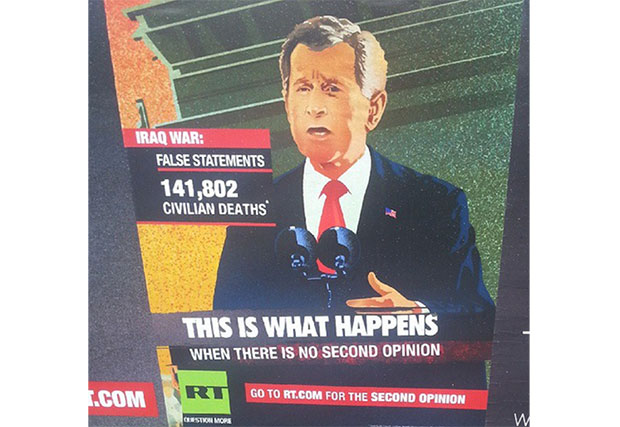
There’s a poster near my house in London. It shows a poorly illustrated George W. Bush, aboard the USS Abraham Lincoln early in the Iraq war, with the now infamous “Mission Accomplished” banner behind him. To his side, the tally of dead in the Iraq War (at least according to Iraq Body Count). Underneath is emblazoned the slogan: “This is what happens when there is no second opinion.” It is an advert for Russian propaganda channel RT (formerly Russia Today).
It’s a slightly muddled poster, but the signal is clear: did you feel lied to about the Iraq war? Watch RT.
Curiously, RT, which launched a UK channel on 30 October, seems to believe the poster doesn’t exist. A “report” on the RT website, dated 9 October, claims that the campaign of which this poster is part was “rejected for outdoor displays in London because of their ‘political overtones’”. The story goes on to claim that the “rejected” posters were replaced by ones that simply say “redacted”, before urging readers to download an RT app to view the ads on their phones.
But I have seen the poster. I even took a picture. Yet RT insists it has been banned, saying that outdoor advertising companies cited the Communications Act 2003, which “prohibits political advertising”. This prohibition is indeed to be found in the act, but only applies to broadcast advertisements, not billboard advertisements for broadcasters.
This is a fairly crude illustration of RT’s attitude to the truth. It is simply not an issue. What’s important is something that might sound true, something just about plausible, to suit the agenda (in this case, the agenda is threefold: one, to get people to download the app; two, to sow the belief that “they” are scared of RT; and three, to introduce the notion that political advertising is subject to a blanket ban in the UK).
Fair enough, you might say. But have you seen Fox News? Don’t all sorts of news organisations bend the truth to fit their agenda? There’s a case to be made, but there’s also a crucial difference. RT is funded and controlled by the Kremlin and is on a mission; a mission outlined in a new report by The Interpreter, part of the Institute of Modern Russia (disclosure: Index on Censorship has on occassion crossposted content from The Interpreter).
“The Menace of Unreality: How the Kremlin Weaponizes Information, Culture and Money” elucidates what we had already long suspected: the Soviet Union may be dead, but Soviet tactics remain. And while the west may not want to believe it is in conflict with Russia, the Russians are already acting like it is (witness reports of heightened Russian air force activity in and near Nato airspace).
The report’s authors, Michael Weiss and Peter Pomerantsev, describe disinformation techniques dating back to the Soviet era: straight propaganda, certainly, but also Dezinformatsiya — the planting of false stories to undermine confidence in western governments. These include alleged coup plots, the bizarre theory that AIDS was created by the CIA, even the suggestion that the assassination of Kennedy was an inside job.
The suggestion is that democracy is a sham, and that democratic governments are at best hypocrites and at worst constantly, deliberately acting against the interests of their own populations.
The best false stories always have a ring of truth and a ring of empathy. Many politicians are hypocrites, some politicians act against the interests of those they should represent. If this much is true, is it that much of a leap to imagine that the entire system is a crock? That democracy and human rights are empty terms? We’re just asking legitimate questions, as every conspiracy theorist ever has said at some point.
Conspiracy theorists find a home at RT. Presenter Abby Martin, for example, who briefly won praise for apparently criticising Russia’s actions in Ukraine, says she still has “many questions” (just asking questions!) about the September 2001 attacks on the World Trade Center, and has used her show to expound on “false flag” attacks, alleged Israeli eugenics, and every US conspiracy theorists’ favourite, the massacre in Waco, Texas of David Koresh’s Branch Davidian cult in 1993.
All this would mean nothing if RT didn’t have a willing audience in the UK, the US and beyond. But a combination of a large budget, photogenic presenters and a certain way with a YouTube clip makes RT a serious player. It never quite veers into the straight out lunacy of Iran’s Press TV, which is quite open about its conspiracist contributors, and it looks like a serious operation. Furthermore, its positioning as an “alternative news source”, albeit one controlled by an increasingly authoritarian, paranoid and erratic Russian state, finds it fans among people who would rail against their own liberal states and societies (on the two occasions I visited the Occupy St Paul’s encampment in London, Russia Today was playing on a large screen there). All the while, the autocratic Putin is strengthened as democracy in undermined worldwide (witness how easily Putin was able to put the kibosh on effective intervention against Syria’s Assad through the relentless repetition of the line that helping the opposition would mean helping jihadist terrorists).
So what, as Lenin himself once asked, is to be done? After reports of UK broadcast regulator Ofcom’s recent investigations into RT for bias earlier this week, some people saw a chance to get RT taken off the air just weeks after it had begun. But this impulse is too close to political censorship in principle, and in practice, an ineffective sanction against a force that has huge power online, with millions upon millions of YouTube hits.
Decent democrats that they are, Weiss and Pomerantsev suggest eternal vigilance is required: we must be able to combat RT’s half truths and insinuations effectively, with hard facts and hard arguments, in order to stop them spreading. As ever, when arguments for counterspeech as the best defence against poison is suggested, one remembers Yeats’s lines: “The best lack all conviction, while the worst/Are full of passionate intensity.”
But this time 25 years ago, as East and West Germans embraced on top of the Berlin Wall, the world showed that the right argument can win even against the very worst. The Kremlin is playing the same games now as it did in its darkest days. Democrats should be ready to fight back.
This article was posted on 13 November 2014 at indexoncensorship.org
