30 Apr 2014 | Brazil, Digital Freedom, News, United States
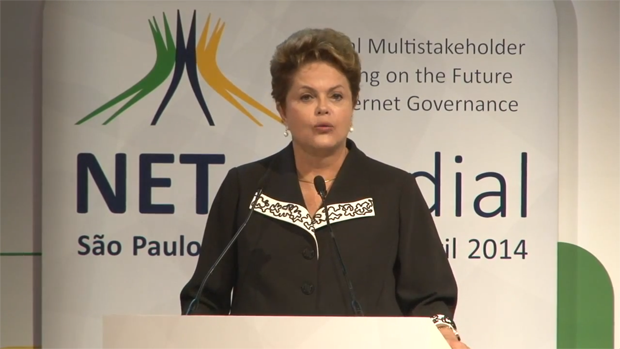
Brazilian President Dilma Rouseff spoke at the opening of NETmundial.
“In 2013, the revelations about the comprehensive mechanisms for spying and monitoring communications provoked outrage and disgust in broad sectors of the Brazilian and the world’s public opinion. Brazilian citizens, companies, embassies and even the President of the Republic had their communications intercepted. Such facts are unacceptable. They undermine the very nature of the Internet: open, pluralistic and free”.
With these words, President Dilma Rousseff opened the NETmundial – Global Multistakeholder Meeting on the Future of Internet Governance, held in São Paulo on April 23 and 24.
Organized by the Brazilian Internet Steering Committee (CGI.br) and /1Net, the unprecedented gathering brought together 1,229 participants from 97 countries. The meeting included representatives of governments, the private sector, civil society, the technical community and academics. Among those present were the Under Secretary-General of the United Nations, Wu Hongbo; the President of ICANN (Internet Corporation for Assigned Names and Numbers), Fadi Chehade; the “father” of the Web, Tim Berners-Lee, and the co-author of TCP/IP and vice-president of Google, Vint Cerfol. The creator of WikiLeaks, Julian Assange, attended the event via Skype.
The words of the president of Brazil seemed to indicate the tone of the meeting: “This reunion responds to a global desire for change in the current situation, with the systematic strengthening of freedom of expression on the internet and the protection of basic human rights, such as the right to privacy”.
In the audience, activists wore masks with the face of Edward Snowden, whose leaks were a catalyst for NETmundial. They protested against the Article 15 of the Marco Civil–signed into law by Rousseff at the event’s opening ceremony–which orders the retention of users’ browsing data. Some demanded that Brazil offer asylum to Snowden.
The main objective of NETmundial was to begin to formulate a system of international internet governance that will come into effect in September 2015, when the United States steps away from the coordination of ICANN, which administers and manages the names and domains used on the internet.
NetMundial was born thanks U.S. spying that targeted the Brazilian government. Rousseff personally stitched together the event after her speech at the UN General Assembly last year that strongly condemned the NSA spying.
After the meeting, a statement of principles was approved. However, the document does not clearly state any principle governing the massive data espionage or violation of privacy. The term “neutrality” appears only in the list of topics to be discussed in the future. The mass surveillance is identified only as a discrediting factor of the net: “Mass and arbitrary surveillance weakens the trust and the confidence in the internet and in the ecosystem of internet governance”, says the document. The collection and use of personal data “should be subject to international human rights law”. And nothing more. Without incrimination, without any preventive or corrective measure, the question remained open. The postponement of the discussion about net neutrality was advocated by the U.S. private sector.
The final document raised much criticism from civil society, which had their expectations disappointed. With a weak text, the Charter of Principles was more like a set of corporate standards, with little affirmative language, full of marketing buzzwords. Its statements are soft. The governments’ voices, especially the U.S.’s, sounded much stronger. Civil society condemned the lack of explicit rules for the “net neutrality” – the term, by the way, was not even mentioned. Another criticized point was the inclusion of protection and copyright of intellectual property, which meets to the interests of lobbyists from business environment and is contrary to the recommendations of collaborative and free creation.
“The document ended up not reflecting the greatness of the debate that happened here. We missed the chance to produce a substantial document to the discussion of the internet governance”, said Laura Tresca, from the NGO Article 19. “The positive balance is in the process, which was interesting: we experienced the idea of the multistakeholder model in practice; but the final document was too weak.”
EFF published a text that defined the outcome of the meeting as “disappointing”.
The multistakeholder model was criticized by activists as “oppressive, determined by political and market interests”. People like Jérémie Zimmermann (La Quadrature Du Net, which defends the rights and freedom of citizens on the web) and Jacob Appelbaum (developer and security researcher) said that the principles of NetMundial were “empty of content and devoid of real power”. These activists argue that governments have an obligation to ensure the rights of users and that the internet is a common, free and geared to citizens’ good.
It would be very difficult to have unanimity with so many sectors present. Russia, Cuba and India disagreed with the Charter of Principles. Brazil’s minister of communications, Paulo Bernardo, missed a more forceful condemnation of espionage. “For obvious reasons, the United States was uncomfortable with it”, said Bernardo. He recognized that the document is not perfect, but evaluates that it means a victory for the future of governance. The idea now is to enhance the text in other debates, such as the Internet Governance Forum (IGF), that will be held next September in Turkey and in Brazil in 2015.
NETmundial was a historic step putting Brazil in the frontline for internet use in the world, even with the disagreements and a questionable model. Nevertheless, it lacked the courage to allow the voice of the people to sound louder than economic interests. To push the most important issues into the future for further discussions was a mistake – both strategic and purposeful. In this sense, they have bitten more than they could chew.
A previous version of this article referred to Wu Hungbo as the Secretary-General of the United Nations. His correct title is Under Secretary-General of the United Nations. This has now been corrected.
This article was published on April 30, 2014 at indexoncensorship.org
31 Mar 2014 | Digital Freedom, News, United States

(Illustration: Shutterstock)
Reforms can be a deceptive thing. They can be particularly deceptive when covering the intelligence community, which is notoriously resistant to legislative meddling it tends to find intrusive.
Last week, Congress and the White House were a flurry with proposals to alter the nature of bulk collecting of calls and communications of American citizens under the Patriot Act. In a statement released through the American Civil Liberties Union, Snowden went so far as to see this as “turning point”. “I believed that if the NSA’s unconstitutional mass surveillance of Americans was known, it would not survive the scrutiny of the courts, the Congress, and the people.”
Three plans are on the table – the USA Freedom Act (otherwise known as the Leahy-Sensenbrenner bill), the more conservative House Intelligence Committee Bill (the Ruppersberger-Rogers bill), and the President’s own proposal. The latter has yet to mutate into the language of legislation, but is by the far the most important one to date. For that reason, it deserves greatest scrutiny.
All the proposals, in some measure, deal with the operation of Section 215 of the Patriot Act. The provision facilitates current bulk collection and remains a creature of the post-September 11 2001 era, when the Bush administration extended the surveillance state with knee-jerk enthusiasm. Defenders of the provision argue that metadata gathered under the program remains vital in identifying links between terrorist cells inside the United States. Privacy advocates remain unconvinced by the inefficiency of a program that has been affirmed.
President Obama’s proposal involves allowing phone companies to retain their databases of records in standardised, interoperable format. The reason behind this is to allow government officials quick and easy access to the material when required. The focus on storage will shift from government agencies – a main bone of contention for privacy advocates – to telephony companies. There is an additional oversight measure – the NSA would, in obtaining access, have to seek an order from the Foreign Intelligence Surveillance Court. In turn, the FISC would have to be satisfied that the records pertained to a person connected with a terrorist organisation.
The enthusiasm for the changes last week was certainly evident, suggesting the administration had struck a delicate balance between privacy and security. In Obama’s own words, “I am confident that this approach can provide our intelligence and law enforcement professionals the information that they need to keep us safe while addressing the legitimate privacy concerns that have been raised.”
Reuters stated that the Obama administration had “announced details of its plan to end the government’s vast bulk collection of data about phone calls made in the United States”. Even more cautious observers, such as Jameel Jafeer, suggested that this was “an acknowledgment that a program that was endorsed in secret by all three branches of government, and that was in place for about a decade, has not survived public scrutiny.”
For all that enthusiasm, Jafeer would also suggest that various operational matters needed clearing up. What would, for instance, be the governing standard of suspicion the FISC would use in its judicial deliberations? There is every suggestion that the reforms are driving down the standard of suspicion required in various cases – from “probable cause” to “reasonable suspicion”. For that reason, it would be difficult to see refusals to government petitions except on rare occasions. The FISC will continue being a formalised rubber stamp.
A looming question here is what constitutes a “phone record” for the purposes of Obama’s reforms. Phone records obtained by national security letter statutes and the pen register would need to be incorporated into the reforms – to not do so would render any changes futile..
There is a striking addition to the NSA’s powers that will take place if Obama’s current proposals go through in their current form. The NSA would only be losing authority to collect and hold telephone calling records for up to five years from landlines. Telephony companies will be expected to hold records for up to 18 months. More than adequate compensation is being offered to the NSA’s apparent trimming of data access. The compromise has come in the form of collecting cell phone data, a considerable expansion of power given that the NSA claims that only 30 per cent of all call data of the country is being tapped into.
This in itself is a curious suggestion, given that the NSA is already gathering up to 5 billion records a day on the location of cell phones around the globe. Presumably, local coverage in the US of cell phone data has been skimpy, at least relative to land lines.
It should come as little surprise that the agency’s chief, the retiring Gen. Keith Alexander, was enthusiastic for a solution that would, in effect, enhance NSA coverage while having metadata from landlines restricted. His lobbying of Congress has been particularly frenetic, given that the collection authority of the agency will expire in 18 months. The drafters have been busy, and Obama has been dismissive of suggestions by such NSA critics as Democratic Senate Judiciary Committee Chairman Patrick Leahy to let the program lapse into oblivion. In that, the President has the support of the House Intelligence Committee members, Republican Mike Rogers and Democrat Dutch Ruppersberger, whose “End Bulk Collection Act” replicates the spirit of Obama’s proposals.
For that reason, privacy advocates can only count the latest measures, notably those of the Obama administration, as refined efforts to enhance surveillance rather than roll back metadata collection. The principle remains only the practice is being tweaked and effectively granted a legal varnish.
25 Mar 2014 | Digital Freedom, Events

(Image: Shutterstock)
Index on Censorship, in association with Doughty Street Chambers, invites you to attend our high-level panel discussion asking who runs the internet?
At a moment when the revelations on NSA and GCHQ mass surveillance are opening up a wide debate about our digital freedoms, our panel will discuss how free the net is today, and the main challenges that lie ahead. In the next couple of years, major international summits will debate new rules on internet governance, and whether to adopt a top-down approach as favoured by China and Russia, or maintain a more open, multistakeholder networked approach. Meanwhile, from the EU to Brazil, reactions to the Snowden’s revelations of mass snooping suggest there is a growing risk of fragmentation of the internet, with calls for forced local hosting of data.
We are delighted to be hosting speakers:
Bill Echikson – Head of Free Expression EMEA, Google
Richard Allan – Head of Europe, Middle East and Africa, Facebook
Tusha Mittal – formerly a correspondent for Tehelka and currently a Fellow at the Reuters Institute, Oxford University
Kirsty Hughes – CEO, Index on Censorship
The panel will make short introductory remarks ensuring plenty of time for a lively Q&A session.
The event will be held at Doughty Street Chambers (53-54 Doughty St, London WC1N 2LS) on Wednesday 2nd April 6-7.30pm, followed by a drinks reception. To RSVP please fill in your details here. If you have any questions please contact Fiona Bradley ([email protected]).
25 Mar 2014 | Americas, Europe and Central Asia, Events, United Kingdom, United States
Over a year after the Leveson report came out, regulation of the British press is still a question of intense debate. Meanwhile, the NSA/Snowden revelations – and the related detention of David Miranda (supported recently by British courts) – open up core questions of how investigative and public interest journalism can function in a world of mass surveillance. In the US, while Guardian editor-in-chief Alan Rusbridger rightly praises the first amendments, Obama himself has a growing reputation as a president who has pursued sources and journalists through the courts.
Join us on a Google Hangout with Guardian Digital journalist, James Ball (now based in New York) and LA Times London correspondent, Henry Chu, hosted by our Editor, Online and News, Sean Gallagher for a lively debate around the media freedom on either side of the Atlantic.
The recording will be broadcast live via Index’s Google+ and YouTube accounts from 10am (EST)/ 2pm (GMT) on Wednesday 26th March. Get involved in the discussion on our Twitter feed and website. Visit the Google+ page here and the YouTube page here.
