12 May 2017 | Events
[vc_row][vc_column][vc_column_text]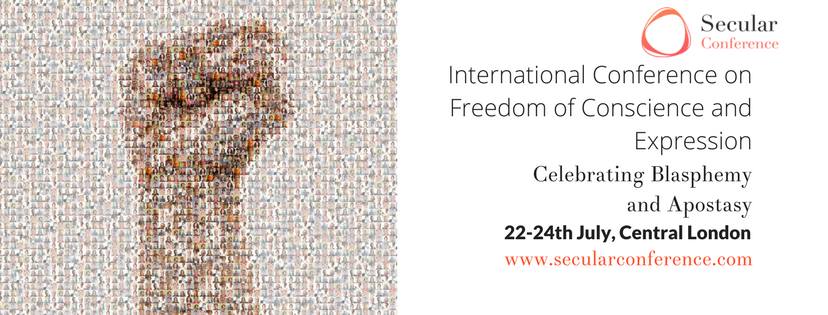
Join notable free-thinkers from around the world for a weekend of discussions and debates on freedom of conscience and expression in the 21st century at a spectacular venue in central London during 22-23 July 2017.
On 24 July, an activist strategy meeting will be followed by body-painting in support of ex-Muslims, which will be open to the public.
The two-day conference will discuss censorship and blasphemy laws, freedom of and from religion, apostasy, the limits of religion’s role in society, LGBT and women’s rights, atheism, secular values and more.
Speakers from countries or the Diaspora as diverse as Afghanistan, Algeria, Bangladesh, Canada, Egypt, France, India, Iran, Iraq, Iraqi Kurdistan, Ireland, Lebanon, Malaysia, Morocco, Nigeria, Norway, Pakistan, Palestinian Territories, Poland, Saudi Arabia, Sudan, Sweden, Switzerland, Syria, Turkey, Tunisia, UK, Ukraine, US and Yemen will gather in London to defend freedom of conscience and expression and argue that freedoms are not western but universal.
The conference will highlight the voices of people on the frontlines of resistance – many of them persecuted and exiled – as well as address challenges faced by activists and freethinkers, elaborate on the links between democratic politics and free expression and conscience, promote secular and rights-based alternatives, and establish priorities for collective action.
Art and culture will be integral to the event as will lively debate with the dauntless use of the free word.
Full schedule: http://www.secularconference.com/agenda-2017/
Confirmed Distinguished Speakers:
A C Grayling, Philosopher
Aliaa Magda Elmahdy, Egyptian Feminist Activist
Alya Al-Sultani, British-Iraqi Vocalist and Composer
Ani Zonneveld, Founder and President of Muslims for Progressive Values
Annie Laurie Gaylor and Dan Barker, Co-Presidents of the Freedom From Religion Foundation
Armin Navabi, Founder of Atheist Republic
Asher Fainman, President of Goldsmiths Atheist Society
Benjamin David, Editor-in-Chief of Conatus News
Bonya Ahmed, Activist, Writer and Blogger at Mukto-Mona
Cemal Knudsen Yucel, Co-Founder and Chair of Ex-Muslims of Norway
Chris Moos, Secular Activist
Damon Conlan and Neil Edwards, Magicians
Dave Silverman, President of American Atheists
Deeyah Khan, Filmmaker
Djemila Benhabib, Author and Activist
Elham Manea, Yemeni-born Author and Human Rights Campaigner
Fariborz Pooya, Bread and Roses TV Presenter and Editor
Fauzia Ilyas, Founder of Atheist & Agnostic Alliance Pakistan
Gina Khan, One Law for All Spokesperson
Gita Sahgal, Director of Centre for Secular Space
Gona Saed, Co-Founder of Kurdistan Secular Centre
Gurpreet Kaur Bhatti, Award-winning Playwright
Halima Begum, Ex-Muslim Feminist Researcher and Blogger
Hassan Radwan, Agnostic Muslim Khutbahs blog
Houzan Mahmoud, Culture Project Co-Founder
Imad Iddine Habib, Founder of Council of Ex-Muslims of Morocco
Inna Shevchenko, FEMEN Leader
Iram Ramzan, Journalist and Founder of Sedaa
Ismail Mohamed, Egyptian Atheist and Founder of Black Ducks Talk Show
Jane Donnelly and Michael Nugent, Atheist Ireland’s Human Rights Officer and Chairperson
Jodie Ginsberg, CEO of Index on Censorship
Karima Bennoune, UN Special Rapporteur in the Field of Cultural Rights
Karrar D. Al Asfoor, Co-founder of Atheist Alliance Middle East and North Africa
Kate Smurthwaite, Comedian
Kenan Malik, Author and Broadcaster
London Humanist Choir
Maajid Nawaz, Founding Chairman of Quilliam Foundation
Marieme Helie Lucas, Algerian Sociologist and Founder of Secularism is a Women’s Issue
Mario Ramadan, Co-Founder of Freethought Lebanon
Maryam Namazie, Iranian-born Rights Activist, Writer and Conference Organiser
Nadia El Fani, Tunisian Filmmaker
Nasreen Rehman, Co-Founder and Chair of British Muslims for Secular Democracy
Nina Sankari, Polish Atheist Activist
Noura Embabi, Muslim-ish President
Peter Tatchell, Human Rights Campaigner
Pragna Patel, Director of Southall Black Sisters
Rana Ahmad, Head of the RDF Arab Atheist Community
Rayhana Sultan, ExMuslimBecause
Richard Dawkins, Author and Scientist (subject to availability)
Sadia Hameed, Spokesperson of the Council of Ex-Muslims of Britain
Sanal Edamaruku, Founder and President of Rationalist International
Sarah Haider, Co-Founder of Ex-Muslims of North America
Sarah Peace, Nigerian Artist and Director of Fireproof Library
Savin Bapir Tardy, Counselling Psychologist for The Iranian and Kurdish Women’s Rights Organisation
Shabana Rehman, Performance Artist and Human and Animal Rights Advocate
Shelley Segal, Singer/Songwriter
Tasneem Khalil, Swedish-Bangladeshi Journalist and Editor of Independent World Report
Teresa Gimenez Barbat, MEP, Group of the Alliance of Liberals and Democrats for Europe and Euromind
Victoria Gugenheim, Award-winning Body Artist
Waleed Al Husseini, Palestinian Writer and Founder of Council of Ex-Muslims of France
Yasmine Mohammed, Confessions of an ExMuslim
Yasmin Rehman, Women’s Rights Campaigner
Zehra Pala, President of Atheism Association of Turkey
Zineb El Rhazoui, Moroccan-born Columnist for Charlie Hebdo
Speaker biographies available here: http://www.secularconference.com/speakers-2017/
For more information, contact Maryam Namazie, [email protected].uk.
The conference is sponsored by: Alliance of Liberals and Democrats for Europe; Atheist International Alliance; Bread and Roses TV; Center for Inquiry; Centre for Secular Space; Council of Ex-Muslims of Britain; Culture Project; Euromind; Equal Rights Now; Fitnah; Freedom from Religion Foundation; National Secular Society; One Law for All; Richard Dawkins Foundation for Reason and Science; Southall Black Sisters; and Secularism is a Women’s Issue.[/vc_column_text][/vc_column][/vc_row][vc_row][vc_column][vc_column_text]
When: 22-24 July
Where: Central London
Tickets: From £65 via Secular Conference No tickets will be sold at the door.
[/vc_column_text][/vc_column][/vc_row]
21 Apr 2017 | Azerbaijan, Azerbaijan Statements, Campaigns -- Featured, Statements
We, representatives of international and national non-governmental organisations, issue this appeal prior to a discussion of the investigation into allegations of corruption at the Parliamentary Assembly of the Council of Europe (PACE) in connection with its work on Azerbaijan, at the Assembly’s April 2017 session and a meeting of the Bureau of the Assembly before the session. We call upon you to support a full, thorough and independent investigation into the corruption allegations, with full civil society oversight.
We are extremely concerned about credible allegations presented in a December 2016 report by the European Stability Initiative (ESI), “The European Swamp: Prosecutions, corruption and the Council of Europe” building on previous findings by ESI and others published in 2012-16, detailing improper influencing of Assembly members by representatives of the Azerbaijani government. In particular, the reports include credible allegations that PACE members from various countries and political groups received payments and other gifts with a view to influencing the appointment of Assembly rapporteurs on Azerbaijan, as well as reports and resolutions of the Assembly on Azerbaijan, most notably the PACE vote on the draft resolution on political prisoners in Azerbaijan in January 2013.
The allegations regarding improper conduct of PACE members are serious, credible, and risk gravely undermining the credibility of the Assembly, as well as the Council of Europe as a whole. It is essential that these allegations are investigated thoroughly and impartially. Calls and recommendations for independent investigation into these allegations put forward by ESI have been echoed by many civil society actors, including Amnesty International, Transparency International, and a group of 60 members of Azerbaijani civil society actors and 20 international NGOs.
We welcome the decision of the PACE Bureau on 27 January 2017 to set up an independent investigation body to shed light on hidden practices that favour corruption. The Bureau has also committed to revising the Assembly’s Code of Conduct and invited GRECO (the Council of Europe’s Group of States against Corruption) to provide advice to the Rules Committee, charged with the investigation.
On 3 March, Wojciech Sawicki, PACE Secretary General, presented the Assembly Bureau with a draft terms of reference for the external and independent investigation at the Bureau meeting in Madrid. The proposal is credible, defining a wide mandate and competences and including strong guarantees for the independence of the investigation and safeguards against non-compliance with its work.
Unfortunately, the proposal was met with resistance at the meeting, and no agreement was made on its substance. The proposal was further discussed at a meeting of the heads of the PACE Parliamentary groups on 28 March in St Petersburg: again, no consensus was reached on its content, and whether it should be adopted.
A thorough investigation is essential to restore PACE’s credibility and allow it to effectively address human rights violations across the Council of Europe, including in Azerbaijan. The chairman of Azerbaijani NGO the Institute for Reporters Freedom and Safety, Mehman Huseynov is already facing reprisals for raising the corruption allegations during the January PACE session. A day after his NGO sent a letter about the corruption allegations to PACE members in January, he was abducted and tortured by police and later sentenced for 2 years on defamation charges for allegedly making false allegations about torture. For PACE to be in a position to respond to such violations, it must be seen as independent and not under the influence of states wishing to influence their conduct.
We call upon members of the PACE Bureau to commit to the Sawicki proposal and to call for a full plenary debate on the proposal at the April session of PACE. We also call on the PACE Bureau to include a mechanism of civil society oversight of the investigation to ensure its full independence and impartiality.
We call upon all Members of the Assembly to support in the strongest possible terms an independent, external and thorough investigation. This can be done by signing a written Declaration on the Parliamentary Assembly Integrity introduced on 25 January 2017 by PACE members Pieter Omtzigt (The Netherlands, Christian Democrat), and Frank Schwabe (Germany, Social Democrat) urging the PACE President Pedro Agramunt (Spain, EPP) to launch a “deep, thorough investigation by an independent panel” that makes its findings public. More than one fifth of the Assembly members have joined the declaration. More voices in support of the Assembly integrity are needed. Moreover, PACE members must insist on their right to discuss the Sawicki proposal at the April session of the Assembly, to ensure that PACE has the mechanisms in place to adequately deal with corruption allegations.
We call on the Secretary General of the Council of Europe Thorbjorn Jagland to make a very strong statement to affirm that there will be no tolerance of any corruption, including bribery, trading in influence or taking up of roles that imply a conflict of interest, in the Parliamentary Assembly and the Council of Europe in general.
Commitment to the rule of law, integrity, transparency, and public accountability should be effectively enforced as the key principles of the work of the Parliamentary Assembly. If such a decision is not made now, reputational damage to PACE may become irreparable, preventing PACE from fulfilling its role as a guardian of human rights across the Council of Europe region.
Signatures:
1. The Netherlands Helsinki Committee
2. International Partnership for Human Rights (Belgium)
3. Centre for the Development of Democracy and Human Rights (Russia)
4. Freedom Files (Russia/Poland)
5. Norwegian Helsinki Committee
6. Ukrainian Helsinki Human Rights Union
7. Analytical Center for Interethnic Cooperation and Consultations (Georgia)
8. Article 19 (UK)
9. The Barys Zvozskau Belarusian Human Rights House (Belarus/Lithuania)
10. Index on Censorship (UK)
11. Human Rights House Foundation (Norway)
12. Human Rights Movement “Bir Duino-Kyrgyzstan”
13. PEN International (UK)
14. Crude Accountability (USA)
15. Legal Transformation Center (Belarus)
16. Bulgarian Helsinki Committee
17. World Organisation Against Torture (OMCT) (Switzerland)
18. The Kazakhstan International Bureau for Human Rights and the Rule of Law
19. Belarusian Helsinki Committee
20. Center for Civil Liberties (Ukraine)
21. Promo LEX (Moldova)
22. Libereco – Partnership for Human Rights (Germany/Switzerland)
23. Public Association “Dignity” (Kazakhstan)
24. Human Rights Monitoring Institute (Lithuania)
25. Swiss Helsinki Committee
26. Human Rights Information Center (Ukraine)
27. Public Verdict Foundation (Russia)
28. Albanian Helsinki Committee
29. Kharkiv Regional Foundation “Public Alternative” (Ukraine)
30. Helsinki Foundation for Human Rights (Poland)
31. Women of Don (Russia)
32. DRA – German-Russian Exchange (Germany)
33. Association UMDPL (Ukraine)
34. European Stability Initiative (Germany)
35. International Media Support (IMS) (Denmark)
36. Civil Rights Defenders (Sweden)
37. International Federation for Human Rights (FIDH) (France)
38. Sova Center for Information and Analysis (Russia)
39. Kosova Centre for Rehabilitation of Torture Victims (Kosovo)
40. Truth Hounds (Ukraine)
41. People in Need Foundation (Czech Republic)
42. Eastern Partnership Civil Society Forum (Belgium)
43. Macedonian Helsinki Committee
44. International Youth Human Rights Movement
45. Human Rights First (USA)
46. Regional Center for Strategic Studies (Georgia/Azerbaijan)
47. Human Rights Club (Azerbaijan)
48. Institute for Reporters Freedom and Safety (IRFS) (Azerbaijan)
49. Media Rights Institute (Azerbaijan)
50. Public Association for Assistance to Free Economy (Azerbaijan)
51. Institute for Peace and Democracy (Netherlands/Azerbaijan)
52. Turan News Agency (Azerbaijan)
53. Democracy and NGO development Resource Center (Azerbaijan)
54. Youth Atlantic Treaty Association (Azerbaijan)
55. Monitoring Centre for Political Prisoners (Azerbaijan)
56. Azerbaijan without Political Prisoners (Azerbaijan)
19 Apr 2017 | Awards, Awards Update, News, Youth Board
[vc_row][vc_column][vc_column_text]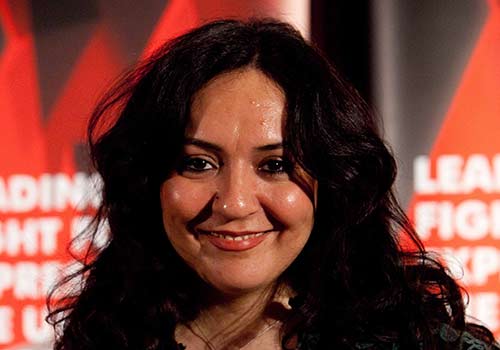
Since winning the Freemuse Award for Music in 2010, Mahsa Vahdat has continued to use her music to fight for freedom of expression for the women of Iran. Since the Iranian revolution in 1979, female solo vocalists are permitted to perform only for female audiences; they cannot perform for men except when part of a chorus as conservative clerics say women’s voices have the power to trigger immorality and arousal.
But Vahdat learned music as a child and went on to study it at university in Tehran. She was encouraged to perform there despite the strict new rules of the Islamic Revolution. Not only does she sing but she also plays the piano and the setar, a Persian string instrument that’s a member of the lute family. Now she has taken that freedom to the Iranian diaspora and world music circles across the globe, performing at international venues where her voice is not discriminated against on the basis of her gender. She refers back to the classical Iranian poets – Rumi, Khayyam and Hafez – as well as using contemporary poetry.
Vahdat’s commitment to fight for her right to sing often meets obstacles; in 2011 she gave a concert at the residence of the Italian embassy in Tehran despite the attempts of the government security forces to stop guests from entering the building. But she has built a following around the world, especially in Norway after touring schools there and presenting a positive, musical image of Iran. In 2011 she released the album Twinklings of Hope with her sister to critical acclaim and has gone on to collaborate with other performers such as Mighty Sam McClain.
Despite the conservatism of her homeland she still teaches Persian singing in Tehran, ensuring that the tradition of both folk music and that of the female artist stays alive. She continues to be an ambassador for the Freemuse Organization which advocates freedom of expression for musicians and composers across the world.
Sophia Smith-Galer is a member of Index on Censorship’s Youth Advisory Board. She is an MA student studying Broadcast Journalism at City University in London. She studied Spanish and Arabic previously at Durham University.[/vc_column_text][/vc_column][/vc_row][vc_row][vc_column width=”1/2″][vc_single_image image=”85476″ img_size=”full” alignment=”center” onclick=”custom_link” link=”https://www.indexoncensorship.org/2016/11/awards-2017/”][/vc_column][vc_column width=”1/2″][vc_column_text]
Index on Censorship Freedom of Expression Awards
Seventeen years of celebrating the courage and creativity of some of the world’s greatest journalists, artists, campaigners and digital activists
2001 | 2002 | 2003 | 2004 | 2005 | 2006 | 2007 | 2008 | 2009 | 2010 | 2011 | 2012 | 2013 | 2014 | 2015 | 2016 | 2017[/vc_column_text][/vc_column][/vc_row][vc_row][vc_column][vc_basic_grid post_type=”post” max_items=”12″ style=”load-more” items_per_page=”4″ element_width=”6″ grid_id=”vc_gid:1492506354793-87f74769-0713-9″ taxonomies=”2562, 7359″][/vc_column][/vc_row]
18 Apr 2017 | Awards, Awards Update, News, Youth Board
[vc_row][vc_column][vc_column_text]
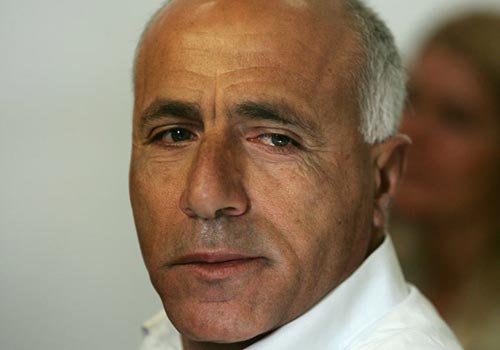
Mordechai Vanunu
Mordechai Vanunu was granted Index on Censorship’s Special Award in 2004 for his work as a whistleblower on Israel’s nuclear programme. While working as a nuclear technician for the Israeli government in the 1980s he was sentenced to 18 years in prison for exposing their possession of nuclear weapons to the Sunday Times.
In April 2004 he was released and has since been fighting for his right to leave Israel – the foundational condition of Vanunu’s release from prison was a prohibition on leaving the country. In addition, he is prohibited from contacting embassies or having any interaction with foreigners that has not been pre-approved by Israeli officials. Shortly after his release he unsuccessfully applied for asylum in Norway, Ireland and Sweden. He has been rejected asylum status numerous times since it is not legally possible to apply for asylum in a country without physically being there. Essentially, so long as the prohibition on leaving Israel remains, he cannot meaningfully seek asylum.
Israel’s High Court has had a central role in determining Vanunu’s fate since 2004. In 2008 24 influential Norwegian lawyers signed the “Norwegian Lawyer’s Petition for Vanunu”. In September of the same year the eighth petition calling for Vanunu’s conditions to be lifted was rejected by the High Court. And less than 2 months ago Vanunu was convicted of violating the terms of his release by meeting with two US citizens in 2013 without permission from the authorities. He is to appear in court for sentencing this month.
This is only the latest struggle in the past 30 years of Vanunu’s life, after he first leaked photos of Isreali nuclear production plants to the Sunday Times in 1986. Vanunu’s struggle for freedom has not gone unnoticed by the world. He has been nominated for the Nobel Peace Prize every year since 1987. In 2010 the International League for Human Rights sent open letters to Benjamin Netanyahu seeking Vanunu’s free release. In 2015 Vanunu said that he had no desire nor even any means of spilling more secrets on Israel’s nuclear programme. He stated that he simply wants to join his wife, theology professor Kristin Joachimsen, in Norway. In the same year the Campaign for Nuclear Disarmament wrote to the Guardian calling for a vigil to be held outside of the Israeli Embassy in London in honour of Vanunu’s birthday.
However, there may be hope. In October 2015 Vanunu appealed the terms of his release to the Israeli Supreme Court, and in January this year he shared on Facebook that the Supreme Court would rule on his appeal in the coming month. On March 3, 2017, Vanunu wrote: “We are now waiting for the Supreme Court decision, it could be anytime soon. And it could be good or nothing, I am used to all this for 31 years, 1986-2017. Freedom must come.”
Fionnuala McRedmond is a member of Index on Censorship’s Youth Advisory Board. She graduated last June from the University of Cambridge with a degree in Classics. She is now studying for a MSc in Political Theory at the London School of Economics.[/vc_column_text][/vc_column][/vc_row][vc_row][vc_column width=”1/2″][vc_single_image image=”85476″ img_size=”full” alignment=”center” onclick=”custom_link” link=”https://www.indexoncensorship.org/2016/11/awards-2017/”][/vc_column][vc_column width=”1/2″][vc_column_text]
Index on Censorship Freedom of Expression Awards
Seventeen years of celebrating the courage and creativity of some of the world’s greatest journalists, artists, campaigners and digital activists
2001 | 2002 | 2003 | 2004 | 2005 | 2006 | 2007 | 2008 | 2009 | 2010 | 2011 | 2012 | 2013 | 2014 | 2015 | 2016 | 2017[/vc_column_text][/vc_column][/vc_row][vc_row][vc_column][vc_basic_grid post_type=”post” max_items=”12″ style=”load-more” items_per_page=”4″ element_width=”6″ grid_id=”vc_gid:1492506170040-ab008603-fefe-8″ taxonomies=”2329, 180″][/vc_column][/vc_row]
