30 Apr 2014 | About Index, Azerbaijan Letters, Campaigns, Statements
Minister Usubov Ramil Idris oglu
Minister of Internal Affairs of the Republic of Azerbaijan
Azerbaijan Avenue 7
1005 Baku
Republic of Azerbaijan
Email: [email protected]
Prosecutor General Zakir Bakir oglu Garalov
Nigar Rafibayli street 7
1001 Baku
Republic of Azerbaijan
Email: [email protected]
Mr Minister, Mr Prosecutor General,
We, the undersigned members and partners of the Human Rights House Network (HRHN) and the South Caucasus Network of Human Rights Defenders, express our deep concern over the persecution and hindrance of free movement of human rights defender Leyla Yunus and her husband Arif Yunus. We call upon you to put an end to the attacks, detention and harassment of human rights defenders and to take steps in order to foster a safe environment for human rights defenders, in line with Azerbaijan’s international obligations and commitments, including as a member of the Council of Europe.
On 28 April 2014 Leyla Yunus and her husband, the historian Arif Yunus, were prevented from leaving the country at Baku’s airport. She then was detained and interrogated by the police regarding the case of the arrested journalist Rauf Mirkadirov and questioned about the relation between the journalist and the Institute for Peace and Democracy. She was released only in the after-noon on 29 April 2014. Searches were conducted in the office of the Institute for Peace and Democracy, and continued in the private home of Leyla Yunus until the night of 29 April 2014. According to Leila Yunus, she was humiliated during the search by the officers. The official grounds on which Leyla Yunus and Arif Yunus were prevented from leaving the country and detained are unclear, as well as the grounds on which the searches are being carried out.
Leader of the Institute for Peace and Democracy, Leyla Yunus is a well-known Azerbaijani human rights defender. Her NGO is a member of the South Caucasus Network of Human Rights Defenders and has from the very start in 1995 worked on the issue to release political prisoners and to establish rule of law in Azerbaijan. Leyla Yunus has within several projects worked to establish dialogue between civil society actors in the South Caucasus. She is a Chevalier of the National Order of the Legion of Honour, as a tribute for her longstanding work promoting human rights.
We are worried that the persecution is related to her outspoken criticism in the past few days against the detention of Rauf Mirgadirov, the investigative journalist of the leading Russian-language newspaper Zerkalo (Mirror), who is now facing charges of treason for his efforts in the peace building process of the Nagorno-Karabakh conflict. Rauf Mirkadirov participated in the numerous joint projects between the Institute for Peace and Democracy and Armenian NGOs.
Under Azerbaijan’s commitments within the Organisation for Security and Cooperation’s Misnk Group, we strongly believe that public diplomacy and cooperation between civil society in the South Caucasus contributes to efforts aiming at finding a peaceful solution to the Nagorno-Karabakh conflict.
As the Commissioner for Human Rights of the Council of Europe Nils Muižnieks stated on his Facebook page, “this is an additional example showing the extent of intimidation and repression of critical voices in Azerbaijan, a problem which I have repeatedly highlighted […] and asked the Azerbaijani authorities to address.”[1]Azerbaijan should indeed guarantee the right to freedom of expression of all human rights defenders and critical voices, in line with its obligations as a member of the Council of Europe.
Furthermore, authorities should prevent the use of unreliable evidence and unwarranted investigations against human rights defenders, as laid out in the United Nations Human Rights Council resolution 22/6 of 21 March 2013.
We are extremely worried to see that human rights defenders, including journalists and bloggers, are persecuted, attacked and detained due to their work. In addition to Leyla Yunus, the Chairperson of the Election Monitoring and Democracy Studies Centre (EMDS) Anar Mammadli, the Executive Director of EMDS Bashir Suleymanli and Elnur Mammadov, president of the Volunteers of International Cooperation, are facing court trials[2].
Ahead of the Chairmanship of the Council of Europe by the Republic of Azerbaijan, we call upon you to put an end to the crackdown of the civil society and to take steps in order to foster a safe environment for human rights defenders.
We further call upon you to report to the Council of Europe on your plans to investigate the acts of the State agents, which prevented Leyla Yunus and Arif Yunus from leaving the country and later detained them and to end all persecutions against them and other human rights defenders.
Sincerely,
Human Rights House Azerbaijan (on behalf of the following NGOs):
- Azerbaijan Lawyers Association
- Institute for Reporters’ Safety and Freedom
- Legal Education Society
- Media Rights Institute
- Women Association for Rational Development
Belarusian Human Rights House in exile, Vilnius (on behalf of the following NGOs):
- Belarusian PEN Centre
- Belarus Watch
- City Public Association “Centar Supolnaść”
- Human Rights Centre “Viasna”
Human Rights House Belgrade (on behalf of the following NGOs):
- Belgrade Centre for Human Rights
- Lawyers Committee for Human Rights YUCOM
- Civic Initiatives
- Helsinki Committee for Human Rights in Serbia
- Policy Centre
Human Rights House Kiev (on behalf of the following NGOs):
- Association of Ukrainian Human Rights Monitors on Law-Enforcement
- Human Rights Information Centre
- Center for Civil Liberties
- Kharkiv Human Rights Protection Group
Free Word Centre London (on behalf of the following NGOs):
- Index on Censorship
- Vivarta
Human Rights House Sarajevo (on behalf of the following NGOs):
- Helsinki Committee for human Rights in Bosnia and Herzegovina
Human Rights House Tbilisi (on behalf of the following NGOs):
- Georgian Centre for Psychosocial and Medical Rehabilitation of Torture Victims – GCRT
- Caucasian Center for Human Rights and Conflict Studies
- Human Rights Centre
- Union Sapari
- Article 42 of the Constitution
- Media Institute
Human Rights House Oslo (on behalf of the following NGOs):
- Health and Human Rights Info
- Human Rights House Foundation
- FIAN Norway
Human Rights House Voronezh (on behalf of the following NGOs):
- Charitable Foundation
- Civic Initiatives Development Centre
- Confederation of Free Labor
- For Ecological and Social Justice
- Free University
- Golos
- Interregional Trade Union of Literary Men
- Lawyers for labor rights
- Memorial
- Ms. Olga Gnezdilova
- Soldiers Mothers of Russia
- Voronezh Journalist Club
- Voronezh-Chernozemie
- Youth Human Rights Movement
Human Rights House Yerevan (on behalf of the following NGOs):
- Armenian Helsinki Association
- Helsinki Citizens’ Assembly-Vanadzor
- Journalists’ Club “Asparez”
- Democracy Today
Human Rights House Zagreb (on behalf of the following NGOs):
- APEO/UPIM Association for Promotion of Equal Opportunities for People with Disabilities
- B.a.B.e.
- CMS – Centre for Peace Studies
- Documenta – Centre for Dealing with the Past
- GOLJP – Civic Committee for Human Rights
- Svitanje – Association for Protection and Promotion of Mental Health
Rafto Foundation, Norway
Helsinki Foundation for Human Rights, Poland
Public Union of Democracy Human Rights Resource Centre, Azerbaijan
Legal Protection and Awareness Society, Azerbaijan
Copies have been sent to:
- Ministry of Justice of the Republic of Azerbaijan
- Presidency of the French Republic
- Ministry of Foreign Affairs of the French Republic
- Office of the Commissioner for Human Rights of the Council of Europe
- Private Office of the Secretary General of the Council of Europe
- Chairman of the Committee of Ministers of the Council of Europe
- Delegation of the Council of Europe in Azerbaijan
- UN Special Rapporteur on human rights defenders
- Office for Democratic Institutions and Human Rights of the Organisation for Security and Cooperation in Europe (OSCE ODIHR)
- Delegation of the European Union in Azerbaijan
- Subcommittee on Human Rights of the European Parliament
- Diplomatic community in Baku, Brussels, Geneva and Strasbourg
- Various ministries of foreign affairs and parliamentary committees on foreign affairs
About the Human Rights House Network (www.humanrightshouse.org)
The Human Rights House Network (HRHN) unites 90 human rights NGOs joining forces in 18 independent Human Rights Houses in 13 countries in Western Balkans, Eastern Europe and South Caucasus, East and Horn of Africa, and Western Europe. HRHN’s aim is to protect, empower and support human rights organisations locally and unite them in an international network of Human Rights Houses.
The Human Rights House Azerbaijan is one of the members of HRHN and served as an independent meeting place, a resource centre, and a coordinator for human rights organisations in Azerbaijan. In 2010, 6’000 human rights defenders, youth activists, independent journalists, and lawyers, used the facilities of the Human Rights House Azerbaijan, which has become a focal point for promotion and protection of human rights in Azerbaijan. The Human Rights House Azerbaijan has been closed after the Ministry of Justice of the Republic of Azerbaijan ordered all activities to be been ceased on 10 March 2011.
The Human Rights House Foundation (HRHF), based in Oslo (Norway) with an office in Geneva (Switzerland), is HRHN’s secretariat. HRHF is international partner of the South Caucasus Network of Human Rights Defenders and the Balkan Network of Human Rights Defenders.
HRHF has consultative status with the United Nations and HRHN has participatory status with the Council of Europe.
[1]Statement available at https://www.facebook.com/HumanRightsHouseNetwork/posts/10152035306640965.
[2]Further information on those cases available at http://humanrightshouse.org/Articles/20033.html.
11 Apr 2014 | Digital Freedom, News

(Illustration: Shutterstock)
State surveillance has been much publicised of late due to Snowden’s revelations, but allegations against the NSA and GCHQ are only one aspect of the international industry surrounding wholesale surveillance. Another growing concern is the emergence and growth of private sector surveillance firms selling intrusion software to governments and government agencies around the world.
Not restricted by territorial borders and globalised like every other tradable commodity, buyers and sellers pockmark the globe. Whether designed to support law enforcement or anti-terrorism programmes, intrusion software, enabling states to monitor, block, filter or collect online communication, is available for any government willing to spend the capital. Indeed, there is money to be made – according to Privacy International, the “UK market for cyber security is estimated to be worth approximately £2.8 billion.”
The table below, collated from a range of sources including Mother Jones, the Electronic Frontier Foundation, Bloomberg, Human Rights Watch, Citizen Lab, Privacy International and Huffington Post, shows the flow of intrusion software around the world.
| Surveillance Company |
Country of Origin |
Alleged Countries of Use |
| VASTech |
South Africa |
Libya (137) |
| Hacking Team |
Italy |
Azerbaijan (160), Egypt (159), Ethiopia (143), Kazakhstan (161), Malaysia (147), Nigeria (112), Oman (134), Saudi Arabia (164), Sudan (172), Turkey (154), Uzebekistan (166) |
| Elbit Systems |
Israel |
Israel (96) |
| Creative Software |
UK |
Iran (173) |
| Gamma TSE |
UK |
Indonesia (132) |
| Narus |
USA |
Egypt (159), Pakistan (158), Saudi Arabia (164) |
| Cisco |
USA |
China (175) |
| Cellusys Ltd |
Ireland |
Syria (177) |
| Adaptive Mobile Security Ltd |
Ireland |
Syria (177), Iran (173) |
| Blue Coat Systems |
USA |
Syria (177) |
| FinFisher GmbH |
Germany |
Egypt (159), Ethiopia (143) |
Note: The numbers alongside the alleged countries of use are the country’s ranking from 2014 Reporters without Borders World Press Freedom Index 2014.
While by no means complete, this list is indicative of three things. There is a clear divide, in terms of economic development, between the buyer and seller countries; many of the countries allegedly purchasing intrusion software are in the midst of, or emerging from, conflict or internal instability; and, with the exception of Israel, every buyer country ranks in the lower hundred of the latest World Press Freedom Index.
The alleged legitimacy of this software in terms of law enforcement ignores the potential to use these tools for strictly political ends. Human Rights Watch outlined in its recent report the case of Tadesse Kersmo, an Ethiopian dissident living in London. Due to his prominent position in opposition party, Ginbot 7 it was discovered that his personal computer had traces of FinFisher’s intrusion software, FinSpy, jeopardising the anonymity and safety of those in Ethiopia he has been communicating with. There is no official warrant out for his arrest and at the time of writing there is no known reason in terms of law enforcement or anti-terrorism legislation, outside of his prominence in an opposition party, for his surveillance. It is unclear whether this is part of an larger organised campaign against dissidents in both Ethiopia and the diaspora, but similar claims have been filed against the Ethiopian government on behalf of individuals in the US and Norway.
FinFisher GmbH states on its website that “they target individual suspects and can not be used for mass interception.” Without further interrogation into the end-use of its customers, there is nothing available to directly corroborate or question this statement. But to what extent are private firms responsible for the use of its software by its customers and how robustly can they monitor the end-use of its customers?
In the US Electronic Code of Federal Regulations, there is a piece of guidance entitled Know Your Customer. This outlines steps to be undertaken by firms to identify what the end-use of its products is. This is a proactive process, placing the responsibility firmly with the seller to clearly identify and act on abnormal circumstances, or ‘red flags’. The guidance clearly states that the seller has a “duty to check out the suspicious circumstances and inquire about the end-use, end-user, or ultimate country of destination.”
Hacking Team has sold software, most notably the Remote Control System (RCS) to a number of countries around the world (see above). Citizen Lab, based out of the University of Toronto, has identified 21 countries that have potentially used this software, including Egypt and Ethiopia. In its customer policy, Hacking Team outlines in detail the lengths it goes to verify the end-use and end-user of RCS. Mentioning the above guidelines, Hacking Team have put into practice an oversight process involving a board of external engineers and lawyers who can veto sales, research of human rights reports, as well as a process that can disable functionality if abuses come to light after the sale.
However, Hacking Team goes a long way to obscure the identity of countries using RCS. Labelled as untraceable, RCS has established a “Collection Infrastructure” that utilises a chain of proxies around the world that shields the user country from further scrutiny. The low levels of media freedom in the countries purportedly utilising RCS, the lack of transparency in terms of the oversight process including the make-up of the board and its research sources, as well as the reluctance of Hacking Team to identify the countries it has sold RCS to undermines the robustness of such due diligence. In the words of Citizen Lab: “we have encountered a number of cases where bait content and other material are suggestive of targeting for political advantage, rather than legitimate law enforcement operations.”
Many of the firms outline their adherence to the national laws of the country they sell software to when defending their practices. But without international guidelines and alongside the absence of domestic controls and legislation protecting the population against mass surveillance, intrusion software remains a useful, if expensive, tool for governments to realise and cement their control of the media and other fundamental freedoms.
Perhaps the best way of thinking of corporate responsibility in terms of intrusion software comes from Adds Jouejati of the Local Coordination Committees in Syria, “It’s like putting a gun in someone’s hand and saying ‘I can’t help the way the person uses it.’”
This article was posted on 11 April, 2014 at indexoncensorship.org
5 Feb 2014 | News, Russia
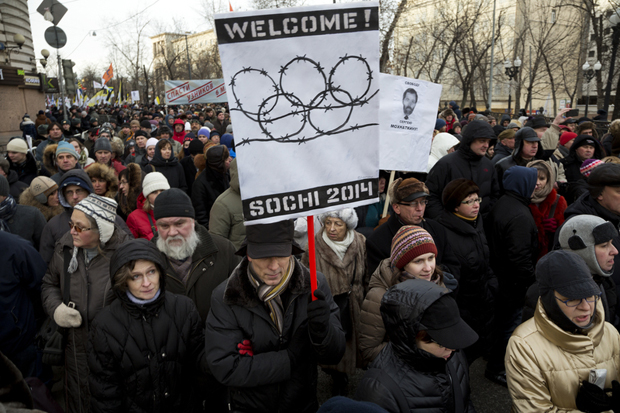
Several thousand protesters marched through central Moscow on 2 February 2014 to call for the release of 20 people who were arrested after clashes between police and demonstrators on 6th May of 2012. Photo: Nickolay Vinokurov / Demotix
Media will face increased restrictions in the build up to the Winter Games in Sochi as Russian president Vladimir Putin tries to rehabilitate a damaged domestic reputation, experts suggest.
Tighter controls on dissident media, more proactive use of state news outlets to mold public consensus, and obstacles to foreign reporters operating in the region can all be expected as the games begin on 7 February.
While Russian authorities have hailed the Games as a triumph, ongoing disputes over the payment of migrant workers, the environmental impact of Sochi’s intensive development, forced evictions of residents, intensive security measures, and Russia’s controversial gay propaganda law have all generated a domestic backlash that many believe is being deliberately ignored by state media. On 17 October, 2013, Roman Kuznetsov, a migrant worker from the Russian city of Orenburg who had helped build the Media Centre for the Sochi Olympic Games, sewed his lips shut with a needle and thread in protest against his employer’s failure to pay him several months of wages. He carried a sign that explained “Please help get reporters attention! I am not from around here”.
In an interview with select global media, Putin explained “I would like the participants, guests, journalists and all those who watch the Games on TV and learn about them from the mass media to see a new Russia, see its personality and its possibilities, take a fresh and unbiased look at the country”. Close restrictions recently imposed on press activity suggest otherwise. Only a small number of Olympic Events have been cleared for coverage by local journalists, including the arrival of IOC delegations and formal updates offered by federal officials. Access to government activities is granted only to the All-Russia State Television and Radio Broadcasting Company.
In a report produced by the Centre for the Protection of Journalists, a number of local journalists allege a more proactive media strategy in addition to direct censorship. Several reporters suggested that it was fairly common for media that receive funding to be directly censored by the administration. Local journalists also reported that the All-Russia State Television and Radio Broadcasting Company often stage interviews, and had been passing off closely scripted lines as dialogue with ordinary residents of Sochi. According to Russian Government website Zakupki, which details financial transactions at all levels of Russian government, the Sochi administration has distributed some 32,628.600 rubles (US$988,788) to 17 media organisations, including four television channels, six newspapers, one magazine, three radio stations, and one informational agency. It is not clear what form the funds took.
Aleksandr Valov, founder of BlogSochi, which seeks to document the impact of the Games on Sochi’s residents, explains “One begins to understand why Sochi media only talk about the government’s achievements and keep silent about the problems. The popular saying ‘He who pays the piper calls the tune’ comes to mind.”
International journalists covering Sochi have also been closely curtailed. Police from the Russian Republic of Adygea neighboring Sochi repeatedly stopped, detained, and threatened a two-person crew from Norway’s TV2- the country’s official broadcaster of the Olympic Games. At every stop and in detention, officials questioned the journalists aggressively about their work plans in Sochi and other areas, their sources, and in some cases about their personal lives, educational backgrounds, and religious beliefs. In several instances they denied the journalists contact with the Norwegian Embassy in Moscow. One official threatened to jail them both, the journalists told Human Rights Watch. Dutch photojournalist Rob Hornstra was denied a Russian visa in an apparent attempt to stop him from doing further work in the turbulent North Caucasus, and American journalist David Satter was forcibly expelled from the country in December.
Since beginning his first term as president in 2000, Vladimir Putin has carefully controlled his media presence, closing a number of independent media outlets and amalgamating others with state bodies, whilst tightly controlling the presence of foreign media. Professor Owen Johnson teaches at the School of Journalism at Indiana University, and has researched the role of media in Russia intensively. He offers a simple explanation for the recent expulsions ‘”While it would seem that this runs counter to other more positive actions by President Putin recently, this might be designed to make visiting journalists more cautious,” Johnson said. “Putin is less concerned about world public opinion than he is about his continued support in Russia.”
Domestic attitudes to Putin are changing fast, according to Mikhail Dmitriev, former director of Russia’s State Run Centre for Strategic Research. Over the past year discontent in the country at large has deepened and broadened, spreading across all social groups and ages. While support for Putin is stable in St. Petersburg and Moscow, where incomes remain high, fluctuating fortunes in Russia’s rural regions is starting to generate distrust. Dmitriev said the latest focus groups show that Putin is less associated with stability and more with uncertainty. His past achievements are becoming a distant memory, and his recent stunts, such as flying with cranes or diving for ancient amphorae, merely cause irritation.
The Sochi Games, Putin explained in a conference with journalists, will be an important global symbol of Russian achievement and resurgence. For Putin, well-managed domestic media coverage seems an important strategic component of his long term success and survival.
This article was originally posted on 5 February 2014 at indexoncensorship.org
10 Jan 2014 | Digital Freedom, Europe and Central Asia, European Union, News

(Illustration: Shutterstock)
This article is part of a series based on our report, Time to Step Up: The EU and freedom of expression
The EU has made a number of positive contributions to digital freedom: it plays a positive part in the global debate on internet governance; the EU’s No-Disconnect Strategy, its freedom of expression guidelines and its export controls on surveillance equipment have all be useful contributions to the digital freedom debate, offering practical measures to better protect freedom of expression. Comparatively, some of the EU’s member states are amongst the world’s best for protecting online freedom. The World Wide Web Foundation places Sweden at the top of its 2012 Index of internet growth, utility and impact, with the UK, Finland, Norway and Ireland also in the top 10. Freedom House ranks all EU member states as “free”, and an EU member state, Estonia, ranks number one globally in the organisation’s annual survey, “Freedom in the World”. But these indices merely represent a snapshot of the situation and even those states ranked as free fail to fully uphold their freedom of expression obligations, online as well as offline.
As the recent revelations by whistleblower Edward Snowden have exposed, although EU member states may in public be committed to a free and open internet, in secret, national governments have been involved in a significant amount of surveillance that breaches international human rights norms, as well as these governments’ own legal commitments. It is also the case that across the EU, other issues continue to chill freedom of expression, including the removal or takedown of legitimate content.
The EU’s position on digital freedom is analysed in more detail in Index on Censorship’s policy paper “Is the EU heading in the right direction on digital freedom?” The paper points out that the EU still lacks a coherent overarching strategy and set of principles for promoting and defending freedom of expression in the digital sphere.
Surveillance
Recent revelations by former US National Security Agency (NSA) whistleblower Edward Snowden into the NSA’s PRISM programme have also exposed that mass state surveillance by EU governments is practised within the EU, including in the UK and France.
Mass or blanket surveillance contravenes Article 8 (the right to respect for private and family life) and Article 10 (the right to freedom of expression) of the European Convention on Human Rights. In its jurisprudence, the European Court of Human Rights has repeatedly stated that surveillance, if conducted without adequate judicial oversight and with no effective safeguards against abuse, will never be compatible with the European Convention.[1]
This state surveillance also breaches pledges EU member states have made as part of the EU’s new cybersecurity strategy, which was agreed in February 2013 and addresses mass state surveillance. The Commission stated that cybersecurity is predominantly the responsibility of member states, an approach some have argued gives member states the green light for increased government surveillance. Because the strategy explicitly states that “increased global connectivity should not be accompanied by censorship or mass surveillance”, member states were called upon to address their adherence to this principle at the European Council meeting on 24th October 2013. The Council was asked to address revelations that external government surveillance efforts, such as the US National Security Agency’s Prism programme, undermining EU citizens’ rights to privacy and free expression. While the Council did discuss surveillance, as yet there has been no common EU position on these issues.
At the same time, the EU has also played a role in laying the foundations for increased surveillance of EU citizens. In 2002, the EU e-Privacy Directive introduced the possibility for member states to pass laws mandating the retention of communications data for security purposes. In 2006, the EU amended the e-Privacy Directive by enacting the Data Retention Directive (Directive 2006/24/EC), which obliges member states to require communications providers to retain communications data for a period of between six months and two years, which could result in member states collecting a pool of data without specifying the reasons for such practice. A number of individual member states, including Germany, Romania and the Czech Republic, have consulted the European Convention on Human Rights and their constitutions and have found that the mass retention of individual data through the Data Retention Directive to be illegal.
While some EU member states are accused of colluding in mass population surveillance, others have some of the strongest protections anywhere globally to protect their citizens against surveillance. Two EU member states, Luxembourg and the Czech Republic, require that individuals who are placed under secret surveillance to be notified. Other EU member states have expanded their use of state surveillance, in particular Austria, the UK and Bulgaria. Citizens of Poland are subject to more phone tapping and surveillance than any other citizens in the European Union; the European Commission has claimed the police and secret services accessed as many as 1,300,000 phone bills in 2010 without any oversight either by the courts or the public prosecutor.
Internet governance
At a global level the EU has argued for no top-down state control of internet governance. There are efforts by a number of states including Russia, China and Iran to increase state control of the internet through the International Telecommunication Union (ITU). The debate on global internet governance came to a head at the Dubai World Conference on International Telecommunications (WCIT) summit at the end of 2012 which brought together 193 member states. At the WCIT, a number of influential emerging democratic powers aligned with a top-down approach with increased state intervention in the governance of the internet. On the other side, EU member states, India and the US argued the internet should remain governed by an open and collaborative multistakeholder approach. The EU’s influence could be seen through the common position adopted by the member states. The European Commission as a non-voting WCIT observer produced a common position for member states that opposed any new treaty on internet governance under the UN’s auspices. The position ruled out any attempts to make the ITU recommendations binding and would only back technology neutral proposals – but made no mention of free expression. The absence of this right is of concern as other rights including privacy (which was mentioned) do not always align with free speech. After negotiations behind closed doors, all 27 EU member states and another 28 countries including the US abstained from signing the final treaty. That states with significant populations and rising influence in their regions did not back the EU and leant towards more top-down control of the internet should be of significant concern for the EU.
Intermediate liability, takedown and filtering
European laws on intermediate liability, takedown and filtering are overly vague in defining what constitutes valid and legitimate takedown requests, which can lead to legal uncertainty for both web operators and users. Removal of content without a court order can be problematic as it places the content host in the position of judge and jury over content and inevitably leads to censorship of free expression by private actors. EU directorate DG MARKT[2] is currently looking into the results of a public consultation into how takedown requests affect freedom of expression, among other issues. It is expected that the directorate will outline a directive or communication on the criteria takedown requests must meet and the evidence threshold required, while also clarifying how “expeditiously” intermediaries must act to avoid liability. A policy that clarifies companies’ legal responsibilities when presented with takedown requests should help better protect online content from takedown where there is no legal basis for the complaint.
The EU must take steps to protect web operators from vexatious claims from individuals over content that is not illegal. Across the EU, the governments of member states are increasingly using takedown requests. Google has seen a doubling of requests from the governments of Germany, Hungary, Poland and Portugal from 2010-2012; a 45% increase from Belgium and double-digit growth in the Netherlands, Spain and the UK. Governments are taking content down for dubious reasons that may infringe Article 10 rights of the ECHR. In 2010, a number of takedown requests were made in response to ‘”government criticism” and four in response to “religious offence”. A significant 8% of takedown requests were in response to defamation offences. With regard to defamation charges, it must be noted that the public interest is not protected equally across all EU countries (see Defamation above).
Although corporate takedown is more prevalent than state takedown, particularly in the number of individual URLs affected, the outcome of the DG MARKT consultation must be to address both vexatious state and corporate takedown requests. The new communication or directive must be clearer than the EU e-Commerce directive has been with respect to the responsibility of member states. While creating a legal framework that was intended to protect internet intermediaries, the EU e-Commerce directive has failed to be entirely effective in a number of high-profile cases. EU member states use filters to prevent the distribution of child pornography with questionable effectiveness. However, filters have not been used by states to block other content after a Court of Justice of the European Union ruling stated EU law did not allow states to require internet service providers to install filtering systems to prevent the illegal distribution of content. The Court made it clear at the time that such filtering would require ISPs to monitor internet traffic, an infringement under EU law. This has granted European citizens strong protections against systematic web filtering on behalf of states. There continue to be legal attempts to force internet intermediaries to block content that is already in the public domain. In a recent case, brought by the Spanish Data Protection authority on behalf of a complainant, the authority demanded that the search engine Google remove results that pointed to an auction note for a reposessed home due to social security debts. The claimant insisted that referring to his past debts infringed on his right to privacy and asked for the search results to be removed. In June 2013, the Advocate General of the European Court of Justice decided Google did not need to comply to the request to block “legal and legitimate information that has entered the public domain” and that it is not required to remove information posted by third parties. Google has estimated that there are 180 cases similar to this one in Spain alone. A final decision in the case is expected before the end of this year, which could have profound implications for intermediate liability.
[1] In Liberty v. UK (58243/00) the ECHR stated: “95. In its case-law on secret measures of surveillance, the Court has developed the following minimum safeguards that should be set out in statute law in order to avoid abuses of power: the nature of the offences which may give rise to an interception order; a definition of the categories of people liable to have their telephones tapped; a limit on the duration of telephone tapping; the procedure to be followed for examining, using and storing the data obtained; the precautions to be taken when communicating the data to other parties; and the circumstances in which recordings may or must be erased or the tapes destroyed”; A. v. France (application no. 14838/89), 23.11.1993: found a violation of Article 8 after a recording was carried out without following a judicial procedure and which had not been ordered by an investigating judge; Drakšas v. Lithuania, 31.07.2012, found a violation of Article 13 (right to an effective remedy) on account of the absence of a judicial review of the applicant’s surveillance after 17 September 2003.
[2] The Internal Market and Services Directorate General
