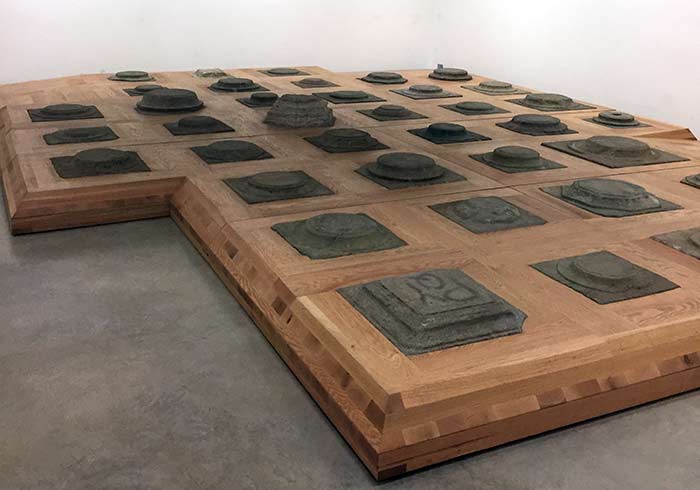
Index on Censorship’s Julia Farrington will be taking part in an evening of rapid-fire talks, screenings and performances staged on Ai Weiwei’s work, Fondation, a platform made from the ruins of ancient columns. In the open spirit of the Roman forum or Greek agora, a number of speakers will discuss borders, identity and people’s role in politics.
Presented by ArtReview Live at the Lisson Gallery.
Speakers include:
Adam Broomberg, Hands off Our Revolution
Sue Clayton, I am Human – Precarious Journeys
Michaela Crimmin, Culture+Conflict
Julia Farrington, Index on Censorship
Jeremy Hutchison, Artist
Sam Jacob, Architect
Keep it Complex Activist group
Kenan Malik, Writer and broadcaster
John Sauven, Greenpeace
Nigel Rolfe, Performance artist
Legacy Russell, Writer and curator
Fatos Ustek, Curator
Richard Wentworth, Artist[/vc_column_text][/vc_column][/vc_row][vc_row][vc_column][vc_column_text]
When: 6.30pm, Thursday 8 December
Where: Lisson Gallery, 67 Lisson Street London NW1 5BY
Tickets: Free, but registration is required. Contact [email protected]
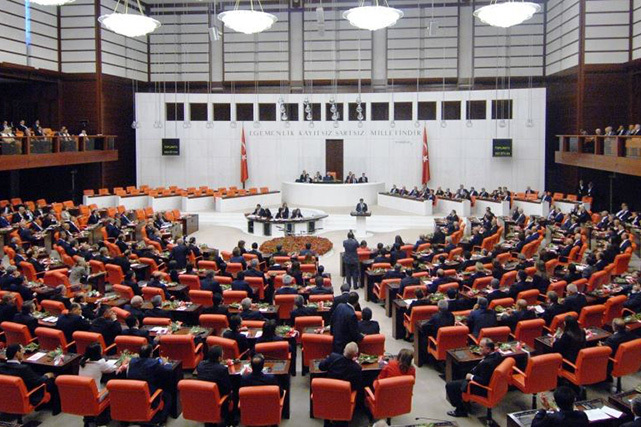
The Grand National Assembly of Turkey. Credit: Wikimedia
The undersigned organisations call on Turkey’s national assembly to end the recently extended state of emergency, and take immediate steps to repair the damage to freedom of expression and Turkish democracy since the defeat of the 15 July coup.
We respect the need for every government to assure the safety of its citizens, yet the measures taken under the state of emergency since July go far beyond what is necessary for public safety, and are destroying the vibrant political culture of open, diverse dialogue that distinguishes a democracy from a dictatorship.
In the three months since 15 July, over 100,000 people have been dismissed from their positions, most for supposed affiliation with the Gulenist movement. Over 25,000 have been arrested, over 2,000 educational establishments have been closed, and more than 150 media outlets have been shut down. Since the declaration of the state of emergency at least 98 journalists have been jailed, bringing the total number of imprisoned journalists in Turkey to 130, not counting those that have been detained and released without charge – making Turkey the world’s leading jailer of journalists.
As Reporters without Borders has documented, those who have worked with or for organisations sympathetic to the Gulenists are being treated as automatic members of the movement. Members of the movement, in turn, are treated as participants in the coup. In casting such a wide net in its crackdown, Turkey’s government is violating both internationally recognised human rights and universally understood principles of justice by ascribing guilt by association, not evidence, and punishing individuals for their thoughts and beliefs, not their actions.
The extension of the crackdown to Kurdish, Alevi and left-wing media uninvolved in the coup suggests that the state of emergency is being abused beyond its stated purpose and is used for harassing individuals and groups that are merely inconvenient to the government in power, not threats to the democratic system. Many are being detained and punished not for a threat they pose to the Turkish government, or to their fellow citizens, but because they disagree with the government’s actions or policy, or are part of or sympathetic to a minority group.
The survival of democracy requires strong tolerance for a broad spectrum of opinion and belief in public life, including those that majority opinion finds inconvenient. Suppressing the independent voice and participation of minorities in public discourse in the name of anti-terrorism is not only a subversion of their free expression rights – it feeds the discontent that grows into extremism. It will be a poor tribute to the peaceful and democratic spirit of 15 July if weakening democracy and strengthening extremism is the direction chosen by the Turkish people’s political representatives in its aftermath.
We call on the national assembly to take immediate steps to protect the right of all citizens to freedom of expression and belief. We believe the state of emergency must either be ended, or greatly narrowed in its scope. We therefore recommend that you:
Return police detention without legal review to the normal maximum four day period, and amend other provisions of the state of emergency to be compatible with the European Convention on Human Rights and International Covenant on Civil and Political Rights;
Explicitly limit terrorism charges to individuals for whom clear evidence exists of acts of violence, intent to commit acts of violence, or advocating of acts of violence, and drop terrorism charges against all those, like Ayşe Çelik and her co-defendants, who have not committed such an act;
Refer cases of media affected by the recent shutdowns back to the judiciary, and permit them to re-open unless and until they are found guilty of a serious crime;
Set clear limits on the use of travel bans and passport confiscation, and end the extension of these measures to family members;
Renew respect for press credentials by state agents, and return confiscated credentials to press not found guilty of a crime.
Signed,
Initiative for Freedom of Expression – Turkey
Afghanistan Journalists Center
Albanian Media Institute
Americans for Democracy and Human Rights in Bahrain
ARTICLE 19
Association for Civil Rights
Bytes for All
Canadian Journalists for Free Expression
Center for Independent Journalism – Hungary
Center for Independent Journalism – Romania
Freedom Forum
Freedom House
Free Media Movement
Human Rights Network for Journalists – Uganda
Index on Censorship
International Press Centre
Journaliste en danger
Maharat Foundation
Media, Entertainment and Arts Alliance
Media Institute of Southern Africa
Media Watch
Norwegian PEN
Observatorio Latinoamericano para la Libertad de Expresión – OLA
OpenMedia
Pakistan Press Foundation
PEN American Center
PEN Canada
PEN International
Reporters Without Borders
Trinidad and Tobago’s Publishers and Broadcasters Association
Vigilance pour la Démocratie et l’État Civique
World Association of Community Radio Broadcasters – AMARC Anatolian Heritage Foundation
Association of European Journalists
Centre for Freedom of Expression at Ryerson University
English PEN
SEEMO
PEN Germany
Wales PEN Cymru
Index on Censorship magazine is discussed in Times Literary Supplement podcast.
With Stig Abell and Thea Lenarduzzi – Elaine Showalter on how extreme misogyny turned Clinton vs Trump into woman vs man; Jonathan Barnes on the long shadow of Bram Stoker’s ‘Dracula’; Houman Barekat on 250 years of ‘Index on Censorship’ and the mutable and myriad threats to free speech; Lara Feigel on two books, by the late Sue Lloyd-Roberts and Lara Pawson, about violence and the sufferings of women around the world – how much progress is there? Download the Shades of Censorship podcast on iTunes
Battle of Ideas 2016 A weekend of thought-provoking public debate taking place on 22 and 23 October at the Barbican Centre. Join the main debates or satellite events.
Comedy and censorship: Are you kidding me? Is the fear of offence killing comedy? Jodie Ginsberg, Timandra Harkness, Will Franken, Tom Walker and Steve Bennett with chair Andrew Doyle.
From hate speech to cyber-bullying: Is social media too toxic?
What of the free speech of those harassed into silence by a stream of abuse? And what of the abuse itself, consisting, as it so often seems to, of fantasy punishments and name-calling? Is that speech worth defending?
I remember the happy clowns of my childhood when the family would sit in front of the TV during the festive holidays to delight at the magnificent performances of the colourful pranksters in Billy Smart’s Christmas Circus.
This sensibility of the clown as the fool, the butt or object of ridicule, loveable but sad, hiding a deep melancholy beneath the exaggerated forced smile was prevalent throughout the twentieth century and was a muse for poets and artists such as Picasso, Bruce Nauman and Uno Rondinone.
The image of the clown changed as I grew older. With glam rock in the 1970s came Leo Sayer’s clown phase and David Bowie’s Lindsay Kemp phase, which re-surfaced in his video for Ashes to Ashes.
But why has the clown now leapt from the realms of the circus, pantomime and contemporary art into our everyday reality? It may the lead up to Halloween but in suburban America the craze of the “creepy” or “killer clown” has reached hysterical proportions. Unsettling, scary individuals dressed as clowns are reported across the media in the USA terrorising the public.
According to Time the craze began in South Carolina in late August where clowns were allegedly spotted trying to lure children into the woods. These reports were unsubstantiated but through meme culture and the media, the frenzy has now gripped the UK. The hysteria has led to lynch mobs hunting down clowns and the banning of clown suits. I have friends and family who told me that school authorities have sent letters, emails and texts to parents warning them about clowns. A policeman even came to visit a school asking secondary school pupils to be on alert.
With the school authorities and the law further whipping up a moral panic about psychotic clowns on the loose, it’s no wonder that children with highly fertile imaginations are spooked and parents are feeling anxious. One twelve-year-old girl daren’t leave the house and sleeps in her parents’ bed. This story has become a familiar one. The panic has even led to the cancellation of a theatre group, The Clown Doctors (the actors wear red noses), who were due to perform in a children’s hospital in Newcastle because “the hospital security said they had been placed on a local hit list for the killer clown craze”.
Fancy dress shops have been asked by the police not to sell clown costumes to anyone suspicious and the NSPCC’s Childline received more than 120 calls from worried children. Instagram, Facebook, Twitter and online news services are awash with impending doom that killer clowns are on the rampage in our communities. What the hell is going on?
Of course, young people love playing pranks on each other but any adult trying to scare children out of their wits by chasing them, or lurking in dark areas, shouldn’t be surprised if they get a punch on the red nose. However, proactively hunting down creepy clowns is stretching the horror narrative a step too far.
Clowns are ambivalent figures where sadness and humour intermingle, but as with most romantic dispositions, there is a dark side to the persona. French Romantic Poets such as Theophile Gautier, Gerard de Nerval and Charles Baudelaire imagined a dark transformation from the happy face/sad visage of the Pierrot to a more tragic figure: “The mask began to give way to reveal a skull beneath, the presence of death.”
The transformation of the clown into the grotesque is indicative of the times we live in. We increasingly feel powerless, disconnected, anxious, paranoid, traumatised, in need of being protected, triggered by certain books, films, art and speech that make some people feel uncomfortable. In this world the clown has become the bogeyman, the outsider, the anti-social, anti-establishment figure of imminent doom, rather like Heath Ledger’s mesmeric portrayal of the nihilistic, terrorist Joker in Christopher Nolan’s The Dark Knight.
This clown’s performance of terror in our everyday lives reveals the growing breakdown of public space as civil, social space. Sociality, the sphere of social intercourse, and sodality – the sense of fraternity and belonging to community in deep and multiple ways – are eroded and replaced by narcissistic attention seeking, exhibitionist tendencies.
The “killer clown” meme is the extreme selfie, demanding that we look at them, that perhaps beneath the grotesque clown mask he or she may have some hidden depths of quality, but sadly that is not the case. They are simply creeps.
Having said that, social media and public space should allow for a multiplicity of expressions. The tiny minority of extreme, aggressive clown’s performing outside of the frameworks of art, theatre, film, circus, the internet and Halloween cannot scream victimhood if they are given a hiding for being deliberately anti-social. However, most of the menace seems to be hyped up via meme culture, the media, hearsay and unsubstantiated stories. It’s how urban myths are created and the craze will eventually die down and fade away.
The greater question we should be asking ourselves is how is it that children, young people, adults and the authorities alike have come to be gripped by this public performance of perceived terror?[/vc_column_text][vc_basic_grid post_type=”post” max_items=”4″ element_width=”6″ grid_id=”vc_gid:1485724639176-d1dda485-42a7-8″ taxonomies=”8826″][/vc_column][/vc_row]