[vc_row][vc_column][vc_custom_heading text=”Index on Censorship has dedicated its milestone 250th issue to exploring the increasing threats to reporters worldwide. Its special report, Truth in Danger, Danger in Truth: Journalists Under Fire and Under Pressure, is out now.”][vc_row_inner][vc_column_inner width=”1/2″][vc_column_text]
Highlights include Lindsey Hilsum, writing about her friend and colleague, the murdered war reporter Marie Colvin, and asking whether journalists should still be covering war zones. Stephen Grey looks at the difficulties of protecting sources in an era of mass surveillance. Valeria Costa-Kostritsky shows how Europe’s journalists are being silenced by accusations that their work threatens national security.
Kaya Genç interviews Turkey’s threatened investigative journalists, and Steven Borowiec lifts the lid on the cosy relationships inside Japan’s press clubs. Plus, the inside track on what it is really like to be a local reporter in Syria and Eritrea. Also in this issue: the late Swedish crime writer Henning Mankell explores colonialism in Africa in an exclusive play extract; Jemimah Steinfeld interviews China’s most famous political cartoonist; Irene Caselli writes about the controversies and censorship of Latin America’s soap operas; and Norwegian musician Moddi tells how hate mail sparked an album of music that had been silenced.
The 250th cover is by Ben Jennings. Plus there are cartoons and illustrations by Martin Rowson, Brian John Spencer, Sam Darlow and Chinese cartoonist Rebel Pepper.
You can order your copy here, or take out a digital subscription via Exact Editions. Copies are also available at the BFI, the Serpentine Gallery, MagCulture, (London), News from Nowhere (Liverpool), Home (Manchester) and on Amazon. Each magazine sale helps Index on Censorship continue its fight for free expression worldwide.
Index on Censorship magazine was started in 1972 and remains the only global magazine dedicated to free expression. It has produced 250 issues, with contributors including Samuel Beckett, Gabriel García Marquéz, Nadine Gordimer, Arthur Miller, Salman Rushdie, Margaret Atwood, and many more.
[/vc_column_text][/vc_column][/vc_row][vc_row][vc_column][vc_custom_heading text=”SPECIAL REPORT: DANGER IN TRUTH, TRUTH IN DANGER” css=”.vc_custom_1483444455583{margin-right: 0px !important;margin-left: 0px !important;border-bottom-width: 1px !important;padding-top: 15px !important;padding-bottom: 15px !important;border-bottom-color: #455560 !important;border-bottom-style: solid !important;}”][vc_column_text]
Journalists under fire and under pressure
Editorial: Risky business – Rachael Jolley on why journalists around the world face increasing threats
Behind the lines – Lindsey Hilsum asks if reporters should still be heading into war zones
We are journalists, not terrorists – Valeria Costa-Kostritsky looks at how reporters around Europe are being silenced by accusations that their work threatens national security
Code of silence – Cristina Marconi shows how Italy’s press treads carefully between threats from the mafia and defamation laws from fascist times
Facing the front line – Laura Silvia Battaglia gives the inside track on safety training for Iraqi journalists
Giving up on the graft and the grind – Jean-Paul Marthoz says journalists are failing to cover difficult stories
Risking reputations – Fred Searle on how young UK writers fear “churnalism” will cost their jobs
Inside Syria’s war – Hazza Al-Adnan shows the extreme dangers faced by local reporters
Living in fear for reporting on terror – Ismail Einashe interviews a Kenyan journalist who has gone into hiding
The life of a state journalist in Eritrea – Abraham T. Zere on what it’s really like to work at a highly censored government newspaper
Smothering South African reporting – Carien Du Plessis asks if racism accusations and Twitter mobs are being used to stop truthful coverage at election time
Writing with a bodyguard – Catalina Lobo-Guerrero explores Colombia’s state protection unit, which has supported journalists in danger for 16 years
Taliban warning ramps up risk to Kabul’s reporters – Caroline Lees recalls safer days working in Afghanistan and looks at journalists’ challenges today
Writers of wrongs – Steven Borowiec lifts the lid on cosy relationships inside Japan’s press clubs
The Arab Spring snaps back – Rohan Jayasekera assesses the state of the media after the revolution
Shooting the messengers – Duncan Tucker reports on the women investigating sex-trafficking in Mexico
Is your secret safe with me? – Stephen Grey looks at the difficulties of protecting sources in an age of mass surveillance
Stripsearch cartoon – Martin Rowson depicts a fat-cat politician quashing questions
Scoops and troops – Kaya Genç interviews Turkey’s struggling investigative reporters
A world away from Wallander – An exclusive extract of a play by late Swedish crime writer Henning Mankell
“I’m not prepared to give up my words” – Norman Manea introduces Matei Visniec, a surreal Romanian play where rats rule and humans are forced to relinquish language
Posting into the future – An extract from Oleh Shynkarenko’s futuristic new novel, inspired by Facebook updates during Ukraine’s Maidan Square protests
The lost art of letters – Vicky Baker looks at the power of written correspondence and asks if email can ever be the same
[/vc_column_text][/vc_column][/vc_row][vc_row][vc_column][vc_custom_heading text=”SUBSCRIBE” css=”.vc_custom_1481736449684{margin-right: 0px !important;margin-left: 0px !important;border-bottom-width: 1px !important;padding-bottom: 15px !important;border-bottom-color: #455560 !important;border-bottom-style: solid !important;}”][vc_column_text]Index on Censorship magazine was started in 1972 and remains the only global magazine dedicated to free expression. Past contributors include Samuel Beckett, Gabriel García Marquéz, Nadine Gordimer, Arthur Miller, Salman Rushdie, Margaret Atwood, and many more.[/vc_column_text][vc_row_inner][vc_column_inner width=”1/2″][vc_single_image image=”76572″ img_size=”full”][/vc_column_inner][vc_column_inner width=”1/2″][vc_column_text]In print or online. Order a print edition here or take out a digital subscription via Exact Editions.
Copies are also available at the BFI, the Serpentine Gallery, MagCulture, (London), News from Nowhere (Liverpool), Home (Manchester), Calton Books (Glasgow) and on Amazon. Each magazine sale helps Index on Censorship continue its fight for free expression worldwide.
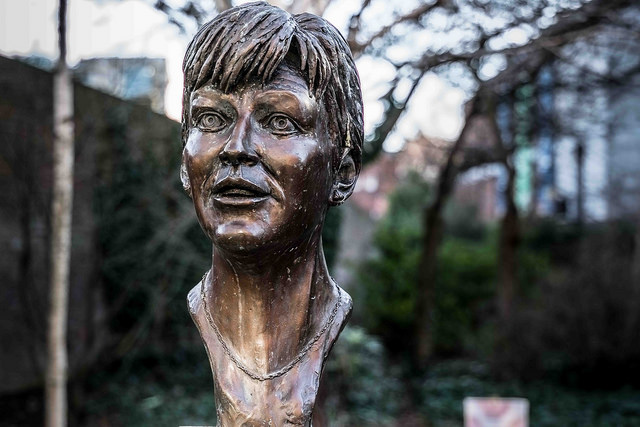
Monument to Veronica Guerin in Dublin Castle gardens. Credit: William Murphy / Flickr
This weekend marks 20 years since the murder of Irish award-winning crime and investigative journalist Veronica Guerin. On 26 June 1996, two masked men on a motorbike pulled up alongside her car at traffic lights on the outskirts of Dublin, opened fire and killed her instantly. Three men were subsequently convicted for their involvement in the murder.
Guerin, who had been working as a freelance journalist for Ireland’s Sunday Independent, made a name for herself investigating and exposing the crimes of senior members of Dublin’s criminal underworld. But such a reputation can be a dangerous thing for an investigative reporter to have. Guerin was subject to a number of attacks and threats, including against the life of her young son Cathal. In 1995 she was shot in her home but survived. Refusing to yield, she continued her work.
“Veronica was a late entrant to journalism; she trained and worked initially in accountancy so she had an instinct for business and understood money,” says Séamus Dooley, Irish Secretary, National Union of Journalists. “That was very useful in studying records and following the money.”
Her death prompted a wave of public anger culminating in the establishment of the Criminal Assets Bureau, followed by more than 150 arrests and a major hunt for organised criminal gangs. “The idea of a designated bureau with sweeping powers to target those with suspicious wealth was a direct response to her murder and caused havoc among those heading criminal gangs,” says Dooley.
Guerin’s death was described by then-Taoiseach John Bruton as a “an attack on democracy”. Unfortunately, this sentiment was echoed earlier this year when current Taoiseach Enda Kenny said: “Journalists and media organisations will not be intimidated by such threats, which have no place in a democratic society.”
The threats he was referring to were made in February 2016 by criminal gangs in Dublin against a number of crime journalists in the city who were reporting on a gangland feud that saw two audacious murders in the space of four days. Police informed Independent News and Media, which owns the Irish Independent newspaper, that the safety of two reporters — a man and a woman — was at risk.
Jimmy Guerin, the brother of Veronica, said at the time: “Successive governments have let down the memory of Veronica … by failing to provide the resources required to beat the gangs.”
So are we back to the way things were two decades ago?
“The situation has been simmering beneath the surface for a while, but the turf wars between the Kinahan and the Hutch families, along with the nature of the violence, is new,” says Dooley. “Gerry Hutch is someone Veronica would have covered in her time, so there is a direct connection with what came before.”
“However, there was this perception that Dublin was a city on lockdown following the killings and journalists are operating under fear,” adds Dooley. “This isn’t bandit country, and there aren’t large numbers of journalists fearful for their lives.”
This shouldn’t mean complacency, adds Dooley, who states that the NUJ has supported a number of journalists at risk in Ireland in recent years.
“One of the problems is that Dublin is a small city, so, naturally, the number of people covering crime is very small,” says Dooley. “Veronica was very well-known to the people she was writing about and so are today’s reporters.”
With crime reporting being such a small part of the market, there is great pressure to deliver stories quicker, which brings problems in itself.
“Today’s journalists are expected to take more risks, and freelancers — as Veronica was — take even greater risks than those in staff jobs,” says Dooley. “While I understand that there is also the commercial element of selling newspapers in order to survive, sensationalising crime coverage in such a high profile way and being overly provocative in the process of selling comes at a price.”
His murder remains an isolated case, but recent years have seen a spate of attacks and threats against journalists in the country. In 2014, Irish News reporter Allison Morris was called a “Fenian bastard” and a “Fenian cunt” as she left court by a gang who threatened to cut her throat.
These are not isolated incidents in either the north or south of Ireland.
If we are to learn anything from the death of Veronica Guerin all these years later, says Dooley, it is that “there needs to be greater recognition of the rights of journalists.”
I have known Erol Önderoğlu for ages. This gentle soul has been monitoring the ever-volatile state of Turkish journalism more regularly than anybody else. His memory, as the national representative of the Reporters Without Borders, has been a prime source of reference for what we ought to know about the state of media freedom and independence.
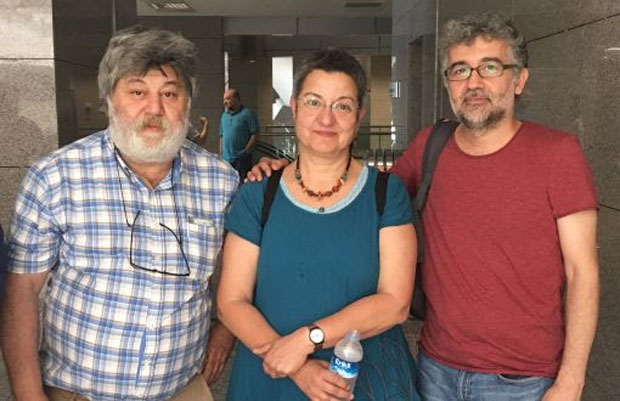
On 20 June, perhaps not so surprisingly, we all witnessed Erol being sent to pre-trial detention, taken out of the courtroom in Istanbul in handcuffs.
Charge? “Terrorist propaganda.” Why? Erol was subjected to a legal investigation together with two prominent intellectuals, author Ahmet Nesin, and Prof Şebnem Korur Fincanci – who is the chairwoman of the Turkish Human Rights Foundation – because they had joined a so-called solidarity vigil, as an “editor for a day”, at the pro-Kurdish Özgür Gündem daily, which has has been under immense pressure lately.
This vigil had assembled, since 3 May, more than 40 intellectuals, 37 of whom have now been probed for the same charges. One can now only imagine the magnitude of a crackdown underway if the courts copy-paste detention decisions to all of them, which is not that unlikely.
Journalism has, without the slightest doubt, become the most risky and endangered profession in Turkey. Journalism is essential to any democracy. It’s demise will mean the end of democracy.
Turkey is now a country — paradoxically a negotiating partner with the EU on membership — where journalism is criminalised, where its exercise equates to taking a walk on a legal, political and social minefield.
“May God bless the hands of all those who beat these so-called journalists” tweeted Sait Turgut, a top local figure of AKP in Midyat, where a bomb attack on 8 June by the PKK had claimed 5 lives and left more than 50 people wounded.
Most recently, Can Erzincan TV, a liberal-independent channel with tiny financial resources but a strong critical content, was told by the board of TurkSat that it will be dropped from the service due to “terrorist propaganda”. Why? Because some of the commentators, who are allowed to express their opinions, are perceived as affiliated with the Gülen Movement, which has been declared a terrorist organisation by president Recep Tayyip Erdoğan.
It is commonplace for AKP officials from top down demonise journalists this way. Harrassment, censorship, criminal charges and arrests are now routine.
Detention of the three top human rights figures, the event in Midyat or the case of Can Erzincan TV are only snapshots of an ongoing oppression mainly aimed at exterminating the fourth estate as we know it. According to Mapping Media Freedom, there have been over 60 verified violations of press freedom since 1 January 2016.
The lethal cycle to our profession approaches its completion.
While journalists in Turkey – be they Turkish, Kurdish or foreign – feel less and less secure, the absence of truthful, accurate, critical reporting has become a norm. Covering stories such as the ”Panama Papers” leak — which includes hundreds of Turkish business people, many of whom have ties with the AKP government — or the emerging corruption case of Reza Zarrab — an Iranian businessman who was closely connected with the top echelons of the AKP — seems unthinkable due to dense self-censorship.
Demonisation of the Kurdish Political Movement and the restrictions in the south eastern region has made it an extreme challenge to report objectively on the tragic events unfolding in the mainly Kurdish provinces which have forced, according to Amnesty International, around 500,000 to leave their homes.
Journalism in Turkey now means being compromised in the newsrooms, facing jail sentences for reportage or commentary, living under constant threat of being fired, operating under threats and harassment. A noble profession has turned into a curse.
In the case of Turkey, fewer and fewer people are left with any doubt about the concentration of power. It’s in the hands of a single person who claims supremacy before all state institutions. The state of its media is now one without any editorial independence and diversity of thought.
President Erdoğan, copying like-minded leaders such as Fujimori, Chavez, Maduro, Aliyev and, especially, Putin, did actually much better than those.
His dismay with critical journalism surfaced fully from 2010 on, when he was left unchecked at the top of his party, alienating other founding fathers like Abdullah Gül, Ali Babacan and others who did not have an issue with a diverse press.
Soon it turned into contempt, hatred, grudge and revenge.
He obviously thought that a series of election victories gave him legitimacy to launch a full-scale power grab that necessitated capturing control of the large-scale media outlets.
His multi-layered media strategy began with Gezi Park protests in 2013 and fully exposed his autocratic intentions.
While his loyal media groups helped polarise the society, Erdoğan stiffly micro-managed the media moguls with a non-AKP background — whose existence depended on lucrative public contracts — to exert constant self-censorship in their news outlets, which due to their greed they willingly did.
This pattern proved to be successful. Newsrooms abandoned all critical content. What’s more, sackings and removals of dignified journalists peaked en masse, amounting now to approximately 4,000.
By the end of 2014, Erdoğan had conquered the bulk of the critical media.
Since 2015 there has been more drama. The attacks against the remaining part of the critical media escalated in three ways: intimidation, seizure and pressure of pro-Kurdish outlets.
Doğan group, the largest in the sector, was intimidated by pro-AKP vandalism last summer and brought to its knees by legal processes on alleged “organized crime” charges involving its boss.
As a result the journalism sector has had its teeth pulled out.
Meanwhile, police raided and seized the critical and influential Koza-Ipek and Zaman media groups, within the last 8 months, terminating some of its outlets, turning some others pro-government overnight and, after appointing trustees, firing more than 1,500 journalists.
Kurdish media, at the same time, became a prime target as the conflict grew and more and more Kurdish journalists found themselves in jail.
With up to 90% of a genetically modified media directly or indirectly under the control Erdoğan and in service of his drive for more power, decent journalism is left to a couple of minor TV channels and a handful newspapers with extremely low circulations.
With 32 journalists in prison and its fall in international press freedom indexes continuing to new all-time lows, Turkey’s public has been stripped of its right to know and cut off from its right to debate.
Journalism gagged means not only an end to the country’s democratic transition, but also all bridges of communication with its allies collapsing into darkness.
Belarus Free Theatre have been using their creative and subversive art to protest the dictatorial rule of Aleksandr Lukashenko for over a decade.
Facing pressure from authorities since their inception, the theatre company nonetheless thrived underground, performing in apartments, basements and forests despite continued arrests and brutal interrogations. In 2011, while on tour, they were told they were unable to return home. Refusing to be silenced, the group set up headquarters in London and continued to direct projects in Belarus. In 2016 the group was shortlisted for Index on Censorship’s Freedom of Expression Arts Award.
Why is it important to mount Burning Doors at this time?
Koliada: Freedom of expression in that geopolitical knot where we come from and where more than 200 million people live under severe pressures of authoritarian and dictatorial regimes. If we do not talk and alert people living in western, democratic countries to our stories, their countries will be infiltrated in different forms, initially unnoticeably, by people manipulating the authorities who say it’s all in the name of the law.
Where did the idea come from?
Koliada: The idea behind Burning Doors is at the heart of Belarus Free Theatre. Close your eyes, just for a moment, and imagine that a theatre company based here in the UK could be prohibited to perform shows by Mark Ravenhill and Sarah Kane, and needs to perform underground. Even operating underground, the actors and managers could be arrested by MI5, riot police or the Met, and audience members threatened and told that they could lose their jobs and education.
(Our audience is a very young one and, of course, they are not scared of the secret services, so what would happen in those cases is that their parents would be threatened with professional retribution.)
I’ll continue and ask you to imagine that all of it has happened and continues to happen to a UK based-theatre company, one that is known and performs across the world, and yet can only exist because its founding members are exiled from their homeland and they now have political asylum in the UK. This has been our story for the past 11 years.
It’s in our blood to feel all the symptoms of dictatorship. Last year when we mounted Staging A Revolution: I’m with Banned which brought international attention to banned artists in Belarus, Ukraine (Ukrainian artists who spoke out against the Russian military invasion of Ukraine and are now prohibited in Russia), and Russia, it was the first time anyone had mounted an artistic solidarity event with Eastern Europe since the collapse of the Soviet Union.
Around the same time that the Festival took place, filmmaker Oleg Sentsov and contemporary artist Petr Pavlensky were arrested. Masha Alekhina, a member of Pussy Riot who served two years in jail, got in contact with us and suggested we work together. We knew we had to do it. We were intrigued by the artistic possibilities of working with a real witness talking about her own personal experiences and bringing her into our Minsk-based ensemble of actors, the most talented and bravest in the world. We wanted to connect Masha’s story to those of other persecuted contemporary actors and through a prism of their personal stories to speak openly about the hypocrisy of politicians and to inspire our audiences to reflect on the reality that we as human beings need to stand up together against repressive regimes. It’s important for us to reemphasise that we are not heroes, we are not victims, we are contemporary artists.
Does BFT think that building cross-border alliances with artists will have an impact on the threats to freedom of expression?
Koliada: Any cross-borders alliances of artists expands audiences. It transforms all of us into a movement. Why do dictators put contemporary artists into jails? Because they want to show with a single example that it’s dangerous to resist systems through the arts. They become scared when we stand up together against them. It’s very simple in thought and action but this is what makes them go into panic mode. Ai Wei Wei was under a house arrest when he created the visual icon for our campaign, Staging A Revolution: I’m with Banned. More than 600,000 people across the world saw it online, and people from more than 37 countries supported our campaign. This kind of collective action makes dictators feel sick and it’s then that they start to make the mistakes that lead to their collapse.
It’s unprecedented for us as a theatre company making work for more than eleven years under dictatorship to collaborate with a woman who served a two-year term in a Russian jail. Within days of announcing this collaboration to the media in the UK, it spread across the world. Even this level of coverage is terrifying to people like Putin or Lukashenko because it demonstrates the tidal wave of support for non-violent resistance by creating art. Art is more powerful than political rhetoric. When Mick Jagger, Tom Stoppard and Vaclav Havel made a video supporting the people of Belarus, we were arrested by the KGB. They knew that it was instigated and created by members of BFT. We understood then that the support of artists across the world was more terrifying to them than statements from politicians.
I think it’s time for all of us to make steps forward and to start to act together with artists, human rights defenders, politicians and journalists, because dictators are scared of a strong mutual position.
How has BFT’s mission evolved since being founded a decade ago?
Koliada: From the very beginning we were only interested in people. Human life is the most interesting subject matter for us. We started with our own personal taboos, then society’s taboos, then moved onto a global dimension. The only thing that is unchanging is our fundamental interest in people. When we perform in different continents across the world, people tell us that they find our work so powerful because they always find themselves within us. And likewise, we find ourselves in our audiences.
How else can people support BFT and Burning Doors?
Koliada: Information is the key. If people know what we do, why and how, we have the chance to continue to exist. People knowing of our existence and our work helps on many different levels including our financial sustainability. Last week, President Obama extended sanctions in Belarus stating that Belarus is “an unusual and extraordinary threat to the national security of the United States of America and its foreign affairs”. Yet at the same time, the EU is playing a badly orchestrated geopolitical rebranding game to try to convince people that “Belarus is normal”. It’s not. It has been a dictatorship in Europe for 22 years, political opponents have been murdered and their bodies never found. Those who perpetrated those crimes are still in power. Even this week, there is a trial underway against Eduard Palchis, who is a blogger and journalist. It seems that Belarus might have seized another political prisoner if human rights organisations across the world do not intervene.
And for BFT more specifically, this month we launched our first-ever Kickstarter campaign. We need to raise £20,000 in the month of June to bring our tireless, extraordinarily brave troupe of actors to the UK to work with them on our new work, Burning Doors. Every pound will help us get there. Please consider finding out more and supporting us today.

 SUBSCRIBE NOW[/vc_column_text][/vc_column_inner][/vc_row_inner][/vc_column][/vc_row]