31 Jul 2014 | Ireland, News, Pakistan, Religion and Culture
It was, apparently, the posting of a “blasphemous image” on Facebook that led an angry mob to burn down houses with children inside them.
It’s been suggested that it was a picture of the Kaaba, Islam’s holiest site, that provoked the mob in Gujranwala in Pakistan. They rallied last Sunday at Arafat colony, home of 17 families belonging to the Ahmadi sect. As police stood by, houses were looted and torched. At the end of the night, a woman in her 50s, Bushra Bibi, and her granddaughters Hira and Kainat, an eight-month-old baby, were dead. None of them had anything to do with the blasphemous Facebook post.
Was the image even blasphemous? In some ways, it doesn’t really matter. What matters was that it was posted by an Ahmadi, whose very existence is condemned by the Pakistani penal code.
Ahmadiyya emerged in India in the late 19th century. It is a small sect based on the belief that its founder, Mirza Ghulam Ahmad, was, in fact, the Mahdi of Muslim tradition. This teaching is rejected by Orthodox Sunni Islam.
In Pakistan, this means that being a member of the Ahmadiyya sect is dangerous. The law says you cannot describe yourself as Muslim. You cannot exchange Muslim greetings. You cannot describe your call to prayer as a Muslim call to prayer. You cannot describe your place of worship as a Masjid.
Any Ahmadi who “any manner whatsoever outrages the religious feelings of Muslims” can be imprisoned for up to three years.
Ahmadis suffer disproportionately from Pakistan’s blasphemy laws, but they are not the only ones who suffer. Accusations of blasphemy are frequently levelled at members of other minorities and at mainstream Muslims too. Often, this is done out of sheer spite. Often it is done to settle scores.
As the New Statesman’s Samira Shackle has pointed out, amid the chaos and fear generated by the law, it’s often difficult to find out what people are actually supposed to have done, as media hesitate to repeat the alleged blasphemy lest they themselves be accused of the crime.
The fevered atmosphere created by the laws mean that to oppose them can be fatal. In Janury 2011, Punjab governor Salmaan Taseer was killed by his own bodyguard after he pledged to support a Christian woman, Aasia Bibi, who had been accused of the crime. Taseer’s assassin claimed that the governor had been an “apostate”. He was widely praised by the religious establishment. Three months later, Minority Affairs Minister Shahbaz Bhatti was killed, apparently because of his belief that the blasphemy law should be changed.
Meanwhile, an amendment proposed by Taseer’s colleague Sherry Rehman, which would have abolished the death penalty for blasphemy, was dropped. Rehman was posted to diplomatic service in the United States later that year, amid allegations that she herself had committed some kind of blasphemy.
The number of blasphemy cases is steadily rising, and Human Rights Watch recently claimed that 18 people are on death row after being found guilty of defaming the prophet Muhammad, though no one has as yet been executed.
The laws may seem archaic, but they are in fact utterly modern. While some of South Asia’s laws on religious offence date back to the Raj, the laws relating to the Ahmadi, and the law making insulting Muhammad a capital offence only emerged in the 1980s, as part of General Zia’s attempts to shore up his religious credentials.
The sad fact is this Pakistan’s new enthusiasm for blasphemy laws is not an international aberration. Nor is this a trend confined to confessional Islamic states.
Ireland’s 2009 Defamation Act introduced a 25,000 Euro fine for the publication of “blasphemous matter”. According to the Act , “a person publishes or utters blasphemous matter if—
(a) he or she publishes or utters matter that is grossly abusive or insulting in relation to matters held sacred by any religion, thereby causing outrage among a substantial number of the adherents of that religion, and
(b) he or she intends, by the publication or utterance of the matter concerned, to cause such outrage.”
Note how similar the wording is to the Pakistani law forbidding Ahmadis from offending Muslims. The Pakistani government repaid the compliment when, along with other members of the Organisation of Islamic Conference, it attempted to force the UN to recognise “religious defamation” as a crime, lifting text from the Irish act. Pakistan claimed, grotesquely, that criminalising blasphemy was about preventing discrimination. Cast your eyes back once again to how its blasphemy provisions treat Ahmadis.
Across Europe, more and more blasphemy cases are emerging. In January of this year, a Greek man was sentenced to 10 months for setting up a Facebook page mocking an Orthodox cleric. In 2012, Polish singer Doda was fined for suggesting that the Bible read like it was written by someone drunk and “smoking some herbs”. The trial of Pussy Riot in Russia was heavy with talk of sacrilege.
We tend to believe that the world is moving inexorably toward a secular settlement. The unintended upshot of this prevalent belief is that organised religions, even in countries like Pakistan, get to portray themselves as weak people who need to be protected from extinction, even as they wield power of life and death over people.
Religious persecution is real, and should be fought. Freedom of belief is a basic right. But blasphemy laws protect only power, and never people.
This article was posted on July 31, 2014 at indexoncensorship.org
30 Jul 2014 | News, Poland, Religion and Culture
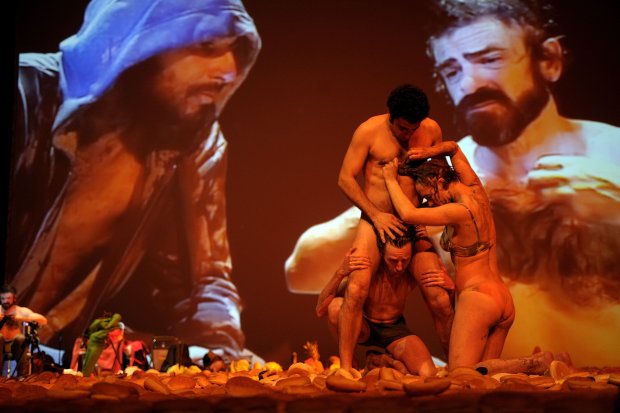
Golgota Picnic was pulled from a the Malta Festival in Poland after religious groups leveled threats.
The Polish theatre scene has been rocked by controversy since late June after the cancellation of Golgota Picnic, a show by the Argentinian theatre maker Rodrigo Garcìa that had previously aroused protest in France.
The play’s supposedly blasphemous content meant that Michał Merczyński, director of the Malta Festival, had pulled the headline show of his festival a week before its scheduled performance. The Malta Festival in Poznań is Poland’s answer to the Edinburgh Festival, and I was visiting with other directors from the Young Vic to learn more about Polish theatre culture. Our experience of the festival was derailed by claims and counter claims of blasphemy and censorship.
Merczyński’s decision to pull the show was based on information that a protest of 50,000 was planned and advice from the police that they could not guarantee the safety of the audience or the performers. The festival’s decision enraged large parts of secular Poland’s cultural elite, who feared that the police warning represented the state’s acquiescence to unofficial censorship by a group of interests centred upon the increasingly powerful Catholic church.
In reaction to the cancellation, there was a proliferation of protest screenings and staged readings of Golgota Picnic in theatres across Poland, some of which were variously picketed by a loose coalition of Catholics, neo-nazis and football hooligans. At the protest screening my group attended, at TR Warzsawa in Warsaw, these three groups all appeared to be embarrassed by each other. They prayed together and held placards warning that “Poland, motherland of Saint John-Paul II must not be a latrine for the trashes of the blasphemer, of the scoffers, of the traitors, of the barbarian and pseudo-artists”.
The Young Vic directors were jostled as we attempted to get in to the theatre and through the double cordon — first the protesters trying to stop us getting into the theatre, and then the police holding back the protesters. In the end we climbed over a low fence around a corner to get in and the police quickly bundled us into the building.
It’s important to say that this was much more exciting than it was scary. Here was evidence that theatre matters: people threatening hostility, if not quite violence, in response to an artwork. As far as I could make out from the DVD, Golgota Picnic (screened in Spanish with Polish subtitles) was a considered and beautiful meditation on the body and on Christ’s body in particular. Although it included a scene where a woman playing Jesus sculpted her gelled hair over another person’s genitalia, I’ve certainly seen more blasphemous plays. The crowd outside were fairly audible in their hymns and their chants, but — in the end, the protesters were defeated by the length of a piece of theatre. When we emerged two and a half hours later, they had given up and gone home.
The cancellation of Golgota Picnic left the Malta Festival deflated, but it felt as if these protests might be a powerful shot in the arm for Polish theatre culture in general. Several people we met were excited by the possibilities of the networks created and issues raised in the fight against religious censorship. Polish theatre provided a central political role in the end years of communism, and then lost its way only to be reinvented at the end of the nineties as a means to interrogate more universal themes in the formally explosive theatre of Gzegorz Jarzyna, Krzystof Warlikowski and Jan Klata, directors who still dominate the scene. It appears that Polish theatre is ripe for a new generation to redefine what theatre means.
As an outsider, this culture war looked complex and unhappy. Of course I was inside the theatre rather than on the street with a rosary, but it was clear that all the theatre people we met were well educated and well heeled. The Catholic protesters were not, and they felt like a demographic who had been left behind by the neo-liberalism that has replaced communism. It’s hardly surprising that these people are angry to see that “they are mocking us”, as one man complained to us on the steps of TR Warszawa.
It’s worrying to encounter theatre censorship in the EU, and artists should be free to present their work. At the same time, theatre institutions have a responsibility to ensure each piece of work finds its audience in the most productive way possible. With Golgota Picnic, the Malta Festival imported a show that had already caused protests elsewhere. Their marketing presented it as sexily controversial, and when this spectacularly backfired they cancelled the performance. Artists should shock and offend, but theatre makers and producers have to tread thoughtfully to ensure that the presentation of powerful work doesn’t play into the hands of those who would censor it.
Jeff James’s visit to Poland was supported by the Adam Mickiewicz Institute, the Young Vic and the Jerwood Charitable Foundation.
This article was posted on July 30, 2014 at indexoncensorship.org
11 Jul 2014 | Awards, News, Turkey
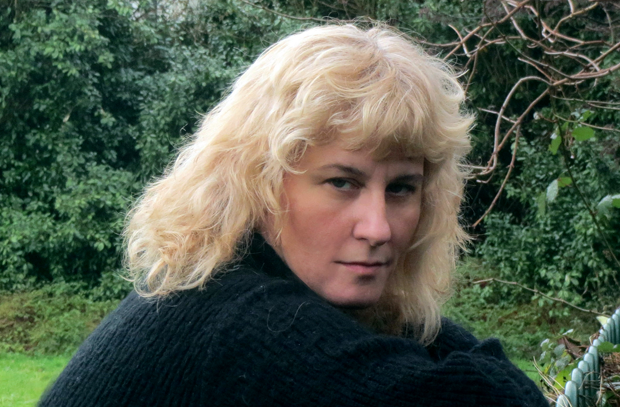
Meltem Arikan
Three months have passed since the 2014 Index Awards and we caught up with arts nominee, Meltem Arikan. The Turkish playwright and author told Index she has finished the script of a new play, Sheep Republic. She hoped it would be staged in Turkey, but the political situation in the country prevents this from happening. She looks forward to hopefully having it staged in the UK with the team who brought her previous play, “Mi Minor” to life.
Index: What projects have you been working on since the Index Awards?
Arikan: I wrote a performance piece for The International Performance Festival Cardiff called “Recalling love: And woman and man” and it was performed in June by Memet Ali Alabora and Pinar Ogun, whom I created Mi Minor with. Then I finished writing the script of my new play “Sheep Republic” which is about oppression and how easily it’s accepted by people.
The play was written to be staged in Turkey originally, however it doesn’t look like it is going to be possible because of political reasons. So we want to stage it here with the creative team of “Mi Minor”.
Nowadays I am working on another theatre piece where I’m questioning the concept of “belonging” through my own experiences, feelings and observations of nationalities, races, languages and communities; this time to be performed in Welsh language, and quite unusually English language will be the foreign language. It will be previewed in Eisteddfod Festival as part of Theatr Genedlaethol’s Cwt Drama on 7 August.
Index: What do you hope for the future of these projects and your life in the next coming months?
Arikan: I always find questions about hope quite difficult to answer. So much that I have even named one of my novels “Hope is a curse.” My agent Meg Davis has introduced my banned book “Stop hurting my flesh” to publishers in the UK. It’s an ongoing process but the idea of my novel being published, excites me very much, just like the thought of “Mi Minor” to be staged in the UK.
Index: Before the awards, did you feel you had less recognition?
Arikan: After being nominated by Index, in February 2014, I was invited to PEN Ethiopia 3rd congress with Julia Farrington from Index, where I met the President of German PEN, Josef Haslinger, who has recently invited us to Frankfurt Book Fair in October to introduce my story and my work.
It was great to be nominated by Index and it surely gave me more recognition. Moreover, being a part of the Index family and to be able to write articles about freedom of speech and expression is just as important for me.
Last year during Gezi Park demonstrations it was hard enough to deal with the false allegations made in various media about my play and the “Mi Minor” creative team. We were accused of rehearsing Gezi park demonstrations with our play. We were completely exhausted, and didn’t feel safe to leave our houses in Istanbul. They were making a lot of TV shows about “Mi Minor” which included an edited version of one of my speeches that I made six years ago about secularism. As a result of these accusations I have received thousands of death and rape threats. The fear I witnessed in my son’s eyes and the anxiety that my partner was living through was what upset me the most. I still feel fragile when I recall the moments I had to leave them behind and come to the UK to stay alive. Because of the notorious recognition, I was even being cautious while walking on the streets of London in the first couple of months of coming here.
Index: How has your life changed since being nominated for an Index Award?
Arikan: I came to the UK with one piece of luggage, leaving everything behind, then I met Julia Farrington and she offered to do an interview with me. So we archived my story with three interviews which was very difficult and encouraging for me at the time.
Later I was nominated for an Index Award, and I met Index staff through the Index Awards and when they asked me to write for the website, I was delighted. Writing is what keeps me sane. I don’t know how to survive without writing so I am thankful to be supported as a writer by Index On Censorship.
This article was posted on July 10, 2014 at indexoncensorship.org
10 Jul 2014 | Europe and Central Asia, Ireland, News

(Image: Quka/Shutterstock)
A recent court ruling in Ireland could have reintroduced the concept of criminal libel to the state, despite criminal defamation offences being abolished as recently as 2009.
The case itself was one of a particularly grim relationship break up. Names are not available as the people involved were also locked in a criminal case in which the male partner was accused of rape and false imprisonment, though he was acquitted of both.
But the details available are: couple breaks up in January 2011. They remain in touch. In April 2011, man goes to woman’s house to, according to the Irish Times’s report “confront her over a perceived infidelity”. Man later leaves woman’s house, but not before stealing her phone. Man goes through woman’s messages, which suggest she has started a new relationship. Man opens woman’s Facebook on phone and posts remarks from her account, making it appear that she is presenting herself as a “whore” who would take “any offers”. Drink was a factor, as the Irish court reporting phrase goes.
This action led to a charge under the Criminal Damage Act 1991, under which “A person who without lawful excuse damages any property belonging to another intending to damage any such property or being reckless as to whether any such property” can find themselves liable to a large fine and up to 10 years in prison.
In this case, the defendant was found guilty and fined €2,000.
The judge, Mr Justice Garrett Sheehan, is reported to have asked how to assess the “damage” when nothing had actually been broken. Prosecutors replied that the case was in fact more akin to harassment and that the “damage” had been “reputational rather than monetary”.
The first question here is obvious: if the facts of the case were more akin to harassment, then why were charges not brought under Section 10 of Ireland’s Non-Fatal Offences Against The Person Act, which would cover anyone who “by his or her acts intentionally or recklessly, seriously interferes with the other’s peace and privacy or causes alarm, distress or harm to the other”? Wouldn’t this be the obvious piece of legislation to use?
But after that, there are a few more: Who actually owns a Facebook profile? And does reputation count as property? And crucially, has Mr Justice Sheehan created a criminal libel law?
Ireland has a complicated relationship with social media. On the one hand, to be plain about it, the big online companies create a lot of employment in Ireland. Facebook, Twitter and Google all employ a lot of people in the country. On the other hand, it is susceptible to the same moral panics as anywhere else, and in a small, largely homogenous country, panics can be enormously amplified.
When government minister Shane McEntee committed suicide in Christmas 2012, the tragic story somehow became conflated with social media and online bullying. McEntee’s brother blamed the minister’s death on “people downright abusing him on the social networks and no names attached and they can say whatever they like because there’s no face and no name”. But his daughter later refuted that claim, saying: “Dad didn’t use Twitter and wasn’t a huge fan of Facebook. So I don’t think you can blame that and I’m not going to start a campaign on that.”
The subsequent debate on social media bullying was almost tragic in its simplicity, the undisputed highlight being Senator Fidelma Healy-Eames describing to the Parliamentary Joint Committee on Transport and Communications how young people are “literally raped on Facebook”.
As ever in discussions that involve social media, a generation gap opens up, or is invoked, between younger “natives” who supposedly instinctively understand the web, and a political and judicial class who are apparently hopelessly out of touch. There is certainly an element of truth to this (I have sat in courts and watched judges express utter bafflement at the very concept of Twitter), but in general, what is actually happening is legislators, magistrates and the judiciary are desperately trying to apply existing, supposedly universal laws to phenomena to which they are simply not suited. This is where controversy usually arises, for example in the UK’s use of public order laws when the only threat to public order is a Twitter mob — as in the case of jailed student Liam Stacey; or use of laws against menacing communications in instances where it’s clear no menace was intended — such as Britain’s now infamous Twitter Joke Trial.
In the current Irish case, it seems obvious that harassment would have been the more relevant charge, but in this instance, that’s not what we have to worry about. The real concern is that by apparently putting reputation in the category of property which can suffer damage, the court has now created a precedent where damage to a person’s reputation, whether by “fraping”, tweeting, or even just the getting facts wrong in a news story, could lead to criminal sanction.
And the very worst thing is that no one seems to have noticed.
From the introduction of the new blasphemy law onward, Ireland has seen a slow, stealthy erosion of free speech. It’s not clear what will get people to start paying attention, but the country needs to be more vigilant.
This article was posted on July 10, 2014 at indexoncensorship.org
