24 Apr 2014 | Ireland, News, Politics and Society, Turkey, United Kingdom
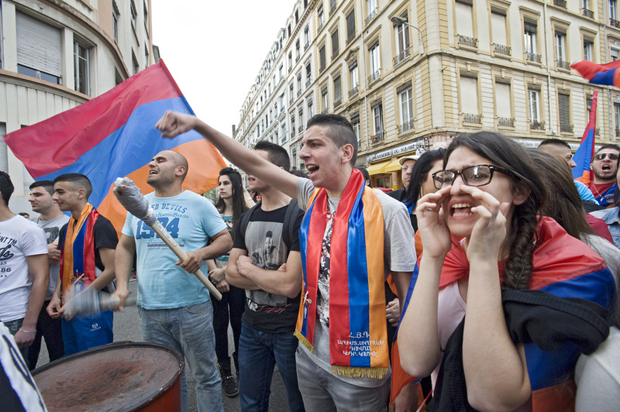
Armenian protesters in Lyons accused Turkey of supporting Islamic rebels in an attack on Kessab, an Armenian majority town located in Syria, on the Turkish border. (Image: Benjamin Larderet/Demotix)
It is, as Zhou Enlai might have said, probably too early to tell how significant Tayyip Erdogan’s comments alluding to the Armenian genocide will be.
The Turkish prime minister seems to have broken one of his country’s great taboos. In a statement translated into nine languages, the AK leader said: “It is with this hope and belief that we wish that the Armenians who lost their lives in the context of the early 20th century rest in peace, and we convey our condolences to their grandchildren.”
“Having experienced events which had inhumane consequences — such as relocation — during the First World War, should not prevent Turks and Armenians from establishing compassion and mutually humane attitudes among towards [sic] one another.”
According to Anadolu, Turkey’s state news agency, Erdogan also commented: “In Turkey, expressing different opinions and thoughts freely on the events of 1915 is the requirement of a pluralistic society as well as of a culture of democracy and modernity.”
This is not, you will have noticed, an apology. Offering condolence is not at all the same as expressing remorse. Though some would say it is not Erdogan’s duty to express remorse; he is the prime minister of the modern republic of Turkey, not the Ottoman Empire under which the alleged slaughter of over 1.5 million Armenian Christians in 1915 took place.
And some are utterly contemptuous of Erdogan’s statement: Reuters quotes the Armenian National Committee of America describing the statement as an “escalation” of Turkey’s “denial of truth and obstruction of justice”.
But let us assume that a) Erdogan is in a position to speak for Turkey past as well as present, and b) there is, at the kernel of this, an attempt at reconciliation with Armenia and the Armenian diaspora.
The very mention of the events are significant against the backdrop of the Turkish Penal Code’s controversial Article 301, which forbids insulting “the Turkish nation”. That law has in the past, effectively barred discussion of the genocide, and created a environment where simply identifying as Armenian within Turkey was seen as a provocative act.
The most famous victim of this culture was Hrant Dink, the editor of Agos who was assassinated in January 2007.
Dink saw himself as Turkish-Armenian, and his newspaper was bilingual. He was a firm believer in the potential for dialogue in bringing some reconciliation between Turks and Armenians. He also believed such dialogue could only take place in an atmosphere free of censorship, to the extent that he vowed that he would be the first person to break a proposed French law making denial of the Armenian genocide a crime (a cheap political trick aimed at both currying favour with the Armenian community in France and creating a barrier for Turkey’s proposed entry into the EU).
Ultimately, Dink believed that progress could only be made if we were able to talk freely and access historical debate without impediment or fear.
History, like science, is a process rather than a dogma. And like science, one’s interpretations of history can vary based on both the evidence available and the prevailing mood.
For a long time after the creation of the Irish state, for example, the teaching of history in schools was simple. I recall one primary school history text which seemed to consist entirely of tales of the terrible things foreigners had done to the Irish: first the Vikings, then the Normans, and finally the English. The book finished pretty much where the 1919 War of Independence began. The last page featured the words of the national anthem and a picture of the national flag.
Sympathetic portrayals of English people, and British soldiers in particular, were thin on the ground — Frank O’Connor’s tragic short story Guests of the Nation being one of the very few.
Since the late 1990s peace process, both fictional and historical perspectives on Ireland’s relationship with Britain have changed. Some of the novels of Sebastian Barry, for example, attempt to tell stories of people who were neglected and even vilified in nationalist, Catholic, post-independence Ireland. Part of the plot of Paul Murray’s Skippy Dies has a Catholic school history teacher attempting to get his pupils interested in Irish soldiers who fought for Britain in World War I. Meanwhile, a recent book by nationalist historian Tim Pat Coogan, attempting to paint the Irish potato famine as deliberate genocide rather than cruel neglect, was given short shrift, in spite of the fact that this would have been a mainstream view until relatively recently — one must only listen to the sickly sentimental lyrics of rugby anthem The Fields of Athenry, penned in the 1970s, to understand the appeal of that victim status to the Irish imagination. Wrongs were certainly done in Ireland, but the relationship between the two nations was a hell of a lot more complex than the oppressor/oppressed line that was spun for so many years.
There was no official sanction on differing views of Anglo-Irish relations, but politics permeated the debate. Likewise with the recent intervention of British education secretary Michael Gove on the issue of how World War I is taught in schools. Gove claimed that the idea of a pointless war in which a moribund (figuratively) ruling class led moribund (literally) working class boys to their graves was a modern lefty invention. He was wrong, in that that view had been common even in the 1920s, but his opponents were equally adamant in their insistence that there could only be one view of World War I. None of this discussion was accompanied by new evidence on either side.
At the extreme end of this hyper-politicisation of history are the Holocaust denial laws of many European countries, and laws on glorification of the Soviet era in former Eastern bloc.
In his cult memoir Fuhrer-Ex, East German former neo-nazi Ingo Hasslebach described how, growing up in the DDR, with its overwhelming anti-fascist narrative, nazi posturing was the ultimate rebellion. In the modern era, France’s prohibition on nazi revisionism has led some young north African immigrants, alienated from the French nation state, to see anti-semitism and the quasi-nazi quenelle gesture as the ultimate “fuck you” to the authorities.
Taboos about discussing events of the past breed bad history and bad politics. For the sake of Turkey, and the rest of us, Erdogan should be held to his words on the necessity of free speaking and free thinking.
This article was originally posted on 24 April 2014 at indexoncensorship.org
23 Apr 2014 | Egypt, Middle East and North Africa, News
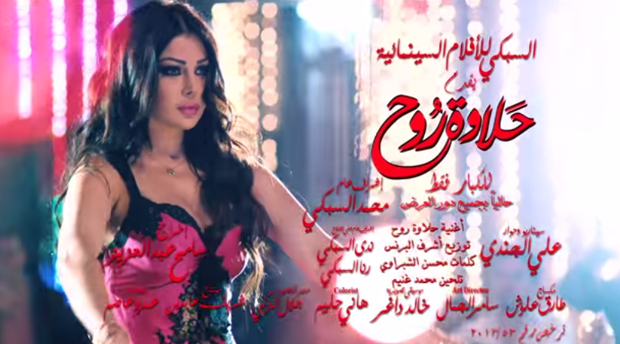
A shot from the trailer of Halawet Rooh (Image: Mohamed Elsobky/YouTube)
Just as Egyptian free expression advocates were celebrating the decision by Egypt’s State Censorship Board to allow the screening of Darren Aronofsky’s Biblical epic Noah, news of the withdrawal of Lebanese diva Haifa Wehbe’s new film Halawet Rooh (Beauty of the Soul) from theatres in Egypt put a damper on their cautiously optimistic mood. The fact that the decision to suspend the screening of the controversial film was made by interim Prime Minister Ibrahim Mehleb — rather than by the censors — has added fuel to the fire.
On Wednesday, the premier ordered the film to be removed from cinemas and sent back to the State Censorship Board for re-evaluation. The move led Ahmed Awad, the head of the State Censorship Board to tender his resignation, saying he was “not consulted” and categorically rejects government interference in his work.
Former Culture Minister Emad Abu Ghazy reminded the prime minister of a court ruling forbidding interference in the work of the independent censorship board. “The Premier has no right to suspend the screening of the film,” Abu Ghazy told AFP.
Popular TV talk show host Ibrahim Eissa meanwhile, cautioned that the ban does not auger well for freedom of expression.”Those who ban films today for damaging public morality will in future, ban films for political reasons,” he warned in an episode of his show “Hunna Al Kahera” broadcast on the privately owned CBC Channel.
Rights activists and groups have also expressed concern over the suspension of the film’s screening, saying the move is part of a wider clampdown on artistic expression in Egypt. In his column in Saturday’s edition of the independent newspaper Al-Shorouq, film critic Kamal Ramzy chided the government for not having learnt history’s lessons on censorship. “Instead of focusing on problems of corruption and the rule of law, the prime minister is instead, more occupied with censorship,” he lamented.
Mehleb meanwhile, downplayed the criticism levelled at him. At a meeting with intellectuals and literary figures on Saturday, he insisted that “there is a clear cut distinction between freedom of artistic expression and creativity on the one hand, and infringement on moral values on the other”.
The premier’s decision to suspend the screening of the film came in the wake of an outcry from conservatives in Egypt who denounced the film on social media networks as “obscene” and “a threat to public morality”. Oddly enough, some “liberal” Egyptians too, have joined the online campaigns accusing Ahmed El Sobky, the film’s producer of “destroying an entire generation” and being “more dangerous than bombs and missiles”. El Sobky’s trademark films are often “low quality” productions characterised by a mix of violence, belly dancing and sexually explicit scenes. His target audience are generally the uneducated, low income youth who traditionally celebrate public holidays by going to the cinema.
Film critics have also decried the film as “sexually provocative,” lambasting lead actress Haifa for “revealing too much flesh”. “There is hardly a scene in which Haifa does not appear half nude,” scoffed critic Ramy Abdel Razak in his review published Thursday in the independent daily Al Masry El Youm.
Critics question how a particularly steamy scene in which Haifa’s clothes are ripped off by a rapist, got past the State Censor board. Overlooking the fact that the film was rated “Adults Only” — which meant it was inaccessible to children under 16 — Egypt’s National Council for Childhood warned in a statement released last week, that the film was “harmful to minors” and “violates public morality”.
The “raunchy” film had been in cinemas for two weeks before it was removed and had reportedly grossed some £84,100 in its first week in theatres. At the time of publication, a two-minute trailer for the film on YouTube had over 3,6 million views.
Described by critics as a “poor imitation of Italian director Giuseppe Tornatore’s widely-acclaimed Malena”, the film tells the story of a young boy’s obsession with a beautiful nightclub singer. The woman, whose husband is abroad, is pursued by the men in her working class neighbourhood and her ardent young admirer subsequently takes it upon himself to protect her.
Fifteen year-old Karim El Abnoudi, who plays the role of the boy infatuated with Rooh, has reportedly been verbally harassed at his school and on the streets, with his classmates and some laymen — angered by what they had read or heard about the film — hurling insults at him and calling him “an infidel”.
The withdrawal of the film from theatres has fuelled fears among some secularists and rights organisations that increased censorship is stifling freedom of artistic expression and creativity in Egypt. In March, the State Censorship Board banned 20 music videos from Egyptian TV Channels for allegedly containing “explicit content”. In another sign that the interim government is putting the lid on artistic expression, a misdemeanour court in the Southern Egyptian province of Bani Suef in March upheld a verdict against Egyptian author and rights activist Karam Saber, who eight months earlier had been sentenced in absentia to five years in prison and LE1000 in bail for “blasphemy”. In June 2013. Saber was convicted on charges of “contempt of religion” and “inciting sedition” in a collection of short stories he wrote two years earlier titled Where is God? Both Al Azhar (the country’s highest Islamic authority ) and the Coptic Orthodox Church had earlier concurred in the opinion that the book was “blasphemous” and “ought to be banned”.
In a joint statement released in September (in the wake of the sentence handed down to Saber), 46 Arab Human Rights Organisations expressed concern for the diminishing space for free artistic expression and creativity. The Arab Network for Human Rights Information also said the verdict against Saber “belies any notion of respect for human rights by the state and violates provisions in the new constitution guaranteeing freedom of creativity and artistic expression”.
A provision in the new charter, endorsed by an overwhelming 98% of voters in a popular referendum in January, guarantees freedom of thought and opinion stipulating that any individual “has the right to express his opinion and to publicise it verbally or in writing or by other means”. Another provision in the 2014 constitution guarantees freedom of literary and artistic creation, stating that “the state shall promote art and literature, sponsor creators and protect their creations, providing the necessary means to achieve this”.
Many artists and writers had joined the mass protests in January 2011, hoping that the revolution would bring an end to decades of repression. For a short period after the fall of authoritarian president Hosni Mubarak, Egypt’s artists and literary figures capitalised on their new-found freedoms, tackling subjects long off limits to them — like sex and religion.The rise of Islamists to power in 2012 , however brought new limitations to the short-lived free flow of artistic and creative expression. New legislation was introduced by the Islamist-dominated parliament, banning art with obvious sexual references as well as concerts featuring female singers. The downfall of the Muslim Brotherhood regime in July 2013 rekindled hopes for an end to censorship and suppression of creativity. But in the new restrictive cultural atmosphere — reminiscent of the Mubarak era — these hopes have been quickly dashed, giving way to disappointment, frustration and fear.
“It is ironic that the ban on Wehbe’s film would come from the interim government that replaced the ousted Islamist regime,” prominent blogger Zeinobia wrote last week. Many of the liberal Egyptians who joined the uprising against the Muslim Brotherhood president in July last year had said they were protesting against “religious fascism” and had hoped the new government would be secular and more democratic.
“The interim government has demonstrated that it is more Islamic than the Islamists,” lamented Sameh Kassem, culture editor at the independent Al Bawabh news website .
“The withdrawal of Wehbe’s film from theatres and the verdict against Saber are attempts by the interim government to appease the ultra-orthodox Salafis ahead of presidential elections scheduled on 28 and 29 May,” he told Index.
Egypt’s Salafis, the ultra-conservative Islamist movement that had initially backed ousted Muslim Brotherhood President Mohamed Morsi, later decided to side with the military and lent its support to the military-backed interim government after his deposition.
“The military-backed authorities are trying to woo the Salafis to guarantee their votes for former military chief Abdel Fattah El Sisi in the upcoming elections,” Kassem said.
This article was originally posted on 22 April 2014 at indexoncensorship.org
17 Apr 2014 | Europe and Central Asia, News, Uzbekistan
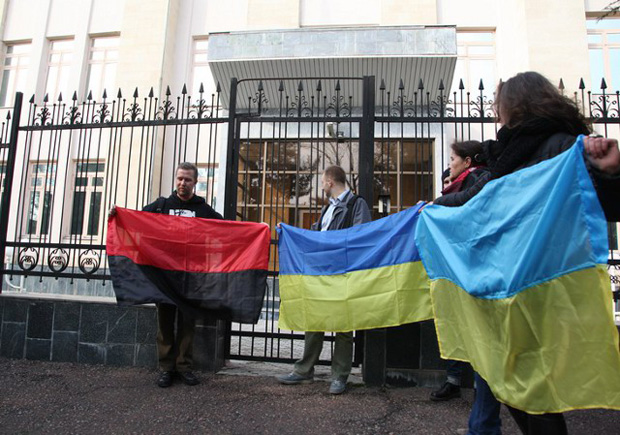
Umida Akhmedova took part in a small protest in Tashkent, in solidarity with the Euromaidan movement.
On 27 January, internationally renowned photographer Umida Akhmedova, her son Timur Karpov and seven other people took to the streets of Tashkent, Uzbekistan. Armed with Ukrainian flags, cameras and a petition, they staged a peaceful protest in solidarity with the Euromaidan movement.
Knowing they might attract unwanted attention, the group, which included one journalist reporting, posed for a few photos outside the Ukrainian embassy, handed over the petition, and quickly wrapped up the demonstration. However, their worries soon proved valid. Three days later, the protesters were hauled in one by one by police for a “short talk”. They would be held incommunicado for one day, first in a central Tashkent police station and later at a more remote location.
Karpov, a photographer based in Russia, told Index about unprofessional and aggressive officers, who called the protesters “dissidents” who were “ruining the constitution”. Passports and phones were taken away, but Karpov managed to keep one concealed to alert the outside world to their detention. It was eventually discovered and confiscated. When he got it back, it had been completely wiped. Without access to lawyers, the protesters were questioned by the SNB — the KGB’s successor — before being put through a quickie court session and ordered to pay fines of some £1,200. Three of them have been sentenced to 15 days in prison. Justice, as understood by Uzbekistan’s notoriously repressive regime.
This is not the first time Akhmedova has run into trouble with the regime of former Communist Party official Islam Karimov. In 2009, the photographer and documentary film maker, whose work has been published in The New York Times and Wall Street Journal, was charged with “damaging the country’s image” over a series of photographs depicting life in rural Uzbekistan. Similar charges were later levelled at her over a film about challenges facing Uzbek women, and in 2010, over a book about Uzbek traditions. It’s worth noting that she never intended to make a political statement with her work — the authorities’ reaction is what has politicised it. The cases have made Akhmedova a credible voice of opposition, and while her high profile provides some protection, it also means her every move is noted — as the latest case shows.
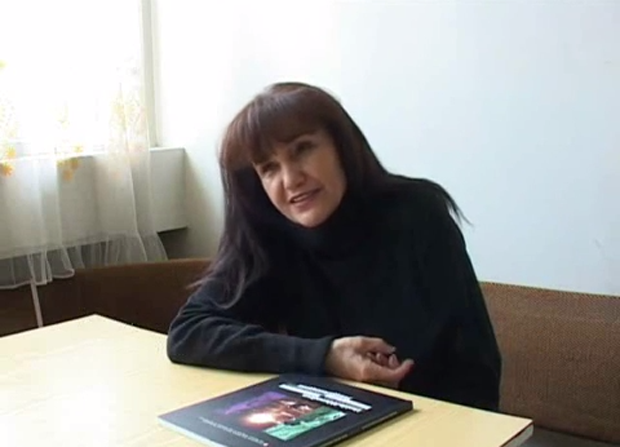
Umida Akhmedova (Image: Uznewsnet/YouTube)
“We live in a strict, archaic society, where all unregulated acts, especially those that can cause some kind of a response in the society, are nipped in the bud,” she told Index. “In the case of our Maidan project, the authorities did not have to be clairvoyants to see the similarities between the situation in Ukraine and the one in Uzbekistan. The government has started scaring children and adults with the word Maidan and did not like it when we showed support for Maidan.”
“As for our previous case,” she adds “we were charged with slander and insult of Uzbek nation, because the government wanted to teach us a lesson that without the approval from above, we were not allowed to film anything or publish books, or generally, do anything artistic without a superior permission.”
While Akhmedova’s latest arrest hit headlines across Central Asia, the story made little impact in the west. This is not surprising. Earlier this year the soap opera-like falling out between first daughter Gulnara Karimova — businesswoman, sometimes pop star, and until recently tipped to follow in her father’s presidential footsteps — and, seemingly, the rest of the family was covered by media outside the country. But on the whole, Uzbekistan rarely commands international attention. Like many other countries in the region, it is able to carry out its repressive rule away from the global spotlight.
President Karimov, by taking a number of liberties with the country’s constitution and term limits, has been in power since it gained independence from the Soviet Union in 1991. Reports of torture and other power abuses are widespread, the darkest days of the regime coming with the Andijan massacre, where security forces killed hundreds of people in the aftermath of a peaceful protest. The country is also one of the most corrupt in the world and despite its gas resources — part of the reason for many western sanctions quietly being dropped — suffers “recurring energy crises“. But Karimov has been careful to remove nearly all institutions that might use this information to challenge his power. Uzbekistan has no official opposition parties and no press freedom to speak of. Opposition news sites that operate outside of the country are blocked. Karpov puts it simply: “There is no freedom of expression in Uzbekistan. Absolutely none.”
One aspect of the widespread press censorship, is that developments in Ukraine have been met with near media blackout in Uzbekistan — the same way authorities dealt with the Arab spring and other incidents of popular unrest outside the country’s borders.
“From my point of view, they’re afraid. Extremely afraid of any sort of freedom,” says Karpov. ” That’s why they made the case with us. To frighten us. To show to other people that if you do this, you will be sentenced.”
Mother and son have accepted their punishment — partly because refusal to do so would lead to further blacklisting, and partly because they weren’t alerted to their appeal until after it had taken place. Unsurprisingly, the sentences were not overturned.
Despite this latest setback, and the possibility of being handed down a travel ban, Akhmedova remains undeterred. “Nothing has changed for me. I will carry on ‘slandering’ as I have done,” she says. “The state cannot help or stop me.”
This article was originally posted on 17 April 2014 at indexoncensorship.org
15 Apr 2014 | Academic Freedom, News, Religion and Culture, United Kingdom, Young Writers / Artists Programme

(Photo: Shutterstock)
At the University of Bristol the stagnating number of female academics in multiple degree subjects has become an increasingly important and concerning issue. Over 65.4% of Bristol students, according to my March 2014 survey, perceived a noticeable imbalance of female to male lecturers. I agree. My research led me towards an obvious concern for Bristol students: gender inequality of academia in all subjects.
With The Independent reporting that 63.9% of female undergraduates are leaving universities with “good” degrees, a lack of visibility of female academics at the University of Bristol — especially in the more scientific faculties — is in stark contrast to the number of undergraduates in the same subjects. More and more articles are appearing asking “Where are the men?” seeking to discover why the gender gap of undergraduates is weighted in women’s favour, but few have even commented on the fact that women are still struggling for visibility as academics. Women are avoiding the academic world and important questions must be asked about whether this is evidence of institutional laziness on the part of universities.
A recent Commons Report titled “Women in Scientific Careers” (focussing solely on the topic of academia) found the gender diversity – or lack of it – in senior academic positions in STEM (Science, Technology, Engineering and Mathematics) “astonishing”. This conclusion of surprise is certainly supported by the Bristol experience: only 19% female Biology academics and fewer than 7% female Chemistry academics. Science students are beginning to question the gender gap at an academic level and why in 2014 it still remains an issue for women to break into STEM academia. One biology student commented: “I’m in my second term of University and I’ve yet to be taught by a woman. Representation is important and it’s worrying that female undergraduates might be less inclined to pursue an academic career.”
Universities are attempting to improve the imbalance in STEM departments with processes such as the Athena Swan awards. However, the School of Chemistry at Bristol holds a Bronze award for “promoting gender equality” despite having fewer than ten female academics in one of the largest departments at Bristol. The bar seems quite low. This doesn’t mean there isn’t a tangible appetite to tackle inequality in academia head on, it just seems that there has been little visible progression, simply supplementary reports and promises to improve.
Many female academics such as Athene Donald, professor of experimental physics at the University of Cambridge, have expressed disappointment with the Commons Report mostly due to it appearing to provide nothing more than “superficial recommendations”. I agree with Donald when she suggests more “drastic action” to tackle the current gender norms in university departments, without a vocal and aggressive protest calling for more inclusive hiring strategies. “There is a long, long way to go but all parts of the system need to be addressed if we are going to get past the stage of mere astonishment,” Donald wrote in February. We need to involve all levels of education; if women aren’t being encouraged equally at all stages of schooling then fixing the top level of academia will do little to fix the imbalance.
Personally, it’s been my experience with the history department at Bristol that has sparked this article. Why in a subject such as history with an equal amount of male and female undergraduates are there only 29% female academic staff? Having so few women lecturers in history when both genders are so equally matched at undergraduate level causes students to wonder if the higher jobs remain a boys’ club even in 2014.
Lynne H. Walling, head of pure mathematics at University of Bristol, has experienced more than her fair of sexism on her route to the top of her profession. Maths stereotypically has always been seen as a masculine pursuit and women have often been excluded or stymied in their interest. “More and more women do math, but we can hardly find female mathematicians who keep on researching the field.” She commented in interview with Somin Kim: “Only a few speakers at academic conferences are women, and sometimes none. Women feel that they don’t fit in the mathematical society and this is the hardship to continue their research.” Representation has always been a core issue. Without at least an approximation of gender equality among lecturers, female students are less like to dream to achieve. There isn’t an absence of female curiosity or intellect, there’s a lack of a platform.
But does a mismatch between women students and male lecturers actually impact free expression? At an undergraduate level the gender of their tutor seems to greatly impact female students. It becomes an issue of their future career as many women are told by those in academia that their gender is a weakness in the fight for research funding. No wonder women are half as likely to choose academia as a preferred career than men. Penelope Lockwood investigated whether the gender of career role models affected university students and she conclusively proved that women are more greatly motivated when inspired by the women in their chosen career, not the men. This is because the female students understood that their role model had surmounted and survived gender-specific challenges that they anticipate combatting in the future. They decisively empathise better with a female tutor.
Without an equal amount of female lecturers and tutors, female students are hindered in their progression through academic ladder. We need female lecturers teaching at an undergraduate level on an equal basis with men otherwise young women will continue to find the idea of achieving equal academic freedom with men in their subject simply unachievable. It’s a cyclical system: a minority of women teach, a minority of women become academics. Freedom of expression in academia involves an equal standing at all levels, and if we’re teaching equality at undergraduate level we need to clear the career path of gender obstacles for women from the grassroots up.
It’s obviously a more complex topic than can be covered in my brief assessment but the debate needs to be breached, universities need to answer questions about their hiring process and work together to close any forms of gender imbalance that still exist in higher education – including the wage gap. The statistics referred to above appear to support the conclusion that women are still experiencing sexism, especially when applying for jobs in STEM departments.
Universities would be well advised to address the issue swiftly so that the gender balance of academic, at the very least, reflects the gender balance of their undergraduates. Research support gender equality, so why aren’t universities?
This article was posted on 15 April 2014 at indexoncensorship.org
