11 Dec 2013 | Asia and Pacific, Japan, News, Politics and Society
Saul Takahashi reports for Open Democracy
(Photo illustration: Shutterstock)
As if it ever needed repeating, the people of Japan were once again treated to a reminder of how secretive and arbitrary their government can be during the nuclear disaster in Fukushima 2011. Government foot-dragging and reluctance to divulge information meant that people remained exposed to high doses of radiation for over a month after the meltdown with potentially grave health consequences. Now, what is easily the most right wing government Japan has seen in decades has forced through parliament a bill to classify “special secrets” that would essentially give the executive carte blanche to withhold information on a massive scale, not seen since the period of militarism directly leading up to, and during, World War 2.
The law, known as the Designated Secrets Bill, was hurriedly rammed throughthe more powerful lower house on 26 November, and then passed through the upper house in equally speedy fashion on 6 December. It gives unrestricted power to the executive to designate a broad range of information as national secrets. There are no effective checks or balances, no truly meaningful opportunity for the involvement of any independent body, and no effective way to ensure that the executive is not abusing its power. Only the barest of outlines of information regarding what sort of information has even been designated as secret will be disclosed to the public. The bill would violate the right of people’s right to access information, severely punish whistleblowers, and have a chilling effect on journalism, civil society organizations, and the actions of concerned citizens.
The government has repeated the mantra that the bill is necessary because Japan is a “heaven for spies” due to a lack of espionage and state secrets legal infrastructure. They would have the people believe that the government lacks the power to keep information confidential, and that Tokyo is full of foreign agents who freely collect sensitive secrets. Nothing could be further from the truth – the government already designates a wide range of information as confidential –410,000 pieces of information have been designated so since a sweeping government policy was implemented on this in 2009.
In addition, in response to a question in parliament, Prime Minister Abe admitted that the government was aware of five cases of “leaks of important information by civil servants” over the past fifteen years. Five cases over fifteen years can hardly be described as a “heaven”. The truth, as even the government admits, is that this bill is intrinsically connected with another bill adopted by parliament in November, establishing a National Security Council much along the lines of the US body by the same name. Indeed, the Secrets bill specifically provides for the sharing of designated secrets with foreign governments, who are apparently more trustworthy than Japan’s own people.
Constitutional infringement
There are four categories of information listed in the bill that could potentially qualify for designation as a secret – defense, diplomacy, “designated dangerous activities”, and prevention of terrorism – but they are worded in an extremely broad manner. Seemingly any kind of information related to defense could qualify, as well as any “important security related information” in the area of foreign relations, any information related to official efforts in the area of counter terrorism, and any information related to “activities potentially harmful to national security”. The possible designations of particular information as ‘secret’ are essentially infinite; though there is a principled maximum period of sixty years (already extremely long) stipulated in the amended bill, there are also categories of information – almost equally sweeping – which it is possible to designate secret with no time limit. The role envisioned for parliament is extremely limited, to the extent that it would most probably be meaningless.
The bill does state that, in applying the law, the government should “fully take into account” journalistic reporting “aimed at ensuring the peoples’ right to access information”. These provisions are “vague” to say the least, and appear to grant the government leeway to decide which reporting is “aimed at ensuring” this right. But punishments for the revealing of secrets are severe – up to ten years imprisonment for civil servants or persons subcontractors dealing with secrets. Persons who obtain secrets through illegal means are also subject to up to ten years imprisonment, and persons who “incite” the revealing of secrets are subject to up to five years imprisonment. Persons who reveal secrets through negligence can also be subject to imprisonment, as are persons who “incite” or conspire to divulge secrets.
It is worth pointing out that the right to access information is not only a vital element of the right to freedom of expression, but also a fundamental human right guaranteed by the Japanese constitution. Article 21 states that “freedom of…speech, press, and all other forms of expression are guaranteed” and, in accordance with developments in international law, this article has been interpreted by the Japanese courts to include the right to access information. The same article also states that the government must “refrain from violating fundamental human rights in an unreasonable manner” in applying the law, begging the question as to what “unreasonable” means in this new environment.
Even worse, article 21 goes on to say that reporting by the media will not be punished “insofar as those activities are aimed solely at ensuring the public interest and are not based on illegal or clearly unreasonable methods”. There is no definition of what the “public interest” means in this context, and just how the government will ascertain this. The government has even stated that some bloggers and other social media activists may not fall under the definition of “media” in this article, indicating that even the above pathetic safeguards would not apply.
As one could imagine, public outcry regarding the bill has been intense with near-daily demonstrations and criticism from human rights organizations, including the Japanese Bar Association, former prominent conservative MPs, academic societies, journalist societies, and prefectural and local councils. Unusually for a country that is used to being under the radar of international scrutiny, the bill was also the target of harsh criticism from human rights actors in the United Nations. The UN Human Rights Council Special Rapporteur on Freedom of Expression together with the Special Rapporteur on the Right to Health issued a statement criticizing the sweeping provisions of the bill, and the lack of protection for whistle blowers. The UN High Commissioner for Human Rights also expressed similar concerns.
Government responses to these concerns have been a shining example of evasion, vagueness, and a condescending ‘shut up and trust us’ mentality – indeed, the fact that the government opened the bill to public comment for only two weeks, as opposed to the normal practice of a full month, shows the contempt in which it holds views it does not agree with. One NGO filed a request for the minutes of the meetings of a government panel that had discussed the provisions of the bill – minutes that date back to 2008. In an insult to the notion of government accountability, the documents the NGO was provided with were almost completely redacted, i.e. blacked out.
A new chilling effect
In one telling response to the obvious question of what would entail a “clearly unreasonable method” of reporting, Minister Masako Mori, the female Cabinet member charged by Prime Minister Abe to steer the bill through parliament seemingly for no reason other than placing a woman in front of the cameras would give the bill a ‘soft’ image, gave the example of the infamous Nishiyama case of 1972. Takichi Nishiyama, a former journalist for Mainichi Shimbun, a major Japanese broadsheet, was arrested for obtaining information from a Japanese Foreign Ministry secretary (with whom, it later came to light, he had been having an affair) regarding a secret agreement between Japan and the US surrounding the return of Okinawa to Japanese sovereignty. Though the agreement that had been made public by the two governments had stated that certain expenses totaling USD 4 million would be paid by the US, this was an outright lie, and the secret agreement specified that the costs would be footed by the Japanese.
For his efforts in exposing government deception of the people, Nishiyama was convicted in 1978 of inciting a civil servant to reveal confidential information. 30 years later, declassified US government documents confirmed Nishiyama’s allegations – and yet his name is used by the government as a good example of ‘bad’ journalism. Tellingly, Mori has declared that subjects of intense public debate, such as the Trans-Pacific Partnership (TPP) economic agreement currently being negotiated behind closed doors with the United States and other countries, could be designated as secrets. And government reassurances have been unable to quell fears that with such broad provisions in the bill, important information regarding nuclear safety could be designated as secret as well.
Perhaps most important in all of this is the chilling effect that the law would have on people accessing or publishing any sort of information. With the opaque phrasing of the law persons will have no idea as to whether information they are accessing or publishing is in fact a designated secret. The Japanese Bar Association notes that, under the provisions of the bill, it is entirely plausible that people could be accused and tried without them or their lawyer being told exactly what information they are accused of having revealed. Unsurprisingly, government assurances that persons who accidentally come across or reveal secrets would not be punished are not convincing – and logic indicates that, even if they ended up not being punished, such persons would be subject to investigation.
In the early hours of 5 December, the government announced in response to mounting pressure that it would create two ‘independent’ bodies to oversee implementation of the law and ensure that there was no abuse. However, of these two bodies, only one is truly independent – a panel of legal experts which will advise the PM in creating guidelines regarding the designation of secrets, and which will receive an annual report on implementation of the law. However, it appears that the PM will only provide this panel with a simple outline stating the number of pieces of information that had been designated secret by category. Beyond that, there is no clarity as to how this panel would operate, and how much power it would actually have. It would be child’s play for the government to appoint a panel of government cronies to rubber stamp a one page note.
Calling the other body to be created “independent” is an insult to one’s intelligence. The “oversight committee for information retention” will monitor application of the law and ensure that there is no abuse, and is clearly the more powerful body of the two. However, it will be made up of undersecretaries (the highest ranking civil servants) from the Foreign and Defence Ministries – the two ministries that will undoubtedly be designating the largest number of secrets. Unsurprisingly, no one in Japan expects any kind of serious oversight from this body.
Many opposed to the bill have pointed out strikingly similar language in legislation from darker times, in particular the infamous National Defence and Public Security Act of 1941, which was used by the government to jail opponents of the war effort. The Japanese experience from those days is that government secrets lead to more government secrets, and then to war. To use a phrase the generation that remembers the 1930s often uses to describe the creeping nature of militarism – the jackboots come closer and closer.
This article was originally posted on 10 Dec 2013 at opendemocracy.net. It is reposted here with Creative Commons permission.
9 Dec 2013 | News, Religion and Culture, Russia
(Photo illustration: Shutterstock)
Olga Khvostunova of Interpreter Magazine reports on media ownership in Russia
Recent history of the Russian media shows how the media system was preconditioned by the country’s political development. In the 1990s the Russian media system underwent major transformations following the collapse of the Soviet Union. The media were introduced into new realities: the market economy, the end of ideological control of the Communist Party, political pluralism, the development of new public institutions, et al. Fascinated by the seemingly ideal Western model of the press, Russian media borrowed most of its characteristics: freedom of speech, private ownership of the media outlets, similar legislation, distance from the state, public influence, and a watchdog role.
Still, development of the new Russian media system in the direction of the Western ideal was constrained by the deeply rooted cultural and professional traditions of Russian journalism. “For centuries, journalism as a social institution in Russia has been developing free from economic considerations while the role of the economic regulator has been carried out by the state which in turn secured the paternalistic foundation in journalism… [In the 1990s] the state, while liberating the economic activity in the media, was not ready to relax control over the content. This has produced practically unsolvable tension for the media themselves trying to function both as commercial enterprises and as institutions of the society.” [Ivanitsky]. The role of the state in the Russian media system has been and remains dominant.
After the new Law on Mass Media was adopted in 1991, thus effectively establishing guarantees for independence of the media and the freedom of speech, the first stage of privatization of the media market followed. In the early 1990s, as the country was going through an acute financial crisis, state funding of the media was cut manifold, which, in its turn, led to drastic cuts in circulation numbers and staff. As some scholars note, a whole generation of Soviet journalists were forced to change profession. At the same time, numerous private media companies were created driven by the forces of the free market; many old media outlets were privatized, reformatted and re-purposed.
Despite the fact that Russian political and social institutions underwent major formal changes during the transition period, there was no systemic change in the informal practices. As the new elites were fighting for redistribution of power and economic wealth, the country’s transformation reminded more of the “democratic civic masquerade” [Gross] rather than presented real change. The “masquerade” could also be observed in the media system. Creation of formal procedures of interactions between the media and the state did not destroy traditional informal relations between journalists and officials.
As the country acquired relative political and economic stability by mid-90s, the second stage of the media privatization began under President’s Yeltsin “polycentric” political model. “Polycentric” model was based on the balance of various power centers—oligarchs, industrial-financial groups, and regional state administrations. During this period the media enjoyed relative freedom and independence from the state, however, the new owners and managers of the media enterprises used them quite instrumentally—to manufacture favorable public opinion. Both political and business elites saw the media as weapons to gain political capital. On various occasions, business elites would barter the loyalty of their privatized media for economic and political perks. As Boris Berezovsky, one of the owners of ORT (Public Russian Television, now renamed to Channel One) of the time acknowledged, he “never got financial profits from ORT… Political profits were endless, economic—none.” [Resnyanskaya].
During this period the struggle among the elite clans was often reflected in the media in the form of “black” and “grey” PR, and kompromat wars. The elites seemed to recognize the advantages of the media in this struggle and aspired for converting these advantages into concrete benefits and moves in the power play. But the media could provide even more leverage for political purposes. Election campaigns—national, regional and local—would be impossible to win without the support of the media. The struggle for political power culminated in 1996 presidential elections, in which the incumbent President Yeltsin went to the runoff with the leader of the Russian Communist Party Gennady Zyuganov. In this historical standoff, Yeltsin managed to win by a small margin.
Much of the credit for this victory is attributed to the new liberal Russian media outlets that actively endorsed the incumbent president, despite his health problems and a much publicized alcohol addiction. Among these media were NTV, Russia’s first independent TV-channel that was considered one of the most objective and highly professional television networks in 1994-96, and Kommersant, one of the first business dailies in Russia. At the time NTV was a part of MediaMost media holding owned by an influential Russian oligarch Vladimir Gusinsky; and Kommersant Daily belonged to another influential oligarch and advisor to President Yeltsin—Boris Berezovsky. Thus, the media played a crucial role in the drive of the public opinion in favor of Yeltsin and in his eventual victory.
The third stage of the evolution of the media system in Russia started with Vladimir Putin’s rise to power in 2000. The new Russian president transformed the country’s political system from “polycentric” to “monocentric” under the slogan of increasing stability and security—the issues that brought him substantial public support. By building the so-called “power vertical” Vladimir Putin eliminated all alternative political forces and established control over the government, the parliament, the judiciary, and the media system to secure stability of the new regime. In early 2000s various state agencies took financial or managerial control over 70 percent of electronic media outlets, 80 percent of the regional press, and 20 percent of the national press [Vartanova]. As a result, Russian media continued to be used as tools of political control but now these “tools” were no longer distributed among competing political parties and businesses, but remained concentrated in the hands of a closed political circle that swore loyalty to President Putin.
Overall, during this period the political discourse in Russia deteriorated, and the public debate in the media was either substituted by the imitative forms1 or squeezed out from the popular media outlets, such as television and dailies with large circulation, to the publications with much smaller readership, like Novaya Gazeta, or to the internet. Under the pressure from the new Kremlin’s elite, in 2001 Boris Berezovsky was forced to sell his share of ORT to Roman Abramovich, another Russian oligarch, who claimed his loyalty to Vladimir Putin. The symbolic culmination of the new elite’s war for media control was the government’s takeover of MediaMost holding (its most valuable asset was NTV) in 2002 by Gazprom Media—a subsidiary of Gazprom, the largest state-owned corporation in Russia.
At the same time, during this period, Russian media became an integral part of the global media community following the process of global convergence and homogenization. “While the media were exercising its policies to make TV less politically engaged, the advertising and media business easily filled ‘empty’ niches of political programming with entertainment content.” [Vartanova] Under the new conditions of the monocentric political system, it was a natural process: the state enjoyed the benefits of controlling the political discourse, and the media welcomed financial inflow from the booming advertising industry in Russia.
One of the key characteristics of Russia’s political system under Vladimir Putin’s rule is informal subjecting of the legislative and judicial branches of power to the executive branch, controlled by the President. This hierarchy helped the President to achieve his goal—to establish control over the entire political process, eliminate possible risks of competition, and restructure the system of checks and balances. By silencing a group of powerful non-conforming businessmen2, Vladimir Putin sent a clear message to the business community to distance themselves from politics and thus established control over corporate Russia. From now on, only those who complied with his political line and demonstrated loyalty and support were allowed to continue their business as usual.
The state learned to utilize a wide selection of political, economic and legal tools to put pressure on and intimidate the media [Vartanova]. Some of them are:
- providing personal privileges or access to closed sources of information; preferential treatment for certain media outlets and journalists;
- acquiring state ownership in media outlets or establishing indirect control through ownership by private companies whose owners are loyal to the state;
- banning access to official events and press conferences, refusal to provide requested information;
- bringing legal suits against media outlets and journalists on the grounds of defamation, libel, et al.;
- penalizing the media and suspending the license;
- using legal sanctions, such as tax or customs legislation, fire safety and sanitary regulation.
Application of these techniques transformed Russian media system into a restricted homogenous field, where only state-controlled media outlets were allowed to operate on the national scale. The regime allowed for limited operations of the independent media (the press and the internet media) to absorb the protest mood3.
Because of the constrained political environment, Russian media were unable to resist the pressure from the state and succumbed to the well-known propaganda and conformism pattern according to which they’ve been operating in the Soviet times. The period of the relative freedom of press ended with Vladimir Putin ascension to power, it was too short for the Russian media to become a strong democratic institution and a watchdog.
It is noteworthy that today’s situation differs from the Soviet times. Russia is no longer a closed country, Russian media are exposed to the free flow of information and the developments of the global media market, and Russian journalists are aware of the media’s role in the free world. Therefore, by choosing to serve as propaganda tools to receive benefits from the state, by abandoning their public duty to report the truth, the majority of the media voluntarily chose to engage in corrupt practices.
Deterioration of the public political discourse is a direct result of the lack of political pluralism and competition. As it happens in all closed regimes, political discourse in Russia transformed from an open political communication into the state’s narrative. As a result, the content of political discourse became flat and dull.
Considering general disillusionment of the Russian citizens in politics and in their own abilities to influence political process or bring about change, public interest shifted from politics to the entertainment segment, which drives the expansion of the entertainment segment. Another reason for this expansion is commercialization of the global media market driven by advertising industry and aimed at stimulating consumption. As mentioned above, the diminishing political discourse created an information vacuum in Russia that, with lack of other alternatives, had been filled with entertainment content. Eventually, this process led to tabloidization of the media and the prevail of the popular media formats that appeal primarily to the mass audience.
Russian Media MARKET and the Global Trends
The outlook of the Russian media market provides an insight into the type of information Russian media produce and the public consumes. It shows that entertainment content has filled the empty niche of the political programming. At the same time, while political and investigative journalism is declining in Russia, Russian media market is booming due to the high inflow of advertising money. Today, Russia ranks ninth in the top-10 media markets in the world, and in 2013 its market growth rate is estimated to be at 12 percent—the highest rate across the top ten media markets (see Table 1).
Table 1. Top-10 Media Markets
-
|
Ranking
(2013, est.)
|
Country
|
Growth Rate
(2012*)
|
Growth Rate
(2012**)
|
|
1
|
United States
|
+4%
|
+3%
|
|
2
|
China
|
+6%
|
+7%
|
|
3
|
Japan
|
+3%
|
+3%
|
|
4
|
United Kingdom
|
+4%
|
+3%
|
|
5
|
Germany
|
-1%
|
0%
|
|
6
|
Australia
|
-1%
|
+1%
|
|
7
|
Brazil
|
+13%
|
+9%
|
|
8
|
France
|
-4%
|
0%
|
|
9
|
Russia
|
+13%
|
+12%
|
|
10
|
Italy
|
-12%
|
-5%
|
Source: Aegis Global Report.
* Compared to 2011; ** Compared to 2012.
According to Aegis Global Report, the high growth rate of the Russian media market is driven by the growth of the advertising market, especially in the premium sector (companies with the annual advertising budget of more than 3 billion rubles, or ~$100,000). Industries, such as medicine and IT, have demonstrated the highest growth of 18 and 13 percent respectively. The 2014 Sochi Olympic Games is expected to give the market an additional boost next year.
Television
The ownership structure of the Russian media market shows that the national media outlets with the highest audience reach are controlled by the state, primarily—television.
Television in Russia is the leading source of information. 99 percent of Russian households have at least one TV-set, and about 94 percent of Russians watch TV on a daily basis [Vartanova]. The core of the TV market consists of 19 federal channels available to more than 50 percent of population. The top-five channels by the audience reach are: Perviy Kanal (Channel One), Rossiya 1, NTV, TNT and Pyatiy Kanal (Channel 5).
Russian television is a mixture of two models—one is state-controlled (major TV channels are either owned by the state or by businessmen and companies loyal to the state); the other model is purely commercial—it provides entertainment content. Regardless of the ownership structure, Russian television is mostly financed through advertising and sponsorship [Vartanova].
The chart below shows that the three main channels—Perviy Kanal (Channel One), Rossiya 1 and NTV—have the highest audience reach: 14.2 percent, 13.7 percent, and 13.5 percent respectively.
All three TV channels are controlled by the state: the majority share of Channel One belongs to Rosimuschestvo (the Federal Agency for State Property Management). Other shareholders include National Media Group (controlled by the structures of Yuri Kovalchuk, Chairman of the Board of Rossiya Bank, one of the largest banks in Russia, and Vladimir Putin’s personal friend; and Roman Abramovich, owner of Chelsea football club and Putin’s ally). Rossiya 2 is a part of VGTRK (All-Russia State Television and Radio Broadcasting Company) which is owned by Rosimushchestvo. NTV is also controlled by the state through Gazprom Media. TNT and Pyatiy Kanal that come respectively fourth and fifth in the top TV channels by audience reach, are also controlled by the state. TNT belongs to Gazprom Media, while Channel 5 is controlled by National Media Group.
Top TV Channels Audience Reach, 2012-2013
Download (DOCX, 165KB)
Print Press
According to the recent Report of the Russian Guild of Press Publishers, the total circulation of print media outlets in Russia is around 7.8 billion copies, including 2.7 billion copies of national dailies, 2.6 billion—of regional copies, and 2.5 billion—of local press copies. Similar to the television segment, the press market is divided between the two media models: quality dailies and weeklies that are mostly business oriented and have relatively small readership; and popular newspapers and magazines that are inclined to tabloidization.
For the last five years, the share of print press has been steadily decreasing. In the first half of 2013, the circulation of national newspapers and magazines went down by 7.5 percent, while its market share shrank by 6 percent. The main reasons for that were the recession following the 2008 financial crisis, growth of the share of internet media, ban of advertising alcohol beverages (since January, 2013) and the expected ban of advertising tobacco products (projected to come into force in 2014). Tobacco and alcohol companies were among the major contributors in the print market profits.
The structure of the print press market is much more diverse in terms of ownership, but publications with entertainment content, glossy fashion magazines, tabloids, et al. are dominating the market.
The results of 2012 TNS survey on the audience reach of the Russian publications presented in Table 2 reveal a number of current trends: 1) the newspaper with the largest audience reach in Russia is a classified daily (Iz Ruk v Ruki); 2) it is followed by Metro—a freesheet daily intended primarily for commuters; 3) the third is Rossiyskaya Gazeta, an official source of political information provided by the state; owned by Rosimushchestvo; 4) out of top ten outlets, only two newspapers provide quality political/business content—Kommersant (8th) and Vedomosti (9th), while other newspapers cover entertainment sector.
It is noteworthy that Izvestia, a well-known, respected Soviet brand, was acquired by the National Media Group in 2011. The new owners pronounced it to become a state-controlled competitor of Kommersant and Vedomosti. Izvestia covers Russian politics, but as one of its owners and editor-in-chief Aram Gabrelyanov told in an interview,4 his newspaper has three forbidden topics: the president, the prime minister, and the patriarch. Another detail that needs to be mentioned is that even though Kommersant gained its reputation of the first independent quality daily in Russia, in 2006 it was acquired by Alisher Usmanov, head of Metallinvest Management Company. Mr Usmanov was ranked 1st in the Forbes’ Top-200 Richest Businessmen in Russia in 2013, and openly supports Vladimir Putin. In the context of the Russian political system, such ownership suggests that Kommersant’s coverage of politically sensitive issues can be managed by application of the so-called “administrative resource,” a.k.a. pressure from the Kremlin.
Table 2. Top Dailies in terms of Audience Reach* (All-Russia)
|
Newspaper |
Audience Reach (thousands of people)
|
%
|
| 1 |
Iz Ruk v Ruki (From Hand to Hand) |
3242.9
|
5.4
|
| 2 |
Metro |
1932.1
|
3.2
|
| 3 |
Rossiyskaya Gazeta |
1060.3
|
1.8
|
| 4 |
Moskovsky Komsomolets |
1048.1
|
1.7
|
| 5 |
Sport-Express |
523.9
|
0.9
|
| 6 |
Sovietsky Sport |
418.9
|
0.7
|
| 7 |
Izvestia |
334.9
|
0.6
|
| 8 |
Kommersant |
219.9
|
0.4
|
| 9 |
Trud (Labor) |
196.9
|
0.3
|
| 10 |
Vedomosti |
134.6
|
0.2
|
Source: TNS Russia, NRS, 2012
* Komsomolskaya Pravda did not participate in this survey, but according to the public data, its daily circulation is around 655,000 copies, Friday edition—2.7 million.
Table 3 provides evidence that the Russian readers lack interest in political issues. All top ten weeklies with the largest audience reach in Russia are popular publications with mass appeal (i.e. Argumenty i Fakty, Komsomolskaya Pravda, Moya Semiya) and tabloids (i.e. Zhizn, Express Gazeta). Weeklies that provide serious analysis of the current political issues are scarce on the market. Few examples are Kommersant-Vlast, Expert, and the New Times, but the first two magazines are owned by the oligarchs who openly support the President. Kommersant-Vlast is produced by Kommersant Publishing House that, as mentioned above, is owned by Alisher Usmanov. Expert is a part of Expert Media Holding that is owned by Oleg Deripaska’s Basic Element and a Russian state corporation—Vnesheconombank.
Table 3. Top Weeklies in terms of Audience Reach* (All-Russia)
|
Newspaper |
Audience Reach (thousands of people)
|
%
|
| 1 |
Argumenty i Fakty (Arguments and Facts) |
6389.3
|
10.6
|
| 2 |
Komsomolskaya Pravda |
5287.1
|
8.8
|
| 3 |
Teleprogramma |
4890.1
|
8.1
|
| 4 |
777 |
4399.0
|
7.3
|
| 5 |
Orakul (Oracle) |
2230.7
|
3.7
|
| 6 |
Moya Semiya (My Family) |
1806.0
|
3.0
|
| 7 |
Moskovsky Komsomolets (MK + TV) |
1744.6
|
2.9
|
| 8 |
Zhizn (Life) |
1710.1
|
2.8
|
| 9 |
MK Region |
1532.2
|
2.5
|
| 10 |
Express Gazeta |
1250.4
|
2.1
|
Source: TNS Russia, NRS, 2012
At the same time the audience preferences across Russia differ from those of the population of the large cities. Table 4 shows this difference for Moscow audience. Moskovsky Komsomolets is the second most popular newspaper in Moscow. Even though the newspaper has a mass media appeal and tends to tabloidization, sometimes it publishes sharp political commentaries. The newspaper is owned by its editor-in-chief Pavel Gusev, who also holds several official positions, such as head of the Moscow Union of Journalists, member of the Presidential Human Rights Council, and member of the Russian Public Chamber. Still, private ownership of the newspaper allows for certain freedom in terms of political discourse.
Another difference is that Novaya Gazeta appears eighth in the top ten most popular newspapers in Moscow. Novaya Gazeta is one of the very few newspapers on the market that produces high standard pieces of investigative journalism. It is owned by the members of the editorial board; minority shares belong to Russian businessman Alexander Lebedev and former Soviet president Mikhail Gorbachev.
Table 4. Top Dailies in terms of Audience Reach* (Moscow)
|
Newspaper |
Audience Reach (thousands of people)
|
%
|
| 1 |
Metro |
1164.1
|
11.6
|
| 2 |
Moskovsky Komsomolets |
685.8
|
6.8
|
| 3 |
Rossiyskaya Gazeta |
210.5
|
2.1
|
| 4 |
Sport-Express |
171.8
|
1.7
|
| 5 |
Sovietsky Sport |
167.5
|
1.7
|
| 6 |
Iz Ruk v Ruki |
138.9
|
1.4
|
| 7 |
Izvestia |
119.2
|
1.2
|
| 8 |
Novaya Gazeta |
112.1
|
1.1
|
| 9 |
Kommersant |
110.4
|
1.1
|
| 10 |
Vedomosti |
91.7
|
0.9
|
Source: TNS Russia, NRS, 2012
Radio
Radio is the growing segment of the Russian media market. According to Vartanova, the main reasons for the increase in number of the radio stations are advancements in broadcasting of commercial music, and fragmentation of the audience. Aegis Global Report shows that in 2012 radio segment of the advertising market in Russia increased by 23 percent, but in the first half of 2013 the growth slowed down to 14 percent.
The majority of the Russian radio stations broadcast music and entertainment content. According to 2012 VTsIOM survey, Russkoye Radio is the most popular radio station in Russia, followed by Europa Plus and Autoradio. Out of 15 radio stations that are listed in the ranking, only three broadcast political talk shows: Mayak, Radio Rossiya, and Ekho Moskvy. Mayak and Radio Rossiya are state-owned (Rosimushchestvo), while Ekho Moskvy is owned by Gazprom Media. Still, Ekho Mosvky allows for members of opposition to participate in some its programs and to voice criticisms of the regime.
Table 5. Most Popular Radio Stations
| # |
Radio Station |
Audience Reach
|
| 1 |
Russkoye Radio (Russian Radio) |
14%
|
| 2 |
Europa Plus |
11%
|
| 3 |
Avtoradio |
10%
|
| 4 |
Mayak |
9%
|
| 5 |
Radio Shanson |
8%
|
| 6 |
Radio Rossiya |
7%
|
| 7 |
Dorozhnoye Radio (Road Radio) |
5%
|
| 8 |
Radio Dacha |
4%
|
| 8 |
Retro FM |
4%
|
| 9 |
Hit FM |
3%
|
| 9 |
Dynamite FM |
3%
|
| 9 |
Yumor FM (Humor FM) |
3%
|
| 10 |
Ekho Moskvy |
2%
|
| 10 |
Love Radio |
2%
|
| 10 |
Militseyskaya Volna (Police Wave) |
2%
|
Source: WTsIOM, 2012
Internet
Internet market in Russia shows extremely positive dynamic. In the first half of 2013, internet advertising grew by 30 percent, which is the highest increase across all media.
As the chart below shows, the increase of the internet share has been quite dramatic. In 2007, the share of internet of the Russian media market did not exceed 3 percent, while by 2012 it has amounted to 19 percent. Over the same period, the share of the print press dropped by 9 percent, and radio—by 3 percent, while the share of television decreased by 1 percent.
Structural Change of the Russian Media Market (market percentage)

Source: Aegis Global Report.
However, it’s noteworthy that the share of internet grows not only because new users acquire access to the internet, but also because of the increase in the number of connection points. Today, every fourth internet user in Russia has three or more devices connecting them to the internet. Meanwhile, the number of Russian citizen who have access to internet hardly exceeds 50 percent5. But as shown at the chart below, the average daily reach of popular Russian internet resources (Yandex, Mail.ru, Vk.com) is actually higher than that of Perviy Kanal.
Source: Aegis Global Report
Table 6 shows the most popular websites of the Russian internet (RuNet) by their audience reach. Yandex tops the list, being the most popular Russian search engine and accumulating 34 websites on its platform. Yandex’s primary competitor Mail.ru comes third, but two other websites of the Mail.ru Group (odnoklassniki.ru and Moi Mir) are rated fifth and sixth.
Popular internet media (as opposed to internet search engines and social media) are at the bottom of the Top-15 list. Rbc.ru and Qip.ru belong to a privately owned RBC Holding, while Ria.ru is an internet platform of RIA Novosti, a state-owned news agency. Kp.ru is a part of Komsomolskaya Pravda Holding is owned by ESN Group, associated with a state transportation company—Russian Railways.
Table 6. RuNet’s Most Popular Internet Websites
|
Website |
Operator |
Monthly Audience Reach* (thousands visits) |
| 1 |
Yandex.ru |
Yandex |
29166.2
|
| 2 |
Vk.com |
VKontakte |
29143.3
|
| 3 |
Mail.ru |
Mail.ru Group |
27065.2
|
| 4 |
Google (ru + com) |
Google |
26036.4
|
| 5 |
Odnoklassniki.ru |
Mail.ru Group |
25264.9
|
| 6 |
Moi Mir (my.mail.ru) |
Mail.ru Group |
22830.5
|
| 7 |
LiveJournal.com |
SUP Media |
16139.4
|
| 8 |
Rutube.com |
RuTube |
15096.5
|
| 9 |
Avito.ru |
AVITO |
14552.8
|
| 10 |
Liveinternet.ru |
Klimenko & Co |
11290.8
|
| 11 |
Kinipoisk.ru |
Kinopoisk |
10634.3
|
| 12 |
Rbc.ru |
RBC Holding |
9995.7
|
| 13 |
Qip.ru |
RBC Holding |
9709.4
|
| 14 |
Ria.ru |
RIA Novosti |
9106.6
|
| 15 |
Kp.ru |
Komsomolskaya Pravda |
8823.7
|
Sources: TNS, Tasscom, March 2012
Today, Russian internet is quite diverse in terms of forms of ownership, which allows for greater freedom of expression and variety of information sources.
This article was originally posted on 6 Dec 2013 at interpretermag.com and is reposted here with permission.
Footnotes:
4 Dec 2013 | European Union, News, Ukraine
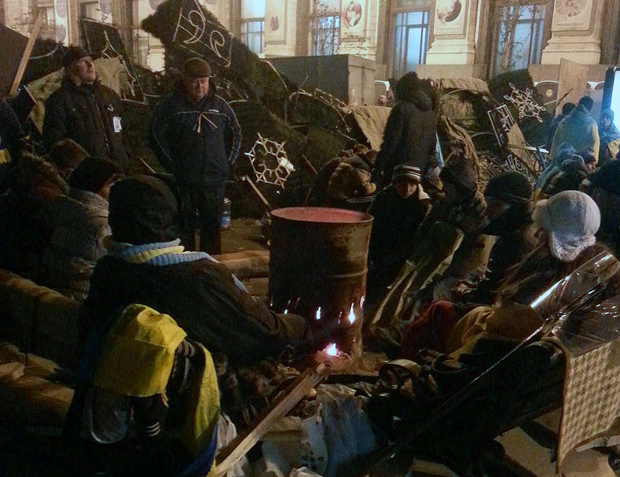
Protesters gather in Maidan Nezalezhnosti to register their disapproval of the government’s refusal to sign an association agreement with the European Union and its violent crackdown on peaceful demostrators. (Photo: Andrei Alaiksandrau / Index on Censorship)
Maidan Nezalezhnosti, the Independence Square in the centre of Kiev, leaves mixed impressions of courage and uncertainty. It has become a symbol of determination among ordinary Ukrainians to push for their rights and freedoms – but after the events of the last weekend it has also turned into a powerful reminder of how difficult and even bloody the fight can be.
Mass actions in Ukraine started on 21 November after it became clear that the country’s leaders were not going to sign a much anticipated association agreement with the European Union. The situation escalated after 29 November, when it was confirmed the agreement was not signed during the Eastern Partnership summit in Vilnius. Around 4 a.m. on 30 November riot police violently dispersed protesters from the Independence Square. Dozens of peaceful protesters and journalists were injured. The next day saw one of the largest mass street rallies in Ukrainian history, at least 200,000 people protested against the violent actions of the police. New clashes occurred; protesters and opposition parties called for the government to resign, but the vote of no confidence in the parliament failed. At the moment nobody has a clear answer what comes next.
There are a lot of young people among the protesters. Yuliya, a student of one of Kiev universities, says they are there to “defend their future.” “We want to live in a European country, and feel we are citizens that enjoy rights and freedoms,” she says. Several students said officials at their universities “promised troubles” to those who joined the protests. Some of the student demonstrators told Index that they were threatened with expulsion – but came out into the streets anyway.
Andrii is an employee of an IT firm from Lviv, a regional centres in western Ukraine. He and his friends traveled to Kiev to join the protest for several days during the last two weeks, despite the fact it is more than 500 km drive each way. “It is a crucial time for my country; I cannot just stay home when the fate of my nation is decided. The association agreement with the EU is a historical chance for Ukraine, the chance not to be missed,” he says.
“I went to Maidan, because I want to live in a European country; I want to walk even pavements, drive quality roads, enjoy quality public services for the high taxes I pay – and I don’t want to see my taxes go to pockets of president Yanukovich and his family. Directives of the EU establish quite high requirements for fighting corruption, this is why I support association with the European Union,” says Khrystyna, a lawyer from Kiev.
Roman Romanov, an expert on freedom of assembly with the International Renaissance Foundation, says he has never seen so many people in the streets of Ukraine.
“Now it is not only people who want the association agreement with the EU to be signed. People raise their voice against the police state and brutality against peaceful protesters; they understand that without them speaking out the rule of law will not be restored and justice will not be done,” Roman Romanov says.
Oksana Romaniuk, an executive director of the Institute of Mass Information, a Kiev-based freedom of expression organisation, also sees the difference in how society treats journalists.
“Fifty-one journalists were beaten by riot police in Ukraine between 29 November and 2 December. On the night of 30 November officers of Berkut, a riot police special force, specifically targeted journalists when they were dispersing the protest from the Independence Square. Now local businessmen offer their help to us – they buy first aid kits for journalists and offer money to cover medical treatment for injured reporters. And ordinary people suggest their help, too. I was really moved when a woman came up to me in a bus, as she heard I was ordering protecting helmets and vets for journalists. The lady gave me 200 hryvnias (around £15) and said ‘I have heard how journalists were beaten – please, take this money to help them’. I hope these are the signs that show society understands the importance of journalists’ work to inform people,” Oksana Romaniuk says.
“I did not know I live in a country where a bloody dispersal of a peaceful meeting can happen, where such inhuman brutality against unarmed people and journalists is possible. It is a disgrace for Ukrainian authorities,” she adds.
State officials of Ukraine promise they will make up for this “disgrace” and investigate the violent actions of the police. At the same time, president Yanukovich left for an official visit to China, despite the serious political crisis his country is in. The OSCE Parallel Civil Society conference called the situation in Ukraine “a human dimension crisis.”
“It looks like the authorities want to show they do not care about people that stay at Maidan. It is difficult to say what is going to happen next. I could not believe that happened in my country. Now I don’t see how this crisis is going to be resolved,” says an employee of a Kiev-based human rights organisation.
Last night it was peaceful at Maidan Nezalezhnosti. There was a concert with Ukrainian patriotic songs. People were sitting around fires in barrels; a dozen youngsters decided to warm themselves by playing football just beside a barricade. No police were seen anywhere.
“Would you like a cup of tea?” asked a young Ukrainian girl with a warm smile – she is just walking around Maidan with her boyfriend and a big thermos and offers a free hot drink she made at home to people who came out in a cold night to tell their government they choose a European future for their country. Will they be heard, remains a question.
This article was posted on 4 Dec 2013 at indexoncensorship.org