14 Dec 2010 | Index Index, minipost
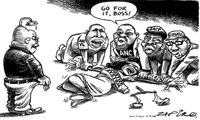 South African president, Jacob Zuma has filed a $440,000 defamation lawsuit over a cartoon depicting him as a rapist of the justice system. The cartoon, published in 2008 by South Africa’s Sunday Times, depicts Zuma pulling his trousers down and about to rape a woman symbolising the justice system, aided by allies. One of Zuma’s allies depicted in the cartoon, filed a complaint about the cartoon before South Africa’s Human Rights Commission in 2008, however the commission concluded that the cartoon did not violate Zuma’s constitutional right to dignity or constitute hate speech.
12 Dec 2010 | Iran, Middle East and North Africa
No right to assembly or protest. As an independent trade unionist in Iran your actions are automatically illegitimate in the eyes of the state and for many carry a prison sentence. One such worker Reza Shahabi, treasurer of the Bus Workers’ Union has been in Tehran’s Evin prison since June 2010 and remains incarcerated in spite of his family’s payment of the 60m Tomans (USD 57,000) bail money demanded as condition of his release on 11 October.
Iran’s Bus Workers’ Union formed to fight for basic rights and working conditions, and to stand against common injustices among them unfair dismissal and unpaid wages. Shahabi upheld the values of this federation and his outcry now manifests itself as an ultimate and pivotal voice of the unheard as he enters the second week of a dry hunger strike (Day 1, Saturday 3 December).
The Declaration on Hunger Strikers (Declaration of Malta) defines a hunger striker as “a mentally competent person who has indicated that he has decided to embark on a hunger strike and has refused to take food and/or fluids or a significant interval.” Most hunger strikes involve an intake of water or other liquid, salt and sugar. Vitamins are also taken to protect against irreversible neurological damage and other critical damage upon the reintroduction of food to the body. Shahabi’s dry hunger strike rejects these precautions as to date he has had nil by mouth.
The medical ethics of hunger strikes remain intensely debated as are the individual’s right to strike, considered against the freedom and authenticity of this decision in a prison environment. The issue of the aims of the strike and their incompatibility with a legitimate state’s policies regarding operating a prison is also pertinent. These points are discussed in a paper entitled The physician and prison hunger strikes, published in 2004, examining prisoner hunger strikes in Turkey.
It is poignant that the Iranian government apparently reveres the actions of hunger strikers in far away lands, naming two streets after IRA hunger striker Bobby Sands — Winston Churchill Boulevard, the address of the British Embassy in Tehran, was renamed Bobby Sands Street, the state Fars news agency calling his death “heroic” — but refuses to heed the desperate actions of its own citizens.
To sign Amnesty International’s campaign for the freedom of Reza Shahabi and fellow unionists click here.
10 Dec 2010 | News
 As ideas move freely around the world attacks on writers continue, reports Lisa Appignanesi
(more…)
10 Dec 2010 | Asia and Pacific, China
With less than a day to go before the Nobel Committee awards Chinese imprisoned dissident (or convicted criminal if you are the Beijing government) Liu Xiaobo this year’s peace prize, China has been stumbling over itself to create diversions, block news, gather allies, and negate the legitimacy of the award.
The first things to go were the news websites. As early as Thursday 9 December, the BBC, CNN and NRK, a Norwegian television channel, were all blocked on the mainland. Naturally nobelprize.org is blocked.
The English-language domestic press, however, were not shy about raising the issue. In the China Daily this morning, a front page lead declared “’Most nations’ oppose peace prize to Liu.” The story, which was merely reporting comments made by Foreign Ministry spokeswoman Jiang Yu also linked to a curious opinion piece: “Insult of the Nobel Peace Prize,” which selected excerpts from an earlier editorial in an unidentified Norwegian newspaper.
It was a similar story in the other English-language daily, Global Times. “Beijing firm on Nobel,” ran the top front-page story, which also carried Jiang’s comments. The lead editorial, “Oslo puts on a farce against China ,” was much more dramatic than China Daily’s. “It’s unimaginable that such a farce, the like of which is more commonly seen in cults, is being staged on the civilized continent of Europe,” it runs. “Tonight’s political show is not an easy task for the Norwegians. They have to ignore the signs of China’s drastic changes and social progress, in a bid to convince themselves that China’s “darkness” is real.”
At least 18 countries have made their excuses, including Russia, Serbia and Saudi Arabia. That leaves approximately two thirds of embassies accepting the invitation. Western news reports say China has pressured diplomats not to attend, but China denies this while publicly making comments such as: “We hope those countries that have received the invitation can tell right from wrong.”
Meanwhile, in China itself, scores of dissidents have had their movements curtailed — put under house arrest, forcibly moved out of Beijing, prevented from leaving the country and having their phone lines cut. “While such tactics are common before important events such as political meetings, it is rare for pressure to last so long and be applied so extensively,” reports The Guardian. Chinese police have surrounded the home of Liu’s wife, Liu Xia, in Beijing, where she is believed to be under house arrest.
However, perhaps the most perplexing of China’s anti-Nobel preparations was the quick whipping up of a new peace prize to rival the Nobel award. The first Confucius Peace Prize was awarded to former Taiwanese vice-president Lien Chan yesterday at a hurriedly held press conference in Beijing. Lien’s office says it knew nothing about the prize, and an infant girl was carried in to accept the prize on his behalf.
Like Lien, Liu will not be picking up his prize in person. Nobel committee secretary Geir Lundestad said Liu will be represented “by an empty chair … the strongest possible argument” for awarding it to him.
If you want a look at the power of Liu’s pen and why the Chinese government considers him a threat, The Telegraph has published parts of a speech he gave two years ago. Read it here.
