17 Jan 2018 | Index in the Press
It wasn’t only the EU nomenklatura who had their noses put out of joint in June 2016, when the British people rudely reminded the Euro-emperor of his embarrassing lack of clothes. Many members of the House of Lords, one suspects, equally resented the ordinary electors’ failure to vote as instructed by their betters, and the backing given to them in this refusal by a raucous, outspoken and undisciplined press that didn’t give two hoots for the views of established politicians. Read the full article
16 Jun 2017 | Index in the Press
[vc_row][vc_column][vc_column_text]People see propaganda as a modern problem – manipulation by mass media. But the story is far older, and the tactics are timeless. While the game has moved on, the rules remain the same. Read the full article[/vc_column_text][/vc_column][/vc_row][vc_row full_width=”stretch_row_content_no_spaces” content_placement=”middle”][vc_column][vc_single_image image=”91122″ img_size=”full” alignment=”center” onclick=”custom_link” link=”https://www.indexoncensorship.org/2017/05/stand-up-for-satire/”][/vc_column][/vc_row]
18 Oct 2016 | Campaigns, Campaigns -- Featured, Middle East and North Africa, mobile, Oman, Statements
Your Majesty Sultan Qaboos bin Said,
We, the undersigned organisations, write to you regarding the systematic targeting of journalists, human rights defenders and online activists by the Internal Security Service (ISS) in Oman.
We believe that these recent arrests and prosecutions are part of an ongoing attempt to silence and curtail the right to press freedom as well as freedom of expression.
Since October 10, 2016, the three Azamn journalists sentenced to years in prison by the Court of First Instance in Muscat are free, pending the outcome of the appeal which is expected on November 7th.
Ibrahim Al-Maamari, the editor-in-chief of the Omani independent newspaper Azamn, and managing editor Youssef Al-Haj were freed after the appeal court, at their lawyers’ request, reduced the amount of bail to 2,000 rials (4,000 euros) from the 50,000 rials (110,000 euros) set by the court that convicted them. The third defendant in this case, Azamn local news editor Zaher Al-Abri, was already released conditionally on August 22nd.
On September 26, 2016, the Court of First Instance had imposed harsh jail sentences on these three journalists and ordered the permanent closure of the Azamn newspaper.
The arrests of the journalists and the closure of the newspaper came after a report, published in July 2016, which accused unnamed officials of influencing the Chief Magistrate of the Supreme Court, to intervene in judicial proceedings. The Vice-President of the Supreme Court thanked the newspaper for the report and for dissemination of “facts without a slur on anybody”.
More precisely, Ibrahim Al-Maamari and Yousef Al-Haj were convicted of four common charges – “disturbing public order, misuse of the Internet, publishing details of a civil case, and undermining the prestige of the state.” They were sentenced to three years’ imprisonment, in addition to a fine of 3000 RO and a ban on working as a journalist for a period of one year. Two additional charges were brought against Yousef Al-Haj: “publishing about a case for which a decree had been issued to ban news about it, and slander.”
Journalist Zaher Al-Abri was sentenced to one-year imprisonment and fined 1000 RO after being found guilty of using “an information network [the Internet] for the dissemination of material that might be prejudicial to public order.”
These harsh sentences are a clear attempt to hinder the work of journalists and to curtail the right to freedom of expression and opinion in Oman. The imprisonment of journalists whose only crime was to exercise their profession in a legitimate manner and the censorship of this story do not bode well for the future of journalism and civil liberties in the Sultanate, which is ranked 125th out of 180 countries in the 2016 World Press Freedom Index compiled by Reporters Without Borders.
In relation with the Azamn case, many online activists showing support with the journalists were targeted by the authorities. Saqr Al-Balushi, and writer Hamood Al-Shukaily, arrested both respectively on October 5th and August 14th, remain in detention. Mohammed Al-Harthi, however, who was arrested on August 18th in relation with posts he made on Twitter in which he expressed his views on corruption and solidarity with the Azamn newspaper, was released the following day.
The undersigned organisations express serious concern at the ISS’ systematic targeting of journalists, writers, human rights defenders including online activists, and view it as a deplorable and urgent threat to media freedom and freedom of expression in Oman.
We call on you to use your influence in Oman to:
- Protect freedom of the media and freedom of speech, especially online;
- Revoke the closure order of Azamn newspaper by the Ministry of Information;
- Revoke the sentences issued against journalists Ibrahim Al-Maamari, Yousef Al-Haj and Zaher Al-Abri;
- Immediately and unconditionally release online activists Hamood Al-Shukaily and Saqr Al-Balushi;
- Ensure that the ISS stops its attacks on media freedom and freedom of expression and its targeting of journalists, online activists and other human rights defenders;
- To guarantee in all circumstances that all human rights defenders including journalists, writers and online activists in Oman are able to carry out their legitimate human rights activities without fear of reprisals and free of all restrictions including judicial harassment.
Signed:
- Committee to Protect Journalists (CPJ)
- Front Line Defenders (FLD)
- Gulf Centre for Human Rights (GCHR)
- Index on Censorship
- International Federation for Human Rights (FIDH), within the framework of the Observatory for the Protection of Human Rights Defenders
- International Federation of Journalism (IFJ)
- PEN International
- Reporters Without Borders (RSF)
- SKeyes Center for Media and Cultural Freedom
- World Organisation Against Torture (OMCT), within the framework of the of the Observatory for the Protection of Human Rights Defenders
27 Oct 2015 | Europe and Central Asia, mobile, News, Romania
Romania has a lot of high-calibre journalists to its name. However, many media outlets are now fighting to survive while maintaining professional standards due to judicial investigations, political scandals and struggles with high debt loads. This is according to the authors of The Men Who Bit the (Watch) Dogs, which explores the media landscape in the country.
The report focuses on transparency and ownership of the media — particularly the most influential medium, television, over the past 25 years — from post-communist enthusiasm to today’s chaotic mix of business models.
While journalists in the early 1990s were independent of the pressures that marked the Soviet age, most of the 1,200 newspapers that were established at the time didn’t take off. Speaking to Index on Censorship, one of two Romanian academics behind the report, Manuela Preoteasa from think tank The Centre for Media Transparency, explains that at the time, well-known international media companies just weren’t interested in quality journalism.
“As we demonstrated in the report, the market was kept half-closed during the early 90s, which means that it was not open to foreign investors,” Preoteasa says. As the report highlights, the “market that was inhospitable to the promotion of professional journalism” and so “foreign investors had to focus solely on commercial success”.
The ethos of the era seemed to be: “We don’t sell our country to foreigners.” Foreign investors could not own a licence without a Romanian partner, and apart from state-owned channels, no other private entity could apply. For nine years, only local licences for each of the 41 counties and Bucharest were available.
With ownership of the media confined a handful of tycoons, many outsiders would have lost interest. “Show me a serious TV investor who would have been willing to invest in such an unfriendly market,” Preoteasa says. “I strongly believe that the media market was intentionally kept closed to serious investors.”
Print was different. “The history of the last decade shows that print media could not exist on its own, but only as part of a conglomerate, and the conglomerates were formed around TV stations,” Preoteasa explains. “That is why the TV industry has such a strong influence.”
Economically, many of these media outlets relied on state advertising. Some TV stations — already benefiting from debt cancellations and debt rescheduling — started to receive public money as state-owned companies began to advertise. The scheme was introduced by the government led by former Prime Minister Adrian Năstase (2000-2004) and was soon adopted by local politicians and businessmen.
Romania’s unfriendly business environment, high taxes, bureaucracy and a chronic economic instability also challenged the viability of commercial models within the media, the report says. Other challenges include “the lack of a clear distinction between information and opinion and the absence of marketing- and sales-related knowledge”.
These days, the media industry faces serious legal problems that involve either the owners of the main media groups or the groups themselves. Media owners such as Adrian Sârbu, Dan Voiculescu, Sorin Ovidiu Vântu, Sebastian Ghiţă and Dinu Patriciu have all been on trial or are under various criminal investigations.
In a young democracy, the media should play a key role in holding the powerful to account. However, this doesn’t seem to be the case in Romania.
So are there any signs of hope? “I believe the initiative will come from the telecom industry,” Preoteasa says. As to whether the telecom industry will swallow the existent media or would it invent a new one, the answer lies somewhere in between. “I am sure the online media started to have a say and the pressure from the interactive medium is high,” she says, offering an open suggestion: “Someone should look carefully at what young people are looking for and perhaps this will reveal the answer about what might come next.”
This article was posted on 27 October 2015 at indexoncensorship.org
Mapping Media Freedom
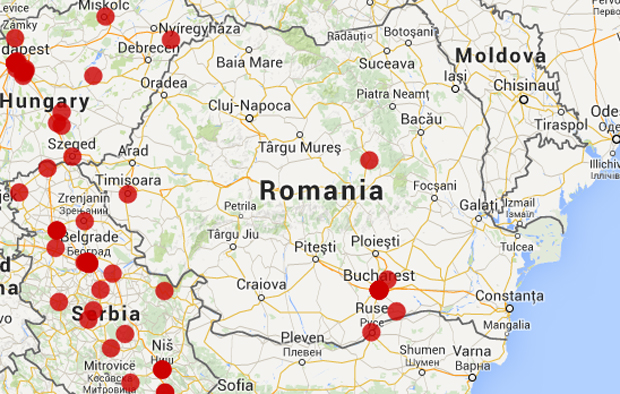
Click on the bubbles to view reports or double-click to zoom in on specific regions. The full site can be accessed at https://mappingmediafreedom.org/
|
