30 Jul 2018 | Europe and Central Asia, Lithuania, Mapping Media Freedom, Media Freedom, media freedom featured, News
[vc_row][vc_column][vc_column_text]
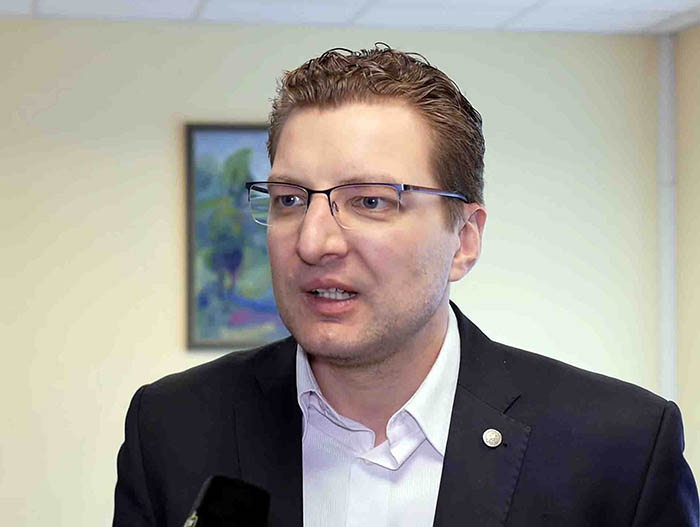
Dainius Radzevicius, chairman of Lithuania’s Journalists Union. Credit: alkas.lt)
In the 28 years since Lithuania gained independence, the country’s media has generally enjoyed high levels of freedom. The country’s constitution guarantees freedom of expression and freedom of the press, and those protections have been respected by successive governments. However, while initiatives by the country’s current ruling coalition haven’t seen the press attacked on the same levels as neighbouring Poland, for example, the government’s resolve is clear: the media must be reined in.
Index spoke with the chairman of the country’s Journalists Union, Dainius Radzevicius about the situation media workers now find themselves in.
Linas Jegelevicius: How would you rate the level of press freedom in Lithuania right now?
Dainius Radzevicius: The ruling Farmers and Greens Party (LVZS), in coalition with the Social Democratic Party of Lithuania, has risen to power as part of the wave of the anti-establishment parties sweeping the West. This coalition has declared the need for more regulation of the media. For example, it has attempted to push through legislation that, if enacted, would have required a 50/50 balance for negative and positive content in the media. It was proposed by the MP Dovile Sakaliene, but she withdrew it after a public outcry. Another MP from LVZS, Robertas Sarknickas, has sought tougher legislative action against the so-called “romanticising” of suicides (he believes that media shouldn’t specify how a person died). Initiatives by the ruling party aimed at regulating media are undoubtedly the biggest concern for journalists. It is likely that we will see more initiatives of this kind in Lithuania.
The second threat to media freedom in Lithuania stems from the determination of authorities, especially those at the municipal level, to control the information that reaches local readers, viewers and listeners.
I see journalists being increasingly barred from accessing certain events, such as those held in state institutions. Recently, journalists in the Gargzdai municipality were denied the right to attend a meeting with the municipality heads and the prime minister, Saulius Skvernelis. It is an abnormal situation when the mayors’ advisors are given exclusive access to information. The mayor’s advisors video-streamed the meeting and posted the news on Facebook. This is an increasing trend in Lithuania, where journalists are being bypassed in the preparing and disseminating of information.
Thirdly, I see the trend of journalists being too complacent with the position of the publishers and the structures behind them and tend to avoid criticising certain political and business entities and so on. In doing so, they feel safe job-wise. This self-censorship is especially prevalent among older, as well as young, inexperienced journalists.
Jegelevicius: Do you foresee more threats to media freedom in Lithuania in the future? Specifically, are there any controversial legislative initiatives on the agenda in the upcoming autumn session of parliament?
Radzevicius: Those initiatives tend to pop up out of the blue as a rule. From what I can see, after reviewing the autumn session draft agenda, there is a draft law on state support for the media, the intention of which is rather obscure so far. I am concerned that state authorities will be entrusted with the distribution of funds. Being aware of the processes, I just cannot rule that out. If this happens, it will deal another big blow to media freedom in Lithuania. I especially worry that freelancers and independent media content producers would be affected by it. The model of state support that existed until now was not ideal, but it was pretty fair, including to freelancers.
Jegelevicius: There have been several cases of closure of Russian TV news channels by Lithuanian authorities. What is your take on the issue? Does the removal of NTV Mir and RTR Planeta off the air for six months count as media violations?
Radzevicius: I want to emphasise that the measures were taken after multiple violations occurred. No state puts up with warmongering and instigating of enmity and disseminating of propaganda. The repetitive violations by the Russian TV channels were reviewed by different Lithuanian media supervision bodies, as well as by the European Commission, before the decision was made to shut them down. Note that suspension of the broadcasting is for a limited period (6 months), after which the channels can resume the license. A big portion of their content had very little to do with journalism – the local viewers were awash with propaganda ordered in Moscow. Many problems of the kind would be solved if all the states, including Russia, would pass laws and ratify international conventions that would allow journalists to work independently and bar states from using journalists as propaganda tools.
Jegelevicius: How does Lithuania compare with other European countries in terms of press freedom?
Radzevicius: We indeed have very few violations but I believe some go unreported. With 28 years as an independent state, the majority of the ruling coalitions have understood the importance of media freedom to democracy and to the checking of legislative, judicial and governmental powers in the country. The fact that the parties tend to change after serving their term in Lithuania has also been an important factor for media freedom.
Jegelevicius: Lithuania holds municipal council, presidential and European Parliament elections next year. There is a worry that unfriendly states such as Russia will meddle with them, including attempts to influence the media. Financially unstable media outlets are especially prone to such acts. Will the authorities step in and regulate the process during the sensitive election period?
Radzevicius: I have no doubt that our state authorities, including the State Security Department, are very well aware of what to expect. Indeed, we live in a small country with a pretty small media market, all of which makes it easier to monitor what is going on. From the point of view of journalism, transparency is the best remedy to guarantee that the elections are violation-proof.[/vc_column_text][vc_raw_html]JTNDaWZyYW1lJTIwd2lkdGglM0QlMjI3MDAlMjIlMjBoZWlnaHQlM0QlMjIzMTUlMjIlMjBzcmMlM0QlMjJodHRwcyUzQSUyRiUyRm1hcHBpbmdtZWRpYWZyZWVkb20udXNoYWhpZGkuaW8lMkZzYXZlZHNlYXJjaGVzJTJGOTAlMkZtYXAlMjIlMjBmcmFtZWJvcmRlciUzRCUyMjAlMjIlMjBhbGxvd2Z1bGxzY3JlZW4lM0UlM0MlMkZpZnJhbWUlM0U=[/vc_raw_html][/vc_column][/vc_row][vc_row][vc_column][vc_basic_grid post_type=”post” max_items=”4″ element_width=”6″ grid_id=”vc_gid:1532934432548-8a5b26e4-acf4-5″ taxonomies=”6564″][/vc_column][/vc_row]
20 Jul 2018 | Mapping Media Freedom, Media Freedom, media freedom featured, News
[vc_row][vc_column][vc_column_text]

İdris Sayılgan’s father Ramazan, mother Sebiha and sisters Tuğba and İrem pose in the meadow where the family comes the summers to breed their cattle (Credit: Özgün Özçer)
“Don’t forget to take pills for nausea,” says İdris Sayılgan’s younger sister, Tuğba, combining her knowledge as a fifth-year pharmacy student and the innate kindness of a host. Together with a colleague, we were about to take the bumpy road to follow in the jailed Kurdish journalist’s footsteps to his family’s village near the eastern Turkish city of Muş. Sayılgan had spent his summer holidays helping his father, a herdsman or “koçer” in Kurdish (literally meaning “nomad”), breeding cattle and goats. One of many Kurdish reporters imprisoned pending trial, Sayılgan has been behind bars for 21 months on trumped-up charges that have criminalised his journalistic work. His hard-working, close-knit family misses his presence dearly.
Heading south of Muş, to the fertile Zoveser mountains, the serpentine road proves Tuğba’s advice to be valuable. The asphalt pavement gives way to a narrow gravel road as we continue to zig-zag toward the southern flank of Zoveser, bordering Kulp in Diyarbakır province and Sason in Batman – two localities which used to be home to an important Armenian community before the Armenian Genocide in 1915. The many majestic walnut trees surrounding the road are a testament to that bygone era. We are told that they were all planted by Armenians before they fled.
The family village – Heteng to Kurds and İnardi to the Turkish state – witnessed another brutal eviction in more recent times. During the so-called dirty war of the 1990s, the Turkish military gave inhabitants a stark choice: either become village guards, armed and remunerated by the state to inform on the activities of militants belonging to the Kurdish insurrection, or leave. If they dared to refuse, a summary death awaited. İdris was just three-years-old when they came.
Left helpless and scared, many left. The family of Çağdaş Erdoğan, the Turkish photographer hotlisted by the British Journal of Photography who recently spent six months in prison on terror-related charges, was among them. Erdoğan scarcely remembers his childhood before his family moved to the western industrial city of Bursa. As a child, the painfully forced exile produced nightmares. He started imagining stories from patches of memories, believing they were real. Zoveser’s idyllic setting is haunted by the ghosts of a dark history brimming with atrocities.
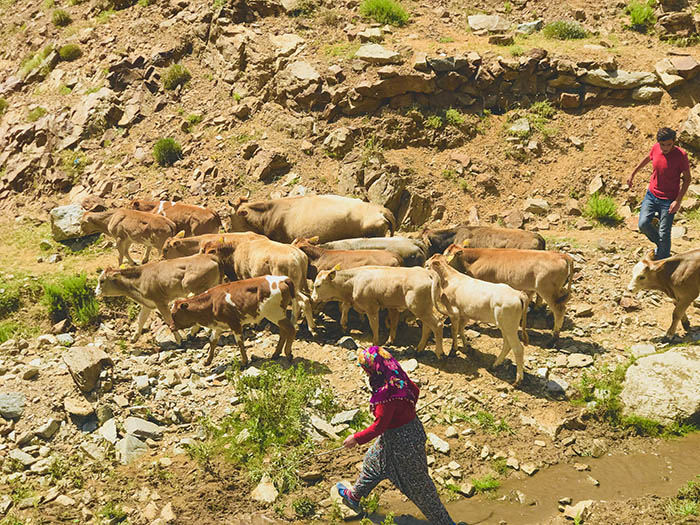
The family guides the cattle to the pasture. (Credit: Özgün Özçer)
As for İdris’ family, they have stayed in the Muş ever since, coming back only for breeding season. İdris used to accompany his father in guiding their cattle, during which time they would cover the 70 kilometres separating their farm near Muş to Heteng in three days. It’s a distance that we could only cover in two-and-a-half hours by vehicle. Once in Heteng, there’s still another 15 minutes on foot to the small meadow where the Sayılgans have set up camp next to a fresh stream.
İdris’ father, Ramazan Sayılgan, greets us with a warm embrace. He has a gentle look with soft and tired eyes. “Are you hungry?” he asks as we are invited to their tent. His wife, Sebiha, brings us milk and fresh kaymak cheese, a cream obtained from yoghurt, that she made herself, as well as milk. All of the children help the family during the breeding season. Ramazan can’t hide his pride when he recounts how well they are doing in their studies and how gifted they are. Unlike many parents in the region, he strived to send his nine children to school despite his meagre income. The nine brothers and sisters are close and often go the extra mile for each other.
İdris is the very picture of his father who, although sunburnt, is a little bit darker than him. He inherited the whiteness of his skin from his mother, whom he calls “the most beautiful woman on earth.” With them are the five youngest of the family. Involving herself in the conversation, eight-year-old Hivda sadly notices that she is the only one with olive skin, like her father. Ramazan Sayılgan is quick to comfort her. “You may be darker but you are such a beautiful, dark-skinned girl.” Hivda giggles cheerfully.
They work together and laugh together, but they also suffer together – like that fateful day when the police came for İdris.
A rifle to the head
It was early in the morning on 17 October, 2016, long before sunrise. The whole house was soundly asleep when their door was broken and ten riot police stormed inside.
“They were screaming ‘police, police!’ I told them: ‘Please be quiet, there is nothing in our house,’” Ramazan Sayılgan says, occasionally mixing Kurdish with his broken Turkish. “I was trying to calm them down and avoid trouble. Then I raised my head and saw that five people were on İdris. That’s when they kicked me in the head.”

İdris Sayılgan’s eight-year-old sister Hivda and 12-year-old Yunus. The family guides the cattle to the pasture. (Credit: Özgün Özçer)
İdris tried to escape their clutches but fell to the floor. Police kicked him repeatedly while threatening him. The blows had left him bleeding. “They are killing İdris!” cried his sister İrem, who was 12 at the time. Police told the family to lie on the ground with their hands on their backs. They pointed a rifle at Ramazan and one of the journalist’s younger brothers, Yunus. “They even pointed two rifles at my head. They have no shame,” Yunus, who was ten-years-old at the time of the raid, says.
Normally, all raids should be filmed as a means of preventing abuse. “But they only started filming after they inflicted their brutality,” Ramazansays. Those who inflicted the beatings have enjoyed complete impunity. The family even saw the commander, a bald officer, when they went to vote during Turkey’s recent presidential elections.
In a written defence submitted to the court, İdris said that when he was brought to the hospital for a mandatory medical examination, doctors effectively turned a blind eye to police brutality by refusing to treat his injuries out of fear of repercussions from the police. To add insult to some very real injuries, İdris was transferred to a prison in Trabzon, some 500 kilometres north on the Black Sea coast, even though there is a prison in Muş. The family, who cannot afford a car, can only visit İdris on rare occasions. İdris was subjected to torture and strip searches after being transferred to Trabzon, where he is held in solitary confinement. “What I have been through is enough to prove that my detention is politically motivated,” the journalist has said in his defence statements.
“Journalism changed him”
After high school, İdris decided to abruptly end his studies and began working as a dishwasher. That, however, only lasted three months before he announced to his father that he wanted to prepare for the national university exams. “When he sets his mind on something, he always tries to do his best. He never puts it off. Nothing feels like it’s too much work for him,” his father tells us. “He didn’t study at first, but when he decided to do so, he devoted himself.”
İdris graduated from the journalism department at the Communication Faculty at the University of Mersin. He then returned to Muş and started to work for the pro-Kurdish Dicle News Agency (DİHA), which today operates under the name Mezopotamya Agency after DİHA was shuttered in 2016, and another iteration, Dihaber, in 2017, both on terror-related allegations. İdris was making a name for himself when he was arrested and now faces between seven-and-a-half and 15 years in prison on the charge of “membership in a terrorist organisation”.
“University and journalism changed him,” 18-year-old İsmail says. “He used to be more irritable. He has been much more cheerful since,” says İsmail, who picked up on his brother’s habit of whistling whenever he comes home. “İdris was even whistling in custody – to the extent that the police asked, ‘How can you remain so upbeat?’”

Sebihan Sayılgan, İdris’ mother, who he calls “the most beautiful woman on earth”. (Credit: Özgün Özçer)
Tuğba remembers endless conversations at nights when İdris would recite poems by Ahmed Arif, a poet from Diyarbakır who was partly Kurdish. Yunus, meanwhile, complains that he only received İdris’ latest letter a full six weeks after it was sent. As for little Hivda, she whispers to us that she just sent him a poem she wrote.
Ramazan adds that İdris is loved by everyone who knows him. At 58, Ramazan continues to work hard but the family faces many adversities. Another son, 21-year-old Mehmet, has also been behind bars for two years. The eldest brother, Ebubekir, who became a math teacher, has been dismissed from the civil service for being a member of the progressive teachers’ union Eğitim-Sen. Ebubekir was well-known for improving the grades of all the students in his classes, but now that he has been forced out of his job, he has gone to Istanbul in an attempt to make ends meet. He will join them a week later to help them during the breeding season.
Since the state of emergency was imposed two years ago, village guards have become ever more self-assured. Like sheriffs in the wild west, they make their own rules. The Sayılgan family, who couldn’t come to the village for two years out of fear following the declaration of a state of emergency, alerts us that village guards often tip off authorities when they see strangers. “The driver of the shuttle is also a village guard,” we are warned. Indeed, we had already introduced ourselves to him as İdris’ friends from university, omitting to reveal our profession. During our trip back, we would tell him of our plans to catch a bus to Van when our real intention was to go north to Varto instead.

İdris Sayılgan’s 18-year-old İsmail who guided us to the meadow, with Hivda and Yunus in the background. (Credit: Özgün Özçer)
Unlike most Kurdish provinces, the ruling Justice and Development Party (AKP), well supported by the conservative voters, won the municipality of Muş in local elections, meaning the government hasn’t appointed trustees to force out elected Kurdish mayors as it has done in other Kurdish areas where it has lost. Police, accordingly, are extremely comfortable. The city abounds with plainclothes police and informants. No precaution is too little. Varto, a town with a majority of Alevis – who are a dissident religious minority with liberal and progressive beliefs – looks like a safer option to spend the night.
I get a sense of how hard it must be for a local Kurdish reporter to work in Muş. It means working behind the adversary’s lines while still living in one’s hometown. It also means never letting your guard down.
We take leave from the family, expressing our hope that İdris will be released at his next hearing on 5 October. “In three months and two days,” his father quickly notes. October will mark two years without his son – two years that a modest but resilient family has endeavoured to fight against state-sponsored injustice with goodwill and affection.

İdris Sayılgan’s father Ramazan, mother Sebiha and sisters Tuğba and İrem pose next to the tent where the family stays. (Credit: Özgün Özçer)
[/vc_column_text][/vc_column][/vc_row][vc_row][vc_column][vc_basic_grid post_type=”post” max_items=”4″ element_width=”6″ grid_id=”vc_gid:1532352402886-c28cce4d-6f18-8″ taxonomies=”1765, 1743″][/vc_column][/vc_row]
9 Jul 2018 | Egypt, Middle East and North Africa, News
[vc_row][vc_column][vc_column_text]
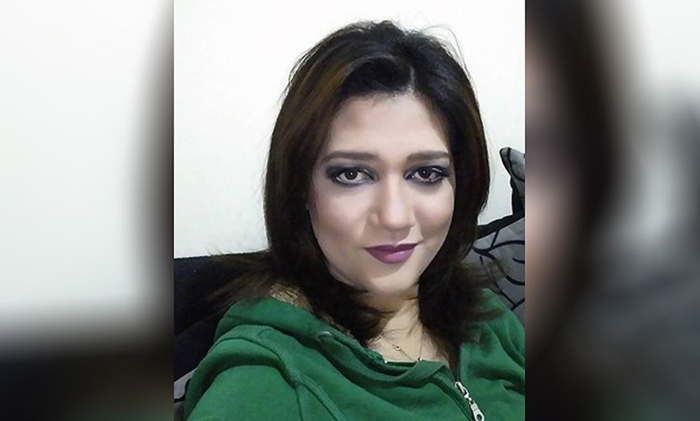
Activist Amal Fathy has been ordered detained. (Photo: Facebook)
Egyptian activist Amal Fathy, who was arrested on 11 May after posting a video criticising sexual harassment in Egypt – of which she herself is a victim – to Facebook, will next appear in court on 15 July 2018 after her pre-trial detention of 15 days was extended for the fifth time.
Fathy, who is detained at Al Qanater prison north of Cairo, stands accused of “belonging to a banned group”, “using a website to promote ideas calling for terrorist acts” and “intentionally disseminating false news that could harm public security and interest”.
When Fathy arrived at the Prosecution Office on 4 July, she showed symptoms of acute stress and was unable to walk on her own having lost sensation in her left leg. She was unable to walk normally unassisted. Fathy has a history of chronic depression, bipolar disorder and anxiety, conditions that have only worsened during her detention.
Fathy, along with her husband, Mohamed Lotfy, director of the Index award-winning NGO Egyptian Commission for Rights and Freedoms, and their son, were taken into custody during an early morning raid on their home soon after she posted the 12-minute video on 9 May about her experience with sexual harassment and the difficulties of being a woman in Egypt. As an activist, Fathy has also been vocal about human rights violations in Egypt, especially the arbitrary detention of other activists. Lotfy and their son – who Fathy was the primary carer of before her arrest – were later released.
“We stand in solidarity with the members of ECRF, call for the immediate release of Amal and demand that all charges against her be dropped,” Perla Hinojosa, fellowships and advocacy officer at Index on Censorship, said. “Index invites our readers to join two existing campaigns for her release, one by Amnesty International addressing the Egyptian president and minister of foreign affairs, and the other by Amal’s husband Mohamed calling for action from the European Parliament.” [/vc_column_text][/vc_column][/vc_row][vc_row][vc_column][vc_basic_grid post_type=”post” max_items=”4″ element_width=”6″ grid_id=”vc_gid:1531134800432-bdb56a3c-c68b-6″ taxonomies=”147″][/vc_column][/vc_row]
5 Jul 2018 | Events
[vc_row][vc_column][vc_single_image image=”100897″ img_size=”full” alignment=”center”][vc_column_text]50 years on do we need a new Theatres Act? Are artists and cultural institutions entering a new era of self-censorship and if so what does the future look like? Join leading cultural and political figures in a panel discussion that explores the complexities of modern day censorship and its impact on arts and culture.
This event is in collaboration with the Index on Censorship.
There will also be the opportunity to put your questions to the panel on the night #JoinTheDebate
Julia Farrington
Index on Censorship – International freelance producer, campaigner and trainer, working at the intersection between arts and human rights. Specialises in artistic freedom of expression
Shereener Browne – Barrister at Garden Court Chambers with over 23 years experience. She started her legal career at the criminal bar and built a reputation for defending young offenders accused of serious gang-related crimes. In 2016 Shereener embarked up an acting career.
Agnieszka Kolek – Artist, Curator, Polish Woman of the Year 2013 in the UK for Co-organizing and Curating Passion for Freedom London Art Festival.
Anders Lustgarten – Political playwright “renowned for his hard-hitting, wide-ranging approach to political and social questions” (Time Out). Recent work includes The Secret Theatre at Shakespeare’s Globe (2017), an allegory for modern surveillance set in the reign of Elizabeth I.
Kenan Malik – Writer, lecturer and broadcaster. Columnist for the Observer and International New York Times. Latest book: The Quest for a Moral Compass (Atlantic).[/vc_column_text][vc_column_text]
When: Thursday 20 September, 7-8:30pm
Where: Sam Wanamaker Playhouse, 21 New Globe Walk, Bankside, London SE1 9DT (Directions)
Tickets: £15 (£12 Members / Students) via Shakespeare’s Globe
[/vc_column_text][/vc_column][/vc_row]
