3 Jul 2018 | Digital Freedom, News
[vc_row][vc_column][vc_single_image image=”101103″ img_size=”full” add_caption=”yes”][vc_column_text]Cultural stereotyping, extremism, a patriarchal society, a deficit of safe and secure educational environments, verbal and sexual harassment. These are the terms that Fereshteh Forough, founder of Afghanistan’s first ever coding school for girls uses to describe what women face in her country every day.
This repression continued after the fall of the Taliban in 2011, the Code to Inspire CEO told Index on Censorship, and still “prevents women from participating in many social activities outside of their hometown”.
Forough is working to open up online spaces for women and hopes that in doing so these digital freedoms will break down social and economic barriers in Afghanistan. Code to Inspire’s first school opened in Afghanistan in 2015 and teaches girls how to programme. By empowering young women Forough hopes to carve a way through the digital space, which mirrors the male-dominated spaces of their lives, so they can participate in the economic market in Afghanistan and gain independence. “Knowledge is power and technology is the tool for empowerment,” she said.
Harnessing technology is a way, Forough believes, of liberating women in all aspects of their lives. It is a way of using progress to combat regression. “Looking at the technology and how it enables people to cross borders without geographical boundaries and share their stories is such an empowering tool,” she explains.
“For an Afghan woman who can not commute due to family restrictions or safety reasons to other cities or outside, it can help her to explore the world virtually, get connected to the people outside of Afghanistan and feel more confident.”
Connecting
Internet use in Pakistan and Afghanistan is far from straightforward and being a woman makes it even harder.
Internet access in Afghanistan has much improved since the fall of the Taliban. Yet despite the current government’s recognition of the tool as important for the country’s development, problems remain. The CIA factbook reported in 2016 that only an estimated 10.6% of the country’s population had access to the internet. The National Unity Government is working to end gender inequality and there are more women holding positions of power than at any other time in history. 27.7% of seats in parliament are held by women. But according to Global Rights Study, 87% of women experience physical, sexual or psychological violence in their lives. Stigma still surrounds female education despite rising numbers in school attendance.
Freedom House concluded in their 2017 Freedom of the Net report that Pakistan’s internet is “not free”. Starting in June 2016, Pakistan’s mobile internet service was shut off for more than a year in Federally Administered Tribal Areas. The internet has been shut down several other times at politically divisive moments. As the country comes up to an election this year, Freedom House predicts internet shutdowns and for political speech to be restricted online.
The country’s first comprehensive cybercrime act was passed in 2016 by the National Assembly and Senate, enabling censorship and surveillance. Alongside infrastructure limitations, taxes on the internet are high and prevent the majority of the population from connecting. Many rural areas remain offline due to ongoing conflict or underdevelopment.
“Women are being excluded from the digital revolution”
While progress may be slow and the internet unstable, going online presents fresh possibilities and challenges for women in these neighbouring countries. As new technologies clash with historically patriarchal cultures, being connected means being seen. Being plugged in provides greater scope for education and potential participation in an ever-expanding jobs market. Online spaces, ideally, enable democratic discussion and freedom of expression. But in societies where independent women can be regarded as shameful, prejudice inevitably follows them into online spaces.
Mats Granryd, director general of the UN’s Working Group on the Gender Digital Divide said in their 2017 report: “Mobile is the dominant platform for internet access in many parts of the world. The issue is that while mobile connectivity is spreading quickly, it is not spreading equally.” Oliver Rowntree reported from GSMA’s Connected Women’s Study 2018: “Women are being excluded from the digital revolution. Only 10% of women in Pakistan use mobile internet compared to 26% of men.”
Access to technology and autonomy online are difficult, however. Access is often monitored by male family members or connections. Some women are fatally endangered through online activity.
In 2016 Qandeel Baloch died after being strangled by her brother for her social media presence. In his confession, he said: “Girls are born only to stay at home and to bring honour to the family by following family traditions.” Online harassment is rife and further discourages women from accessing information communication technologies, especially with social support in such situations unlikely.
“The digital divide between men and women in Pakistan is among the highest in the world as a result of religious, social, and cultural restrictions on women owning devices,” Freedom House’s report outlines. Militant Islamic attacks have also been carried out on internet cafes for encouraging moral corruption.
Professor Deborah Wheeler has lectured throughout the Middle East and Europe about her research into the internet’s impacts on women. She currently works in the United States Naval Academy’s Political Science Department. Wheeler is passionate about the potential for technology to empower women everywhere.
She tells Index on Censorship: “Given social constraints on women’s movement, participation in public life, dress, expectations and voice in the Muslim world, digital communication gives women tools with which to create change on issues which directly affect their lives.”
“While censorship and punishment for violating media laws by directly opposing the government online do occur, what I find more interesting and more promising as a force for change in women’s lives, are the kinds of widespread experimentation with voice and agency taking place in everyday life.”[/vc_column_text][/vc_column][/vc_row][vc_row][vc_column][vc_raw_html]JTNDZGl2JTIwc3R5bGUlM0QlMjJtYXgtd2lkdGglM0E4NTRweCUyMiUzRSUzQ2RpdiUyMHN0eWxlJTNEJTIycG9zaXRpb24lM0FyZWxhdGl2ZSUzQmhlaWdodCUzQTAlM0JwYWRkaW5nLWJvdHRvbSUzQTU2LjI1JTI1JTIyJTNFJTNDaWZyYW1lJTIwc3JjJTNEJTIyaHR0cHMlM0ElMkYlMkZlbWJlZC50ZWQuY29tJTJGdGFsa3MlMkZuaWdoYXRfZGFkX2hvd19wYWtpc3Rhbmlfd29tZW5fYXJlX3Rha2luZ190aGVfaW50ZXJuZXRfYmFjayUyMiUyMHdpZHRoJTNEJTIyODU0JTIyJTIwaGVpZ2h0JTNEJTIyNDgwJTIyJTIwc3R5bGUlM0QlMjJwb3NpdGlvbiUzQWFic29sdXRlJTNCbGVmdCUzQTAlM0J0b3AlM0EwJTNCd2lkdGglM0ExMDAlMjUlM0JoZWlnaHQlM0ExMDAlMjUlMjIlMjBmcmFtZWJvcmRlciUzRCUyMjAlMjIlMjBzY3JvbGxpbmclM0QlMjJubyUyMiUyMGFsbG93ZnVsbHNjcmVlbiUzRSUzQyUyRmlmcmFtZSUzRSUzQyUyRmRpdiUzRSUzQyUyRmRpdiUzRQ==[/vc_raw_html][vc_column_text]Time for change
Like Forough, Nighat Dad, who runs Pakistan’s Digital Rights Foundation, is trying to enable just that. A digital rights lawyer and activist in Pakistan, she is fighting against women’s exclusion from online spaces and working to ensure safety online. She told TED: “It’s how patriarchal norms treat women in offline spaces, and the same mindset is true in online spaces.”
Dad explains that her family forbade her from having a phone as a young woman. Her husband, from whom she is divorced, allowed her to have a phone but it was so strictly monitored she says it felt more like a surveillance device. She founded the Digital Rights Foundation, which like Code to Inspire was shortlisted for a 2018 Index on Censorship Freedom of Expression Awards Fellowship, in 2012 to defend women’s rights online. They recently established a helpline for women experiencing harassment online.
Women, who make up only 20-25% of internet users in the country, are regularly subjected to revenge porn, harassment, blackmail, privacy violations and more. As a result, they retreat from online spaces. Dad wants to prevent this silencing of women’s voices.
The DRF said: “Digital Rights Foundation envisions a place where all people, and especially women, are able to exercise their right of expression without being threatened.”
Hope
Thanks to the courage and persistence of women like Forough and Dad, things are changing in Afghanistan and Pakistan. Forough is not letting a lack of resources hold her back. “Sometimes you don’t have the available resources to succeed,” she said. “As a refugee born, I learned to be scrappy and resourceful. Change is possible, no matter who or where you are!”
Over email, she quotes Rumi. “‘Where there is ruin, there is hope for a treasure.’ From the ruins of a shattered nation and shattered lives of refugees can come treasure, if we know where to find it. We hope to empower this generation of young women in Afghanistan with technology so that the next generation will be peacebuilders and not war makers.”
Women like Nighat and Fereshteh are forging a new future for women, both online and off. Nighat tells Index on Censorship she hopes for “A future where women don’t have to fight for the rights they were born with, a future that is without discrimination and is safe, inclusive and free for everyone.”[/vc_column_text][/vc_column][/vc_row][vc_row][vc_column][three_column_post title=”Digital Freedom” full_width_heading=”true” category_id=”4883″][/vc_column][/vc_row]
26 Jun 2018 | Artistic Freedom, India, News
[vc_row][vc_column][vc_single_image image=”101140″ img_size=”full”][vc_column_text]Indians took to Twitter to express their frustration after the Central Board of Film Certification (CBFC) pushed the release of the film Love, Simon back indefinitely.
Originally slated to be released on 1 June, Love, Simon was eagerly awaited by some Indian moviegoers, who attempted to purchase advance tickets only to be denied. Soon after the hashtag #ReleaseLoveSimoninIndia began trending.
Love, Simon is a film based on the book Simon vs. the Homo Sapiens Agenda written by Becky Albertalli in 2015. Simon is a 17-year old boy in high school who despite having close, loving and supportive relationships with his friends and family keeps his homosexual identity a secret from them. This is the first major gay romantic comedy film to be released by a major US studio. Fox 2000 rolled it out in the US, where the movie had a favourable response from both critics and movie-goers.
According to an anonymous source cited by The Free Press India, the CBFC decided against allowing the film to be shown because there is “no audience” for it. This assertion flies in the face of the film’s worldwide success and vocal supporters within India.
“I doubt that it can be said that the film has “no interest” but rather it has less popularity than other mainstream foreign movies, the reason being India is deeply homophobic but I don’t think that justifies not releasing it,” Ruth Chawngthu, the digital editor at Feminism in India and co-founder of Nazariya LGBT, told Index on Censorship via email. “I could be wrong but to my knowledge the film creators decided to not release it so perhaps the concerned persons should petition them instead? I personally don’t have strong feelings regarding the issue because it’s mostly the privileged upper class who are concerned about it. They were focused on the movie while ignoring the fact that members of the LGBT community were facing violence in different parts of the country at the same time.”
The CBFC states that it stands in the way of “[moral] corruption [as social depravity] has been one of the major obstacles to economic, political and social progress of [India].” This is in relation to Penal Code 377, a leftover from the Victorian era when India was a part of the British empire, and has yet to be changed due to social anxiety around the LBGT+ community. While India is in the process of reconsidering its 377 Penal Code which criminalizes “unnatural relations with man, women, and animal”, the diverse traditional religious communities within India and social stigma hold back public opinion.
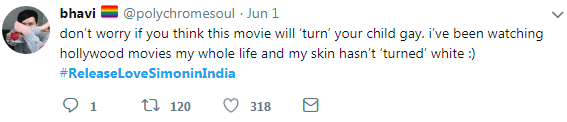
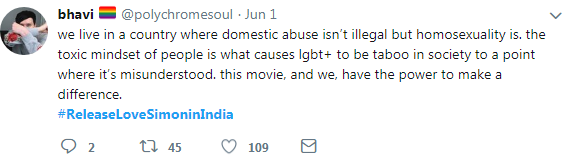
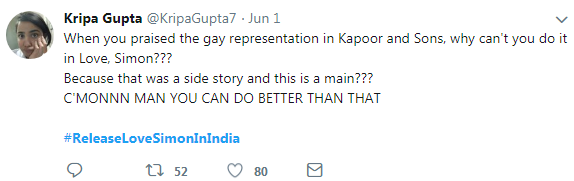
Indians took to Twitter to express their opinions on the indefinite delay on Love, Simon’s release: [/vc_column_text][vc_column_text]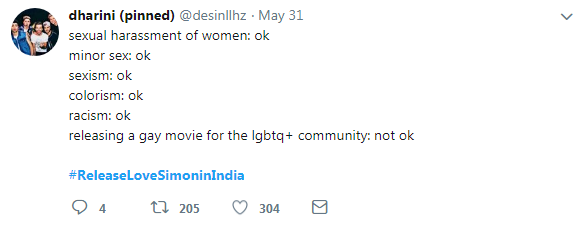
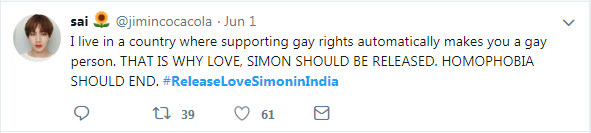 [/vc_column_text][vc_column_text]Politicians such as Rajya Sabha MP and BJP leader Subramanian Swamy feel justified in delaying the release of the film to “protect the culture of India”. Twitter users raved that Love, Simon would have been a landmark film that would humanize the LBGT+ community in India. However, at the tail end of International Pride Month, the film has still yet to be released. [/vc_column_text][/vc_column][/vc_row]
19 Jun 2018 | Artistic Freedom, Music, News
The right to freedom of expression is considered by many to be a cornerstone of a modern democratic society. Countries that fail to adequately protect this hallowed right – routinely censoring journalists, writers and musicians whose speech challenges and offends those in power – are rightly regarded by the West to be the worst examples of dictatorial, autocratic regimes.
But right here in the UK, artists are fighting the censorship of their work by global corporations bowing to pressure from and, arguably, colluding with the state and its organs. In May of this year YouTube, the video streaming platform owned by Google, succumbed to pressure from the Metropolitan Police and took down 30 music videos made by drill artists. The Met had been trying to persuade YouTube for almost two years to take down between 50 and 60 videos, alleging the material was contributing to the increase in violent crime on London streets.
This attack on the freedom of expression of musicians who make drill music does not stop at the removal of their videos from YouTube. Defendants convicted in criminal cases may in the future be banned from making music for a period up to three years if the offender is under 18 and indefinitely for adult offenders under criminal behaviour orders[1]. Crucially, the prosecution can use evidence to support the making of an order that would not have met the strict rules of admissibility as in a criminal trial[2]. The threat to freedom of expression goes further. The Met have expressed publicly their intention to push for new legislation, similar to anti-terrorism laws, that will criminalise the making of drill videos.
Drill is not for everyone. The lyrics are violent. There is liberal use of expletives. Descriptions of acts of violence using knives and guns are common themes. The images portrayed in the accompanying videos are similarly hard-hitting. Large groups of mainly young, mainly black men can be seen inhabiting the screen wearing hoodies and tracksuit bottoms – the uniform of the young in some sections of society.
Drill DJs are not, however, pioneers of explicit lyrics and violent images in music. The genesis of what is known as drill in the UK today sprang from a trap-style rap that originated in Chicago in the early 2010s. The hip hop of the 1980s and the gangsta rap of the 1990s are all part of the same family tree of poetic verse poured over a thumping beat. Drill is a close relative.
Nor is it new to blame this type of music for inciting violence. In the 1990s C. Delores Tucker campaigned against violent lyrics aimed at women in rap music. Then, as now, there was little direct evidence of a causal link between rap music and particular acts of violence. What the critics of this music fail to grasp is that the lyrics of this genre of music are inspired by, and not the cause of, the violence that infects the lives of many of these young men.
Censorship of a form of music which affords an already marginalised minority a rare opportunity to express themselves publicly is an attack against their fundamental rights as human beings.
Looked at in its true context then, drill is less about inspiring violence and more about providing a narrative of lives defined by violence. They are telling the stories of their lives, minus the sugar-coating, just as other writers, poets and musicians have done before them.
The courtroom has often been the battleground of the clash between the values of the young minority against those of the old majority. In 1960 Penguin Books was prosecuted under the Obscenity Act 1959[3] for the publication of a book entitled Lady Chatterley’s Lover. The prosecution’s case was that the book had a tendency “to deprave and corrupt” those who read it in daring to portray the affair of a married woman with the family’s gamekeeper. Penguin Books was acquitted[4].
In 1971, the publishers of a satirical magazine were prosecuted when an issue of the magazine featured a sexualised cartoon of the children’s literary character Rupert the Bear. Known as the Oz trial, the three defendants were convicted by the Crown Court but were then acquitted on appeal[5].
Today, UK common law has arguably been strengthened by the enactment of the Human Rights Act 2000 by enshrining in law article 10 of the European Convention of Human Rights[6]. One former Court of Appeal judge said this of the importance of freedom of expression: “Free speech includes not only the inoffensive but the irritating, the contentious, the eccentric, the heretical, the unwelcome and the provocative provided it does not tend to provoke violence. Freedom only to speak inoffensively is not worth having.”[7]
You or I may not wish to stream drill music videos on our mobile device. Many people may find the content offensive. The videos may even be performed by individuals who are suspected of a crime or have criminal convictions[8]. None of this should confer on the state, aided and abetted by global corporations, a wide-ranging power that ultimately infringes the right of musicians to express themselves freely.
This censorship of a form of music which affords an already marginalised minority a rare opportunity to express themselves publicly is an attack against their fundamental rights as human beings.
We all need to sit up and take notice.
1. Under Part 2 of the Anti-social Behaviour, Crime and Policing Act 2014. Such an order may contain requirements for the defendant to inform the police of any activity that may be in breach of the order. The order may be varied, reviewed or discharged. Breach of the order is in itself a criminal offence.
2. An CBO was made recently against 1011 members Micah Bedeau, Jordean Bedeau, Yonas Girma, Isaac Marshall and Rhys Herbert. They are required under the CBO to inform the police 24 hours in advance of their intention to publish any videos online and are required to give a 48 hours warning of the date and locations any live performance.
3. The 1959 Act is still on the statute books.
4. R v Penguin Books Ltd. [1961] Crim LR 176.
5. R v Neville, Dennis & Anderson, The Times, 24 June 1971.
6. Article 10 (1) ECHR states: “Everyone has the right to freedom of expression. This right shall include freedom to hold opinions and to receive and impart information and ideas without interference by public authority and regardless of frontiers. This article shall not prevent states from requiring the licensing of broadcasting, television or cinema enterprises.” Article 10 (2) sets out limitations to this right.
7. Sir Stephen Sedley in Redmond-Bate v Director of Public Prosecutions [1999] Crim LR 998.
8. A number of successful high-profile rap artists have criminal convictions.
18 Jun 2018 | Campaigns -- Featured, Egypt, Statements
[vc_row][vc_column][vc_single_image image=”100868″ img_size=”full”][vc_column_text]Monday 18 June 2018 — Human rights groups expressed growing concern about Egyptian campaigner Amal Fathy and urged authorities to release her immediately.
Ms Fathy was seized by police on 11 May after posting a video about sexual harassment. Ms Fathy and her husband Mohamed Lotfy, co-founder of award-winning human rights group the Egyptian Commission for Rights and Freedoms, had their Cairo home raided by armed police in the early hours of the morning, and she, Mr Lotfy and their two year-old son were taken to a police station.
Mr Lotfy and his son were released several hours later but Ms Fathy remains in custody, where her health is deteriorating. Her lawyer has reported that Ms Fathy, a communications student, is suffering panic attacks in detention. Initially detained for 15 days, Ms Fathy’s detention has twice been extended, with no date yet set for a hearing.
The trigger for the arrest was a 12-minute Facebook video in which Ms Fathy complained about having been sexually harassed at a bank and the difficulties of being a woman in Egypt. Ms Fathy has since been charged with membership of a terrorist organisation.
Mr Lotfy is one of the leaders of the Egyptian Commission for Rights and Freedoms, which coordinates campaigns for those who have been tortured or disappeared. Between August 2016 and August 2017, the ECRF documented 378 cases of enforced disappearance, many of them concerning students. In April 2018, ECRF was awarded an Index on Censorship Freedom of Expression Award.
Index on Censorship, together with international lawyers Doughty Street Chambers and ECRF, last month submitted a complaint on the treatment of Mr Lotfy and his son, and the continued detention of Ms Fathy, to the UN rapporteurs on freedom of expression and human rights defenders.
“We are seriously worried about Ms Fathy and the lack of due process in her case. This continued detention is already having a terrible impact on her own health not to mention that of her young son, for whom Ms Fathy is the primary carer,” said Index on Censorship CEO Jodie Ginsberg.
Egypt has seen an escalation in violence against women and prominent women human rights defenders and activists are routinely harassed and silenced by the authorities. A 2017 poll named Cairo as the most dangerous major city for women.
The organisations ask Egypt to release Ms Fathy immediately.
For more information, please contact Sean Gallagher at Index on Censorship: [email protected].
Signatories:
Article 19
The Arabic Network for Human Rights Information (ANHRI)
Civicus
Doughty Street Chambers
Front Line Defenders
Index on Censorship
PEN International[/vc_column_text][/vc_column][/vc_row][vc_row][vc_column][vc_basic_grid post_type=”post” max_items=”12″ style=”load-more” items_per_page=”4″ element_width=”6″ grid_id=”vc_gid:1571391767658-84d8abc6-2e8d-7″ taxonomies=”25926″][/vc_column][/vc_row]
