4 Jun 2018 | Artistic Freedom, Europe and Central Asia, News, Risks, Rights and Reputations, United Kingdom
[vc_row][vc_column][vc_column_text]
On Saturday 24 March the final performance of my play Elephant was cancelled in Birmingham, bizarrely the same city where, just over 13 years ago, my play Behzti was closed after protests against the show turned violent. Last month, a different kind of protest brought the run of Elephant to its premature end. The Football Lads Alliance were in town, apparently marching against “extremism” on the same day as the play’s final outing.
Elephant had completed a run in the Birmingham Rep’s studio space, The Door, and was on tour in the community. The last performance was for a closed group of visually impaired adults from a local charity and was scheduled to go on at the Old Joint Stock, a pub theatre in the city centre. However, because of the FLA demonstration, many local pubs, including the Old Joint Stock, which happened to be near the focal point of the rally, closed, following police advice.
The Rep found another location for the show, a large room at the theatre, but the charity did not feel safe bringing their group across town, such was the atmosphere of trepidation surrounding the march. With no audience, there was to be no show.
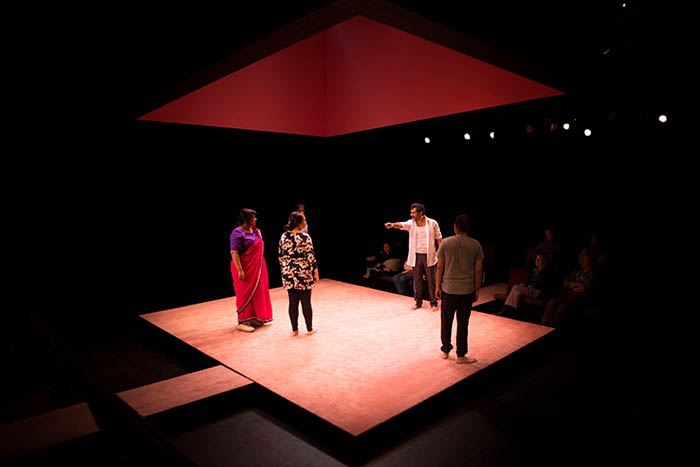
The cast of Elephant. Credit: Ellie Kurttz
Elephant was certainly not targeted like Behzti, it was simply collateral damage, as were the many businesses who lost significant income and the thousands of ordinary people who were intending to come into town to work and play in their city, but ended up changing their plans.
The FLA marching in Birmingham, a city defined by multiculturalism, was clearly an act of provocation. Everyone has a right to protest but the question here is about the policing of such action. The police facilitated the FLA and their cohort, most of whom came from outside the West Midlands, protecting their freedom to express their views. Afterwards the police framed the march as a success and Birmingham West Chief Superintendent Danny Long thanked the public for their understanding, saying: “Our aim was to facilitate the lawful protest and lawful assembly of all the groups here and that’s what’s happened.” Words which show little regard for the lawful freedoms of local people.
The clear message given out by the police was one of fear – keep a low profile and stay away, because today this is not your city. It’s a dysfunctional way of keeping order, one that we’ve got used to and don’t question. Peddling this type of fear gives credence to abhorrent views and fuels underlying tensions.
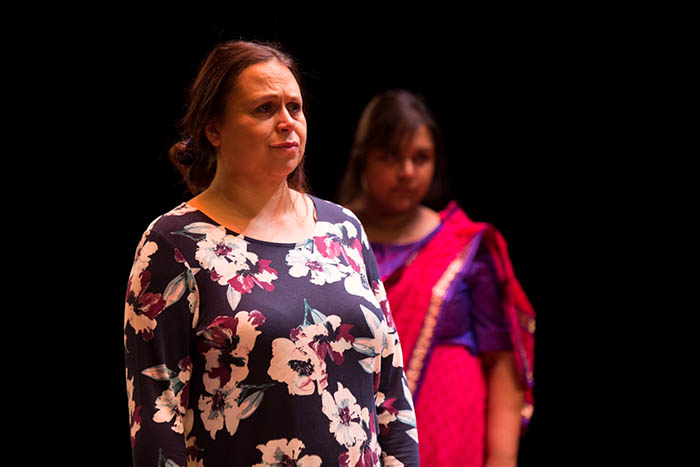
Yasmin Wilde as Deesh in Elephant. Credit: Ellie Kurttz
The West Midlands police have considerable form. Five years after Behzti was cancelled (the main reason being that because the police said they could not guarantee the safety of staff or public), Penny Woolcock’s film 1Day was removed from Birmingham cinemas after the same police force suggested it might incite gang violence. In 2010, during rehearsals of my play Behud, the police asked the Coventry Belgrade to pull the production, as they were expecting protests. The theatre refused and the show continued without incident.
Each of these situations tells us more about the police’s anxieties than our own. Given their attitude around the FLA march, there is clearly still much to learn about managing order in a city where almost half the population do not identify as white British. In her speech at the demonstration, the leader of far-right organisation For Britain, said: “We are living through a dark time in this country.” It’s a dark time indeed when the freedoms of racists brought in to intimidate and frighten a community, trump the freedoms of that very community to live their lives.
What happened in Birmingham last month raises questions of power and control. Who runs our cities and who are they for? The FLA march left a trace of unease and fracture in a city where many of its inhabitants already feel marginalised.
Elephant tells the story of a woman who is ostracised for telling the truth about being abused as a child. Although the circumstances of the play’s cancellation were totally different to Behzti in 2004, it’s hard not to feel a similar sense of sadness and loss at having been silenced.
Facilitating an inflammatory protest at the expense of the freedoms of the silent majority is no victory and shutting people out of their own city is no fit way of dealing with tensions between communities. Public order should be maintained in a fair and equal way, otherwise those who shout loudest get heard, and everyone else ends up without a voice.[/vc_column_text][vc_column_text]
ALSO READ
[/vc_column_text][/vc_column][/vc_row][vc_row][vc_column width=”1/3″][staff name=”Gurpreet Kaur Bhatti on Behzti” profile_image=”100618″]When I started writing my third play, Behzti, in 2003 I could never have imagined the furore which was going to erupt. There was an atmosphere of great tension in the lead up to its production in December 2004, and it was indeed an extraordinary time. Mass demonstrations culminated in a riot outside the theatre. Read on[/staff][/vc_column][vc_column width=”1/3″][staff name=”Birmingham Repertory Theatre: Behzti” profile_image=”100620″]In December of 2004, Birmingham Repertory Theatre staged the world premiere of Behzti, a new play by Gurpreet Kaur Bhatti, in the smaller of its two theatres, The Door, which is a space exclusively dedicated to the production and presentation of new plays. “Behzti” is a word in common usage amongst the Punjabi speaking community meaning “dishonour” or “shame”. Read on[/staff][/vc_column][vc_column width=”1/3″][staff name=”Challenging the UK’s risk averse culture” profile_image=”100621″]It’s easy to dismiss the importance of arts in a democracy; its social value is disregarded when it is seen as the province of the rich and privileged. Yet when we look to more authoritarian regimes across the globe Index is reminded constantly of the importance of the role of arts as a voice of dissent and the extraordinary amount of time that repressive states spend suppressing it. Read on[/staff][/vc_column][/vc_row]
31 May 2018 | Mapping Media Freedom, Media Freedom, News
[vc_row][vc_column][vc_column_text]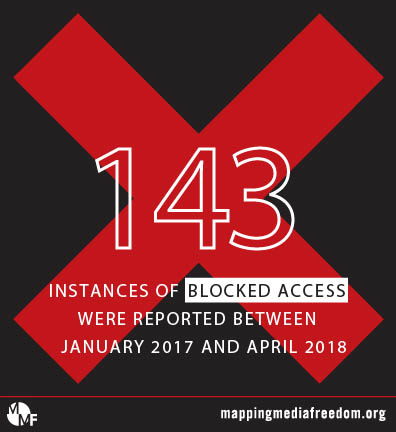 From the beginning of 2017 until April 2018, 143 reports of blocked access, in which journalists were expelled from a location or prevented from speaking to a source, were submitted to Index on Censorship’s Mapping Media Freedom project. Out of the 25 countries in which such violations have occurred, the five worst were: Ukraine, Russia, Belarus, Turkey and France.
“Mapping Media Freedom has highlighted is a continual prevention of journalists from doing their job by way of blocked access,” Joy Hyvarinen, head of advocacy at Index on Censorship, said. “For the sake of the public’s right to know, journalists must be granted access in order to eliminate the problem of important issues going underreported.”
Ukraine
With 20 separate incidents of blocked access, Ukraine tops the list. Thirteen of the reports involved Russian or Georgian media outlets, highlighting the tension between the three countries, with November 2017 being the busiest month, with five violations recorded. At least 12 journalists were barred from entering the country in the last 15 months, with another six being deported. Among those deported was Georgian television channel Rustavi-2 journalist Tamaz Shashvishvili, who was forcibly detained in November 2017 by around 15 armed members of Ukraine’s security services who stormed his apartment, hit him in the face with a pistol and blindfolded him.
In another case, two Spanish journalists were deported to the Netherlands in August 2017 and banned from entering the country for three years after being detained for about 20 hours at Kyiv International Airport. They say they were treated like “criminals” and blacklisted from the country until 2020. A spokeswoman for the Ukrainian secret service said that the journalists were barred because of their “activities that contradict the national interest of Ukraine”.
Russia
In Russia, journalists were denied access on 18 occasions, including 10 times from courtrooms and state assemblies. In March 2018, while live reporting from the Dzerzhinsky District Court of St. Petersburg, Sasha Bogino, a correspondent for the online news site Mediadzona, and her colleague photographer David Frenkel were dragged from the hall. In January 2018, journalists were barred from former Kirov governor Nikita Belykh’s court hearing for bribery.
In January 2018, investigative website Russiangate was closed down three hours after publishing an article claiming to have traced expensive properties to director of Russian secret service FSB Aleksandr Bortnikov, following a request of the General Prosecutor’s Office. Editor-in-chief Aleksandrina Elagina was subsequently dismissed from her position, with investors pulling funding for the site causing it to close.
Belarus
In Belarus eight cases, usually with inadequate explanation, were reported. Pavel Dailid, a journalist for the website Pershy Regiyon, was barred from reporting at a local council meeting in December 2017, when deputy chairman of the Ivatsevichi district Ideology department Aliaksandr Velikaselets demanded to see “an accreditation by the local government” despite the council meeting being as open to the public. In another case, a correspondent for the independent newspaper Hazeta Slonimskaya was barred from local meeting in May 2017 by a government official who stood in front of the entrance calling the paper biased. The journalist was invited to the meeting by local residents.
Photojournalists have also been targeted. In July 2017 city authorities in Babruisk banned photography and filming during Belarus’ Independence Day. Journalists for the newspaper Bobruiski Courier and others, therefore, had no opportunity to photograph the festivities during the public holiday. Two months later a journalist was denied accreditation by the Foreign Ministry for the eighth time. The ministry noted that Victar Parfionenka’s accreditation had been rejected because he “had carried out journalistic activities on behalf of a foreign media outlet without accreditation of the Ministry of Foreign Affairs in Belarus”.
Turkey
In the seven out of nine reports from Turkey, access to a number of websites and TV stations was denied. Sendika, a left-wing labour-oriented news website, has been blocked 23 times in all. In January 2018 access to five news websites was banned, including feminist and pro-Kurdish news website jinnews.org, over a report on the murder of three Kurdish women in Paris in January 2013. Access to daily-German newspaper BILD was blocked online in February 2017 after its harsh criticism of the arrest of German-Turkish reporter Deniz Yucel, a correspondent for daily newspaper Die Welt. Kurdish-language newspaper Rojava Medya was also blocked online in May 2017, most likely for its position as the informal successor of Azadiya Welat, which was shut down under State of Emergency rules introduced after the coup attempt on 15 July.
France
Eight reports of blocked access were reported in France. With a presidential election underway in 2017, five of these involved journalists being denied access to candidates, usually by force.
In April 2017, two Buzzfeed News journalists, David Perrotin and Paul Aveline, were physically prevented from filming a meeting with Francois Fillon. The journalists were filming two people who had interrupted a meeting with Filion when security personnel grabbed the men, threatened them and demanded they delete their footage. It was only when the journalists threatened to write an article about the incident that security backed off.
A similar incident occurred in February 2017 when three journalists were violently expelled from a conference with Marine Le Pen, president of the National Front. Working for the daily current affairs show Quotidien, the journalists were violently kicked out of a conference after attempting to ask Le Pen a question about claims she had misused European Parliament funds to pay her bodyguards. Before journalist Paul Larrouturou could finish his question, he was grabbed, ejected by security and was prevented, along with his two colleagues, to regain access, despite his official accreditation. [/vc_column_text][/vc_column][/vc_row][vc_row][vc_column][vc_basic_grid post_type=”post” max_items=”4″ element_width=”6″ grid_id=”vc_gid:1528726702751-832c0106-cd52-7″ taxonomies=”6564″][/vc_column][/vc_row]
24 May 2018 | Campaigns -- Featured, Press Releases
[vc_row][vc_column][vc_single_image image=”100566″ img_size=”full”][vc_row_inner][vc_column_inner width=”1/3″][vc_single_image image=”74586″ img_size=”full”][/vc_column_inner][vc_column_inner width=”1/3″][vc_single_image image=”88957″ img_size=”full”][/vc_column_inner][vc_column_inner width=”1/3″][vc_single_image image=”100560″ img_size=”full”][/vc_column_inner][/vc_row_inner][vc_column_text]International human rights lawyers Doughty Street Chambers have lodged a complaint to the United Nations on behalf of Egyptian campaigner Amal Fathy, her husband and their son after the family was seized by police.
Ms Fathy and her husband Mohamed Lotfy, co-founder of award-winning human rights group the Egyptian Commission for Rights and Freedoms, were arrested by police in the early hours of May 11. Their Cairo apartment was raided by armed police, searched and Ms Fathy, Mr Lotfy and their two year-old son Zidane taken to a police station.
Mr Lotfy and Zidane were released several hours later but Ms Fathy remains in custody. The trigger for the arrests was said at the time to be a short 12-minute Facebook video posted by Ms Fathy in which she complained about having been sexually harassed at a bank and the difficulties of being a woman in Egypt. Ms Fathy has since been charged with membership of a terrorist organisation.
“Unfortunately, the case of Mr Lotfy, his son, and Ms Fathy, are not isolated, nor in many ways surprising,” said Caoilfhionn Gallagher QC, one of the lawyers acting for the family. “Over the past several years, many Egyptian human rights defenders, bloggers and journalists have been subjected to state harassment, disproportionate police and judicial treatment, and arbitrary curtailment of their most fundamental rights.”
Ms Fathy is a communications student and former activist and actress who is active on social media, especially Facebook, where she advocates and expresses her views on ongoing issues in Egypt especially on women’s rights.
Mr Lotfy leads the Egyptian Commission for Rights and Freedoms, which coordinates campaigns for those who have been tortured or disappeared. Between August 2016 and August 2017, the ECRF documented 378 cases of enforced disappearance, many of them concerning students.
Caoilfhionn Gallagher QC and Jonathan Price of Doughty Street Chambers have submitted their complaint on the treatment of Mr Lotfy and his son, and the continued detention of Ms Fathy, to the UN rapporteurs on freedom of expression and human rights defenders. The complaint has been lodged jointly with ECRF and freedom of expression organisation Index on Censorship, which in April awarded ECRF one of its Freedom of Expression Awards Fellowships.
“We have grave concerns given the inevitable lack of due process for Ms Fathy. We also have serious concerns for her wellbeing given the likelihood of prolonged detention, away from her young son, and for the wellbeing of Zidane himself, removed from his primary carer,” said Index on Censorship CEO Jodie Ginsberg.
Egypt has seen an escalation in violence against women and prominent women human rights defenders and activists are routinely harassed and silenced by the authorities. A 2017 poll named Cairo as the most dangerous major city for women.
The organisations have asked the rapporteurs to:
-
- gather, request, receive and exchange information and communications from the Egyptian Government in relation to this case;
- publicly make concrete recommendations to the Egyptian authorities on their duty to adhere to their international obligations; and
- issue an opinion finding that Egypt has failed to adhere to its own obligations, and violated the rights of the complainants, under international law.
For more information, please contact Joy Hyvarinen at Index on Censorship: [email protected]. [/vc_column_text][vc_separator][/vc_column][/vc_row][vc_row][vc_column width=”1/2″][vc_single_image image=”97988″ img_size=”full” onclick=”custom_link” link=”https://www.indexoncensorship.org/2018/04/campaigning-fellow-2018/”][/vc_column][vc_column width=”1/2″][vc_column_text]
Egyptian Commission for Rights and Freedoms
[/vc_column_text][/vc_column][/vc_row][vc_row][vc_column][vc_basic_grid post_type=”post” max_items=”12″ style=”load-more” items_per_page=”4″ element_width=”6″ grid_id=”vc_gid:1545209658751-e048b322-11bd-8″ taxonomies=”24135″][/vc_column][/vc_row]
22 May 2018 | News, Turkey
[vc_row][vc_column][vc_single_image image=”81952″ img_size=”full” alignment=”center”][vc_column_text]While the scale of Turkey’s crackdown on freedom of expression in the post-coup-attempt emergency rule era has been intense, the assault on dissenting voices predated the failed putsch.
Whether it they were Kurdish writers at the turn of the decade, or worked for Feza Publications just months before the night elements of the military betrayed their fellow Turks, journalists that offered alternative viewpoints were long in president Recep Tayyip Erdogan’s crosshairs.
In the case of Feza’s popular publications — among them Zaman and the English-language Zaman Daily — which had been raided and its employees arrested on several occasions since 2014 as the shakey rule of law eroded in Turkey. In a March 2016 move that was condemned internationally, Feza Publications was targeted with the imposition of government-appointed trustees. This resulted in the termination of hundreds of media professionals from journalists to advertising reps and the literally overnight change from independent and critical outlets to government propaganda sheets.
An appeal on the takeover of Feza was made to the European Court of Human Rights to address a clear violation of the right to freedom of expression, among others. Yet the application was rejected on what was seen as questionable grounds, becoming one of the many disappointing decisions taken by the international court.
Takeover
The assault on Feza Publications was ordered by the Istanbul 6th Criminal Court of the Peace on Friday 4 March 2016. By nightfall, the police had raided the Zaman newspaper office, using tear gas and water cannons on the protestors outside. The Saturday edition of Zaman was the last version of a free newspaper. The front page headline declared “the constitution suspended” and noted that Turkish press had seen one of its “darkest days”. The Sunday edition, under new ownership, was a disconcerting contrast. The front page showed a smiling president Erdogan holding hands with an elderly woman, coupled with an announcement that was he hosting a Women’s Day event. The main headline was “Historic excitement about the bridge”, a reference to a span being built across the Bosphorus with state funding.
Newly appointed government trustees immediately interfered with editorial decisions. A staff member commented that: “Before the takeover, our deadline was 7:30pm. The trustees moved that deadline to 4:30pm, and in the remaining three hours they censored and changed the paper to fit their new ‘line’.” The new management had also banned staff access to the newspapers’ archives.
The police who had raided the office on the Friday, stayed on to check staff IDs and prevent groups of three or more from assembling. Hundreds of Feza Publications employees were then dismissed under Article 25 of the Turkish labour law which lays out that contracts can be annulled without prior notice if an employee displays “immoral, dishonourable or malicious conduct”. Those dismissed have recounted how they received a generic letter which gave no explanation the accusations.
Considered enemies of the state, former Feza Publications employees found it difficult to obtain new jobs. They were left to survive on little to no income; Article 25 outlines that those dismissed are not eligible for redundancy packages or other compensation And recruiters were right to be weary; four-and-a-half months after the takeover, the July 16th coup attempt occurred, and purges began on a massive scale. Thousands of journalists were dismissed, and dozens were detained on terrorism-related charges. Feza Publications, already marked as Gulen-linked and thus terrorist – without the presumption of innocence – during the takeover, was a prime target. Thirty-one Zaman employees are currently standing trial, with nine, including Şahin Alpay, facing life sentences. In January 2018, Turkey’s constitutional court ordered that Şahin Alpay, alongside journalist Mehmet Altan, be released from pre-trial detention.
After the lower courts refused to comply, the ECtHR ruled that their detention was unlawful and that they should each be compensated €21,500.
The other journalists, unable to garner the same international support, have remained in pre-trial detention. Zaman’s Ankara chief Mustafa Ünal, arrested purely because of his newspaper columns and facing the same circumstances as Alpay, has also applied to the ECtHR. But his application was rejected, and after almost two years behind bars he expresses in despair “my scream for justice has faded away in a bottomless pit”. He is not alone, with the ECtHR and international community doing little in light of the Feza Publications debacle and abolishment of the freedom of expression in Turkey.
Appeal to the ECtHR
The Feza Publications takeover and ensuing rights violations, on top of individual pleas for justice, has led to appeals for the entity itself. Two shareholders of Feza Gazetecİlİk A.Ş. (the Feza stock company) took the matter of government-appointed trustees to the Turkish constitutional court. When this appeal failed, they applied to the ECtHR regarding violations of: Article 10, right to freedom of expression; Protocol Article 1, right to property; Article 7 and 6.2, no punishment without law and presumption of innocence; and Article 8, respect for private and family life. Dated 29 July 2016, the application was rejected by ECtHR Judge Nebojsa Vucinic on 14 December 2017 with reference to the Köksal v. Turkey decision.
The decision is reference to a case surrounding Gökhan Köksal, a teacher and one of over 150,000 dismissed from their jobs after the coup attempt. The ECtHR had rejected his appeal on the basis that he must first apply to the Turkish State of Emergency Commission, i.e., first exhaust all domestic avenues. The Köksal decision was problematic. The State of Emergency Commission was established in January 2017 for appeals against dismissals and closures assumed under the state of emergency imposed since 20 July 2016. To date, the Commission has only approved 310 out of 10,010 finalised cases, a 3% success rate. There are almost 100,000 cases still under examination. Many consider the mechanism to be inefficient, and its impartiality questionable. It should not be considered a reliable domestic avenue. Reference to the State of Emergency Commission in relation to Feza Publications poses a further problem; the appointment of government trustees occurred four-and-a-half months before the state of emergency was implemented.
The ECtHR decision is completely inadequate. Although some Feza employees were dismissed under state of emergency decrees, other dismissals and violations pertaining to the Human Rights Convention commenced well before. Although all Feza media outlets (Zaman and Zaman Daily, the Cihan News Agency, Aksiyon magazine, and the Zaman Kitap publishing house) were closed via emergency decree in July 2016, Feza shareholders are not entitled to apply to the State of Emergency Commission. Only persons in charge of the legal entities or institutions at the time of closure – by that point, the government appointed trustees – have the right to apply. Such a situation is implausible, leaving the ECtHR as the only option. Besides, it has been shown that regardless, neither the State of Emergency Commission nor the Turkish judicial system should be considered viable domestic avenues to appeal rights violations.
This ECtHR decision, one in a long line of disappointing rulings for Turkish victims, is seriously flawed. The ECtHR must reconsider the Feza Publications application, alongside those such as Köksal v. Turkey which only pave the way for future rejections. Without adequate ECtHR rulings there is little hope for the upholding of human rights, such as freedom of expression, in Turkey.
[/vc_column_text][/vc_column][/vc_row]
