22 May 2014 | Czech Republic
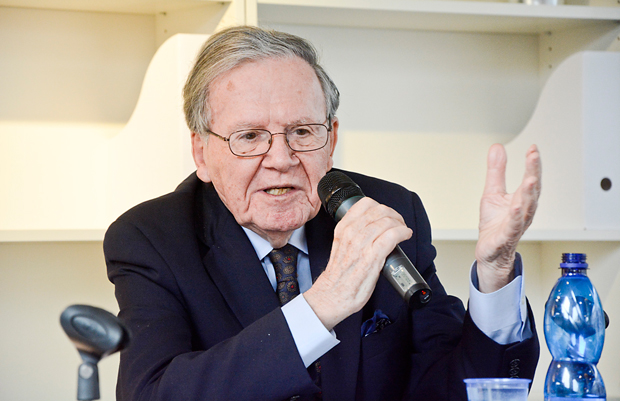
Peter Demetz (Photo: Prague Book Fair)
Emeritus Yale University professor and author Peter Demetz was awarded the Jiri (George) Theiner prize at the Prague Literary Festival this year.
George’s son Pavel, the prize organiser, said Demetz received the award because “all his life he has remained intellectually honest in his demystification of views which sometimes became popular such as the notion of magical Prague, rather stressing the reality of Czech history, as well as his life-long commitment to Czech literature in American and German environments and as translator of Frantisek Halas´ and Jiri Orten´s poetry”.
Theiner set up the prize in memory of his father’s work, as a former editor of Index on Censorship magazine he brought attention to Czech writing and writers during the communist era. He said: “Almost five years ago I discussed with the director of World of Books (Prague Book Fair), Dana Kalinova, the possibility of making this prize an important permanent fixture at the annual book fair. Looking back I realised that George Theiner´s reputation here was as solid as it was in other countries, despite the fact that he left in 1968.
The jury this year was chaired by Lenka Jungmannova (professor at the Institute of Czech Literature, Academy of Sciences), Martin Putna (literary historian, professor at Prague´s Charles University and critic), Jiri Gruntorad (guardian of the largest samizdat collection in central and eastern Europe, dissident persecuted in the 1970´s and 1980´s) and Ivan Biel (documentary film-maker and lecturer in Film Studies). Next year’s jury was also announced and will include Karel Schwarzenberg (a former Czech foreign minister, one of Havel´s closest aides and supporter of dissidents before 1989 whilst living in Austria), Michal Priban (academic at the Institute of Czech Literature, Academy of Sciences), Vladimír Pistorius (samizdat publisher who successfully made the transition into becoming a ´straight´ book publisher) and Jan Bednar (radio journalist and commentator, signatory of Charter 77, between 1985 and 1992 and who worked for the BBC in London).
Theiner said that they received between 35 and 60 nominations each year from all over the world. The criteria stated that the recipient (or organisation) had made a major long-term contribution to the promotion of Czech literature overseas, with an expectation that they have also made a contribution to freedom of speech and human rights in general. Other prize winners include Andrzej Jagodzinski, translator of Havel, Hrabal, Kundera, journalist as well as a leading member of the democratic opposition on Poland); Ruth Bondy (an Israeli of Czech origin, survivor of Auschwitz and Bergen-Belsen who worked as a journalist on the Hebrew daily Davar; and Paul Wilson (a Canadian who lived in Czechoslovakia as a young man before being thrown out in 1977 for collaborating with dissidents and, above all, the band Plastic Pepople of the Universe, translator of Skvorecky, Klima, Havel, Hrabal, radio producer, editor and writer).
Theiner said: “One of the most positive aspects that has come out of the activity surrounding the prize has been the link made between old and new Index on Censorship. It was a real joy to welcome to Prague at the first prize-giving the founding editor Michael Scammell along with some of his old colleagues such as Philip Spender, Haifaa Khalafallah and others. Four years later the present editor Rachael Jolley joined us and moderated a discussion following the award-giving ceremony on freedom after the fall of the Berlin Wall, a reflection on the democratisation of society and freedom of expression in literature and journalism. It´s great to see that the bridge-building that George Theiner was so adept at is still going strong.”
This article was published on May 22, 2014 at indexoncensorship.org
7 May 2014 | Magazine, Volume 43.02 Summer 2014
[vc_row][vc_column width=”1/2″][vc_single_image image=”90659″ img_size=”full” onclick=”custom_link” link=”https://shop.exacteditions.com/gb/index-on-censorship”][/vc_column][vc_column width=”1/2″][vc_column_text]
Subscribe to Index on Censorship magazine on your Apple, Android or desktop device for just £17.99 a year. You’ll get access to the latest thought-provoking and award-winning issues of the magazine PLUS ten years of archived issues, including Brick by brick.
Subscribe now.[/vc_column_text][/vc_column][/vc_row]
30 Apr 2014 | About Index, Azerbaijan Letters, Campaigns, Statements
Minister Usubov Ramil Idris oglu
Minister of Internal Affairs of the Republic of Azerbaijan
Azerbaijan Avenue 7
1005 Baku
Republic of Azerbaijan
Email: [email protected]
Prosecutor General Zakir Bakir oglu Garalov
Nigar Rafibayli street 7
1001 Baku
Republic of Azerbaijan
Email: [email protected]
Mr Minister, Mr Prosecutor General,
We, the undersigned members and partners of the Human Rights House Network (HRHN) and the South Caucasus Network of Human Rights Defenders, express our deep concern over the persecution and hindrance of free movement of human rights defender Leyla Yunus and her husband Arif Yunus. We call upon you to put an end to the attacks, detention and harassment of human rights defenders and to take steps in order to foster a safe environment for human rights defenders, in line with Azerbaijan’s international obligations and commitments, including as a member of the Council of Europe.
On 28 April 2014 Leyla Yunus and her husband, the historian Arif Yunus, were prevented from leaving the country at Baku’s airport. She then was detained and interrogated by the police regarding the case of the arrested journalist Rauf Mirkadirov and questioned about the relation between the journalist and the Institute for Peace and Democracy. She was released only in the after-noon on 29 April 2014. Searches were conducted in the office of the Institute for Peace and Democracy, and continued in the private home of Leyla Yunus until the night of 29 April 2014. According to Leila Yunus, she was humiliated during the search by the officers. The official grounds on which Leyla Yunus and Arif Yunus were prevented from leaving the country and detained are unclear, as well as the grounds on which the searches are being carried out.
Leader of the Institute for Peace and Democracy, Leyla Yunus is a well-known Azerbaijani human rights defender. Her NGO is a member of the South Caucasus Network of Human Rights Defenders and has from the very start in 1995 worked on the issue to release political prisoners and to establish rule of law in Azerbaijan. Leyla Yunus has within several projects worked to establish dialogue between civil society actors in the South Caucasus. She is a Chevalier of the National Order of the Legion of Honour, as a tribute for her longstanding work promoting human rights.
We are worried that the persecution is related to her outspoken criticism in the past few days against the detention of Rauf Mirgadirov, the investigative journalist of the leading Russian-language newspaper Zerkalo (Mirror), who is now facing charges of treason for his efforts in the peace building process of the Nagorno-Karabakh conflict. Rauf Mirkadirov participated in the numerous joint projects between the Institute for Peace and Democracy and Armenian NGOs.
Under Azerbaijan’s commitments within the Organisation for Security and Cooperation’s Misnk Group, we strongly believe that public diplomacy and cooperation between civil society in the South Caucasus contributes to efforts aiming at finding a peaceful solution to the Nagorno-Karabakh conflict.
As the Commissioner for Human Rights of the Council of Europe Nils Muižnieks stated on his Facebook page, “this is an additional example showing the extent of intimidation and repression of critical voices in Azerbaijan, a problem which I have repeatedly highlighted […] and asked the Azerbaijani authorities to address.”[1]Azerbaijan should indeed guarantee the right to freedom of expression of all human rights defenders and critical voices, in line with its obligations as a member of the Council of Europe.
Furthermore, authorities should prevent the use of unreliable evidence and unwarranted investigations against human rights defenders, as laid out in the United Nations Human Rights Council resolution 22/6 of 21 March 2013.
We are extremely worried to see that human rights defenders, including journalists and bloggers, are persecuted, attacked and detained due to their work. In addition to Leyla Yunus, the Chairperson of the Election Monitoring and Democracy Studies Centre (EMDS) Anar Mammadli, the Executive Director of EMDS Bashir Suleymanli and Elnur Mammadov, president of the Volunteers of International Cooperation, are facing court trials[2].
Ahead of the Chairmanship of the Council of Europe by the Republic of Azerbaijan, we call upon you to put an end to the crackdown of the civil society and to take steps in order to foster a safe environment for human rights defenders.
We further call upon you to report to the Council of Europe on your plans to investigate the acts of the State agents, which prevented Leyla Yunus and Arif Yunus from leaving the country and later detained them and to end all persecutions against them and other human rights defenders.
Sincerely,
Human Rights House Azerbaijan (on behalf of the following NGOs):
- Azerbaijan Lawyers Association
- Institute for Reporters’ Safety and Freedom
- Legal Education Society
- Media Rights Institute
- Women Association for Rational Development
Belarusian Human Rights House in exile, Vilnius (on behalf of the following NGOs):
- Belarusian PEN Centre
- Belarus Watch
- City Public Association “Centar Supolnaść”
- Human Rights Centre “Viasna”
Human Rights House Belgrade (on behalf of the following NGOs):
- Belgrade Centre for Human Rights
- Lawyers Committee for Human Rights YUCOM
- Civic Initiatives
- Helsinki Committee for Human Rights in Serbia
- Policy Centre
Human Rights House Kiev (on behalf of the following NGOs):
- Association of Ukrainian Human Rights Monitors on Law-Enforcement
- Human Rights Information Centre
- Center for Civil Liberties
- Kharkiv Human Rights Protection Group
Free Word Centre London (on behalf of the following NGOs):
- Index on Censorship
- Vivarta
Human Rights House Sarajevo (on behalf of the following NGOs):
- Helsinki Committee for human Rights in Bosnia and Herzegovina
Human Rights House Tbilisi (on behalf of the following NGOs):
- Georgian Centre for Psychosocial and Medical Rehabilitation of Torture Victims – GCRT
- Caucasian Center for Human Rights and Conflict Studies
- Human Rights Centre
- Union Sapari
- Article 42 of the Constitution
- Media Institute
Human Rights House Oslo (on behalf of the following NGOs):
- Health and Human Rights Info
- Human Rights House Foundation
- FIAN Norway
Human Rights House Voronezh (on behalf of the following NGOs):
- Charitable Foundation
- Civic Initiatives Development Centre
- Confederation of Free Labor
- For Ecological and Social Justice
- Free University
- Golos
- Interregional Trade Union of Literary Men
- Lawyers for labor rights
- Memorial
- Ms. Olga Gnezdilova
- Soldiers Mothers of Russia
- Voronezh Journalist Club
- Voronezh-Chernozemie
- Youth Human Rights Movement
Human Rights House Yerevan (on behalf of the following NGOs):
- Armenian Helsinki Association
- Helsinki Citizens’ Assembly-Vanadzor
- Journalists’ Club “Asparez”
- Democracy Today
Human Rights House Zagreb (on behalf of the following NGOs):
- APEO/UPIM Association for Promotion of Equal Opportunities for People with Disabilities
- B.a.B.e.
- CMS – Centre for Peace Studies
- Documenta – Centre for Dealing with the Past
- GOLJP – Civic Committee for Human Rights
- Svitanje – Association for Protection and Promotion of Mental Health
Rafto Foundation, Norway
Helsinki Foundation for Human Rights, Poland
Public Union of Democracy Human Rights Resource Centre, Azerbaijan
Legal Protection and Awareness Society, Azerbaijan
Copies have been sent to:
- Ministry of Justice of the Republic of Azerbaijan
- Presidency of the French Republic
- Ministry of Foreign Affairs of the French Republic
- Office of the Commissioner for Human Rights of the Council of Europe
- Private Office of the Secretary General of the Council of Europe
- Chairman of the Committee of Ministers of the Council of Europe
- Delegation of the Council of Europe in Azerbaijan
- UN Special Rapporteur on human rights defenders
- Office for Democratic Institutions and Human Rights of the Organisation for Security and Cooperation in Europe (OSCE ODIHR)
- Delegation of the European Union in Azerbaijan
- Subcommittee on Human Rights of the European Parliament
- Diplomatic community in Baku, Brussels, Geneva and Strasbourg
- Various ministries of foreign affairs and parliamentary committees on foreign affairs
About the Human Rights House Network (www.humanrightshouse.org)
The Human Rights House Network (HRHN) unites 90 human rights NGOs joining forces in 18 independent Human Rights Houses in 13 countries in Western Balkans, Eastern Europe and South Caucasus, East and Horn of Africa, and Western Europe. HRHN’s aim is to protect, empower and support human rights organisations locally and unite them in an international network of Human Rights Houses.
The Human Rights House Azerbaijan is one of the members of HRHN and served as an independent meeting place, a resource centre, and a coordinator for human rights organisations in Azerbaijan. In 2010, 6’000 human rights defenders, youth activists, independent journalists, and lawyers, used the facilities of the Human Rights House Azerbaijan, which has become a focal point for promotion and protection of human rights in Azerbaijan. The Human Rights House Azerbaijan has been closed after the Ministry of Justice of the Republic of Azerbaijan ordered all activities to be been ceased on 10 March 2011.
The Human Rights House Foundation (HRHF), based in Oslo (Norway) with an office in Geneva (Switzerland), is HRHN’s secretariat. HRHF is international partner of the South Caucasus Network of Human Rights Defenders and the Balkan Network of Human Rights Defenders.
HRHF has consultative status with the United Nations and HRHN has participatory status with the Council of Europe.
[1]Statement available at https://www.facebook.com/HumanRightsHouseNetwork/posts/10152035306640965.
[2]Further information on those cases available at http://humanrightshouse.org/Articles/20033.html.
31 Mar 2014 | News, Russia
Punitive psychiatric treatment is returning to Russia. This is a throw back to Soviet times, with opposition activists condemned by a kangaroo court to bogus psychiatric treatment courses, with no chance of release until a doctor says so.
Mikhail Kosenko, 39, last week became the highest profile case when he lost his appeal case against enforced psychiatric treatment. As such he will be interned immediately at a state-owned medical facility in Moscow. At worst, his sentence could be for life, with no chance of parole, as his release depends on vaguely described criteria. His assessment will also be made by doctors whose political neutrality is not guaranteed.
In 2012, Kosenko was arrested by Moscow police after taking part in a peaceful protest against Putin in Bolotnoya Square. Charged with rioting, he spent much of the next twenty two months behind bars. When his sentence was read out in court last October, his sister Kseniya, told the BBC : “I have an awful feeling. There are really frightening stories about what goes on in these places.”
Kseniya describes her brother as “a very quiet, homely type of guy.” She confirms various inspecting doctors reporting that he’s very shy – “shunning any kind of violence.”
Kosenko did have a pre-existing psychiatric condition when he was arrested – slow on-set schizophrenia diagnosed in 2001. But after medication and good advice, the condition was very much under control. Kosenko had never shown any tendency to be violent, according to his doctors.
Tanya Lokshina, Russia Program Director and Senior Researcher at Human Rights Watch, opposes the ruling.
“Mikhail’s case simply reminds me of the Soviet Union,” Lokshina warns. She tells how punitive psychiatry was a tool that was rarely used, but always with devastating effect. “Back then the medications used were really heavy, they were designed to slow down movements and just keep you out of the way.”
It’s impossible know exactly what treatments are now in store for Kosenko. But whatever is to come, it will only end if Kosenko dies, renounces his politics, or wins a final case of appeal at the Supreme Court. This is his last chance, but it could be some time. Lokshina remembers that when Pussy Riot took an appeal case to the Supreme Court, they had to wait a year before their case was heard. In the meantime, Kosenko’s treatment will continue.
The only medical evaluation the court heard was conducted by the Serbsky Institute in Moscow. Their crebility was disputed by medical experts, including the head of Russia’s Independent Psychiatric Association, when they noted that the assessment had completely omitted any reference to Kosenko’s successful ten years of self-medication, with no history of violence. Serbsky Insitute is also owned and operated by the state. The judge threw out a petition to have a second medical assessment.
Lokshina tells me there have been a few cases recently – but this is by far the worst. Amnesty International call it “an abhorrent return to Soviet-era practices.” The weeping sister of Kosenko told the BBC she felt “physically sick” when she heard that her brother had been found guilty.
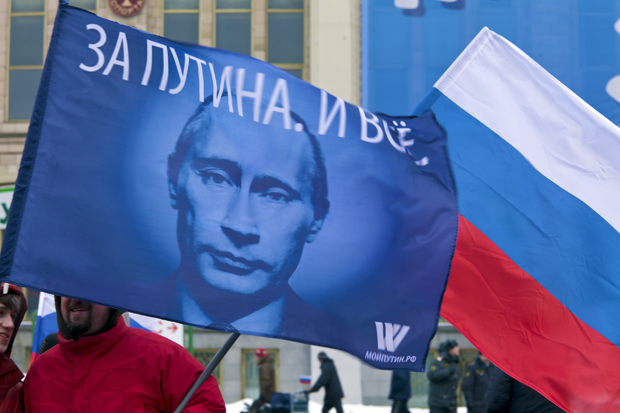
Putin is turning to medieval, desperate measures as he balances himself on a rattling economy, a tonne of debt and a country that is too big to govern. Those with the bitterest memories, like Ukraine, Poland and the Baltic states, fear a renewed bid to expand borders permanently, especially looking at adventures into Crimea.
But Putin is smarter. He must distract the population from a certain amount of oligarch asset-stripping and poor management, which has become epidemic under his reign. But he also must not overstretch or overspend. Enter the Roman strategy of “bread and circuses,” minus the bread.
Putin’s inaugural circus took place during the Georgia invasion in 2008, and according to Mark Adomanis remembering the war in Forbes magazine “bathed Russia in a warm patriotic glow.” Putin’s ratings took a generous bump as a result.
But Admonanis predicted, just two months ago, that Putin’s ratings would have dipped by the end of this year. The economy was weak and Sochi had been a slightly uncomfortable experience for anyone even remotely Russian.
Sadly Adomanis, nor anyone outside Putin’s inner circle, could not reasonably have predicted Putin’s subsequent gamble in Crimea.
The incursion has seen approval ratings leap from sixty five to eighty percent almost over-night. That is an extraordinary success.
Yet while Crimea has been a successful though highly irritating move, Putin’s political future is still at risk. The balance of world media commentary has been unapproving. The lies he is telling about dangerous neo-Nazi gangs have been proved as untruths, journalists have exposed the role of vicious nationalist thugs (on the Russian side), and Putin’s cheeky disregard for international law condemned. His domestic woes also go on regardless – senior officials within the Kremlin admit that the capital outflows and fall in the stockmarket are far greater than they had forecast. There certainly isn’t any capacity for “bread.”
Facing criticism at home and abroad – Putin turns to censorship and propaganda to secure himself domestically and reap political reward out of Crimea. Any oppositionist media has been bloodily censored. Reports of self-censorship are leaking out from the remaining clutch of titles.
There are three varieties of public criticism which particularly irk Putin. First, a human rights group can get hold of and successfully publicise a story (Kosenko). Second, a one-off event focuses the world on Russia (Sochi). The third is that Russian activists go out onto the streets (again Kosenko’s case, see also Pussy Riot).
In each scenario, Putin potentially loses. But he’s developed mitigation strategies. The first is to denounce foreign criticism as biased and baseless. The second is to claim it’s-a-great-big-Western-plot-we’re-the-victims-don’t-worry-Putin-here-will-rescue-you. The third is to allow some freedom of speech, but only as an opposition release valve. The fourth is to treat protesters like animals.
Street-marches are targeted by violent thugs, who act with suspicious impunity. But it’s the judiciary, and their shoddy self-discipline, who play the more important role. There were serious judicial errors in Kosenko’s case. Other victims have seen key witnesses prevented from giving testimony. Or biased “expert opinions.” Or paid goons threatening the families of the accused.
Putin’s actions abroad might bring back memories of Communist Russia, but Putin probably doesn’t see it this way. Putin needs the circuses of Georgia and Crimea, even if he can’t afford bread back home. He has also applied a blanket of censorship on the media.
Now Putin is turning to psychiatric institutions in a bid to remain in power.
This article was published on March 31, 2014 at indexoncensorship.org