15 Jan 2015 | Events, Saudi Arabia
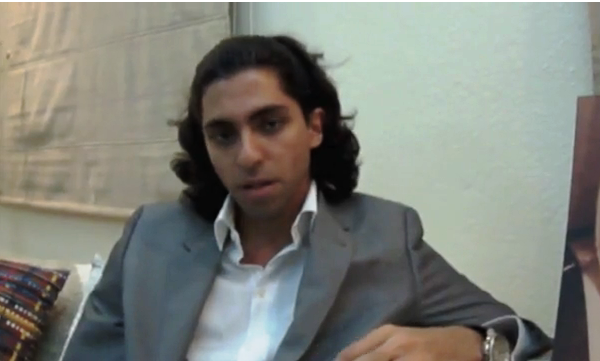
Index on Censorship, English PEN and Article 19 will hold a peaceful vigil in front of the embassy of Saudi Arabia at 9am on Friday 23 January in condemnation of the ongoing flogging and imprisonment of Raif Badawi. Please meet at the Curzon Street side of the embassy.
Blogger and activist Badawi will receive his second set of 50 lashes on the 23rd after a postponement on Friday Jan 16 to let the wounds from his first 50 lashes heal. Badawi’s punishment will continue every week until 1,000 lashes have been given. He is being punished for speaking out against Islam and powerful Saudi religious figures on his blog, Free Saudi Liberals, which encouraged political debate. As well as the lashings, he has been sentenced to 10 years in prison and fined 1 million riyals (£175,000).
He received his first 50 lashes in the port city of Jeddah on Friday 9 January. An anonymous witness said:
“A security officer approached him from behind with a huge cane and started beating him. Raif raised his head towards the sky, closing his eyes and arching his back. He was silent, but you could tell from his face and his body that he was in real pain. The officer beat Raif on his back and legs, counting the lashes until they reached 50.”
It’s crucial that we take a stand against the Saudi government’s brutal treatment of this political prisoner. Every week that Raif Badawi is dragged to the public square in Jeddah and given another 50 lashes for exercising his right to freedom of expression, scores of Saudi activists will muffle themselves in fear of a similar reprisal.
We call on the Saudi government to stop this extreme punishment, and to release Raif immediately.
Join us at 9am. Please meet at the Curzon Street side of the embassy.
2 Jan 2014 | News, Politics and Society
Activists are continually harassed and punished for standing up and speaking out about social and political issues they feel are unjust in their country. Here are five activists whose government didn’t quite like what they had to say.
Raif Badawi- Saudi blogger punished after calling for ‘day of liberalism’
It would seem absurd to most people that “liking” a Facebook page could land you in jail. However, that was one of the crimes charged against Raif Badawi after he “liked” an Arab Christian page on the social networking site. The young co-founder of the Liberal Saudi Network, a website that has since been shut down, was arrested in June 2012 for “insulting Islam through electronic channels”, including insulting Islam and portraying disobedience.
In January, a court had refused to hear apostasy charges against Badawi, concluding that there was no case. Apostasy carries the death sentence in Saudi Arabia. He has since been sentenced to 600 lashes and seven years in jail.
Eskinder Nega- Ethiopian blogger
Eskinder Nega is a well-known name in Ethiopia whose journalism has been recognised by major organisations globally; he is currently serving 18 years in jail for supposedly violating the country’s anti-terrorism legislation.
Nega was arrested in September 2011 after publishing, somewhat ironically, an article criticising his government’s detainment of journalists as suspected terrorists, in particular the arrest of Ethiopian actor and government critic Debebe Eshetu . Along with 23 others, he was then convicted of having links with US-based opposition group Ginbot Seven, an organisation Ethiopia had recently added to its list of terrorists.
This is not the first time Nega has been imprisoned for speaking out in defense human rights. Meles Zenawi’s government handed him a total of eight sentences over the past decade. He is also not the only journalist to face prosecution under the Ethiopian government. According to the Amnesty Annual Report 2013 a number of journalists and political opposition members were sentenced to lengthy prison terms on terrorism charges for calling for reform, criticizing the government, or for links with peaceful protest movements. Much of the evidence used against these individuals consisted of examples of them exercising their rights to freedom of expression and association.
Shi Tao- Stung by Yahoo in China
2013 was a good year for Shi Tao; the Chinese reporter was finally released after documents leaked by Yahoo to his government saw him spend the past eight and a half years behind bars.
Tao sent details of a government memo about restrictions on news coverage of the Tiananmen Square massacre anniversary to a human rights forum in the United States. He was subsequently arrested in 2004 and sentenced the following year charged with disclosing state secrets.
Reporters Without Borders said the branch of Yahoo in Hong Kong assisted the Chinese government in linking Shi Tao’s email account to the message containing the information he had sent abroad. Yahoo was heavily criticised at the time by human rights activists and U.S. legislators with Jerry Yang, co-founder of Yahoo, publicly apologising to Shi Tao’s family.
Tao was released 15 months before the end of us 10 year restriction. It is unclear why his early release occurred.
Ngo Hao- Vietnamese blogger
You’re never too old to go to prison as 65-year-old activist Ngo Hao found out after he was handed 15 year sentence earlier this year on charges of attempting to overthrow the Vietnamese government. Accused of writing and circulating false and defamatory information about his government and its leaders, Hao was arrested in February. Further accusations included a peaceful attempt to instil an Arab Spring-style revolution and of working with dissident group Bloc 8406.
Reporters Without Borders criticised Hao’s trial for a lack of his right to a fair defence and the unwillingness to allow any family members to attend the hearing asides from his son.
Just weeks before an appeal court in the south of the country also sentenced two bloggers, Nguyen Phuong Uyen and Dinh Nguyen Kha. This takes the estimated total of bloggers behind bars in Vietnam to 36.
Jabeur Mejri- Tunisian blogger seven and a half years for posting on Facebook
After the 2011 Arab Spring many Tunisian bloggers were able to express themselves freely; a stark contrast to the censorship, arrest and jail they had come to expect under the rule of former President Ben Ali. One such blogger was Jabeur Mejri who, in March 2012, posted a cartoon of the Prophet Mohamed on his Facebook page, a post that sentenced the blogger to over seven years in jail for “attacking sacred values through actions or words” and “undermining public morals”.
The rise of ‘opinion trials’ has become a concern to many with Mejri being the first person sent to jail under the procedure. Lina Ben Mhenni told Amnesty International: “You can go to jail for a word or an idea. ‘Opinion trials’ have become part of our daily lives. As in many other countries, Tunisia’s taboo topics are religion and politics. You can’t criticize the government in general or the Islamists in particular.”
30 Jul 2013 | Religion and Culture, Saudi Arabia
Raif Badawi, founder of the Free Saudi Liberals site, has been sentenced to seven years in jail and 600 lashes by a Jeddah court, according to a tweet from his lawyer Waleed Abu Alkhair yesterday
Badawi’s wife Ensaf Haidar, who now lives in Lebanon, confirmed the sentence to CNN’s Mohammed Jamjoom.
Badawi was arrested in June 2012 for “insulting Islam through electronic channels”. Abualkhair said the conviction was connected to charges of “insulting the religious police” and ridiculing religious figures in the kingdom.
In January, a court had refused to hear apostasy charges against Badawi, concluding that there was no case. Apostasy carries the death sentence in Saudi Arabia.
Among evidence against Badawi was an allegation that he had “liked” an Arab Christian page on Facebook. His lawyer believes he was pursued after calling for a “day of liberalism” in May 2012.
The court has also ordered that Badawi’s website be shut down.
15 Feb 2013 | Index Index
At least 17 prisoners of conscience are on hunger strike in Oman. They began the strike on 9 February at Muscat’s Samayel prison, and other detainees have since joined them, making the total number of hunger strikers 23. Six who were reported to be in a critical condition were taken to hospitals around the capital on 13 February. Yaqoob Al-Harith, a lawyer to seven of the original 17 refusing to eat said they are protesting against the time it is taking to transfer their cases to the supreme court to appeal their jail sentences. The have all been imprisoned for between six and 18 months. The free speech defenders, political activists and civil society representatives were jailed under charges of cyber crimes, illegal assembly, violating communications regulations and insulting ruler Sultan Qaboos on online social networks. Relatives of those imprisoned wrote to the National Human Rights Commission on 10 February and have appealed to the Omani authorities to have the detained released.

Iranian opposition candidate Mirhossein Mousavi has been under house arrest for two years
Two daughters of a former presidential candidate held under house arrest for nearly two years have been arrested in Iran. Zahra and Narges Mousavi, daughters of Mirhossein Mousavi, Iranian prime minister in the 1980s, were arrested by security forces on February 11. Along with Mousavi’s third daughter, they had written in a statement that authorities had denied Mousavi and his wife Zahra Rahnavard access to their children for weeks. Mousavi and Rahnavard were placed under house arrest along with opposition figure Mehdi Karroubi and his wife Fatemeh, after they called for demonstrations to support the Arab uprisings across the region in February 2011. The Islamic Republic is facing a presidential vote in June, and hardliners have accused opposition leaders of plotting a second sedition after the last protests were crushed by security forces. They have also called for the execution of both men, but the government are choosing to keep them in solitary confinement.
Saudia Arabia’s minister for media and culture has confirmed that a range of government bodies have been censoring Twitter, reports on 13 February said. Abdel Aziz Khoga called on Saudi citizens to ”raise their awareness” and monitor their social media activity more carefully, as it was proving increasingly difficult to monitor the three million Twitter subscribers around the kingdom. Under the Sunni monarchy, writer Turki Al-Hamad is one of many journalists in prison under blasphemy charges. He was arrested for insulting Islam in January, after he accused radical Islamists of corrupting Prophet Mohammad’s “message of love” in a Tweet in December 2o12. Online activist Raif Badawi was arrested in June 2012 and was charged with apostasy for his tweet, a sentence which carries the death penalty.
On 14 February, two Nigerian journalists appeared in court for criticising the government’s polio campaign. Yakubu Fagge and Mubarak Sani were charged with criminal conspiracy, abetment, defamation of character, obstruction of a public officer carrying out his duty, intentional insult, and incitement to violence. They plead guilty before judge Ibrahim Bello during their appearance before a senior magistrate court in Gyadi Gyadi, Kano. The pair were arrested after hosting a radio show on Wazobia FM on 6 February, where they alleged the government had forced parents to immunise their children against polio, claiming officials were abusing their power. Fagge and Sani have been granted bail with two sureties each at NGN 100, 000, on the condition the surities are community leaders or heads of department of government organisations. The case was adjourned until 13 March.
