10 Aug 2021 | Belarus, Index in the Press, Media Freedom, Uncategorized
[vc_row][vc_column][vc_column_text]
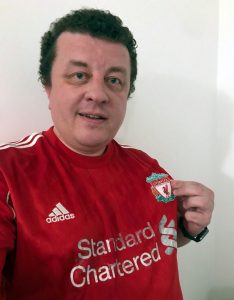
Journalist and former Index colleague Andrei Aliaksandrau
Few things can better describe the spirit of Liverpool fans better than the words etched in gold above the Shankly gates.
When Richard Rodgers and Oscar Hammerstein sat down to write the musical Carousel and its anthem, You’ll Never Walk Alone, they did not envisage it becoming a hymn for the masses, cascading down the creaking terrace of the Kop for decades after they penned its stirring lyrics.
It has provided hope in times of sorrow and ecstasy in times of glory at Anfield. Now it is giving comfort to a Belarusian journalist wrongly locked in a jail cell.
Journalist and Liverpool fan Andrei Aliaksandrau previously worked in the UK at the charity Index on Censorship – where I now work on placement from Liverpool John Moores University – for a number of years before returning to his native Belarus. The organisation, set up 50 years ago this year, aims to help those wrongly imprisoned and persecuted for daring to express their views or for telling the truth about what is happening in countries with oppressive regimes. Little did Andrei know; he would one day require our help.
Andrei was detained – along with his girlfriend Irina – in January this year and faces up to 15 years in prison in his home country due to a charge of high treason. His ‘crime’ was helping friends and colleagues pay off the oppressive fines given to them by the Belarusian authorities for their peaceful protests or covering demonstrations as journalists in the unrest following elections last August.
It is an act of generosity that Liverpool fans can recognise as the sort of community spirit and care for your fellow citizen that served them so well after the Hillsborough Disaster and through other projects such as Fans Supporting Foodbanks. Bill Shankly, who was known for welcoming many a supporter to his home, would surely have approved.
The situation in Belarus is dire. The president, Alexander Lukashenko (known often as “Europe’s last dictator”), has been in power since 1994, after the break-up of the Soviet Union of which the country was previously a part. Lukashenko declared himself winner of the 2020 elections with 80% of the vote. Opposition leader Svetlana Tikhanovskaya disputed the result and was forced to flee to Lithuania. Following the election, the UK and many other governments said they would not accept the outcome, yet Lukashenko acts with impunity because of ongoing support from Russian leader Vladimir Putin.
Outrage over the result erupted in countrywide protests, demanding Lukashenko step down. But these demonstrations were met with a mass crackdown. Journalists, activists, lawyers and other regular citizens have been arrested and detained by the thousands. Over 1,000 were arrested in a single day in November alone.
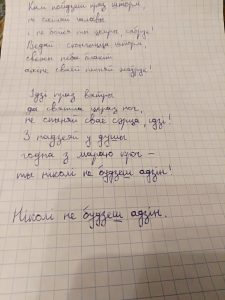
Andrei’s translation of the lyrics of Liverpool FC anthem You’ll Never Walk Alone
As of 6 July, the number of those arrested stands at more than 35,000. According to the Belarusian Association of Journalists (BAJ), 29 reporters, including Andrei, remain in captivity and 87 have been arrested since January 2021. They have been arrested because Lukashenko does not like what they are writing.
The conditions in Belarusian jails are appalling and a number of those detained have been tortured.
And yet, our former colleague Andrei has seemingly remained upbeat and has not cowed in the face of a regime that wants him silenced. Indeed, it seems that the famous words of Rodgers and Hammerstein have steeled another in times of adversity.
The connection, aside from the fact the song is indeed the club’s official anthem, is obvious. People in Liverpool have faced years of adversity and strife, be it through the bombing of the docks in the Second World War, the strikes of the 1970s and 1980s, or the dreadful injustice of the Hillsborough Disaster in 1989, their ability to draw resilience from a few lines of a musical written in 1945 has always been remarkable.
So, when a Liverpool fan watches, thousands of miles away, as his home country is torn apart by greed and corruption, it is little wonder that his own resolve derives from the very same words.
In a letter to Andrei Bastunets in April, chairperson of the BAJ, the jailed Aliaksandrau offered words of comfort to his close friend, quipping “It turned out so funny. As I went to jail, Liverpool stopped playing properly!”
Even though it was Aliaksandrau behind bars, it was Bastunets receiving reassurance. Aliaksandrau wrote: “In general, there were many reasons to repeat the club’s anthem to myself – You’ll Never Walk Alone.”
“Words of support from letters (sometimes – with the results of the matches) made me sing [and] play it in my head. One day it got to the point where I caught myself mumbling the club’s anthem in Belarusian. It seemed a bit pompous – but it is a hymn.”
“But it seemed to me that it was somehow in tune with the moment, [with my] feelings or mood. So, I decided to share it with you. As an Arsenal fan (sorry for this) you will understand me. At least [you know] what they sing about in Liverpool. And – you will never be alone!”
Andrei’s words remained upbeat despite the Belarusian regime making it even more difficult for Aliaksandrau since his arrest.
Those detained in the country must be released after six months unless they are charged and Andrei was expecting to be released around now, perhaps with a fine as others have been. But the authorities have now slapped the treason charges on him and he faces an uncertain future.
It was also announced in mid-July that Andrei’s lawyer Anton Gashinsky had his license revoked by the authorities. The prominent human rights lawyer also counts among his clients Sofia Sapega, the girlfriend of Roman Protasevich, the journalist who was recently arrested after his Ryanair flight was forcibly redirected by the Belarusian authorities when flying over Belarusian airspace after a faked bomb scare.
Dzmitry Navazhylau, Andrei’s friend and former colleague at Belapan news agency, where Aliaksandrau worked as deputy director, spoke of his friend’s sheer joy that could be found from watching his team.
“Liverpool FC, without exaggeration, is Andrei’s love,” said Navazhylau. “He is one of few Belarusians to have LFC Official Membership. He watched all Liverpool games on the internet with English commentary.”
Andrei used his time in the UK to good effect, he says.
“While working in London, he was lucky enough to see the Reds play live. At one point, there was no way to get a ticket to Anfield. Therefore, Andrei bought a season ticket for Fulham’s home games. He bought a season ticket for another club’s matches to attend one game of his favourite team! But it was worth it!”
Navazhylau recalls: “The most memorable match we watched together was the 2019 UEFA Champions League Final – Liverpool against Tottenham Hotspur. We were dressed in Liverpool kits, chanting, and singing “You’ll Never Walk Alone”. When Salah and Origi scored their goals, and especially after the final whistle, Andrei was as happy as a child.”
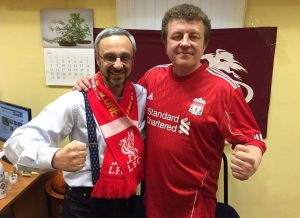
Andrei and his friend Dzmitry Navazhylau
It is unknown exactly when his fascination with the Reds began, but it is clear that his upbringing was in a household that was football mad. According to his friend and fellow journalist Kanstantin Lashkevich, Andrei’s father is “probably the only amateur statistician who tracks Belarusian lower-level leagues results”.
Like many fans, Andrei has spent a great deal of time, effort and money has been spent following his team over the years and it is a love for football and club that many on Merseyside can relate heavily to, as is his particular admiration for manager Jürgen Klopp and midfielder James Milner. He also travelled to Munich in 2019, as a journalist, to cover Liverpool’s quarter final Champions League tie with Bayern Munich.
And yet the reality is that, immortal as the words of You’ll Never Walk Alone are, they should not be used to sustain the sanity and goodwill of a man who has given much of his career to the protection of others.
Andrei’s situation is a reminder of how the day-to-day lives of people in a supposed democracy can deteriorate and why protests and free speech are so vital to protecting our individual rights and liberties.
When around 10,000 Liverpool fans marched out of a home game against Sunderland in 2016, protesting the rise of ticket prices, nobody was arrested.
When any person in the UK has to face the courts, for whatever reason, they do not have their legal representation forcibly removed from them.
But both of these things did happen to Andrei Aliaksandrau, whose only crime, many would argue, was embodying the spirit of what it is to be a Liverpool fan.
So how can Liverpool fans help Andrei realise he is not ‘walking alone’? You can sign the petition calling for the release of Andrei and his girlfriend – https://freeandreiandirina.org/ – and write to your local MP calling on the UK government to do more than just condemning the actions of ‘Europe’s last dictator’.
This article was originally printed in issue #276 of Liverpool FC fanzine Red All Over The Land. It has been published online with the kind permission of John Pearman. You can buy a copy outside Anfield on matchdays, or online here.[/vc_column_text][/vc_column][/vc_row][vc_row][vc_column][three_column_post title=”You may also like to read” category_id=”172″][/vc_column][/vc_row]
4 Aug 2021 | Bosnia, News, Russia, Serbia, Syria, Volume 50.02 Summer 2021, Volume 50.02 Summer 2021 Extras
Thirty years separate the beginnings of conflicts in Bosnia-Herzegovina, where I come from, and Syria, where I work now. Bosnia and Syria are the bookends that encompass the three decades when we lived in a world where our collective conscience, eventually, recognised we had a responsibility to protect the innocent, to bring those responsible for war crimes to justice, and to fight against revisionism and denial. Whereas the Bosnian tragedy of the 1990s marked the (re)birth of these values, the Syrian carnage has all but put an end to them.
Nowhere is this sad fact more apparent than in the expansion of disinformation, revisionism and denial about the crimes perpetrated by the Syrian regime against its own people. As a result, disinformation campaigns have become increasingly vicious, targeting survivors, individuals and organisations working in conflict zones.
Coddled by the ever-expanding parachute of academic freedom and freedom of expression, these unrelenting smear campaigns have ruined, endangered and taken lives. They have eroded trust in institutions, democratic processes and the media and sown division in fragmenting democratic societies. Their destabilising effect on democratic principles has already led to incitement to violence. Left unchecked, it can only get worse.
The disinformation movement has brought together a diverse coalition of leftists, communists, racists, ideologues, anti-Semites and fascists. Amplified by social media, their Nietzschean contempt for facts completes the postmodernist assault on the truth. But more important than the philosophical effect is the fact that disinformation campaigns have been politically weaponised by Russia. Under the flag of freedom of expression, they have become a dangerous tool in information warfare.
I know this, because I am one of their targets.
Beyond the fringe
Earlier this year, the Commission for International Justice and Accountability (CIJA), an NGO of which I am one of the directors, flung itself into the eye of the Syria disinformation storm by exposing the nefarious nature of the Working Group on Syria, Propaganda and Media (WGSPM), an outfit comprising mainly UK academics and bloggers.
The CIJA investigation revealed that, far from being fringe conspiracists, these revisionists, employed by some of the UK’s top universities, were collaborating with Russian diplomats in four countries; were willing to co-operate with presumed Russian security agents to advance their agenda and to attack their opponents; were co-ordinating dissemination of disinformation with bloggers, alternative media and Russian state media; appeared to be planning the doxxing of survivors of chemical attacks; and admitted to making up sources and facts when necessary to advance their cause.
The investigation was a step out of my organisation’s usual focus. For almost a decade, CIJA has been working (quietly and covertly) inside Syria to collect evidence necessary to establish the responsibility of high-ranking officials for the plethora of crimes that have become a staple of daily news. More than one million pages of documents produced by the Syrian regime and extremist Islamist groups sit in CIJA’s vaults and inform criminal investigations by European and American law enforcement and UN bodies. These documents tell, in the organisers’ and perpetrators’ own words, a deplorable story of a pre-planned campaign of murder, torture and persecution, a story that started in 2011 when the Syrian regime began its systematic and violent crackdown on protesters.
CIJA’s work is pioneering and painfully necessary as it ensures crucial evidence is secured, analysed and properly stored when there is no political will or ability to engage official public bodies to investigate the crimes. Our evidence has been described by international criminal justice experts to be stronger than that available to Allied powers holding the Nazi leadership to account during the Nuremberg trials. This makes us dangerous and this makes us a target – both in the theatre of war and in the war on the truth.
Before long, we were in the crosshairs of apologists for Syrian president Bashar al-Assad and, soon after that, in those of the Russian-sponsored disinformation networks.
The weaponisation of propaganda
Propaganda has been the key ingredient of every war since the beginning of time. But its unrelenting advance in the midst of the Syrian war is unprecedented. The beginnings of its weaponisation can be traced back to 2015 when the wheels of fortune turned for Syria as Russia got militarily involved in the conflict. Assad was on the way to winning on the ground but the battle to own the narrative of the war was only just beginning. In its advance, Moscow’s disinformation machinery swept up Western academics, former diplomats, Hollywood stars and punk-rock legends. New outfits and personalities mushroomed, bringing a breath of fresh air to the stale and steady group of woo-woo pedlars and conspiracy theorists from the 1990s.
The WGSPM is one such outfit. Founded in 2017, its most prominent members are Piers Robinson, formerly of Sheffield University; Paul McKeigue and Tim Hayward, of the University of Edinburgh; David Miller, of the University of Bristol; and Tara McCormack, of the University of Leicester. Apart from their shared interest in proliferating pro-Assad, pro-Russian Syria propaganda, between them these professors cover 9/11 truthism, Skripal poisoning conspiracies, Covid-19 scepticism, anti-Semitism and Bosnian war crimes denial.
The modus operandi of disinformation in Syria is simple and borrows from how it was done in Bosnia: sow seeds of doubt regarding two or three out of myriad atrocities committed by the Syrian regime in order to put a question mark over the whole opus of criminal acts overseen by Assad over the past decade.
In Bosnia, according to revisionists, Sarajevo massacres were staged or committed by the Bosnian army against its own people, Prijedor torture-camp footage was faked and the number of Srebrenica genocide victims was inflated. In Syria, according to disinformationists, the Syrian regime’s chemical weapon attacks were staged or committed by opposition groups, footage of children and other civilian victims was faked and the number of those who went through the archipelago of torture camps was inflated.
Syria disinformationists make great use of the postmodernist scepticism about evidence and truth in order to advance their theories. They resort to obfuscation, distortion and alternative evidence. The vision is blurred. Questions are important, answers not so much. Context is irrelevant.
There is not much of a change there from the 1990s. The only marked difference is that today’s approach to advancing disinformation focuses much more on tearing down individuals and organisations working in or reporting on the war. In order to make a lie believable, one must discredit those who endeavour to test the truth.
The WGSPM started by disputing that chemical weapons attacks were conducted by the Assad regime, proffering instead pseudoscientific arguments that the attacks either did not happen, or were staged or committed by opposition groups, potentially with the support of Western imperialist governments. They zoned in on two out of more than 300 documented chemical weapons attacks. But two was enough to start sowing the seeds of doubt among wider audiences.
The Organisation for the Prohibition of Chemical Weapons (OPCW) was in the crosshairs as its investigative teams and fact-finding missions returned with findings pointing to the Syrian regime’s responsibility for the attacks over and over again. The OPCW was portrayed to be issuing doctored reports in support of the alleged Western imperialist agenda to overthrow the regime, including by the use of military intervention for which chemical weapons attacks would be a pretext. The disinformationists parroted Damascus and Moscow in whose view all of the alleged chemical attacks were staged on the orders of the West.
The targeting of the White Helmets
A special level of vitriol targeted the White Helmets, a Syrian search and rescue organisation whose cameras record the daily toll of Syrian regime and Russian bombs and chemical weapon attacks on innocent people’s lives as they rush in to pull the victims out of the rubble. They were branded as actors, jihadists and Western intelligence service agents. They were accused with zero evidence of organ-harvesting. The children they pulled out of the rubble were cast as fake or actors. WGSPM members promulgated theories that the White Helmets killed civilians in gas chambers and then laid them out as apparent victims of fake chemical weapons attacks.
The group’s most influential member, Vanessa Beeley, a self-proclaimed journalist residing in Damascus, openly incited and justified the deliberate targeting of the White Helmets, hundreds of whom have died in so-called double and triple-tap airstrikes carried out by the Russian and Syrian air forces. Beeley claimed the White Helmets’ alleged connection to jihadists made them a legitimate target. The jihadists connection itself was a “manufactured truth”. Beeley has spent years producing blogs and twisting the facts to present the White Helmets as aiders and abetters of the extremist armed groups. This falsehood then proliferated in cyberspace, amplified by alternative and Russian state-sponsored media, and eventually parts of these allegations began to stick with wider audiences.
Last year, a study from Harvard University found that the cluster of accounts attacking the White Helmets on Twitter was 38% larger than the cluster of accounts representing their work in a positive light or defending them from orchestrated info warfare.
Soon, Russian state officials started singling out White Helmets’ co-founder James Le Mesurier, branding him as an MI6 agent with connections to terrorist groups. The hounding of this former British soldier was relentless. Le Mesurier was so deeply affected by the relentlessness of the campaign against the organisation, its people and himself that it contributed to the erosion of his psychological wellbeing and, eventually, his death.
The fastest way to erode the credibility of an entity is to discredit its leadership. This is what the disinformation network tried to do with the White Helmets and Le Mesurier. When they started shifting focus to CIJA, the messaging and the mode of its delivery did not change much.
At first, CIJA did not pay attention to the attacks. As with the White Helmets, the coverage of CIJA’s work by the international media was overwhelmingly positive, although with the difference that we were not as prominent in the public eye. But after the New Yorker published a long read in 2016, within days the alternative media and bloggers produced a dozen articles casting doubt over the authenticity or even the existence of the documents in our archive, branding CIJA the latest multi-million-dollar propaganda stunt.
By 2019, things had got more serious. When The New York Times and CNN within days of each other published articles about CIJA’s evidence of Assad’s war crimes, inexplicably it was the Russian embassy in the USA that spoke out first, issuing a statement attacking the media for writing about such an “opaque” organisation. Within 10 days, US online outlet The Grayzone published a lengthy hit piece, calling CIJA “the Commission for Imperialist Justice and al-Qaeda”, claiming we were collaborating directly with Isis and Jabhat al-Nusra affiliates.
It was reproduced in other alternative media outlets and among social media enthusiasts. But, more worryingly, calls from the people who work in the field of international criminal justice and Syria started coming in. These are not the types who would normally believe in conspiracy theories, and the majority of them are apolitical. However, the more the hit piece circulated, the fewer people focused on its source – a Kremlin-connected online outlet that pushes pro-Russian conspiracy theories and genocide denial – and focused instead on what was being said about the people in their field who are so rarely in the media.
Predictably, before long, the allegations raised by the hit piece were being directly or indirectly shared by and referred to on social media by international lawyers and other NGOs in our field. It was a perfect example of the speed and efficiency with which information warfare could penetrate the mainstream.
CIJA and disinformation
In 2020, the WGSPM made it known it was turning its attention to CIJA. The focus, replicating that of the White Helmets attack, was on CIJA founder and director Bill Wiley who was perceived by the conspiracists to be a CIA agent in Canadian disguise working with British money and jihadists to subvert the government of Assad and, in the process, enrich himself. It was one year after Le Mesurier’s death and, by then, the impact the disinformation campaign had on the last months of his life had been well documented.
We would not be sitting ducks. CIJA’s undercover investigation commenced out of fear for the security of its people and operations. Only three out of 150 of us appear in public. Locations of our people and our archives are kept secret. This is not because we are a covert intelligence front but because the threat is real.
Our investigators have been detained, arrested and abused at the hands of both the regime and extremist armed groups. One has been killed. Among the Syrian regime documents in our possession are those that show that Assad’s security intelligence services are looking for our people both inside and outside Syria.
Running investigative teams inside one of the world’s most dangerous countries requires a low profile, independence, access and mobility. The nature of the narrative falsehoods spread by the likes of the WGSPM was such that it threatened each of those requirements.
Being caught in possession of Syrian regime documents in the country would be a death sentence if our people were stopped, either by the regime or by Islamist extremist groups. Linking the organisation to foreign intelligence services or even to jihadist groups makes them easy targets in the theatre of war that is Syria. Allegations of financial or other types of impropriety are a death sentence to organisations that are donor dependent.
This is what makes these disinformation networks dangerous. By proliferating lies and innuendo and obfuscating the reality about organisations and individuals working in the field, they not only threaten to derail the legitimate work we are doing but also directly endanger the lives of the people doing it. This is not what freedom of expression should be about.
The old saying goes, a lie travels halfway around the world before the truth puts its boots on. The influence of disinformation networks today cannot be compared to those of the 1990s. The proliferation of online media outlets, the growing influence of social media, the increasing embrace of alternative facts and multiple versions of truths have all contributed to the dissemination of a skewed picture of what is really happening in Syria.
Even with the constant reporting by the international media of the atrocities the Syrian regime has bestowed on its own people – with thousands of crimes and survivors’ testimonies unrelentingly documented by Syrian and international human rights organisations as well as the UN – Western communities have remained at best on the sidelines in the face of the biggest carnage of this century. The core values of humanity dictate that a collective outcry should have reverberated across the political divide at the sight of gassed children gasping for breath, babies being pulled out of rubble, and emaciated, tortured and decaying bodies strewn around prison courtyards. Yet, by and large, the general population stayed silent. Why? Because the Syrians have been dehumanised on an industrial scale in Western general public opinion.The purpose of disinformation campaigns is to sow the seed of doubt about what is happening, to stoke fear and ultimately to erode trust in democratic processes and human rights values. And that is precisely the effect of the Syria disinformation campaign.
This has been possible only because the revisionists are no longer a fringe group with limited reach. The trajectory of an untruth about the White Helmets just like that about CIJA is very similar: a blog will come out, which will be picked up by a connection in alternative online media, which will then be amplified by Russian state-linked media, which will then be repackaged by Moscow and presented as legitimate facts worthy of discussion in front of the UN Security Council in New York, at the UN in Geneva, and at OPCW State Parties meetings in The Hague. They have even started penetrating parliaments in London, Berlin and Brussels.
With the help of social media, bots and trolls, and in the era of Trumpian contempt for mainstream media, its trajectory can go only upwards.
CIJA’s probe revealed the level of these connections as the Assad apologist from WGSPM Paul McKeigue outlined them in quite some detail in correspondence with our investigators. The campaigns against the White Helmets, the OPCW and CIJA were not isolated attempts to point to inconsistencies in the “mainstream narrative” of the Syrian war. They were an orchestrated attack on what were deemed to be the biggest obstacles to an attempt to whitewash Assad’s crimes.
Although CIJA uncovered the nefarious connections between academics, bloggers and Russian state operatives, the “alternative truth” lives on even when it is proven to be a lie.
Fake news?
For proof, again look at Bosnia. Twenty years ago, Living Marxism magazine went bankrupt after a UK court found that it had defamed ITN and its journalists by claiming the images they recorded in death camps in north-western Bosnia in 1992 were fake. Since then, an international tribunal in The Hague has established beyond reasonable doubt the truth about the macabre crimes that took place in the camps. The journalists’ reports were entered into evidence and withstood rigorous challenges offered by the defence in more than a dozen cases. Yet the claim that this was “the picture that fooled the world” and that the camps were mere refugee centres lives on.
My friend Fikret Alić is the man whose emaciated body behind barbed wire was snapped by cameras on that hot August afternoon in 1992. Thirty years later, he is still tortured by a relentless denial campaign. Weeks ago he was ridiculed on Serbian television by journalists and filmmakers who relied on Living Marxism’s proven lie to back their claims.
It is a never-ending quagmire. As he told Ed Vulliamy, the Observer journalist who reported from the Bosnian camps in 1992: “When those people said it was all a lie and the picture of me was fake, I broke completely. There was nothing they could give me to get me to sleep.”
Living with the nightmare of survival is a lifelong struggle for most. Living with the accusation that what they experienced did not happen condemns them to reliving that torture over and over again.
Mansour Omari, a Syrian journalist who survived a whole year of being bounced around different detention facilities in the Syrian security services’ torture grid, recently wrote that “those who callously deny our torture ever happened are torturers in another guise”. His words are not a poetic metaphor. The psychological and physical suffering for thousands of Fikrets and Mansours subjected to that denial is very much real.
Yet the survivors are effectively told that those whose denial torments them are doing so in the name of free speech and with the aim of challenging injustices. The idea is preposterous. Disinformation encourages discrimination, dehumanisation and prejudice against the victims.
Instead of being denied the platform from which to inflict further pain and incitement, the revisionists are revered and rewarded with peerages and space to spread the poison in the mainstream.
The mainstream media of today is even more reluctant to challenge revisionism than it was in the 1990s. When ITN decided to sue Living Marxism, the debate it ignited in media circles was not about the heinousness of the lie but about whether it was right for a large media outfit to sue a smaller one.
Today’s alternative media go much further than Living Marxism dared to venture. Reports of massacres are challenged by attacking the journalists who bring them. They are claimed to be Western imperialist shills connected to US/UK intelligence services, fabricating reports from Syria with the assistance of Isis or al-Qaeda.
But I have yet to see a mainstream media outlet take steps to defend the honour of its journalists, the integrity of its reporting and the truth in the way ITN did so many years ago. The result? Public trust in the media is in steady decline, with a 20% slump recorded in the UK in the past five years alone.
This is not to undermine the journalists who continue seeking to investigate and understand the actors in the Syrian disinformation network space. But they face more of an uphill struggle to get the space for it from their editors than was the case in the past. The question media management should ask themselves is not if it is unseemly for a large media outlet to defend its journalistic track record by challenging the revisionist lies that make it a target of disinformation. The more important question is whether it is right to let such a falsehood go unchallenged. What impact does it all have in the long run on historic record, on the victims, and on journalistic ethics which include seeking the truth?
Academia, too, has been stunned into inaction as a growing number of university staff abuse their credentials to spread propaganda. Whether gathered in coalitions such as the WGSPM, or working as lone wolves, they have become weaponised agitprop agents of Moscow (in the case of the WGSPM and its affiliates, knowingly and wilfully so, as their members have admitted to be co-ordinating with a variety of Russian diplomats to subvert the work of the OPCW, the White Helmets and others such as CIJA).
Universities are hiding behind academic freedom to explain their lack of action to sanction such wholly unscientific behaviour. The professors and their universities alike claim that these individuals are acting in their private capacity. Yet each one of them links to their university page on the WGSPM website. As plain Paul, Tim, Tara, Piers and David, they would be just another set of fringe conspiracists in the masses. With their full affiliations to prestigious universities listed every time they put their names to a revisionist or disinformationist story, they command credibility.
Fighting the disinformation war
With media and academia becoming major carriers of disinformation, what kind of a history of Syrian conflict is being written?
The perturbing answer of what awaits Syrians and the future discourse about that conflict can be gleaned from what has transpired in Bosnia in the years since. The denial of Bosnian atrocities has not only seeped into the mainstream but is being rewarded at the highest level. In 2019, Peter Handke, a prominent denier of the Srebrenica genocide and supporter of Serb leader Slobodan Milošević, received the Nobel Prize in Literature. In 2020, Claire Fox, who was co-publisher of Living Marxism and continued to deny Bosnia war crimes afterwards, was given a peerage.
What hope is there, then, for the truth about Syria to prevail when Assad apologists are regularly given space in the traditional media, on neo-liberal platforms and within academia? Revisionists such as the WGSPM’s Tara McCormack, who lectures at Leicester University and holds a regular slot on Russia Today and Sputnik, frequently appears on the BBC and LBC, too. The DiEM25 movement, a pan-European organisation whose stated aims are to to “democratise the EU” gives over a whole panel to some of the most vehement Assad apologists, including Aaron Maté who not only denied the survivors their truth but openly mocked them on social media. These are not people who present “diversity” of opinions or ideological or political alignments.
Ultimately, these people, instead of being challenged for their lies and the harm they cause to survivors and others, are being given the space to trickle their pseudoscientific revisionism into the mainstream. It is time to stop giving them a platform. And it is time to challenge them with all lawful means.
It might be unpalatable to read such a proposal in a magazine that stands up against censorship. After all, without freedom of expression and academic freedom we might as well bid goodbye to democracy and human rights. But this crucial value is what revisionists clutch at every time they are called out. In turn, such accusations make most of us uncomfortable to take the necessary steps to tackle a growing problem.
Truth-seeking is supposed to be at the core of universities’ existence, but revisionism and denial do not constitute truth-seeking. Academic freedom should allow for robust debate and challenge the conventional wisdom. But it should not allow for incitement of hatred or slandering of victims, survivors, journalists and others.
Truth matters because disinformation destroys lives, as history has taught us. It torments people: from Fikret Alić to Mansour Omari to James Le Mesurier, to countless others whose names we will never learn.
Disinformation exposes those such as the White Helmets or CIJA working in conflict situations to additional risk. Labelling journalists as security intelligence or jihadi sympathisers puts a target on their backs. The unrelenting advance of disinformation must be stopped before more harm is done.
