25 Mar 2020 | News, Press Releases, Statements
[vc_row][vc_column][vc_column_text]Index on Censorship and Justice for Journalists Foundation (JFJ) announce a joint global initiative to monitor attacks and violations against the media, specific to the current coronavirus-related crisis.
According to Rachael Jolley, Editor-in-Chief, Index of Censorship: “In times of extraordinary crisis, governments often take the opportunity to roll back on personal freedoms and media freedom. The public’s right to know can be severely reduced with the little democratic process. Index is already being alerted to attacks and violations against the media in the current coronavirus related crisis, as well as other alarming news pertaining to privacy and freedoms”.
“In our daily work in the post-Soviet region, Justice for Journalists Foundation experts and partners come across grave violations of media freedom and media workers’ human rights. Today, we are witnessing how the corrupt governments and businessmen in many of the regional autocracies are abusing the current limitations of public scrutiny. This major decrease in civil liberties makes pursuing their interests easier and even less transparent, whereas media workers striving to unveil murky practices are facing more risks than ever before”, said Maria Ordzhonikidze, JFJ’s Director.
Index draws on its experience running other mapping projects to enable easy comparisons of media violations in each country, and also so data can be collated and discussed when the global crisis is over.
Justice for Journalists Foundation will contribute to this monitoring effort by expanding cooperation with its existing regional partners who provide data and analysis for the series of Media Threats and Attacks Reports in Azerbaijan, Armenia, Belarus, Georgia, Kazakhstan, Kyrgyzstan, Moldova, Russia, Tajikistan, Turkmenistan, Ukraine and Uzbekistan.
The overall goal of the project is threefold: to increase awareness about the importance of media freedom and the existing state of press freedom at this particular point in history, to support journalists whose work is being impeded, by highlighting the challenges they face to an international audience and to continue to improve media freedom globally in the long run.
Anyone interested to learn more about or contribute to this initiative by providing information on incidents and/or translation, publicity and ideas, please get in touch:
[/vc_column_text][/vc_column][/vc_row]
13 Feb 2020 | Awards, Fellowship 2020, News
[vc_row][vc_column][vc_single_image image=”112380″ img_size=”large”][/vc_column][/vc_row][vc_row][vc_column][vc_column_text]Hip-hop, satirical YouTube videos, a youth arts festival and rap are some of the ways in which art is being used today to protest against restrictions on freedom of expression.
Four individuals and organisations have been shortlisted in the Arts category for Index on Censorship’s 2020 Freedom of Expression Awards, which will be held at the May Fair Hotel in London on 30 April. The Arts is one of the four categories that will be recognised at the awards, alongside Campaigning, Digital Activism and Journalism.
Cameroonian rapper and pro-democracy activist Gaston Serval Abe, known as Général Valsero, has been using hip-hop to criticise government corruption in the country and to call for more transparency, and encourage civil engagement.
His music has seen him gain international recognition but he was banned from performing and radio stations rarely play his material. Despite being arrested and detained in 2019, Valsero remains courageous in his mission for justice and equality. Valsero was released last October after Cameroonian President Paul Biya ordered the discontinuance of proceedings against him and other political opponents.
Until its dissolution in April 2019, Casablanca-based NGO Racines worked to promote Moroccan culture and protect free speech, addressing taboo subjects such as politics, religion and sex.
The organisation, co-founded in 2010 by Dounia Benslimane and Aadel Essaadani, was forced to close after its offices were used to host an episode of the satirical YouTube series 1 Dîner 2 Cons (One Dinner, Two Fools). Racines itself had not organised the filming of the show nor had it posted the resultant clip, which included criticism of Morocco’s King Mohammed VI; it was viewed more than half a million times.
The Casablanca civil court ordered the closure of the NGO in December 2019 expressing “political views were far removed from the purposes for which the association was created”.
The organisation took the case to the Supreme Court but, in April 2019, the appeal was rejected and the dissolution of the organisation confirmed.
Rap Against Dictatorship is a Thai rap group which has produced anti-military rap songs criticising the Thai government.
The group released their hit song Prathet Ku Mee (What My Country’s Got) on 14 October 2018 “to mark the 45th anniversary of the 1973 popular uprising against a coup-installed prime minister in which 77 people died”, according to the Bangkok Post.
The song’s lyrics confront corruption, nepotism, the lack of accountability and transparency, poor healthcare, suppression of freedom of speech and the privileges afforded to the rich while the poor suffer.
The song went viral, eliciting a response from Prime Minister Prayut Chan-o-cha who argued “Is life really that hard? Is it that oppressive? Am I so dictatorial?”
Yulia Tsvetkova is a Russian artist and activist promoting women’s well-being and LGBTQ awareness. Her work has brought about positive change in discussions towards body positivity and gender stereotypes in Russia. However, this acclaim has made her a target.
In 2018 she began a campaign promoting body positivity which resulted in her being named a suspect in a criminal pornography distribution case. Tsvetkova, currently under house arrest, could face up to six years in prison if convicted.
In March 2019, her youth arts festival was cancelled after officials accused Tsvetkova of illegally trying to hold a gay pride event under the guise of a youth theatre festival.
In 2019, the winner of the Arts award was Kurdish painter and journalist Zehra Doğan.
Doğan had been arrested after painting the destruction in the town of Nusaybin in Turkey’s Kurdish region and sharing it on social media. She did this after realising that reports from the region were being ignored by mainstream media,
Speaking at her trial, a judge told Doğan about one of her works of art that “This picture has crossed the line between art and criticism.”
While in prison Doğan was denied access to materials for her work but made dyes made from crushed fruit and herbs, even blood, and used newspapers and milk cartons as canvases.
During her imprisonment she refused to be silenced and continued to produce journalism and art. She collected and wrote stories about female political prisoners, reported on human rights abuses in prison.
Doğan was released on 24 February 2019.
Accepting the word at the 2019 Freedom of Expression Awards after her release, Doğan said, “The limits of art, which the artistic world has not been able to agree upon for centuries, have apparently been figured out by the decision of a Turkish court.”
“It is not only art that has had boundaries drawn around it in Turkey: the things that can be said between friends, the topics you can write about, and the concepts you can debate at school with your students have all been limited by the authorities.”
The winner of the 2020 Arts award will be chosen by a panel of judges which includes artist Molly Crabapple, award-winning Guardian journalist Amelia Gentleman and Cindy Gallop, founder of social sex video platform MakeLoveNotPorn.[/vc_column_text][/vc_column][/vc_row]
7 Feb 2020 | News, Statements
[vc_row][vc_column][vc_column_text]We live in the midst of radical changes to the ways people access news and information.
When Index on Censorship was founded nearly 50 years ago, few could have foreseen the manner in which technology would now be changing the ways we engage with politics and democracy. Although the landscape of communication has changed, threats to freedom of expression remain as grave as they were 50 years ago – in the UK and around the world.
Index is looking for a resourceful and outspoken leader to steer the organisation through this changing terrain, and to protect the right for everyone to be free to express themselves without fear of harm or persecution – no matter what their views. From tackling legislative threats to digital freedom at home, to spotlighting issues of repression and censorship in China, Russia and Azerbaijan, we are seeking a Chief Executive to put free speech for everyone at the forefront of the political, campaign and news agenda.
What you will do
Index on Censorship has a small team that punches well above its weight. You will ensure the organisation is well run and enjoys a healthy office culture, strong relationships with the board and diligent financial management, so that we are well set to protect freedom of expression for another fifty years.
You will be the main outward face of Index on Censorship and build that presence on broadcast media, in the papers and on social media. You will be confident in championing the cause of freedom of expression and when explaining why it must be protected as a universal right for all, even at times when others are looking to close down conversations.
You will be an excellent fundraiser, nurturing relationships and developing philanthropic partnerships which allow us to continue our advocacy campaigns, our magazine and our projects to support freedom of expression. We have a strong board with which you will work closely, while also building your own networks, to ensure we receive the financial backing we need from private individuals, corporates and foundation trusts.
You will build Index on Censorship as both a publisher of freedom of expression and a campaign organisation – a leader in advocacy for freedom of expression, ensuring that voices are heard beyond those normally associated with our cause. Through building strong partnerships and networks you will enable us to grow our capacity to advocate for individuals and groups, including to the government.
Key Components of the Role
(1) Fundraising and Finance
- Lead fundraising and be successful at bringing in funding from a variety of sources.
- Work closely with the board, both on our strategic vision for fundraising and on building new donor relationships.
- Use your contact book and leverage the board’s contacts in order to build relationships to benefit the organisation.
- Proactively seek opportunities to diversify the funding base and attract a wider range of funders.
- Lead on and manage proposal-writing for both core and project funding.
- Ensure obligations and reporting to funders are fulfilled.
- Be in regular contact with donors and take proactive care of donor relationships.
(2) Campaigning, Advocacy and Publishing
- Be the main public face of the organisation with excellent written and oral communication skills for a range of audiences, including interacting with politicians, opinion-formers and media as well as broader general public audiences.
- Lead senior management on setting and implementing Index’s priority range of campaigns, advocacy projects, editorial and events.
- Lead with key staff on defining policy positions across a range of free expression issues. Identify where Index can take clear, unambiguous positions and where there are complex, grey issues that may need more debate and analysis.
- Identify and build relationships with expert analysis and key opinion formers who can contribute usefully to our policy work
- Build coalitions where necessary with partner organisations on shared policy objectives
- Sign-off and provide strategy guidance on key policy statements and policy papers, delegating where appropriate
- Work closely with the editor-in-chief who manages our historic magazine and our online editor and leads on the relationship with Index magazine publishers, Sage.
- Lead on, and develop, the Index on Censorship Freedom of Expression Awards.
(3) Strategic Leadership
- Lead on developing and implementing strategic vision and framework; setting clear programmes of activities within overarching goals and priorities, in cooperation with the senior management team and staff.
- Report to and work with the chair and board in ensuring good governance, finances, strategy and risk management. Prepare quarterly board meetings and relevant reporting requirements with the Finance Director.
- Lead and develop rolling, state-of-the art evaluation and impact assessments ensuring all Index’s external-facing activities are high impact, increasing our influence and audiences.
- Oversee work outputs delivered to high standards and deadline.
- Build the team – the CEO will be an excellent team player as well as leader, ensuring integrated working across Index, encouraging creativity and innovation.
- Encourage staff appreciation of both mission and strategy and their role in it
- Line-manage senior staff and lead the senior management team.
Requirements
The successful applicant will be expected to demonstrate the following:
- A commitment to freedom of expression
- Excellent fundraising skills with proven experience of all areas of fundraising including grant and bid writing
- Excellent communication and media presentation skills
- Excellent political and policy knowledge and experience of advocacy
- In-depth knowledge of international current affairs, especially concerning issues of freedom of expression, digital and media freedom
- The ability to build relationships and networks with partners and stakeholders
- Strategic and staff management, as part of leadership experience at a senior level
- Management experience of managing change and growth
- A great contact book and ability to use your networking ability to grow funding and opportunities for the organisation
- Knowledge of freedom of expression issues in relation to the digital world
The following knowledge, skills and experience are desirable:
- An established public profile
- Knowledge of foreign languages
- Experience in addressing global freedom of expression issues
- Knowledge of the civil liberties/human rights sector
Salary: £70-80k per annum based on experience
Hours: Full time, some national and international travel and flexible working required
Based: Our offices near Old Street, London
Recruitment timetable
Friday 13th March Closing date for applications
Monday 16th March First round interviews with board representatives
Monday 30th March Second round interviews with staff and board
How to apply
Send your CV and a cover letter of no more than three A4 pages outlining your suitability for the role to [email protected] by Friday 13th March[/vc_column_text][/vc_column][/vc_row]
22 Jan 2020 | News, Volume 48.04 Winter 2019
[vc_row][vc_column][vc_custom_heading text=”In the winter 2019 issue of Index on Censorship magazine, editor-in-chief Rachael Jolley argues that a new generation of democratic leaders is actively eroding essential freedoms, including free speech” google_fonts=”font_family:Libre%20Baskerville%3Aregular%2Citalic%2C700|font_style:400%20italic%3A400%3Aitalic”][vc_column_text]
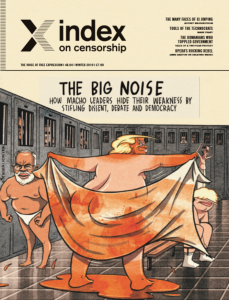 Like brothers in arms, they revel in the same set of characteristics. They share them, and their favourite ways of using them, on social media.
From Orbán to Trump and from Bolsonaro to Johnson, national leaders who want to dismiss analysis with a personalised tweet, and never want to answer a direct question, have come to power – and are using power to silence us. They like to think of themselves as strongmen but what, in fact, they are doing is channelling the worst kind of machismo.
For toughness, read intolerance of disagreement. They are extremely uncomfortable with public criticism. They would rather hold a Facebook “press conference” where they are not pressed than one where reporters get to push them on details they would rather not address. Despite running countries, they try to pretend that those who hold them to account are the elite who the public should not trust.
While every generation has its “tough” leaders, what’s different about today’s is that they are everywhere, and learning, copying and sharing their measures with each other – aided, of course, by the internet, which is their ultimate best friend. And this is not just a phenomenon we are seeing on one continent. Right now these techniques are coming at us from all around the globe, as if one giant algorithm is showing them the way. And it’s not happening just in countries run by unelected dictators; democratically elected leaders are very firmly part of this boys’ club.
Here are some favoured techniques:
If you don’t like some media coverage, you look at ways of closing down or silencing that media outlet, and possibly others. Could a friend buy it? Could you bring in some legislation that shuts it out? How about making sure it loses its advertising? That is happening now. In Hungary, there are very few independent media outlets left, and the media that remain is pretty scared about what might happen to them. Hungarian journalists are moving to other countries to get the chance to write about the issues.
In China, President Xi Jinping has just increased the pressure on journalists who report for official outlets by insisting they take a knowledge test, which is very much like a loyalty test, before being given press cards.
Just today, as I sit here writing, I’ve switched on the radio to hear that the UK’s Conservative Party has made an official complaint to the TV watchdog over Channel 4’s coverage of the general election campaign (there was a debate last night on climate change where party leaders who didn’t turn up were replaced with giant blocks of ice). A party source told the Conservative-supporting Daily Telegraph newspaper: “If we are re-elected, we will have to review Channel 4’s public service broadcasting obligations. Any review would, of course, look at whether its remit should be better focused so it is serving the public in the best way possible.” In summary, they are saying they will close down the media that disagree with them.
This not very veiled threat is very much in line with the rhetoric from President Donald Trump in the USA and President Viktor Orbán in Hungary about the media knowing its place as more a subservient hat-tipping servant than a watchdog holding power to account. It’s also not so far from attitudes that are prevalent in Russia and China about the role of the media.
For those who might think that media freedom is a luxury, or doesn’t have much importance in their lives, I suggest they take a quick look at any country or point in history where media freedom was taken away, and then ask themselves: “Do I want to live there?”
Dictators know that control of the message underpins their power, and so does this generation of macho leaders. Getting the media “under control” is a high priority. Trump went on the offensive against journalists from the first minute he strode out on to the public stage. Brazil’s newish leader, President Jair Bolsonaro, knows it too. In fact, he got together with Trump on the steps of the White House to agree on a fightback against “fake news”, and we all should know what they mean right there. “Fake news” is news they don’t like and really would rather not hear.
New York Times deputy general counsel David McCraw told Index that this was “a very dark moment for press freedom worldwide”.
When the founders of the USA sat down to write the Constitution – that essential document of freedom, written because many of them had fled from countries where they were not allowed to speak, take certain jobs or practise their religion – they had in mind creating a country where freedom was protected. The First Amendment encapsulates the right to criticise the powerful, but now the country is led by someone who says, basically, he doesn’t support it. No wonder McCraw feels a deep sense of unease.
But when Trump’s team started to try to control media coverage, by not inviting the most critical media to press briefings, what was impressive was that American journalists from across the political spectrum spoke out for media freedom. When then White House press secretary Sean Spicer tried to stop journalists from The New York Times, The Guardian and CNN from attending some briefings, Bret Baier, a senior anchor with Fox News, spoke out. He said on Twitter: “Some at CNN & NYT stood w/FOX News when the Obama admin attacked us & tried 2 exclude us-a WH gaggle should be open to all credentialed orgs.”
The media stood up and criticised the attempt to allow only favoured outlets access, with many (including The Wall Street Journal, AP and Bloomberg) calling it out. What was impressive was that they were standing up for the principle of media freedom. The White House is likely to at least think carefully about similar moves when it realises it risks alienating its friendly media as well as its critics.
[/vc_column_text][vc_row_inner][vc_column_inner width=”1/4″][vc_icon icon_fontawesome=”fa fa-quote-left” color=”custom” size=”xl” align=”right” custom_color=”#dd3333″][/vc_column_inner][vc_column_inner width=”3/4″][vc_custom_heading text=”And that’s the lesson for media everywhere. Don’t let them divide and rule you” font_container=”tag:h3|text_align:left” google_fonts=”font_family:Libre%20Baskerville%3Aregular%2Citalic%2C700|font_style:400%20italic%3A400%3Aitalic”][/vc_column_inner][/vc_row_inner][vc_column_text]
And that’s the lesson for media everywhere. Don’t let them divide and rule you. If a newspaper that you think of as the opposition is not allowed access to a press briefing because the prime minister or the president doesn’t like it, you should be shouting about it just as hard as if it happened to you, because it is about the principle. If you don’t believe in the principle, in time they will come for you and no one will be there to speak out.
That’s the big point being made by Baier: it happened to us and people spoke up for us, so now I am doing the same. A seasoned Turkish journalist told me that one of the reasons the Turkish government led by President Recep Tayyip Erdogan was able to get away with restrictions on critical media early on, was because the liberal media hadn’t stood up for the principle in earlier years when conservative press outlets were being excluded or criticised.
Sadly, the UK media did not show many signs of standing united when, during this year’s general election campaign, the Daily Mirror, a Labour-supporting newspaper, was kicked off the Conservative Party’s campaign “battle bus”. The bus carries journalists and Prime Minister Boris Johnson around the country during the campaign. The Mirror, which has about 11 million readers, was the only newspaper not allowed to board the bus. When the Mirror’s political editor called on other media to boycott the bus, the reaction was muted. Conservative Party tacticians will have seen this as a success, given the lack of solidarity to this move by the rest of the media (unlike the US coverage of the White House incident).
The lesson here is to stand up for the principles of freedom and democracy all the time, not just when they affect you. If you don’t, they will be gone before you know it.
Rallying rhetoric is another tried and tested tactic. They use it to divide the public into “them and us”, and try to convert others to thinking they are “people like us”. If we, the public, think they are on our side, we are more likely to put the X in their ballot box. Trump and Orbán practise the “people like us” and “everyone else is our enemy” strategies with abandon. They rail against people they don’t like using words such as “traitor”.
Again in Hungary, people are put into the “outsiders” box if they are gay, women who haven’t had children or don’t conform to the ideas that the Orbán government stands for.
Dividing people into “them and us” has huge implications for our democracies. In separating people, we start to lose our empathy for people who are “other” and we potentially stop standing up for them when something happens. It creates divides that are useful for those in power to manipulate to their advantage.
The University of Birmingham’s Henriette van der Bloom recently co-published research pamphlet Crisis of Rhetoric: Renewing Political Speech and Speechwriting. She said: “I think there is a risk we are all putting ourselves and others into boxes, then we cannot really collaborate about improving our society. Some would say that is what is partly going on at the moment.” Looking forward, she saw one impact could be “a society in crisis, speeches are delivered, and people listen, but it becomes more and more polarising”.
But it’s not just the future, it’s today. We already see societies in crisis, with democratic values being threatened and eroded. This does not point to a rosy future. But there are some signs for optimism. In this issue, we also feature protesters who have campaigned and achieved significant change. In Romania, a mass weekly protest against a new law which would allow political corruption has ended with the government standing down; in Hungary, a new opposition mayor has been elected in Budapest.
Democracies need to remember that criticism and political opposition are an essential part of their success. We must hope they do.
[/vc_column_text][/vc_column][/vc_row][vc_row][vc_column][vc_column_text]
Rachael Jolley is editor-in-chief of Index on Censorship magazine. She tweets @londoninsider. This article is part of the latest edition of Index on Censorship magazine, with its special report on macho male leaders
Index on Censorship’s winter 2019 issue is entitled The Big Noise: How macho leaders hide their weakness by stifling dissent, debate and democracy
Look out for the new edition in bookshops, and don’t miss our Index on Censorship podcast, with special guests, on Soundcloud.
[/vc_column_text][/vc_column][/vc_row][vc_row][vc_column width=”1/3″][vc_custom_heading text=”How macho leaders hide their weakness by stifling dissent, debate and democracy” font_container=”tag:h3|text_align:left” link=”url:https%3A%2F%2Fwww.indexoncensorship.org%2F2019%2F12%2Fmagazine-big-noise-how-macho-leaders-hide-weakness%2F|||”][vc_column_text]The winter 2019 Index on Censorship magazine looks at how male leaders around the world are using masculinity against our freedoms[/vc_column_text][/vc_column][vc_column width=”1/3″][vc_row_inner][vc_column_inner][vc_single_image image=”111045″ img_size=”full” onclick=”custom_link” link=”https://www.indexoncensorship.org/2019/09/magazine-border-forces-how-barriers-to-free-thought-got-tough/”][/vc_column_inner][/vc_row_inner][/vc_column][vc_column width=”1/3″][vc_custom_heading text=”Subscribe” font_container=”tag:h3|text_align:left”][vc_row_inner][vc_column_inner][vc_column_text]In print, online. In your mailbox, on your iPad.
Subscription options from £18 or just £1.49 in the App Store for a digital issue.
Every subscriber helps support Index on Censorship’s projects around the world.
 SUBSCRIBE NOW[/vc_column_text][/vc_column_inner][/vc_row_inner][/vc_column][/vc_row]
