8 Aug 2016 | mobile, News, Youth Board
(Photo illustration: Shutterstock)
For the past six months the Index on Censorship Youth Advisory Board has attended monthly online meetings to discuss and debate free speech issues. For their final assignment we asked members to write about the issue they felt passionately about that took place during their time on the board.
Simon Engelkes – Terrorism and the media in Turkey
When three suicide bombers opened fire before blowing themselves up at Istanbul Atatürk airport on 28 June 2016, Turkey’s social media went quiet. While the attacks were raging in the capital’s airport, the government of president Recep Tayyip Erdogan blocked social networks Facebook and Twitter and ordered local media not to report the details of the incident – in which at least 40 people were killed and more than 200 injured – for “security reasons”.
An order by the Turkish prime minister’s office banned sharing visuals of the attacks and any information on the suspects. An Istanbul court later extended the ban to “any written and visual media, digital media outlets, or social media”. Şamil Tayyar, a leading deputy of the ruling Justice and Development Party said: “I wish those who criticise the news ban would die in a similar blast.”
Hurriyet newspaper counted over 150 gag orders by the government between 2010 and 2014. And in March 2015, Turkey’s Constitutional Court approved a law allowing the country’s regulator to ban content to secure the “protection of national security and public order” without a prior court order. Media blackouts are a common government tactic in Turkey, with broadcast bans also put in place after the bombings in Ankara, Istanbul and Suruç.
Emily Wright – The politics of paper and indirect censorship in Venezuela
Soaring inflation, high crime rates, supply shortages and political upheaval all typically make front-page news. Not so in Venezuela, where many newspapers have suspended printing because of a shortage of newsprint.
For over a year now, the socialist government of Nicolás Maduro has centralised all paper imports through the Corporación Maneiro, now in charge of the distribution of newsprint. It is a move the political opposition is calling a form of media censorship, given that many newspapers critical of Chavismo and Maduro’s regime, have been struggling to obtain paper to print news.
In January, 86 newspapers declared a state of emergency, announcing they were out of stock and their capacity to print news was at risk. El Carabobeño, which is critical of the government and Chavismo, stopped circulating in March due to a lack of paper. A year earlier the newspaper had been forced to change its format to a tabloid, and reduce its pages, after running as a standard newspaper since 1933.
Censorship is an long-term problem in Venezuela but it is taking new, covert forms under Hugo Chávez’s successor, Nicolás Maduro. Media outlets are being economically strangled through tight regulation. On top of this huge fines for spurious charges of defamation or indecency linked to articles have become commonplace. Correo del Coroni, the most important newspaper in the south of the country, went bankrupt in this fashion. In March it was fined a million dollars and its director sentenced to four years in jail for defamation against a Venezuelan businessman. A month earlier it was forced to print only at weekends after being systematically denied newsprint.
Under Maduro’s regime, censorship in Venezuela has gone from piecemeal to systemic and the public’s right to information has been lost in the mix. Unable to mask the country’s hard realities with populist promises like his predecessor did, Maduro has been cracking down on the media instead.
Reporters Without Borders recently rated the press in Venezuela as being among the least free in the world, ranking it 139 out of 180 countries, below Afghanistan and Zimbabwe. Freedom House recently rated the press in Venezuela as Not free.
Mark Crawford – The UK government’s anti-BDS policy
In February this year, the British government banned public boycotts of Israeli goods. In recent years, the Boycott, Divestment and Sanctions campaign has become popular among those in opposition to the oppression of the Palestinian people, whereby Israeli goods, services and individuals are evaded or censored.
It’s illogical to punish an entire nation, as BDS does, for the actions of those in power. The answer to this illiberal policy must not be, however, to hand greater power to faceless, bureaucratic law enforcement to suppress freedom of expression.
As a result of the government’s clampdown, the board of trustees at my students’ union, UCLU, has already overridden a pro-BDS position democratically endorsed – however poorly – by its Union Council; but as well as emboldening the very illiberal voices that thrive on the aloof vilification of bureaucrats, the board even elected to censor council’s harmless and necessary expressions of solidarity with the Palestinian people.
The cure for faulty ideas and tactics is better ideas and better politics – translated through debate and honest self-reflection. Not only have legal shortcuts never worked, but they’re ideologically hypocritical and politically suicidal.
Ian Morse – Twitter’s safety council
Twitter unveiled its safety council in February. Its purpose is to ensure that people can continue to “express themselves freely and safely” on Twitter, yet there are no free speech organisations included.
So while the group ostensibly wants to create safety, its manifesto and practice suggest otherwise. The group doesn’t stop incitements of violence, it stops offensive speech. Safety only refers to the same attempts to create “safe spaces” that have appeared in so many other places. There is a difference between stopping the promotion of violence within a group – as Twitter did with 125,000 terrorism-related accounts – and stopping people from hearing other people’s views. Twitter has a mute and block button, but has also resorted to “shadow banning”.
Now compound this with the contradiction that is Twitter’s submission to authoritarian governments’ demands to take down content and accounts in places where not even newspapers can be a forum for free information, such as Russia and Turkey.
It’s indicative of two wider trends: the consolidation of “speech management” in Silicon Valley, and the calamitous division of the liberal left into those who allow the other side to speak and those who do not.
Layli Foroudi – Denied the freedom to connect: censorship online in Russia
The United Nations Human Rights Commission has brought the human rights framework into the digital age with the passing of a resolution for the “promotion, protection, and enjoyment of human rights on the internet”, particularly freedom of expression.
Russia opposed the resolution. This is unsurprising as the government institutionalises censorship in legislation, using extremism, morality and state security as justifications. Since November 2012, the media regulatory body Roskomnadzor has maintained an internet blacklist. Over 30,000 online resources were listed in April, plus 600,000 websites that are inaccessible due to being located on the same IP address as sites with “illegal” information.
This year, the internet in Russia has experienced increased censorship and site filtering under the influence of Konstantin Malofeev whose censorship lobbying group, the Safe Internet League, has been pushing for stricter standards in the name of Christian Orthodox morality, freedom from extremism and American influence.
Activists in Russia have claimed that their messages, sent using encrypted chat service Telegram, have been hacked by Russian security forces. Surveillance was what originally drove Pavel Durov, founder of Telegram and social network VKontakte, to set up the encrypted service as he and his colleagues felt the need to correspond without the Russian security services “breathing down their necks”. Durov himself lives in the US, a move prompted by the forced sale of VKontakte to companies closely aligned with the Kremlin, after the social network reportedly facilitated the 2011 protests against the rigging of parliamentary elections. His departure confirms theories about the chilling effect that crackdowns on expression can have on innovation and technology in a country.
In June a new law was passed which requires news aggregators, surpassing one million users daily, to check the “truthfulness” of information shared. Ekaterina Fadeeva, a spokesperson for Yandex, the biggest search engine in Russia, said that Yandex News would not be able to exist under such conditions.
Madeleine Stone – The murder of Joe Cox
The brutal daylight murder of Yorkshire MP Jo Cox may not initially seem like a freedom of speech issue.
Approached outside her constituency surgery on 16 June 16, at the height of the polarising Brexit debate, Cox was stabbed to death by a man who shouted “Put Britain first” as he attacked her. Cox was an ardent supporter of Britain remaining a member of the European Union, flying a “Stronger In” flag as she sailed down the Thames with her family in a dingy the day before her murder. Her passionate campaigning over the referendum should not have been life threatening.
In Britain, we imagine political assassinations to take place in more volatile nations. We are often complacent that our right to free speech in the UK is guaranteed. But whilst there are people intimidating, attacking and murdering others for expressing, campaigning on and fighting for their beliefs, this right is not safe. For democracy to work, people need to believe that they are free to fight for what they believe is right, no matter where they fall on the political spectrum. Jo Cox’s murder, which for the most part has been forgotten by British media, should be a wake-up call to Britain that our freedom of speech cannot be taken for granted.
2 Aug 2016 | About Index, Index Reports, Press Releases
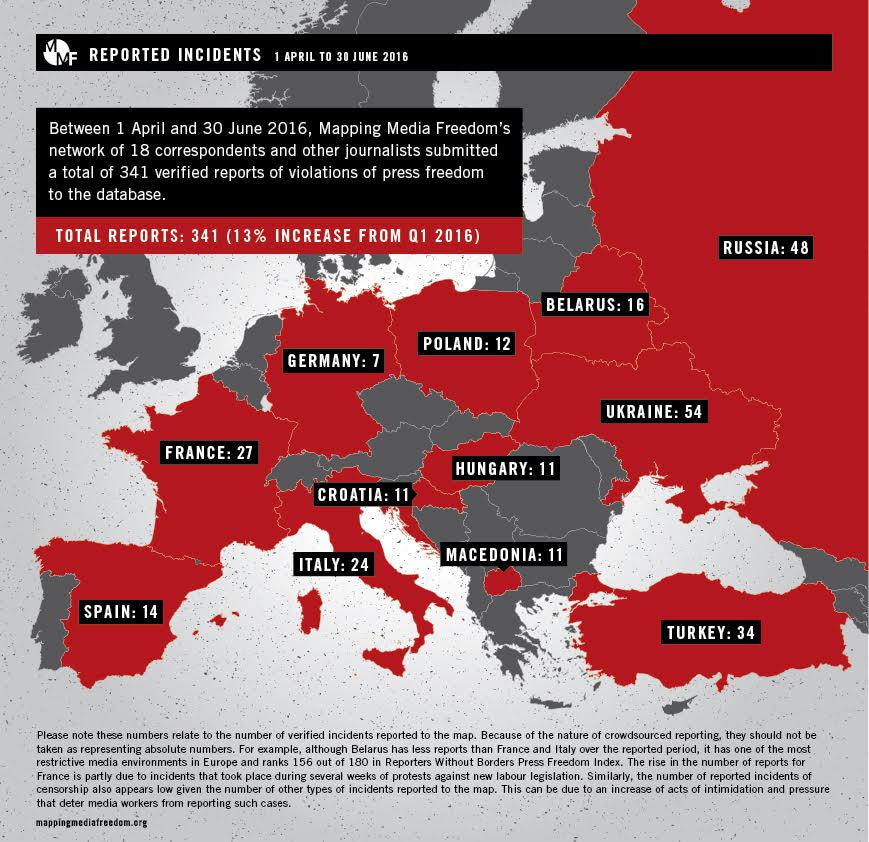
Violence against journalists in Europe increased in the second quarter of 2016, reports submitted to Index on Censorship’s Mapping Media Freedom platform show, as a government crackdown in Turkey intensified and protests turned violent in countries from France to Finland.
“Europe is considered one of the safest places for journalists in the world. However, increasing concerns about national security in the region – coupled with creeping authoritarianism – is making it an increasingly difficult place for the media to operate freely and safely,” said Hannah Machlin, project officer for Mapping Media Freedom. “And the threats are not just coming from the usual suspects: 12 incidents of injuries to journalists occurred in France and in a number of these cases journalists appear to have been directly targeted by police.”
Between 1 April and 30 June 2016, Mapping Media Freedom’s network of 18 correspondents and other journalists submitted a total of 341 violations of press freedom to the database, a 13% rise over the first quarter of 2016.
Key findings from the Q2 report
- Two journalists were killed. Mohammed Zahir al-Shergat died as a result of gunshot wounds in the city of Gaziantep, Turkey; journalist and radio host Luka Popov from northern Serbia was found dead in his home in Srpski Krstur
- 60 incidents of physical assault were confirmed
- 45 criminal charges and civil lawsuits were filed
- Media professionals were detained in 41 incidents
- 80 verified reports of intimidation, which includes psychological abuse, sexual harassment, trolling/cyberbullying and defamation were recorded
- Work was censored or altered 15 times
- Media professionals were blocked from covering a story in 73 incidents
“The fight for the abolition of prison sentences for offences committed through the press is unfortunately still relevant in Europe and neighboring countries,” Christophe Deloire, Reporters Without Borders secretary general said. “In a climate of growing fear and suspicion, judicial persecution of journalists takes more and more diversified forms. The Turkish authorities continue to invoke the anti-terrorism law, the protection of state secrets or insults to the head of state to prosecute and imprison more journalists.”
“Journalists are beaten, intimidated, imprisoned and killed in the pursuit of telling a story, exposing the truth and informing the public. These courageous men and women are the vanguard for free speech, freedom of expression and, ultimately, a free and democratic society. We need to come together and fight for journalists’ safety and end impunity for crimes committed against journalists,” said Dunja Mijatović, the OSCE Representative on Freedom of the Media.
The report is available now at https://mappingmediafreedom.org/plus/ or as a PDF.
For more information, please contact Hannah Machlin, Mapping Media Freedom project officer at [email protected]
About Mapping Media Freedom
Mapping Media Freedom – a joint undertaking with the European Federation of Journalists and Reporters Without Borders and partially funded by the European Commission – covers 42 countries with a network of correspondents, including all EU member states, plus Albania, Azerbaijan, Belarus, Bosnia, Iceland, Kosovo, Macedonia, Montenegro, Norway, Russia, Serbia, Turkey, Ukraine and Vatican City. In September 2015 the platform expanded to monitor Russia, Ukraine and Belarus and in February 2016 into Azerbaijan. Each report is fact checked with local sources before becoming available on the interactive map. Since launching in May 2014, the map has recorded over 2,000 incidents threatening media freedom.
29 Jul 2016 | Bosnia, Europe and Central Asia, Macedonia, Mapping Media Freedom, mobile, News, Poland, Turkey, United Kingdom
Click on the dots for more information on the incidents.
Each week, Index on Censorship’s Mapping Media Freedom project verifies threats, violations and limitations faced by the media throughout the European Union and neighbouring countries. Here are five recent reports that give us cause for concern.
Turkey: Warrants issued for arrest of 89 journalists
Turkish authorities have issued two lists of journalists to be arrested since the 15 July failed military coup attempt in the country. Firstly, on 25 July, authorities issued the names of 42 journalists as part of an inquiry into the coup attempt. Well-known commentator and former parliamentarian Nazli Ilicak was among those for whom a warrant was issued, as was Ercan Gun, the head of news department at Fox TV in Turkey.
Two days later, 27 July, authorities issued warrants for the detention of 47 former executives or senior journalists of the newspaper Zaman. The arrests were part of a large-scale crackdown on suspected supporters of US-based Muslim cleric Fethullah Gulen, accused by Ankara of masterminding the failed coup. The authorities shut down Zaman in March. At least one journalist, former Zaman columnist Şahin Alpay, was detained at his home early on Wednesday.
26 July, 2016 – Media Print Macedonia, the publisher of several daily and weekly newspapers, announced that it would dismiss 20 staff members, mostly experienced journalists and former editors from the daily Vest.
Layoffs are also to include employees from daily Utrinski Vesnik, Dnevnik, Makedonski Sport and weekly magazine Tea Moderna.
MPM stated layoffs were prompted by bad results and that the decision on who to dismiss would be based on the company’s internal procedures. Employees who lose heir jobs are to be compensated from one up to five average salaries, TV Nova reported.
24 July, 2016 – Emir Talirevic, a doctor who owns Moja Klinika, a private healthcare institution in Sarajevo, used Facebook to insult Selma Ucanbarlic, a journalist for the Centre for Investigative Journalism, following her articles about Moja Klinika, regional TV outlet N1 reported.
On 24 July Talirevic wrote on Facebook, among other things, that “judging by her psycho-physical attributes [the journalist] should never be allowed to do more complex work than grilling a barbecue”. He alleged hers were “imbecilic findings”, adding that “her work requires higher IQ than 65”.
In a second post, published on 27 July, Talirevic wrote that “as the toilet tank is taking away my associations on Selma and her CIN(ical) website I am thinking about the oldest profession in the world – prostitution”. He also wrote: “CIN is financed by gifts, like prostitutes”, and “after today’s article at least we know for whom Selma Ucanbarlic and her CIN colleagues are spreading their legs”.
22 July, 2016 – Masza Makarowa, a former journalist for the Russian language division of national broadcaster Polskie Radio, left the station due to a repressive climate and censorship, she claimed on her Facebook page.
An “atmosphere of scare tactics and paranoia” was prevalent at the broadcaster, Makarowa said. She also claimed that the station management instructed staff on which sources to consider for publication to Russian-speaking audiences, approving right-leaning, pro-governmental websites while explicitly prohibiting liberal sources like Gazeta Wyborcza for being opinionated. Certain updates, furthermore, were removed from the website.
22 June, 2016 – Jeff Howell, who had been writing a home maintenance advice column for The Telegraph for 17 years, was allegedly dismissed and removed from the Telegraph website after comments he made to his property section editor, Anna White.
According to Private Eye, the column, which was initially published both on the website and online, was removed from the website after he made a joke to property section editor White about correcting the Telegraph’s editing errors following a typo in January. Much of the column’s online archive was deleted following the incident.
Howell’s page on the Telegraph website used to get up to 10,000 hits daily but the removal of most of his columns from the website “made it easy to justify his dismissal by saying he didn’t produce any online traffic”.
26 Jul 2016 | Europe and Central Asia, Mapping Media Freedom, News, Ukraine
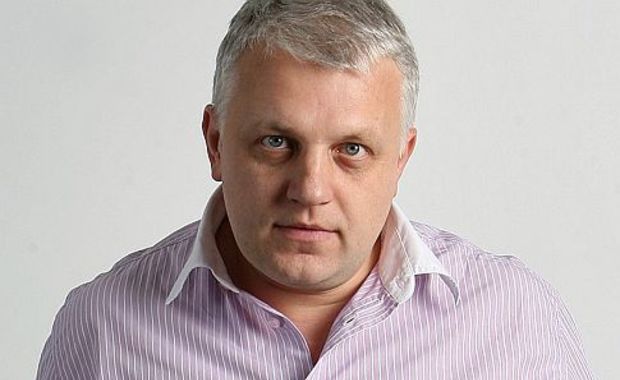
Pavel Sheremet (Photo: Ukrainska Pravda)
The death of Pavel Sheremet on Wednesday 20 July is the latest and most egregious example of violence against journalists in Ukraine, according to verified incidents reported to Index on Censorship’s Mapping Media Freedom project.
Sheremet was killed when the car he was driving exploded on the morning of 20 July in Kyiv. In a statement, Ukrainian police said that an explosive device detonated at 7.45am as Sheremet was driving to host a morning programme on Radio Vesti, where he had been working since 2015.
The car belonged to Sheremet’s partner, journalist Olena Prytula, who co-founded Ukrainska Pravda with murdered journalist Georgiy Gongadze.
Sheremet had been imprisoned by Belarusian authorities in 1997 for three months before being deported to Russia. Though stripped of his citizenship in 2010, he continued to report on Belarus on his personal website. He moved to the Ukrainian capital in 2011 to work for the newspaper Ukrainska Pravda.
A review of Mapping Media Freedom data from 1 January to 20 July found 41 attacks on journalists — including physical violence, injuries and seizure or damage to equipment and property of journalists — have taken place in Ukraine since the beginning of the year. The largest number of incidents – about one-third – occurred in Kyiv. More than half of these journalists were attacked by unknown assailants, while the names of perpetrators in a third of these incidents are known. In about one in three cases, the attacks were committed by representatives of local authorities.
While impunity remains a key issue in Ukraine contributing to violence against journalists, the situation is slowly beginning to change for the better compared to previous years. According to the Institute of Mass Information, a positive trend has been spotted since the beginning of the year: There has been a slight increase in the number of cases involving violation of the journalists’ rights submitted to courts. In particular, there were 11 such cases in 2015. Meanwhile, 12 such cases were submitted to court for the first quarter of 2016 alone.
Despite the improvement in prosecutions, journalists are continuing to be subject to violence and intimidation.
In June, a series of incidents occurred in Berdiansk in the Zaporizhzhia region.
On 10 June Volodymyr Holovaty, a journalist working for Yuh TV, and his cameraman, Anatoliy Kyrylenko, were physically assaulted at a recreation center in Berdiansk Spit. A group of people in camouflage set upon them without warning. The attackers swore, demanded that filming stop, took the camera, stole a data storage device and struck the journalist and the cameraman, who were taken to a hospital.
On 7 June, during a rally at the Berdiansk courthouse, an unknown person harassed cameraman Bohdan Ivanuschenko and journalist Volodymyr Dyominof, who both work for Yuh TV. In that incident the individual interfered with their filming of a report with obscene language and threatened the media professionals with physical violence.
In response, journalists staged a rally on 13 June to bring attention to the recent threats and assaults in the town and demand a stronger police response. The journalists wrote an open letter demanding prosecutors help protect the rights of media workers in the town.
In May physical attacks took place in Kherson, Kyiv, Mariupol, Mykolayiv, Kharkiv, Marhanet, Zaporizhzhia and Zirne.
In the Kyiv incident, photographer and cameraman Serhiy Morhunov, who covers the conflict in eastern Ukraine, was assaulted on 22 May by unknown assailants. The journalist suffered serious head injuries including a brain haemorrhage, fractured lower jaw and partial memory loss. The doctors described his condition as serious. Morhunov was not robbed during the attack.
In Zaporizhzhia Anatoliy Ostapenko, a journalist working for Hromadske TV, who reported on corruption allegedly involving regional officials, was assaulted by masked individuals on 24 May. The journalist was walking to work when he was cut off by a car with tinted windows and lacking a license plate. Three masked men exited the car, knocked Ostapenko to the ground and physically assaulted him. Ostapenko suffered numerous bruises.
On 25 May, in Kherson, Taras Burda, the husband of a member of the Suvorivsky district council, attacked Serhiy Nikitenko, a journalist for Most media and the representative of NGO Institute of Mass Information in the region, with a tablet computer during an altercation. Burda told IMI that the journalist had attacked him first.
Many attacks have been directed at the property or equipment of journalists. In the village of Lebedivka in the Odesa region, poachers threatened the crew of the Channel 7 investigative programme Normal. The individuals pierced the tires of the journalists’ car by laying spike strips and threw eggs at the vehicles. The incident occurred when the crew was filming a TV report about the activities of poachers in the Tuzla Coastal Lakes national reserve.
On 1 April, in the town of Konotop in the Sumy region, unknown persons threw Molotov cocktails at local TV studio. A similar incident occurred in Kyiv on April 22 when 15 unidentified people attacked the office of the Ukraine TV channel. They poured red paint in the channel’s lobby and left a print out reading “Blood will be spilled!”
In April, several assaults on journalists took place in Kyiv (journalists of 1+1 TV channel were attacked), and in the village of Lymanske in Odesa region.
Only one attack on journalists was recorded in February. However, it was a flagrant incident in the context of physical violence. In Kharkiv, representatives of the Hromadska Varta organisation attacked Stanislav Kolotilov and Lesya Kocherzhuk, journalists for the Kharkiv News portal. Kolotilov suffered a concussion and spinal injury. Kocherzhuk was burned on the hand with a cigarette. The journalists were investigating allegations of illegal construction connected to the Hromadska Varta.
Also in February, representatives of the Azov civil corps blocked the premises of the Inter TV channel. The blockade participants tried to enter the office, threw debris at it and painted the doors black.
In January, journalistic activity was obstructed in Zhytomyr during a conflict involving the Zhytomyrski Lasoshchi confectionery factory. Guards prevented reporters from Channel 5 and UA1 local online media outlet from filming. A microphone was snatched from Channel 5 journalist and a camera was damaged.
Also in January, assaults on journalists, as well as attacks on journalists’ property occurred in Ternopil, Kyiv, Mykolayiv and Odesa, as well as in the village of Dovzhanka in the Ternopil region and the town of Karlivka in the Poltava region.
On 11 January 2016, the windows of a car belonging to journalist Svitlana Kriukova were smashed by unknown perpetrators but nothing was stolen from the vehicle. Kriukova was writing a book on Hennadiy Korban, a politician and businessman said to be close to oligarch Ihor Kolomoyskiy. Korban was under investigation for alleged criminal offences including kidnapping and theft. The incident occurred when the Kriukova was visiting Korban at the hospital and she believes the damages are linked to her professional activities.
