Hebib Müntezir is an Azerbaijani blogger andsocial media manager of the non-profit Meydan TV. Müntezir is one of Azerbaijan’s most famous online activists, and in a country where social media is the final platform on which journalists are able to report, his influence has made him a significant annoyance to the Azerbaijani authorities. His YouTube videos have now been watched upwards of 27 million times, and his Facebook page is followed by over 22,000 people.
The organisation Müntezir has aligned forces with, Meydan TV, launched in 2013, and is one of the few news sites critical of the Azerbaijani government and its policies. The site is published in Azerbaijani, English, and Russian.
2015 saw a huge media crackdown in Azerbaijan, with government critics sentenced to long prison terms, and journalists facing harassment and prosecution. The crackdown intensified when Baku, the capital of Azerbaijan, hosted the first European Games – at a significant economic cost to a country already suffering from plummeting oil prices. The clampdown by the ruling New Azerbaijan party, re-elected in 2015 to serve another five years on their 20-year-run, showed their nervousness about the Games, and the international scrutiny that came with them.
With little coverage by traditional media, Azerbaijanis looked online for information, says Müntezir. “During the European Games in Baku in June 2015, our social media content reached over 1.5 million people in a population of less than 10 million,” Müntezir told Index.
Meydan TV’s powerful online presence and outspoken journalists have made them repeated targets during the authorities’ crackdown.
On 16 September 2015, freelance Meydan TV reporter Aytaj Ahmadova and a Meydan TV intern were stopped by police and taken to the organised crime unit. They were released after several hours in which Ahmadova says she was threatened and told to stop doing “opposition work”.
The same day a former Meydan employee Aysel Umudova was summoned by the prosecution service and questioned about her past work.
Then a couple of days later, Shirin Abbasov, a reporter for Meydan, was imprisoned, and authorities searched the home of another Meydan reporter.
The following day three Meydan journalists were detained after flying into Baku airport and questioned for several hours about Meydan. They were summoned by police again on 22 September and told off for speaking to the press after their earlier detention.
Emin Milli, Meydan’s director who is living in exile,told the media that Azerbaijani authorities had also threatened to punish him. According Milli, a threatening note allegedly sent by Azerbaijan’s sports minister read: “We will get you wherever you are and the state will punish you for this smear-campaign against the state that you have organized. You will get punished for this. You will not be able to walk freely in Berlin or anywhere else.”
During this crackdown, social media has been hailed as the only way journalists can freely report on otherwise censored issues in Azerbaijan. “Our social media strategy has been the driving force of our success in terms of audience outreach and engagement,” said Milli.
“Many people in Azerbaijan are afraid to talk to independent media,” said Müntezir. “But citizens still reach out to me to share content and offer support.”
GreatFire was set up in 2011 by three anonymous individuals to counter the “Great Firewall of China”, the systematic blocking by the Chinese government of any website deemed controversial, including any that touch on news, human rights, democracy or religion.
“We know them as a mix of folks within China and outside of China who have a mix of activism and technological expertise,” said Dan Meredith of the Open Tech Fund, one of GreatFire’s financial backers.
“Their motivations are not regime change, but purely wanting to see progress for the Chinese people, and see more reforms happen in the Chinese government. They’re passion driven, but they also have this insider knowledge about how to circumvent some of these really sophisticated things that are happening in China,” he told Index.
“GreatFire is quite a mysterious organisation,” Jimmy Wales, founder of Wikipedia told Index. “It’s, roughly speaking, five people, maybe it’s not quite five, maybe its more,” he said. “But it really is just a small group of people who have come together to do something important.”
The team started out collecting data about which sites were blocked in China, and now monitors over thousands of sites, domains and Google searches. “They have a network of computers in and outside of China, testing for whether websites that are generally available to the public here in the UK or the US or any other country that has unrestricted access to the whole internet, are available within China,” Meredith explains. Their site also shows how much of the time it has been blocked, and offers an explanation as to how.
GreatFire are also the makers of FreeWeibo, which was a shortlisted in 2015’s Index Awards and acts as a mirror to Weibo, the popular, but heavily censored, Chinese social network. As well as this they also run FreeBooks, allowing people in China read censored books.
“GreatFire are one of the organisations that are really fighting hard against censorship in China,” said Wales.
But last year GreatFire’s work went from being an annoyance to the Chinese authorities, to being something they couldn’t ignore, Meredith explained.
Using an idea called collateral freedom, GreatFire made blocked sites accessible to millions in China and around the world. The collateral freedom idea works by pinning banned websites to those of big corporations (such as Amazon, Microsoft or GitHub) which, in order to compete in the global marketplace, China cannot block. When organisations normally blocked in China – like the BBC or Reuters – use, for example, amazon.com as a host their sites can remain visible in China.
In February 2015, GreatFire used this technology to release an Android app, allowing anyone in China, or in other countries where the web is censored, to access these otherwise censored sites. Everything they do is open source, so their work can be replicated by others.
However, it was GreatFire’s work with Reporters Without Borders, Meredith says, that finally caused the Chinese government to retaliate.
“We know is that they are incredibly frustrated by this collateral freedom idea,” he said. “But what happened last year when Reporters Without Borders started employing this is…there became a very big press strategy, so what ended up being a thing that was quietly annoying the Chinese became a very public thing that was annoying the Chinese.”
The project was launched on World Press Freedom Day in March 2015, and used collateral freedom to unblock websites around the world, making previously censored sites available in Russia, Iran, Vietnam, Cuba and Saudi Arabia. The unblocked websites included Reuters Chinese, BBC on China and German broadcaster Deutsche Welle.
The response from the Chinese government, which became known as the “Great Cannon”, was a critical test for the idea of collateral freedom, says Meredith.
“They took all the Chinese traffic that was trying to come in, and put a mirror on it – so this is one billion people, a third of the internet – and instead of directing that to an internal website, they redirected all that traffic to GitHub, to Amazon, to Microsoft,” said Meredith. By directing this traffic to all the sites used by collateral freedom, the Chinese government were testing those service providers.
“It was just enough to raise all the flags and create a very public storm which created a further media event that said ‘China is blocking Amazon or blocking GitHub’ – at which point they stopped.”
The point of this, Meredith explains, is that the economic cost of blocking the big providers, this time, outweighed the Chinese government’s desire to censor the web. So if in the future, during a major election for example, the government might be tempted to block these sites. GreatFire showed the Chinese government, and the world, what it would cost.
“What it shows is possible is something GreatFire can really lay claim to. They showed that China could do this, would try to do it, that those companies could weather that storm, and that the balance is still there where millions of people are able to get online because of collateral freedom.”
Each week, Index on Censorship’s Mapping Media Freedom project verifies threats, violations and limitations faced by the media throughout the European Union and neighbouring countries. Here are just five reports from 15-22 March that give us cause for concern.
Serbia: B92 journalists receive several death threats
Insajder’s editor-in-chief Brankica Stankovic and B92’s editor-in-chief Veran Matic have also received threats. Both have been under police protection for years due to severe threats.
Interior Minister Nebojsa Stefanovic announced on 23 March that a person had been arrested for threatening Stankovic and Matic. Due to a pending police investigation no details of the threats have been revealed, Veran Matic told Index on Censorship.
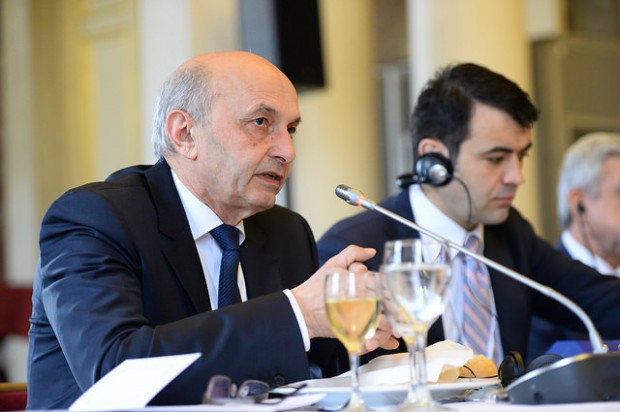
Kosovo: Investigative journalist claims prime minister threatened him
Isa Mustafa, European People’s Party Summit, March 2015, Brussels. Credit: Flickr / EPP
Kajtazi had published an in which he criticised Kosovo’s healthcare system, stating it is so poor that even Mustafa’s brother has to seek asylum in the EU for treatment for his throat cancer. Mustafa has denied threatening the journalist.
The Serbian Crime and Corruption Reporting Network (KRIK) has condemned the “lynch campaign” against it by Informer, a Serbian pro-government tabloid. KRIK claims Informer has been following its editor-in-chief Stevan Dojcinovic, monitoring its work and putting his life at risk.
On 18 March, Informer published a photo of Dojcinovic on the front page with an article stating that KRIK is working with “drug dealers, criminals, corrupt cops, but also agents of some of the foreign intelligence services” in order to force prime minister Aleksandar Vucic to give up his position.
“Besides the fact that KRIK’s editor was followed and photographed on the street, we are most concerned about the details presented in the article about specifics of our current journalistic research on the assets of politicians,” Jelena Vasic from KRIK told Index on Censorship. “This raises a serious question about who is monitoring KRIK and how they know the details of our unpublished stories.”
Russia: Local editor and deputy knifed by two assailants
The assailants reportedly waited for him outside the café and when the editor left, they slashed him with a knife. Rudnikov was taken to hospital where he was operated on. The editor’s contacts claim the attack is related to his journalism activities.
He has published a number of articles on crime and corruption in the Kaliningrad region. He was previously assaulted in 1998 when he was Rudnikov was severely beaten in the entrance to his home.
Macedonia: Constitutional court ban journalists from session
The constitutional court in Macedonia announced on 16 March that a session on whether the president will regain the right to pardon persons convicted of electoral fraud would be closed to journalists and the public.
A heavy police presence kept protesters and critics 100 metres away from the court building, while a group of government supporters had set up camp protesting “in defence of the judges”. In a statement, the Association of Journalists in Macedoni (ZNM) and condemned the decision to hold such an important session behind closed doors and have.
For over a decade the Belarus Free Theatre have performed underground in Minsk, with audiences subject to raids and arrests while, exiled from Belarus, the theatre’s directors plan their plays via Skype. But an online revolution has seen Belarus Free Theatre, and its new project the Ministry of Counterculture, bring their form of underground activism to the masses in 2015. Index on Censorship spoke to Belarus Free Theatre founder Natalia Kaliada and managing editor of the Ministry of Counterculture Georgie Weedon.
Seeing in their 10th anniversary in 2015, Belarus Free Theatre’s continued existence is in many ways a source of shame to EU and US politicians, the theatre’s founder Natalia Kalaida told Index. The underground theatre group was set up in 2005 by Kaliada and her husband Nikolai Khalezin, in response to censorship and oppression by the Belarusian regime.
The group immediately became a target for the authorities because of their criticism of Aleksandr Lukashenko, and plays touching on taboo subjects like mental health and sexuality. However, despite repeated arrests, brutal interrogations and harassment by the KGB (one of the few intelligence services to keep that sinister Cold War name) they continued to perform underground, using apartments, basements, cafés and forests as their stages.
“We started from just an idea, not having any support,” says Kaliada. But doing nothing was not an option, she says.
“When your friends are kidnapped, killed, thrown into jail, tortured, there is no way for you to just stay and observe. I don’t have such a luxury to be apolitical, and I don’t have time to spend doing entertainment theatre, it has to have a meaning behind it.”
Audience members in Belarus first have to search on social media for a phone number, name and the title of a show. They then call that number to leave their details, and when the theatre has a place to perform, receive a phone call or text message telling them to come to a meeting point, from where they taken to the performance.
“Usually we advise our audience to bring their passports, so if there is a police or KGB raid, people will have less time to spend in the police department while police are identifying them,” says Kaliada. “That’s why we always say our audience back in Belarus is the bravest audience in the world.”
“It’s a very big step for audience members, for us it’s clear what we do and it’s our choice, why we do this theatre, but it’s amazing to have such an audience – every time we get on Skype from London to say hello to our audience, we will ask how many are new, and it will be around 40 percent. Which is just amazing.”
Via Skype is now the only way Kalaida can greet her Belarusian audience. During a tour abroad in 2011, Kalaida and other members of the theatre learned that if they returned to Belarus they would be imprisoned.
This, however, did not stop Belarus Free Theatre. They now have London headquarters – at the Young Vic Theatre – and underground Minsk headquarters. They conceive of new projects and direct their actors in Minsk via Skype, where the company continues to perform in secret locations.
“We survive not because of support, unfortunately, of many different governments, but despite all difficulties that we’re facing on a daily basis,” says Kaliada. The group have now staged 27 productions in over 30 countries.
Having protested the Belarusian regime for over a decade, the theatre have now started to use their unique mix of art, performance and political protest to take on dictatorships and authoritarian regimes across the world, by teaching others their unique model of activism.
“The major point for us last year was to move from an idea of us talking about only Belarus, to start to frame the message that it’s not possible to talk only about one particular country or issue, because then you forget about global context,” Kaliada told Index.
The power of this was exemplified in a concert the theatre organised in 2015. Hosted in London but featuring Ukrainian, Belarusian and Russian artists, as well as many well-known names from around the world, the event was watched online by over half a million people.
“It was that unique evening where you understand that it’s necessary for us to connect all those geopolitical doors and to explain to dictators and authoritarian regimes that, with the help of the internet, we could become even bigger than us physically present in Russia, Belarus or Ukraine,” Kalaida said.
“So we continue to say to those dictators, when we go underground, it’s more dangerous for you – because underground doesn’t have any boundaries.”
Belarus Free Theatre’s new project, the Ministry of Counterculture, also aims to harness the power of the internet, art and activism to effect social change.
Published in both English and Russian, the online platform was launched as part of the theatre’s 10 year anniversary, and the site features interviews, videos, photo stories, and news about art and activism around the world.
“It was launched to broadcast and engage with lots of issues – issues that the Belarus Free Theatre are engaged with, but also other issues too,” says Georgie Weedon, managing editor of the Ministry of Counterculture.” But part of the story of Ministry of Counterculture is to look forward. “The Belarus Free Theatre has achieved incredible things in the last 10 years, and we hope the Ministry of Counterculture will become part of the next 10 years and beyond.”