26 Sep 2014 | Digital Freedom, Europe and Central Asia, News, Politics and Society
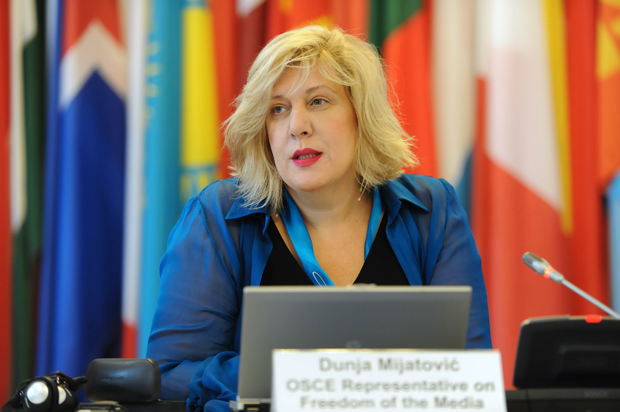
Dunja Mijatovic, OSCE Representative on Freedom of the Media
“States must stop trying to define who is and isn’t a journalist. The media landscape has changed irreversibly,” said Dunja Mijatovic, OSCE Representative on Freedom of the Media, as she opened the organisation’s Open Journalism event in Vienna on Friday, 19 Sept.
Journalism – wherever you draw its boundaries – has more voices than ever, but are all they all being properly recognised and safeguarded? This was one of the main problems addressed by the expert panel, which included Index on Censorship, alongside delegates from Azerbaijan, Serbia, Estonia, Russia, Kazakhstan, Bosnia and many other OSCE member states.
Gill Phillips, the Guardian’s director of editorial legal services, spoke via pre-recorded video about difficulties in defining journalism and deciding who gets journalistic protection. She cited the Snowden scoop, which was led by Glenn Greenwald, a former lawyer, and later embroiled his partner, David Miranda. Who gets the protection? Greenwald? Miranda? Lead staff reporter David Leigh? All three?
There was widespread condemnation of Russia’s new law, which compels bloggers with more than 3,000 views per day to be registered with the authorities. “[The bloggers] have certain privileges and obligations,” said Irina Levova, from the Russian Association of Electronic Communications, who repeatedly defended the law. “Online and offline rights are not the same,” she said, adding that some of those who deemed the law a mode of censorship have been revealed as “foreign agents”.
Another topic – raised repeatedly by various attendees – was Russian media’s growing influence over citizens in nearby countries. Begaim Usenova of the Media Policy Institute in Kyrgyzstan said: “The common view being spread from the Russian media is that the United States is starting world war three and only Putin can stop him.”
Yaman Akdeniz, a Turkish cyber-rights activist, shared news of Twitter accounts that remain blocked in his country, including some with over 500,000 followers. Igor Loskutov, a business director from Kazakhstan, looked back on the first 20 years of internet in his country and how authorities have gone from ignoring their first rudimentary websites to now wanting complete control.
The thorny issue of “public interest” was also discussed. Jose Alberto Azeredo Lopes, professor of International Law at the Catholic University of Porto, raised some smiles with his theory: “It’s like pornography. You can’t define it. But you know it when you see it.”
As the day-long discussions wrapped up, one delegate asked: if a blogger’s first-ever post goes viral, are they immediately subject to the same laws as the press? Especially in countries that now insist bloggers register.
The debate over the difference between journalists and bloggers went round in circles – as it always does – but the OSCE is hoping to be able to compile all the findings from its expert meetings into an online resource to move the discussion forward.
Azeredo Lopes concluded: “If you don’t distinguish freedom of expression from freedom of the press, you end up with no journalists, and that is the crisis that journalism faces today.”
Read our interview with Dunja Mijatovic, OSCE’s Representative on Freedom of the Media, in the autumn issue of Index on Censorship Magazine, coming soon
This article was published on Friday September 26 at indexoncensorship.org
16 Sep 2014 | Magazine, Volume 43.03 Autumn 2014
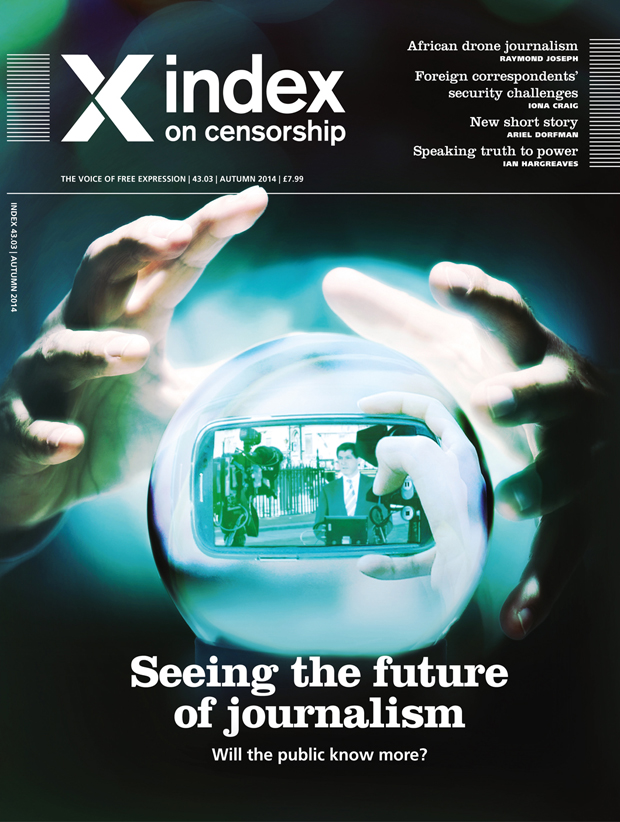
Index on Censorship autumn magazine
In the autumn issue of Index on Censorship magazine, don’t miss: Burmese-born author Wendy Law-Yone on the challenges the Burma’s media face in the run-up to the next election; TV journalist Samira Ahmed on how television channels should respond to viewers’ complaints; award-winning foreign correspondent Iona Craig reports from Yemen on threats to journalism in conflict zones; plus a brand new short story from playwright and author Ariel Dorfman.
While debates on the future of the media tend to focus solely on new technology and downward financial pressures, we ask: will the public end up knowing more or less? Will citizen journalists bring us in-depth investigations? Will crowd fact-checking take over from journalists doing research? Who will hold power to account? The subject is tackled from all angles, from our writers from across the globe.
Also writing for this issue are Australia’s race commissioner Tim Soutphommasane; human rights lawyer Tamsin Allen on defamation; and novelist Kaya Genc. From South Korea Steven Borowiec talks to controversial artist Lee Ha, and in London political editor Ian Dunt walks the corridors of political power in the UK’s Houses of Parliament and asks if journalists there get too close to government.
Other articles include:
- African digital journalism by Ray Joseph
- Generation why by Ian Hargreaves
- Funding news freedom by Glenda Nevill
You can buy the print version magazine or subscribe for £31 per year here, or download a digital version for your iPad for just £1.79. All subscriptions help fund Index’s work, protecting freedom of expression worldwide.
Read about our magazine launch at the Frontline Club on 22 October.
FULL CONTENTS: ISSUE 43, 3 – The future of journalism
Back to the future: Iona Craig on journalists trying to stay safe in war zones
Digital detectives: Ray Joseph on the new technology helping Africa’s journalists investigate
Re-writing the future: Five young journalists talk on their hopes and fears for the profession – from Yemen, India, South Africa, Germany and the Czech Republic
Attack on ambition: Dina Meza on a Honduran generation ground down by fear
Stripsearch cartoon: Martin Rowson envisages an investigative reporter meeting Deep Throat
Generation why: Ian Hargreaves asks on how the powerful may or may not be held to account in the future
Making waves: Helen Womack reports from Russia on the radio station standing up for free media
Switched on and off: US journalist Debora Halpern Wenger on TV’s power shift from news producers to news consumers
TV news will reinvent itself (again): Taylor Walker interviews a veteran TV reporter on the changes ahead
Right to reply: Samira Ahmed on how the BBC tackles viewers’ criticism
Readers as editors: Stephen Pritchard on how news ombundsmen create transparency
Lobby matters: Political reporter Ian Dunt on the push/pull of journalists and politicians inside Britain’s corridors of power
Funding news freedom: Glenda Nevill looks at innovative ways to pay for reporting
Print running: Will Gore on how newspapers innovate for new audiences
Paper chase: Luis Carlos Díaz on overcoming Venezuela’s newsprint shortage
IN FOCUS
Free thinking? Australia’s race commissioner Tim Soutphommasane on bigotry
Guarding the guards: Jemimiah Steinfeld on China’s human rights lawyers becoming targets
Taking down the critics: Irene Caselli investigates allegations that Ecuador’s government is silencing social media users
Maid equal in Brazil: Claire Rigby on the Twitter feed giving voice to abuse of domestic workers in Brazil
Home truths in the Gulf: Georgia Lewis on how UAE maids fear speaking out on maltreatment
Text messaging: Indian school books are getting “Hinduised”, reports Siddarth Narrain from India
We have to fight for what we want: our editor, Rachael Jolley, interviews the OSCE’s Dunja Mijatovic on 20 years championing free speech
Decoding defamation: Lesley Phippen’s need-to-know guide for journalists
A hard act to follow: Tamsin Allen gives a lawyer’s take on Britain’s libel reforms
Walls divide: Jemimah Steinfeld speaks to Chinese author Xiaolu Guo about a life of censorship
Taking a pop: Steven Borowiec profiles controversial South Korean artist Lee Ha
Mapping media threats: Melody Patry and Milana Knezevic look at rising attacks on journalists in the Balkans
Holed up in Harare: Index’s contributing editor Natasha Joseph reports from southern Africa on the dangers of reporting in Zimbabwe
Burma’s “new” media face threats and attack: Burma-born author Wendy Law-Yone looks at news in the run up to the impending elections
Head to head: Sascha Feuchert and Charlotte Knobloch debate whether Mein Kampf should be published
CULTURE
Political framing: Kaya Genç interviews radical Turkish artist, Kutlug Ataman
Action drama: Julia Farrington on Belarus Free Theatre and the upcoming Belarus election
Casting away: Ariel Dorfman, a new short story by the acclaimed human rights writer
ALSO
Index around the world: Alice Kirkland gives a news update on Index’s global projects
From the factory floor: Vicky Baker on listening to the world’s garment workers via new technology
20 Aug 2014 | Digital Freedom, News, Turkey Statements
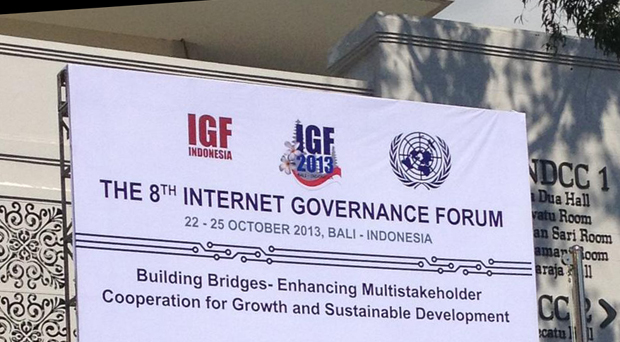
IGF 2013 was in Indonesia. This time Turkey plays host.
This year’s Internet Governance Forum (IGF) — a high-profile, United Nations-mandated annual conference on issues surrounding governance of the internet — is taking place in Istanbul, Turkey. But Yaman Akdeniz and Kerem Altiparmak, two renowned Turkish internet rights advocates, are boycotting it. Here they explain why.
Between May 2007 and July 2014 Turkey blocked access to approximately 48,000 websites subject to its controversial Internet Law No 5651. Although the law is ostensibly aimed to protect children from harmful content, from the very beginning it has been used to prevent adults’ access to information. In February amendments made to the legislation extended blocking provisions to include URL-based blocking of internet content. The same amendments compelled all internet service providers (ISPs) to be part of an association for access providers to centrally enforce blocking orders within four hours of receipt. It also introduced one-to-two-year data retention requirements for hosting companies and all ISPs. Furthermore, subject to new provisions, ISPs are required to take all necessary measures to block alternative access means such as proxy websites and other circumvention services including, possibly, VPN services. The amended version of the law also shields staff from the Presidency of Telecommunications and Communication (TIB) from prosecution if they commit crimes in their work for the telecoms authority.
In March access to both Twitter and YouTube was blocked arbitrarily and unlawfully by the TIB. With both blocking orders the government aimed to prevent the circulation of graft allegations ahead of local elections to be held on 30 March. During the blocking period, the authorities also ordered major ISPs to hijack Google and OpenDNS’s DNS servers, tampering with the DNS system to surveil communications, as well as to prevent users from circumventing blocking orders. Turkey’s constitutional court stated that the blocking of Twitter by TIB constituted a grave intervention on the freedom of expression of all Twitter users. Furthermore, in a 14-2 majority judgment, the court decided that the YouTube ban infringed on freedom of expression protected by the constitution.
However, despite these strong rulings, Twitter decided to implement its country withheld content policy for Turkey and started to block access to certain Turkish accounts and individual tweets. It was reported in June that Twitter complied with 44 out of 51 court decisions since they visited Ankara on 14 April, and the US-based social media platform continues to aid and assist Turkish authorities in censoring political content.
Facebook has also banned the pages of a number of alternative news sources, including Yüksekova Haber (Yuksekova News), Ötekilerin Postası (The Others’ Post), Yeni Özgür Politika (New Free Policy), Kürdi Müzik (Kurdish Music), and other groups related to Kurdish movements. The site has also been criticised for removing several pages related to the Peace and Democracy Party (BDP). Regardless of the above-mentioned constitutional court decisions, access to popular platforms such as Scribd, Last.fm, Metacafe, and Soundcloud is currently blocked from Turkey. Access to WordPress, DailyMotion, Vimeo and Google+ has in the past year been blocked temporarily by court or administrative orders. A number of alternative news websites that report on Kurdish issues, including Firat News, Azadiya Welat, Dengemed and Keditor, remain indefinitely blocked. In total it is estimated that 200 websites are banned indefinitely for their pro-Kurdish or left wing content.
Over the past year, many people have received suspended sentences and fines for their social media activity, usually on charges related to terrorism, blasphemy, or criticism of the state and its officials. In the crackdown following the Gezi Park protests of June 2013, dozens of people were detained over their social media posts. Criminal investigations and prosecutions were initiated subject to Articles 214 and 217 of the Turkish criminal code concerning incitement to commit a crime and disobey the law, as well as miscellaneous provisions of Law No 2911, on demonstrations and public meetings. In September 2013, pianist and composer Fazil Say was given a suspended sentence of 10 months and court supervision for insulting religious values in a series of tweets. Such criminal investigations and prosecutions have a chilling effect on all social media platform users.
In addition to widespread blocking of websites and content as well as criminal investigations and prosecutions to silence political speech, the Turkish authorities are also building surveillance infrastructure, which includes the deployment of deep packet inspection systems to monitor all forms of communications unlawfully.
Therefore, we have decided to boycott IGF 2014 hosted by Ministry of Transport, Maritime and Communications and coordinated by the Information and Technologies Authority. We also confirm that we will not be taking part in the IGF.
Yaman Akdeniz & Kerem Altiparmak
This edited version of the statement has been republished with permission from the authors. You can find the original and fully referenced statement here.
15 Aug 2014 | Europe and Central Asia, News, Turkey
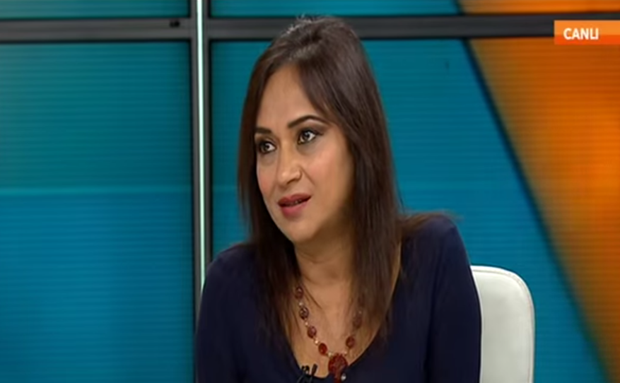
Amberin Zaman during a TV appearance (Image: serm canker/YouTube)
“A militant in the guise of a journalist, a shameless woman.” “Know your place.” “[Y]ou insult at a society of 99 percent Muslims.”
The comments from Recep Tayyip Erdogan — Turkey’s newly elected president and outgoing prime minister — were heard across the world. While he did not mention a name, it was the clear the woman in question was Amberin Zaman, a journalist for The Economist and Taraf. Erdogan’s tirade came during a campaign rally last Thursday in the city of Malatya, ahead of Sunday’s presidential vote. Zaman had expressed opinions critical of Erdogan during a TV discussion the night before.
Erdogan continued during a rally in Ankara on Saturday, calling her a “despicable woman” and saying she had insulted Islam. She has also been targeted online by Erdogan supporters, in what the Organisation for Security and Cooperation in Europe (OSCE) has labelled a “widespread smear campaign“.
“The pro-Erdogan camp emboldened by his very public insults against me continue to mob lynch me via the social media,” Zaman told Index on Censorship. “My Twitter feed is flooded with threats and profanities. Being called an enemy of Islam in a Muslim country, when radical groups like IS have Turkish members who are active Twitter users, puts me at physical risk and hobbles my work.”
She says she was unable conduct interviews on the streets on election day, “for fear of being recognised and attacked”.
This is not the first time Zaman has been targeted for speaking out against Turkish authorities. She was fired last year from Haberturk over articles critical of the government, and she was also one of the journalists reportedly wiretapped with the approval of Erdogan. As she said at a recent Index event on digital freedom, she is attacked online daily by pro-government trolls.
But Zaman is not the only member of the Turkish media under threat. According to recent figures there are 40 journalists behind bars in the country, making it one of the world’s worst jailers of press. Since 1992, 14 journalists have been murdered with impunity. Turkey stands at 154th out of 180 countries in the latest Reporters Without Borders Press Freedom Index, and its ranking has deteriorating over the past years.
In addition to Zaman’s case, there have been a number of other attacks on press freedom just over the past few days, as reported by the Index media mapping tool among others. Enis Berberoglu, editor-in-chief of Hurriyet, resigned on 8 August. The paper has denied that it was as a result of political pressure. However, in his attacks on Zaman during the Malatya rally, Erdogan specifically mentioned the owners of the TV channel she was on, Dogan Holding. Hurriyet is also owned by Dogan.
“The consensus is that he was pushed out but his departure coincided with the elections so it didn’t get the attention it deserved. But it is a further sign that media bosses will continue to cave in to power. It’s a tragic comment on the state of the Turkish media,” says Zaman.
The same day as Berberoglu’s resignation, investigative journalist Mehmet Baransu was beaten by police. The day after he was detained for tweeting about the incident, and about the Istanbul public prosecutor. There have also been reports that the Cihan news agency was restricted from covering the presidential election, with police ordered to keep journalists out of polling sites across the country.
The election also put the spotlight on issues surrounding biased media coverage in favour of Erdogan; something that was highlighted by observers after the vote. Zaman says it is difficult to measure the impact of the poor state of media freedom on the election and its outcome — Erdogan won comfortably after one round. But it was not, she says, “a level playing field”.
“Erdogan has indirect control over a broad swathe of media outlets, most crucially of television. So the opposition candidates received scant coverage, and the little they got in pro-government was more of a smear campaign to which they were unable to effectively respond. Intimidation of the media and of media bosses has created an environment of self-censorship where journalists fear losing their jobs,” she explains.
“Even the mildest criticism is no longer tolerated. It’s stifling.”
Despite the attacks from Erdogan and his supporters, Zaman says she is “very heartened by the thousands of messages of support I have received, including from pious Muslims”.
The Women’s Equality Monitoring Group, whose membership includes female journalists, academics and writers has called on Erdogan to apologise.
“Making a female journalist a target by calling her shameless for simply performing her job was the last link in a chain of sexist stances,” they said. “This attack was also an attempt to silence the few remaining critical voices in the media, which has been silenced with bribery, censorship and self-censorship.” The Economist have stated that they “stand firmly” by Zaman.
“I am not alone,” she said.
But as Erdogan has indicated intention to expand the powers of the presidency, Zaman is not optimistic about the future.
“Should he continue to run the government as he announced he would it is horrible news for journalists. Things can only get worse not better.”
This article was posted on August 15, 2014 at indexoncensorship.org
