26 Jun 2014 | Azerbaijan, Azerbaijan News, News
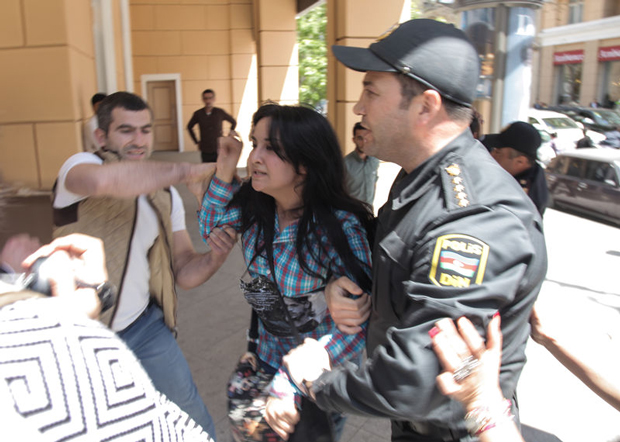
The Baku Court of Grave Crimes announced the verdict for the NIDA movement activists in May 2014. The human rights defenders Rashadat Akhundov, Zaur Gurbanly and Ilkin Rustamzadeh to 8 years’ imprisonment, Rashad Hasanov and Mamed Azizov – to 7.5 years. Protesters were detained and victimised by police. (Photo: Aziz Karimov / Demotix)
In a bleakly comic turn at the beginning of Ilham Aliyev’s address to the Parliamentary Assembly of the Council of Europe this week, Assembly president Anne Brasseur asked press photographers to leave the chamber and reminded those present that they were not permitted to vocalise their approval or disapproval during the Azerbaijani dictator’s stand. It appeared that Brasseur hadn’t quite meant what she said, as in the end photographers at the front of the room were merely required to move their tripods to ensure everyone in the room could see Aliyev as he spoke.
Aliyev’s speech was given to mark the Azerbaijan’s taking up of the chair of the Council of Europe’s Committee of Ministers last month. And what a speech it was!
The man who promises to “turn initiatives into reality” (still no idea) told of Azerbaijan’s enormous progress in all fields, not just oil fields. He spoke of the country’s “very positive atmosphere” and listed the country’s great freedoms: freedom of political activity, freedom of expression, freedom of media… Azerbaijan was proud of these freedoms, he said. Azerbaijan knew that an uncensored internet and independent newspapers were important for democracy.
It was a lovely speech, and also one that contained barely a word of truth beyond the conjunctions. Aliyev may as well have praised the nation’s Quidditch team for defeating Ravenclaw on penalties at the World Cup. He could have told us about his new motorcar, and his adventures with Ratty, Mole and Badger, and been more believable.
Watching Aliyev, the only time one got the sense he even believed what he was saying himself was when discussing the disputed territory of Nagorno-Karabakh, and even then he was only drily insisting that the regions “geographical toponyms” (place names?) were Azeri in origin: All Your Geographical Toponyms Are Belong To Us, so to speak.
The truth about Azerbaijan is quite different from the picture painted by its president this week. As Human Rights Watch pointed out ahead of the Council of Europe speech, “In the past two years, Azerbaijani authorities have brought or threatened unfounded criminal charges against at least 40 political activists, journalists, bloggers, and human rights defenders, most of whom are behind bars.” Search for Azerbaijan stories on Index, and you will find more details of those arrests and abuses.
And this isn’t exactly obscure knowledge. People know three things about Azerbaijan: it has a lot of gas and oil; it takes Eurovision very seriously; and it has a poor human rights record. After his speech, Aliyev was confronted by Michael McNamara of the CoE socialist group, who quoted Amnesty’s statistic that there are currently 19 political prisoners in Azerbaijan. Not so, said Aliyev. There are no political prisoners in Azerbaijan. The people who came up with these statistics were lying. There was a programme of “deliberate provocation” against Azerbaijan — though it was unspecified who was leading this programme.
Aliyev swore that this plot to undermine Azerbaijan would fail.
The Azerbaijani president is not alone in his capability for bare-faced falsehood. It’s a specific strain of Soviet and post-Soviet behaviour, learned from the Communist Party and the KGB. If the leader says something, it is true, no matter what the evidence to the contrary. There are no political prisoners in Azerbaijan, says Aliyev, and we encourage a free media because it is important to our democracy; Ukraine has been taken over by fascists, says Vladimir Putin, and Russia has no choice but to fight them. There is no point in putting on a play about depression in Belarus, an Alexander Lukashenko apparatchik tells the Belarus Free Theatre, because there is no such thing as depression in Belarus.
“So what?” you may say. “Politicians and institutions lie.” And you’d be right. But this is a form of lying that goes far beyond “I was perfectly within my rights to claim those expenses”/”I did not have sex with that woman”. Political lies in functioning democracies tend to have to do with cover ups of personal or institutional failings. In an authoritarian society, with power utterly concentrated to the leader and his cadre, there is no such thing as an isolated failure. As a result, every aspect of life must be spun. All triumphs belong to the leader, all criticisms are propaganda, all failures sabotage. When there is no balance of power, is there really an objective truth? When, for example, the dictator Lukashenko told a journalist that journalist Irina Khalip, under house arrest, could leave Belarus any time she wanted, was that actually true? Was it true the moment he said it? Did it become true after he said it? And did it remain true?
This state of things raises a question for those of us seeking to better the lot of people living under regimes such as Belarus and Azerbaijan: can we pounce on the moments when autocrats declare as fact something we know to be untrue, cling on until they actually make it true? Or does this merely confirm the idea that truth is whatever their whim makes it?
This article was posted on June 26, 2014 at indexoncensorship.org
25 Jun 2014 | News, Russia, Ukraine
Wrestling for the rights to define the Ukrainian conflict, both Russia and Ukraine have utilised a range of tactics to control and limit media coverage in the region. This, alongside, the constant to and fro between media freedom and the skewed official lines has politicised the role of the media and manipulated perceptions of the conflict, further distancing coverage from reality.
Every fact is a battle to be fought and won. Who made up the Ukrainian protest movement? Activists and other members of civil society, or thugs, neo-Nazis or far-right extremists? What are Russia’s motivations? Geo-political revisionism, a nationalistic desire to rebuild empire or for the protection of a persecuted minority? There is not one answer to questions like these; indeed the answers appear to changes depending on where they come from.
A sure-fire tactic to control the number of answers on offer is to limit the number of journalists able to cover the story. There have been a number of cases across the region where journalists have either been detained or refused entry to key areas of the conflict. In May, it was reported that three journalists, including a writer for Russia Today, had been detained by Ukraine’s Security Services (SBU), with a further three refused entry at the border. With no clarification of the grounds for their detention, as well as refusing them access to legal representation, the legality of such acts is dubious at best; as Human Rights Watch (HRW) states: “Failure to provide information on the whereabouts and fate of anyone deprived of their liberty by agents of the state, or those acting with its acquiescence, may constitute an enforced disappearance.”
This however, is not a tactic employed exclusively by Ukraine. According to the Committee to Protect Journalists (CPJ), Russian authorities and pro-Russian separatists detained five journalists in Crimea and mainland Ukraine. On 2 June in Donetsk, unidentified armed men in camouflage raided the offices of regional newspapers Donbass and Vecherny Donetsk, detaining senior editorial staff, and accusing the publications of “incorrect reporting”. It is reported that the captor’s demands included the stipulations that the editors, “change the papers’ editorial policy”.
This proved to be effective. The deputy editor of Donbass stated that both his paper and Vecherny Donetsk were “discussing the separatists’ demands and were considering shutting down the outlets for fear of future retaliation”.
Beyond limiting the freedom of journalists covering the conflict, state-led censorship and propaganda is creating media vacuums in key areas, promoting narrow and strictly controlled interpretations of the conflict.
Attacks on the media in Russia have ramped up significantly following Putin’s return to the presidency and have taken on a distinct urgency with the continuation of the Ukraine conflict. One example is the legislation pushed through the Duma banning the publication of negative information about the Russian government and military. This positions Russian activities in Ukraine at the heart of controlling perceptions of Russia in the media. Quoting the official explanatory note to the legislation, HRW reports: “’The event in Ukraine in late 2013-early 2014 evidenced…an information war’, and demonstrated the necessity to protect the younger generation from ‘forming a negative opinion of [their] Fatherland.’”
Another key piece of legislation at play in this context is the “Lugovoi Law”, which allows Roskomnadzor, the Russia state body for media oversight, to block online sources without any court approval. One publication that was blocked was Grani.Ru due in part to its criticism of the state’s handling of the Bolotnaya Square protests. Grani.Ru have unsuccessfully appealed the ruling, but Yulia Berezovskaya, director-general of Grani-Ru is not surprised.
Roskomnadzor has not lost a single case against the media. The Office of the Prosecutor General and Roskomnadzor refused to indicate the “offensive” materials that should have been removed from the website so that access could be restored.
Berezovskaya continues to see this as part of a larger shift in the state’s relationship to the media in the light of the Ukrainian crisis: “The Ukrainian crisis is a major part of Russian TV news while domestic issues are not covered.”
Rolling out robust limitations against opposition or independent media outlets in Russia, at times irrespective of the events in Ukraine, guarantees in a large part the allegiances of media bodies covering the crisis. Indeed with many voices absent from the debate, the state can be confident the official line is being towed, at times, irrespective of fact.
The manipulation of fact has come to define a large part of pro-Russia content. Moscow Times reports “when Vesti.Ru described clashes between pro-Russian and pro-Kiev protesters in Simferopol…it showed footage of earlier protests in Kiev, which were more violent.” Channel One, when alleging that violence in Ukraine has sent a flood of refugees heading for Russia’s Belgorod region, used footage, not of the Ukrainian-Russian border, but of the Ukrainian-Polish border.
By restricting who can report on the Ukrainian crisis through access or censorship, the state can identify which untruths should be accepted as “truth” and which truths should not be seen. But as the conflict endures, the battle to shape perceptions, both home and abroad will continue. As it does, how can we identify the true actions, motivations and responsibilities, before untruths take hold and become something more, something resembling and assumed to be fact?
This article was published on 25 June 2014 at indexoncensorship.org
23 Jun 2014 | Belarus, News
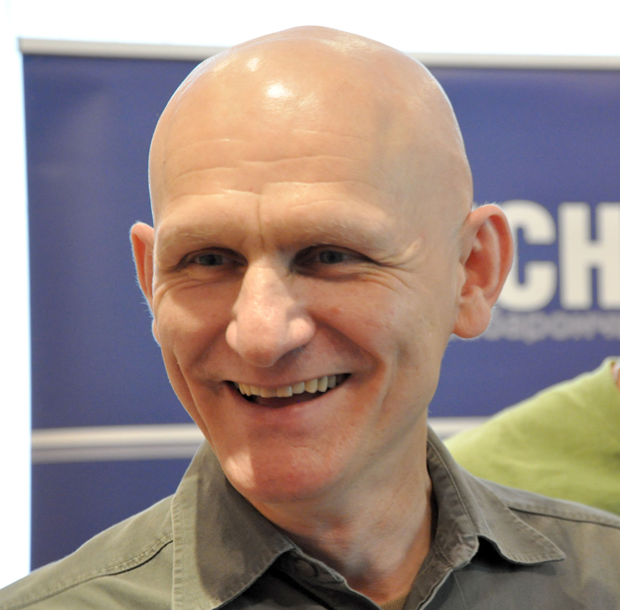
Ales Bialiatski was released from detention. (Photo: Andrei Aliaksandrau for Index on Censorship)
Ales Bialiatski, a Belarusian human rights defender, was released from prison on Saturday after almost three years behind bars on politically motivated charges.
“My release came as a surprise. I was not expecting anything like that. There was a usual routine check in the morning and they took me to work with other prisoners. But around 9 a.m. I was summoned to the prison director’s office, where they told me I am being released due to an amnesty,” Bialiatski said during the press conference in Minsk today.
Bialiatski, the chair of the Human Rights Centre Viasna and a vice president of the International Federation for Human Rights (FIDH), was arrested on 11 August 2011 in Minsk and later sentenced to 4.5 years in prison for alleged tax evasion. He did not admit guilt and stated the funds in his bank accounts abroad were in fact spent for activities of Viasna and supporting victims of human rights abuses in Belarus.
“I am not sorry for those three years I spent in prison. This is the price you pay for making Belarus a free and democratic country. If we want to improve our life and drag Belarus out of the swamp it has been in for 20 years already, we need to be active and not to be afraid of repressions civil society faces. I knew what I was in prison for, that is why it was easy for me emotionally,” Bialiatski said.
In fact, it was not always easy. “Political prisoners in Belarusian jails are kept in different conditions than other prisoners. For instance, no one was allowed to talk to me, even if it was a friendly chat about weather or football, a person who approached me could be punished by the prison authorities. That was just one of many examples of physiological pressure political prisoners face in jail,” he said, describing his time behind bars.
He symbolically crossed his name out of the list of Belarusian political prisoners on a campaigning T-shirt his colleagues wore while he was in jail.
“So, Bialiatski is out, but seven more are still there. Belarus has to become a country without political prisoners. I demand from the authorities to release all political prisoners and stop prosecuting people for their political views,” Bialiatski said.
Bialiatski expressed his gratitude to “tens of thousands of people” from Belarus and around the world who supported him during his time in prison and campaigned for his release. Bialiatski also said he is not going to leave the country and he is determined to continue his human rights work.
There will certainly be ground for that as Belarus continues to have a poor human rights record. Most commentators inside the country do not see Bialiatski’s release as a sign of any genuine improvement of the human rights situation, but merely a step of “good will” that can ensure possible renewal of a dialogue with the European Union.
“The EU is clearly looking for ways and platforms for a dialogue with Belarus. Europe certainly wants to decrease tensions in the region and stabilize the situation that was created because of Ukraine and its conflict with Russia. And it can be strategically important for the EU not to allow Belarus turn completely pro-Russian. The problem is the authorities of the country refuse to talk to the Belarusian civil society, and what we have started seeing is the West is ready to give in to the government of Belarus and ‘sacrifice’ participation of active NGOs in a possible dialogue. This will be a huge mistake. Lukashenko is going to deceive Europe once again, and we can see another clampdown on civil society of the country after the presidential elections of 2015,” Uladzimir Matskevich, a Belarusian methodologist and analyst, says.
“I am really happy Ales is out of prison – but I can hardly say he is ‘free’. We are all not free here. Bialiatski’s release is certainly great, but it does not signal any change. The authorities keep tight control over society. Dictators act this way; they need to show they are capable of strict punishment and mercy; they need to show acts of both time to time to manifest they are in charge. This is perhaps what we see with Ales’ release. The opposition is still too weak and disengaged to break through this vicious circle,” Matskevich said.
This article was published on June 23, 2014 at indexoncensorship.org
20 Jun 2014 | Digital Freedom, News, Russia
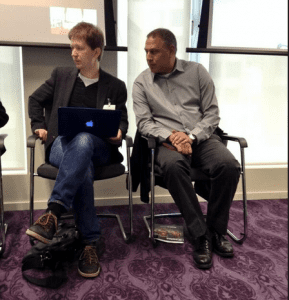
@AndreiSoldatov and @cyberrights at the @IndexCensorship Brussels event on Press Freedom in Russia Turkey Azerbaijan. Photo: Ricardo Gutiérrez
On Thursday, Index hosted a discussion with five leading media experts from Turkey, Russia, and Azerbaijan. As journalists, bloggers, entrepreneurs and campaigners, they experience first-hand how censorship – online and off – is being ramped up in their countries, and they argue that their stories are still not being sufficiently heard.
Turkey’s Yaman Akdeniz and Amberin Zaman, Russia’s Andrei Soldatov and Anton Nossik, and Azeri blogger Arzu Geybulla shared shocking stories about journalists harassed in government-led smear campaigns, the arrests on spurious criminal charges of those who speak openly on social media, and the growing role of governments in blocking free expression online.
“The internet is becoming less and less independent of government interference,” Nossik told the Brussels audience.
Index works with writers – including authors, journalists and bloggers – and artists globally to help them tell a wider world about the threats they face. We are a platform that allows individuals to speak for themselves, and fights for those who cannot.
In the first article from one of our event speakers, Andrei Soldatov assesses the state of online freedom in Russia:
Since November 2012, we’ve been living in a country with the internet censored extensively by a nationwide system of filtering.
This system has been constantly updated ever since. Now we have four official blacklists of banned websites and pages: the first one is to deal with sites deemed extremist; the second is about sites blocked because of child pornography, suicide and drugs; the third consists of sites with copyright problems; the fourth, the most recent one, was created in February and lists the sites blocked without a court order because they call for non-sanctioned protests. There is also an unofficial fifth blacklist aimed not at sites but at hosting companies, based abroad, which have proven themselves not very cooperative with Russian authorities.
Technically, the internet filtering system in Russia is not very sophisticated. Thousands of sites were blocked by mistake, while if you want to access a blocked site you can do that using circumvention tools or even very basic things like Google translate.
At the same time very few people were sent to jail for posting critical things online, and relatively few new media were put under direct government pressure.
But surprisingly, freedom of expression on the internet in Russia has been hugely affected: users have become cautious in their comments, and internet companies, the largest in the country, even when invited to talk to Putin, are so frightened that they failed to raise the issue of regulation at the meeting.
The beauty of the Russian approach is that it doesn’t need to be technically sophisticated to be efficient. It also doesn’t need mass repression against journalists or activists.
So why is that?
Basically, the Russian approach is all about instigating self-censorship. To do this, you need to draft the legislation as broad as possible, to have the restrictions constantly expanded — like the recent law which requires bloggers with more than 3.000 followers to be registered — and companies, internet service providers, NGOs and media will rush to you to be consulted and told what’s allowed. You should also show that you don’t hesitate to block entire services like YouTube – and companies will come to you suggesting technical solutions, as happened with DPI (deep packet inspection). It helps the government to shift the task of developing a technical solution to business, as well as costs.
You also need to encourage pro-government activists to attack the most vocal critics, to launch websites with list of so-called national traitors, and then to have Vladimir Putin himself to use this very term in a speech.
All that sends a very strong message. And as a result, journalists will be fired for critical reporting from Ukraine by media owners, not by the government; the largest internet companies will seek private meetings with Putin, and users of social networks will become more cautious in their comments.
We have seen this before – the very same approach was used against traditional media in the 2000s. What made the situation on the internet special is that the government found a way to shift the task of providing a technical solution for censorship to companies, including the global ones, and make the companies pay for the system. The way global platforms seem to respond to that is not very impressive. Localisation cannot be a solution because it helps to localise the problems of censorship. Now the Russian search engine Yandex presents two different maps of Ukraine, with and without Crimea, for the Ukrainian and Russian audiences respectively.
The biggest problem with this approach is that it provokes governments to put more pressure on global platforms. One day Twitter was heavily criticised by a Russian official in a pro-Kremlin paper who threatened to block the platform completely. The next day Twitter rushed to block an account of Pravy Sector, one of the most-anti Russian political parties in Ukraine, and blocked it for Russian users.
This article was published on June 20, 2014 at indexoncensorship.org
