17 Apr 2014 | Europe and Central Asia, News, Uzbekistan
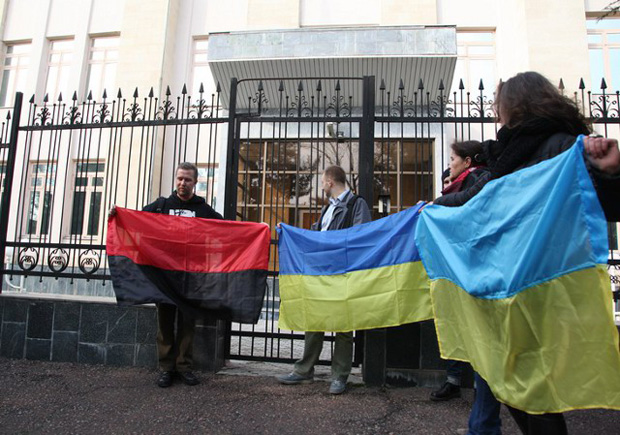
Umida Akhmedova took part in a small protest in Tashkent, in solidarity with the Euromaidan movement.
On 27 January, internationally renowned photographer Umida Akhmedova, her son Timur Karpov and seven other people took to the streets of Tashkent, Uzbekistan. Armed with Ukrainian flags, cameras and a petition, they staged a peaceful protest in solidarity with the Euromaidan movement.
Knowing they might attract unwanted attention, the group, which included one journalist reporting, posed for a few photos outside the Ukrainian embassy, handed over the petition, and quickly wrapped up the demonstration. However, their worries soon proved valid. Three days later, the protesters were hauled in one by one by police for a “short talk”. They would be held incommunicado for one day, first in a central Tashkent police station and later at a more remote location.
Karpov, a photographer based in Russia, told Index about unprofessional and aggressive officers, who called the protesters “dissidents” who were “ruining the constitution”. Passports and phones were taken away, but Karpov managed to keep one concealed to alert the outside world to their detention. It was eventually discovered and confiscated. When he got it back, it had been completely wiped. Without access to lawyers, the protesters were questioned by the SNB — the KGB’s successor — before being put through a quickie court session and ordered to pay fines of some £1,200. Three of them have been sentenced to 15 days in prison. Justice, as understood by Uzbekistan’s notoriously repressive regime.
This is not the first time Akhmedova has run into trouble with the regime of former Communist Party official Islam Karimov. In 2009, the photographer and documentary film maker, whose work has been published in The New York Times and Wall Street Journal, was charged with “damaging the country’s image” over a series of photographs depicting life in rural Uzbekistan. Similar charges were later levelled at her over a film about challenges facing Uzbek women, and in 2010, over a book about Uzbek traditions. It’s worth noting that she never intended to make a political statement with her work — the authorities’ reaction is what has politicised it. The cases have made Akhmedova a credible voice of opposition, and while her high profile provides some protection, it also means her every move is noted — as the latest case shows.
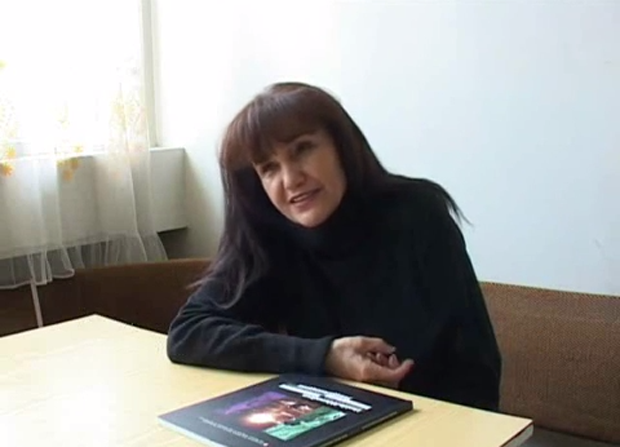
Umida Akhmedova (Image: Uznewsnet/YouTube)
“We live in a strict, archaic society, where all unregulated acts, especially those that can cause some kind of a response in the society, are nipped in the bud,” she told Index. “In the case of our Maidan project, the authorities did not have to be clairvoyants to see the similarities between the situation in Ukraine and the one in Uzbekistan. The government has started scaring children and adults with the word Maidan and did not like it when we showed support for Maidan.”
“As for our previous case,” she adds “we were charged with slander and insult of Uzbek nation, because the government wanted to teach us a lesson that without the approval from above, we were not allowed to film anything or publish books, or generally, do anything artistic without a superior permission.”
While Akhmedova’s latest arrest hit headlines across Central Asia, the story made little impact in the west. This is not surprising. Earlier this year the soap opera-like falling out between first daughter Gulnara Karimova — businesswoman, sometimes pop star, and until recently tipped to follow in her father’s presidential footsteps — and, seemingly, the rest of the family was covered by media outside the country. But on the whole, Uzbekistan rarely commands international attention. Like many other countries in the region, it is able to carry out its repressive rule away from the global spotlight.
President Karimov, by taking a number of liberties with the country’s constitution and term limits, has been in power since it gained independence from the Soviet Union in 1991. Reports of torture and other power abuses are widespread, the darkest days of the regime coming with the Andijan massacre, where security forces killed hundreds of people in the aftermath of a peaceful protest. The country is also one of the most corrupt in the world and despite its gas resources — part of the reason for many western sanctions quietly being dropped — suffers “recurring energy crises“. But Karimov has been careful to remove nearly all institutions that might use this information to challenge his power. Uzbekistan has no official opposition parties and no press freedom to speak of. Opposition news sites that operate outside of the country are blocked. Karpov puts it simply: “There is no freedom of expression in Uzbekistan. Absolutely none.”
One aspect of the widespread press censorship, is that developments in Ukraine have been met with near media blackout in Uzbekistan — the same way authorities dealt with the Arab spring and other incidents of popular unrest outside the country’s borders.
“From my point of view, they’re afraid. Extremely afraid of any sort of freedom,” says Karpov. ” That’s why they made the case with us. To frighten us. To show to other people that if you do this, you will be sentenced.”
Mother and son have accepted their punishment — partly because refusal to do so would lead to further blacklisting, and partly because they weren’t alerted to their appeal until after it had taken place. Unsurprisingly, the sentences were not overturned.
Despite this latest setback, and the possibility of being handed down a travel ban, Akhmedova remains undeterred. “Nothing has changed for me. I will carry on ‘slandering’ as I have done,” she says. “The state cannot help or stop me.”
This article was originally posted on 17 April 2014 at indexoncensorship.org
8 Apr 2014 | About Index, Campaigns, Press Releases
A NEW CHAMPION FOR FREE EXPRESSION
Index announces new CEO
Index on Censorship, the organization that advocates for freedom of expression and against censorship throughout the world, is delighted to announce the appointment of our new Chief Executive Officer, Jodie Ginsberg.
Jodie, who takes up her post next month (mid-May), comes from the think-tank, Demos. A former London Bureau Chief for Reuters, Jodie worked for more than a decade as a foreign correspondent and business journalist. She was previously Head of Communications for Camfed, a non-profit organisation working in girls’ education.
The Chair of Index, David Aaronovitch, said; “Index is an indispensible organization and I am really pleased to have someone of Jodie’s experience and talents coming to us. Index’s work defending freedom of expression on- and off-line is more important than ever in the face of growing censorship in many countries around the world from Turkey to Russia, from Azerbaijan to India to China. I am sure Jodie will build on the great work of her predecessor Kirsty Hughes and all the Index staff, and lead Index into new and important campaigns.”
Jodie Ginsberg said: “Defending freedom of expression is not an easy task but it is a vital one. If we want to live in a world where everyone is free to speak, write, publish or perform without fear of persecution then we need to champion those rights every day. I’m thrilled to be leading an organisation with such an amazing track record in defending free expression and can’t wait to start working with our incredible roster of supporters and contributors.”
Outgoing CEO, Kirsty Hughes, said: “I am delighted that Jodie will lead Index in its vital campaigning work around the world. I wish her all success in this vital and exciting challenge.”
Press enquiries to [email protected]
1 Apr 2014 | Egypt, News, Politics and Society
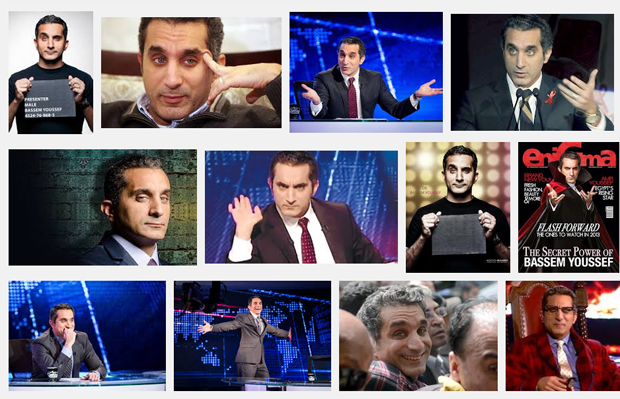
Dr Bassem Youssef, the former heart surgeon and Egyptian TV presenter likened to Jon Stewart, has declared he is taking extended time off from journalism, after an anti-semitism and plagiarism row swept through Egypt.
Dr Youssef was named by Time Magazine as one of the “100 most influential people in the world.” He has over two and a half million followers on his Twitter account and his weekly TV show, Al Bernameg, attracts millions. A political satirist and comedian, he is heavily influenced by Stewart’s Daily Show in the US.
Youssef’s self-censorship comes after a very public humiliation. The Cairo Post reports that an article written for publication in last Tuesday’s edition of Al Shoroqu, concerning events in Ukraine was heavily plagiarised a similar article Ben Judah wrote for Politico about the same topic.
The article was entitled “Why Russia No Longer Fears the West,” and while Ben Judah is a recognised global expert on Russia, Eastern Europe and Central Asia, Youssef is a pop-politics TV presenter with clearly scant knowledge of tensions with Putin.
Youssef tweeted that he had cited Ben Judah’s work at the end of his piece, but that editors had not include this in the final version.
Judah was then targeted by hundreds of anti-semitic messages, including pictures of Nazi symbols.
“Isreal [sic] under my shoes holocaust b***h lol hitler b***h hahahaha if I were hitler I will burn u all,” said one Cairo-based user.
Another from Cairo – “Jews curse of God on Earth.”
Another from Mansoura wrote “I will f**k your family one by one.”
“I made a public statement to lessen the damage on him as I respect his work for freedom of the press” Judah told Index. “Everyone can make mistakes under journalistic stress.” He received no apology from Dr. Youssef, even after the anti-Semitic tweets started arriving.
“Regarding the Twitter rage : I am from a family of Holocaust survivors, so it did not surprise me such hatred of Jews exists.”
Judah believes that the majority of the abusers were “middle class English-speakers in Cairo.”
“The whole experience reveals the scale of racial hate in the Arab world towards Jews,” he added.
In 1945 there were eight hundred thousand Jews living across the Arab world. Today, there are fewer than eight thousand.
Like Christians in the Middle East, who have seen their numbers drop from 15% to 5% in the last hundred years, the last fifty years saw many Jews move to Europe, the US, or Israel. The beginning of the exodus correlates roughly with the establishment of the state of Israel in 1948, suggesting that Arabs persecutions of Jews has also been politically motivated.
Judah says he received hundreds of anti-Semitic messages, many of them referencing the state of Israel.
“u re a f****** israeli dog &put ur tongue in ur ass f*** u son of pimp,” was one, another “I want to tell you f*** you Israel: F*** u Israelis and all Jews,” as well as “Israel under my shoes holocaust bitch lol hitler bitch hahahaha if I were hitler I wud burn you all.”
Judah also observed that many of those tweeting abuse had been key players in the Arab Spring.
“Egyptians who were baying for my Zionist blood were not peasants but mostly middle-class English speakers. Many of them were women, the heroes of the Arab spring.”
The anti-Semitism was not uniform, according to Judah “a lot of big Egyptian bloggers did touchingly tweet their shame and apologies to make me feel a bit better”.
This article was published on April 1, 2014 at indexoncensorship.org
25 Mar 2014 | Digital Freedom, Events

(Image: Shutterstock)
Index on Censorship, in association with Doughty Street Chambers, invites you to attend our high-level panel discussion asking who runs the internet?
At a moment when the revelations on NSA and GCHQ mass surveillance are opening up a wide debate about our digital freedoms, our panel will discuss how free the net is today, and the main challenges that lie ahead. In the next couple of years, major international summits will debate new rules on internet governance, and whether to adopt a top-down approach as favoured by China and Russia, or maintain a more open, multistakeholder networked approach. Meanwhile, from the EU to Brazil, reactions to the Snowden’s revelations of mass snooping suggest there is a growing risk of fragmentation of the internet, with calls for forced local hosting of data.
We are delighted to be hosting speakers:
Bill Echikson – Head of Free Expression EMEA, Google
Richard Allan – Head of Europe, Middle East and Africa, Facebook
Tusha Mittal – formerly a correspondent for Tehelka and currently a Fellow at the Reuters Institute, Oxford University
Kirsty Hughes – CEO, Index on Censorship
The panel will make short introductory remarks ensuring plenty of time for a lively Q&A session.
The event will be held at Doughty Street Chambers (53-54 Doughty St, London WC1N 2LS) on Wednesday 2nd April 6-7.30pm, followed by a drinks reception. To RSVP please fill in your details here. If you have any questions please contact Fiona Bradley ([email protected]).
