4 Mar 2014 | Africa, News, Uganda
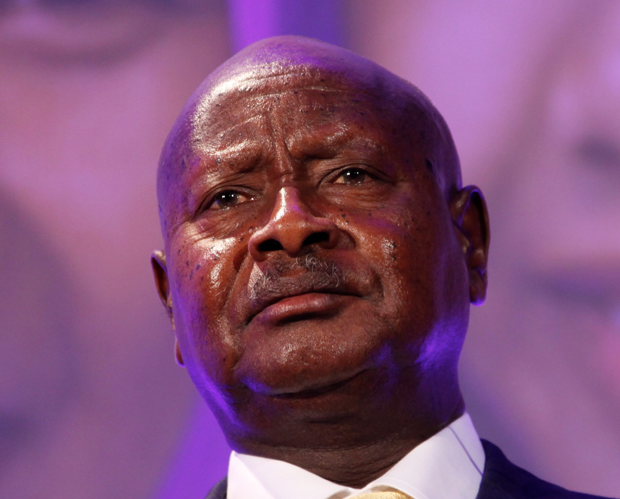
Ugandan president Yoweri Museveni (Photo: Wikipedia)
President Yoweri Museveni signed Uganda’s Anti-Homosexuality bill into law on 24 February, and the fallout has already started. The World Bank has cancelled a $90 million loan to the country, European Union countries are threatening to withdraw aid, and the United States is reviewing its cooperation with Uganda. President Museveni has hit back, saying Uganda would raise its own money to fund its development projects. The US, which was the first voice its discontent, was told off: “Our relationship with the US was not based on homosexuality.” David Bahati, the MP who introduced the bill, said in an interview that the west is imposing social imperialism on Uganda, a thing they are not ready to accept.
“I will work with the Russians,” Museveni said.
So the president feels that even without the west, Uganda has development partners that it can still rely on. Considering he was not supportive of the so-called Bahati bill in its initial stages, Museveni’s last-minute change of heart is baffling.
The law stipulates that punishment for homosexuals will be a life jail sentence, while those who “attempt” to engage in homosexual acts face seven years in prison. The law also targets journalists and others seen to participate in “production, procuring, marketing, broadcasting, disseminating, publishing of pornographic materials for purposes of promoting homosexuality”. It even attempts to reach beyond the country’s borders, implong that Uganda will have to ask countries where gay Ugandans live to extradite them so that they can face the law.
Public opinion goes both ways. Many are happy that the president is standing firm against “the west” and the perceived scheme of promoting homosexuality in Uganda and Africa at large. Others claim that the president signed this law to achieve cheap popularity with the 2016 elections around the corner. It is also claimed that President Museveni is just playing his usual political games. When the anti-homosexuality bill was passed by parliament early this year, one of the president’s legal brains, Fox Odoi, publicly stated that if the president ever assents to this law, he would challenge it in court.
Odoi has now teamed up with Ugandan journalist Andrew Mwenda to take the case to the constitutional court. It is alleged that this was Museveni’s game plan: sign the law, annoy the west and appease the locals, and then have his henchmen challenge this law in court and make sure it remains there forever. In this case, the west will soften their stance towards Museveni, and the locals will be told to be patient and leave the legal process to take its course. In that case, he will have killed two birds with one stone, and would go for the 2016 elections with both the west and the locals in his pockets.
Civil society has also been critical, not because the anti-homosexuality law is unnecessary per se, but they have questioned whether homosexuality is the biggest problem Uganda faces today, and warrants such urgency. With high youth unemployment, squalid conditions in health facilities and theft of public funds in government institutions, they believe priorities should lie somewhere else other than “fixing” homosexuality.
“The timing for the assenting to this law by the president is meant to divert the country’s attention from the discussion on the deployment of Ugandan forces in South Sudan and our mandate there. This law is very diversionary, and it is unfortunate that Ugandans have swallowed the president’s bait,” said Godber Tumushabe, a renowned civil society activist.
Opposition leader Kizza Besigye has criticised the new law, saying that homosexuality was not “foreign” and that the issue was being used to divert attention from domestic problems. “Homosexuality is as Ugandan as any other behaviour, it has nothing to do with the foreigners,” said Besigye. He accused the government of having “ulterior motives” and using the issue to divert attention from other issues, including Uganda’s military backing of neighbouring South Sudan’s government against rebel forces.
Sweden’s Finance Minister Anders Borg, who visited the country a day after the signing of the law, said it “presents an economic risk for Uganda”.
But Besigye accused them of double standards, saying that their cutting of aid over gay rights alone was “misguided”:
”They should have cut aid a long time ago because of more fundamental rights, our rights have been violated with impunity and they kept silent,” he said.
This article was posted on March 4, 2014 at indexoncensorship.org
20 Feb 2014 | Digital Freedom, News, Vietnam
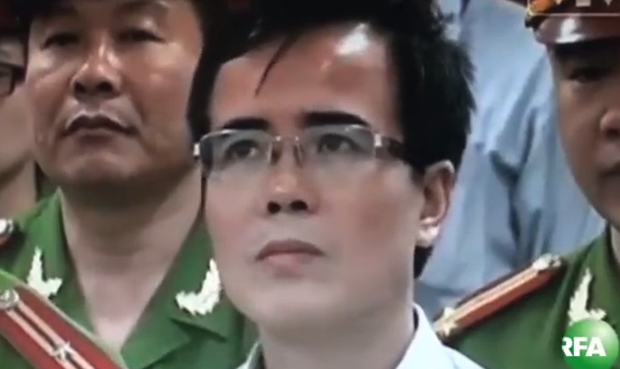
Le Quoc Quan (Image: RFAVietnamese/YouTube)
The 30 month prison sentence for Vietnamese human rights lawyer and blogger, Le Quoc Quan, was today upheld by a Hanoi appeals court. Quan, who has frequently blogged about human rights violations by the government, was convicted in October 2013 on tax evasion charges. He has been arbitrarily detained since December 2012. A crowd of hundreds wearing t-shirts in support of Quan were present outside the court, while a European Union delegation, representatives from the United States and Canada and a small group of journalists were present at the trial. This is just the latest move in the Vietnamese authorities’ ongoing attack on dissent, free speech, free press and a free internet.
If you need to communicate with someone the Vietnamese government is interested in keeping an eye, it is always been useful to be careful. Phone conversations can be listened to. Meetings at houses could be watched. Protests are invariably filmed by government operatives. If you were going to, say, chat via Gmail’s chat function it should be switched to “off the record” to prevent a copy of the discussion being archived. Some unlucky people have seen their blog posts traced to the internet cafe they’ve later been arrested at. If you are a dissident you won’t be the only one the police are interested in; they’ll talk to your family, friends and employers, too. The latter they may ask to dismiss you.
It is Vietnam Ministry of Public Security conducts this surveillance work, while the Ministry of Information and Culture drafts many of the laws regarding internet usage and “abuse”. And it is most likely a unit within the MPS that is responsible for these, and earlier, malware attacks.
Much of the surveillance and intimidation is hardly new; similar operations took place during the Terror in the USSR. In fact, the CIA has compared the MPS with Russia’s KGB. The KGB of comrade days, however, never had to deal with the vastness of the internet. The government owns every newspaper and printing press in the country, but it has few serious servers, making control of the internet difficult. It does not stop them from trying.
In January the Associated Press in Vietnam reported on malware attacks against one of its journalists, against an American-Vietnamese blogger and against the Electronic Frontier Foundation (EFF). These are certainly not the first of their kind but may have been the first directed against those on foreign shores. The private correspondence of Vietnamese-American blogger Ngoc Tu was posted on her blog after someone — supposed, but not verified to be the Vietnamese government — sent her an email with a link that installed malware and key logging software giving the sender access to her password and her email account. The Associated Press reporter was a sent an email purportedly from Human Rights Watch with a link to a ‘white paper’ on human rights.
Vietnam’s internet history: Enthusiasm and repression
Vietnam’s relationship with the internet has not been simple. The government has always been enthusiastic about the internet and the wholesale benefits it could, and has, brought to the nation. Though classified as an “enemy of the internet” by Reporters Without Borders for its blocking of websites and arrests of bloggers and journalists, Vietnam’s communist government has done an awful lot to ensure good internet access.
But the country’s vibrant internet culture is a direct result of government guidance and intervention. Vietnam has long valued literacy and learning and according to Professor Carlyle Thayer at the Australian Defence Force Academy, the government believed that the “knowledge era” was key to the nation’s economic development. The internet helped to provide that and greater world integration, something they have been increasingly keen for since Doi Moi in 1986 when the country began a period of economic renovation, shunning its former isolationist politics.
Twenty years ago the Vietnam Communist Party (CPV) noted three dangers facing the country: corruption, deviation from the socialist path and falling behind. The internet was seen a perfect way to engage more with the world. A 2011 report by market research firm Cimigo, headquartered in Ho Chi Minh City, says: “Vietnam has seen a more rapid growth of the internet over the last few years than most other countries in the region and is one of the fastest growing internet countries in the world… Since the year 2000, the number of internet users in Vietnam has multiplied by about 120.”
However, the government misjudged, believing control to be easy, and circumventing its block beyond the ken of its citizens.
Putting the genie back in the bottle
There are three main laws bloggers, activists and others the state dislikes are charged under. Criminal Code Article 88 relates to “conducting propaganda against the state”. This is the one most often used — both draconian and helpfully vague. Then there is Article 258, relating to “abusing democratic freedoms”, and Article 79 covering “activities aimed overthrowing the Communist Party of Vietnam and People’s Socialist Republic of Vietnam”.
However there have also been numerous internet laws drafted, largely aimed at keeping citizens’ net activities restricted to useful research or harmless entertainment. An August 2001 law imposed “stringent” controls and required net cafe owners to report breaches to relevant authorities and to collect ID from their users. An August 2005 law criminalised using the internet to oppose or destabilise the state, security, economy or social order, infringe on the rights of organisations or individuals, or mess around with Domain Name System (DNS) settings — something many Facebook users started doing in 2009. In October 2007 the Ministry of Information and Culture issued a decision requiring all businesses to obtain a license before setting up a website. This has stymied growth in some ways, as it is only now that businesses are as present online as individuals.
In August 2008 Decree 97 made it illegal to “abuse” the internet to oppose the government. What got more attention was Circular 7, restricting bloggers to cover only personal, not political, topics. At the time blogging was a favoured pastime in Vietnam, Yahoo! 360 the favoured platform. Interest in blogging and blogs in general has since waned significantly. According to Cimigo, in 2009 40 per cent of internet users visited blogs and 20 per cent blogged themselves. By 2011 those numbers had halved as people increasingly moved to social media sites like Facebook.
It was the quiet block of Facebook in 2009 that caught the world’s attention. The government never mentioned a ban publicly though a purported scan of instructions to ISPs to block the site did rounds online. As the government never said much, Vietnam’s legion of Facebook users simply muttered something about “technical problems” as they “fixed” the DNS settings to access the site.
What led to the Facebook block was the organising between previously disparate groups against Chinese-run bauxite mines in the Central Highlands of Vietnam — an already ecologically and politically sensitive area. Catholics, activists, environmentalists and anti-China activists all united via Facebook to protest the mines. In 2010 the government tried to launch its own social networking site (which led to headlines such as ‘In Communist Vietnam, State Friends You’), go.vn, where users had to provide their full names and ID card details, but could also “friend” communist luminaries. The Minister for Culture and Information Le Doan Hop praised the site’s usefulness for young people and promotion of “culture, values and benefits”.
In 2010 came a decision requiring all public hotels to install Green Dam monitoring software. Theoretically it allowed the government to see what was being looked at, possibly by whom and take appropriate steps. In fact decision 15/2010/QD-UBND was something of a paper tiger; many pointed out how such a piecemeal and scattershot approach would have limited utility and could be wholly circumvented by any serious activist, though rights organisations took the appropriate potshots as a matter of course.
In 2010 a ban was put in place, ostensibly on all online gaming between 10pm and 6am, to combat gaming addiction. However, it was never fully possible to enforce thanks to most popular games being hosted by overseas servers.
The most recent attempts at curbing net use via legislation has been Decree-Law 72 on Management of the internet which formally came into effect in September 2013. Like many laws it is confusing and vague enough to be useful for any enthusiastic government prosecutor. Among other things it banned the sharing of news online. Or, rather, it banned the aggregation of news onto websites. The government took the time to publicly respond to the flurry of foreign concern and the head of the Ministry of Information and Culture’s Online Information Section protested to Reuters that the law did not violate any of Vietnam’s human rights commitments. “We will never ban people from sharing information or linking news from websites,” he said, arguing it had been misinterpreted.
There has been talk that Decree 72 was also designed to protect intellectual property, as violations have long been problematic and go far beyond dollar copies of new Hollywood films on DVD. One of the things 72 supposedly sought to do was prevent websites re-posting news from its original source with no attribution and thus make things easier for news sites whilst also laying groundwork for membership of the Trans Pacific Partnership in regards to intellectual property protection.
The more interesting requirement was that ISPs locate servers, or at least one, within Vietnam and deliver information on users to the government, rather as internet cafes have been required to do. They were also required to take down anything contravening laws. However Vietnam’s most trafficked sites do not have servers within Vietnam and with such new laws do not entirely see the point, either. Indeed there are not many substantial servers located there at all, and bloggers who fear the law usually host their blogs overseas in any case. Should the government instruct local ISPs to block say, Google, many will simply respond again to “technical difficulties” by readjusting their settings.
Peaceful evolution, draconian repression
The threat of peaceful and not so peaceful evolution hangs heavily over the heads of those in power in Hanoi.
Vietnam is regularly excoriated for its human rights record which generally means the way the nation locks up its dissidents, bloggers, religious leaders. Even US President Barack Obama made mention of blogger Dieu Cay’s ongoing detention, ostensibly for tax reasons.
According to Human Rights Watch there were at least 63 political prisoners convicted in Vietnam last year. And yet, as Professor Thayer said in a 2011 paper: “Great effort is put into monitoring, controlling and restricting Internet usage. The enormity of resources devoted for these purposes contrasts with the comparatively small number of political activists, religious leaders, and bloggers who have been arrested, tried and sentenced to prison.”
Though the numbers have increased since the above was written there is still little mass organising in this area, and large scale protests tend to be over more concrete issues: workers’ rights and wages or land grabs. However those considered potentially subversive are closely monitored, watched by both a physical presence and an online one.
Actual harassment of bloggers and their families has been common over the years. Most famously, mother of Vietnamese blogger Ta Phong Tan set herself on fire outside the Bac Lieu People‘s Committee building in the Mekong Delta in July 2012, in protest at the way her daughter had been treated.
Within the MPS are units that monitor all forms of communication and there are records of the country purchasing more complicated surveillance equipment. According to the same 2011 paper by Professor Thayer, Vietnam by 2002 had the Verint call monitoring system. Verint, a US company, supplies over 150 nations and 10,000 organisations with varied forms of security and monitoring equipment.
China in the 1990s also offered technical assistance to “monitor internal threats to national security” to the General Department II. The military also collects intelligence related to national security and with attention paid to those, abroad or within Vietnam, who “plot or engage in activities aimed at threatening or opposing the Communist Party of Vietnam or the Socialist Republic of Vietnam”.
General Department II not only, arguably, watched dissidents but also tapped senior party officials in an incident of usually opaque factionalism that later came to light.
There have been many attacks against varied blogs and websites; 16 starting in 2009 and intensifying in April of the next year. Varied activists came under fire: Catholics discussing land issues — there have been ongoing spats between Catholics and the state over land grabs — as well as environmentalists and political agitators. Sites allied to the anti-bauxite movement were also hit. IP addresses were allegedly traced back to within Vietnam and to addresses connected to the military. The attacks, verified by McAfee and Google, were botnet attacks where spyware hid in seemingly innocuous Vietnamese language keystroke software (though a Romanised alphabet Vietnamese has 29 letters and many diacritics). Neel Mehta, a security expert with Google, wrote in a blog post that: “While the malware itself was not especially sophisticated, it has nonetheless been used for damaging purposes.”
Vietnam joining the “technology race”?
That Vietnam has taken up the internet quickly and with great passion is beyond dispute but there are still gaps in the industry. Everyone may be using Google but few local businesses are profiting from the web and mobile boom.
Bryan Pelz, an IT developer, says there is “no means for direct monetization”.
“The banking industry and regulatory environment hasn’t taken strong steps to lay the groundwork for easy online payments. Essentially nobody has credit cards. If you’re building a website and hope to charge users or make a living off of advertising, it’s a tough road in Vietnam.”
And despite talented hackers and software engineers — Flappy Bird was designed by a Vietnamese engineer — with experience and skill comparable to the rest of Asia, software isn’t considered a hugely lucrative field, according to Pelz.
Of those aged 15 – 24, according to Cimigo, 95 per cent are online and spend over two hours each day on the web, via internet cafe, desktop or phone. Ninety five per cent use it for news. Google remains the top rated site in Vietnam, followed by local entertainment hub Zing. News sites Dan Tri and Tuoi Tre also feature, as does Yahoo!, Facebook and YouTube.
Last year a Russian-backed challenger to Google called Coc Coc (knock knock) opened shop. It has aimed to take some of Google’s 97 per cent market share, the reasoning being that Google had no offices in Vietnam and did not have algorithms well written enough to understand Vietnamese well. Unlike other startups it was backed with serious investment and a staff of over 300, according to the AP.
A recent article in The Atlantic reported that Vietnam’s Ministry of Science and Technology has sponsored something called the Silicon Valley Project which aims to push Vietnam to be more than a simple producer of electronic parts (Intel has a 1 billion USD plant in the country) to a tech powerhouse with a strong startup industry and innovative firms. The recent success of Flappy Bird — one of the most downloaded apps ever — is seen as evidence of Vietnam’s larger potential.
Indeed the Silicon Valley Project’s mission statement is not dissimilar to the Communist Party’s mid-1990s ideas about the upcoming “knowledge era”: “This is the time for Vietnam to join in the technology race. Countries which fail to change with this technology-driven world will fall into a vicious cycle of backwardness and poverty.”
This government-backed and sanctioned creativity and entrepreneurship has been lauded, though it’s also been pointed out how it may rather clash with many of the internet restrictions set out in varied laws, such as Decree 72. Of course Vietnam’s ministries do not always march in-sync and what the Ministry of Information and Culture believes to be good may clash with a more pro-tech Ministry of Science and Technology.
The confirmation today that Le Quoc Quan is facing 30 months behind bars, does not bode well for the future of internet freedom in Vietnam.
This article was published on 20 February 2014 at indexoncensorship.org
18 Feb 2014 | Europe and Central Asia, News, Russia
Homosexuality and LGBT rights have made headlines across the globe during the Sochi Winter Olympics, following Russia’s introduction this summer of laws banning “gay propaganda”.
Index invited Brian Pellot, Director of Global Strategy and Religious Freedom Editor at Religion News Service, and Joel Bedos, International Coordinator for International Day Against Homophobia (IDAHO), to join us for our first ever Drawing the Line Google Hangout, to debate young people’s views on same-sex relationships.
Watch the discussion below and have your say in the comments, or get in touch on Twitter @IndexCensorship using the hashtag #LoveandFEX
This article was published on 18 February 2014 at indexoncensorship.org
12 Feb 2014 | Belarus, News
Join Index at a presentation of a new policy paper on media freedom in Belarus on 19 February, 2014, 15.00 at the Office for Democratic Belarus in Brussels.
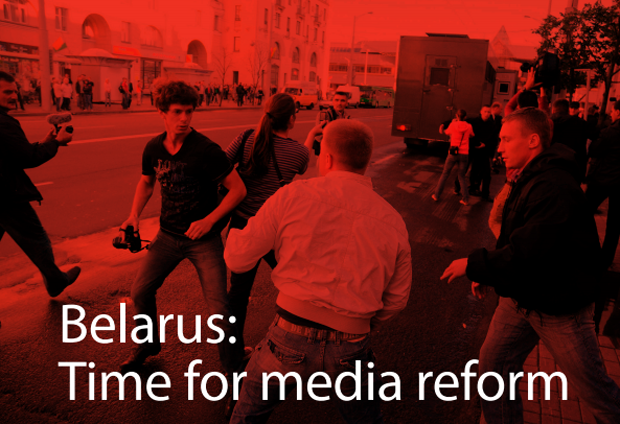
This article is the third of a series based on the Index on Censorship report Belarus: Time for media reform.
Despite the constitutional guarantees and international obligations, Belarusian laws, by-laws and practices of their implementation seriously restrict the media freedom. The Law “On Mass Media” and practices of its implementation have negative effects on media diversity, including complicated procedure of compulsory registration of media outlets. The law can be used to push independent newspapers to the verge of being closed down. The procedure of accreditation and laws on state secrets are also used to restrict access to information.
Law “On mass media”
The Law “On Mass Media” was adopted in 2008 and came into force on 8 February 2009, despite concerns voiced by the Belarusian Association of Journalists and the office of the OSCE Representative on Freedom of the Media. Five years after the law came into force, the fears of civil society and international organisations have proved to be well-founded. In particular, the following provisions of the law have been assessed to be restrictive:
• new media outlets have to apply for permission to be registered, which is an impediment to the right of freedom of expression;
• the process of licensing of broadcast media is non-transparent;
• the process of accreditation restricts journalists’ access to information;
• activities of a media outlet can be suspended or cancelled on the basis of a court appeal by the Ministry of Information, with no regard to proportionality or freedom of expression; the process to cancel a broadcasting license is even simpler;
• the government of the country receives the right to regulate activities of “media that are distributed via internet”, although there is no definition of online media in the law.
Registration of media outlets
The compulsorily registration of the print media, which has a chilling effect of media freedom, is still used in Belarus.
Article 13 of the media law provides for obligatory registration of any printed publication with a circulation of more than 299 copies. The registration process in Belarus has two stages; it is necessary to register an editorial board as a legal entity, and then to apply for registration of a media outlet. The law is arbitrary and presents a barrier to new entrants to the media market.
Editors of new media outlets must have higher education and at least five years of experience as editor-in-chief of a registered media. This is an arbitrary provision that makes it difficult for new media outlets to establish themselves. There are also additional restrictions that the Ministry of Information imposed in its decrees No. 17 and 18 of 7 October 2009, although they are not provided for in the law. There is a general rule that a company that is a unitary enterprise can be registered at its founder’s home address. Editorial boards of mass media that are unitary enterprises don’t have such right as the Ministry of Information demands them to have separate offices in non-residential premises.38
In 2010-2012 the ministry of information issued 105 refusals to register new media outlets. “These are not draconian measures. We have the media law; we have always acted and will continue to act within the framework of this law,” commented Aleh Praliaskouski, the Minister of Information.
Newspapers with a circulation of less than 300 copies are not obliged to register, but their activities are also regulated and controlled by the state. Each publication with a circulation of more than ten copies has to send at least five copies to state regulatory bodies according to “an obligatory mailing list.” Moreover, state bodies, first of all public prosecutors’ offices, demand such small-circulation publication to register as legal entities, thus obliging them to rent offices, pay taxes and employ editors according to the rules of the ministry of information. On several occasions the local prosecutors’ offices has issued warnings to publishers of such small-circulation media. These restrictions contradict the approach set out by the United Nations Human Rights Committee that stated that the requirements for the obligatory registration for small-circulation publications that are not issued on a regular basis is excessive; it has chilling effect of freedom of expression and it cannot be justified in a democratic society.
Suspension and closing down of media outlets
Possibility of suspension and closure of media outlets is still a major problem despite changes in the law. The previous media law provided for a possibility to close down a media outlet by a court decision if the media violated Article 5 of the law at least twice within a year. Article 5 of the media law contained a list of ten particular violations that could lead to a court appeal against a media outlet.
In the new Law “On Mass Media” this article is omitted, but this is not necessarily an improvement. On the contrary, Article 51 of the present media law allows for the closing down of any media outlet after any two (or, in some cases, even after one) warning, issued by the ministry of information or a prosecutor’s office, for any infringement, even a minor one.
In 2010-2012 the ministry of information issued 180 official warnings to mass media; two of them, Narodnaya Volia and Nasha Niva, were on the verge of being closed down. The ministry withdrew its claims, but the legal framework that allows closing media outlets down is still in place.
Case study: Appeals against Narodnaya Volia and Nasha Niva
In 2011 the ministry of information appealed to the supreme economic court with a legal claim to close down two leading independent newspapers Narodnaya Volia and Nasha Niva.
Prior to the appeal the ministry issued three warnings to Nasha Niva. Two of them were issued for articles over the reaction of the Belarusian authorities to a Russian documentary called “God Batska” (a reference to the title of Francis Ford Coppola’s Godfather movie and a Belarusian word “batska” meaning “father”), in which president Lukashenko was criticised. The film was broadcast by the Russian NTV television channel in 2010-2011 to considerable public interest. One more warning was issued for an article about a bomb blast in the Minsk underground on 11 April 2011; according to the minister Aleh Praliaskouski, the reason for the warning was “improper coverage of the bombing.”
Narodnaya Volia received four official warnings before the appeal. The last one was issued for an article called “Goebbels-TV is on air” and was a critique of a highly sensationalist documentary broadcast by state television about events after the presidential election of 19 December 2010 in Minsk that accused the opposition of organising mass riots.
The newspapers appealed against the warnings and a court examination of their cases was postponed. While it was on hold, on 6 July 2011 the ministry of information issued one more warning to each of the two newspapers stating that Nasha Niva did not publish its subscription index in a single issue and that Narodnaya Volia had printed the wrong number of issues.
In July 2011 the Ministry of Information withdrew its court appeals to close the newspapers down. The decision to withdraw the appeal was arguably due to the significant public response to the case, including reactions from the international community. It is worth mentioning, that Narodnaya Volia and Nasha Niva were the two independent newspapers that were returned to the state press distribution systems in 2008; at that time it had been presented as a step forward by the authorities of Belarus in order to normalise their relations with the EU.
Despite the court appeals against the newspapers being withdrawn, each of the publication was fined 14 m roubles (about £1,800) for violation of Article 22.9 of the administrative code (“violation of the media legislation by a mass media outlet iteratively within a year after a previous written warning”).
Regulation of online media
While online media in Belarus are able to operate relatively freely, the authorities of the country reiterate their commitment to introduce tougher regulation for information websites to duplicate restrictions media face offline. It already resulted in restricting the access to several independent news websites that are included in an official black list.
Articles 11 and 17 of the media law provide for the registration of “mass media that are distributed via the internet global computer network” while giving space for the council of ministers to develop particular regulations. At the same time, the law provides no definition of online media. No governmental decree on the regulation of online media has ever been actually published, despite the law being in force for five years.
The current definition in the law allows the government to in theory consider many different types of websites as “mass media that are distributed via the internet global computer network”; including corporate websites that publish updates and personal blogs. Presidential decree No. 60 (On the Measures to Improve the Use of the National Segment of the Internet Network), signed on 1 February 2010, marked a new set of challenges to online free speech.
About 20 different by-laws and governmental decrees have been adopted since to regulate the implementation of different provisions of the decree No. 60. None of them specifically addresses online media outlets, but they influence activities of Belarusian websites. In particular, the present legislation provides for the following regulations:
• all Belarusian websites that provide services to citizens of Belarus must be moved to the national .by domain zone and be physically hosted on servers, located in the country;
• customers of internet cafes are obliged to register and present their passports before they can go online;
• internet service providers must identify all internet connections and store data about their customers and websites they visit; ISPs are also obliged to install technical system for search and surveillance in the internet, System for Operative Investigative Activities (SORM), that the police and security services officers have access to;
• “lists of limited access” of websites are introduced; the sites on the list are banned from access from computers at state bodies, educational institutions, public libraries, etc.
Governmental regulation of online media may be introduced in the near future. According to Belarus’s deputy information minister Dzmitry Shedko, “the most influential Belarusian websites may be given the mass media status.” The Deputy Minister stated in November 2013 a working group had been set up to address this issue. The ministry is taking a restrictive approach to regulation of online media. Only representatives of government agencies have been included in the working group. The deputy minister has argued the regulations are a necessity to make “the most popular and influential websites accountable for distributing any kind of information”, including a possibility of revocation of registration for breaking the regulations.
As Sedko reiterated in his letter to Index in November 2013, “at the moment the ministry of information is considering the issue in detail in order to elaborate an optimal decision to be suggested to the council of ministers.”
Independent media experts have noted that the proposals will not create additional opportunities for the journalists of online publications. In line with the practice of the current law, the regulation seems to be intended to introduce additional responsibilities for online media outlets to restrict their coverage in a similar manner to that of the printed press.
Possible media law reforms
The authorities of the country have been quite reluctant to discuss or implement recommendations on reforms of media-related legislation. Nor have there been changes to the implementation of the law to bring the practices of public bodies in line with international standards. In particular, the country’s officials have stated they do not recognise the mandate of the UN Special Rapporteur on the Situation of Human Rights in Belarus, Miklós Haraszti, and will not cooperate with him.
Dunja Mijatović, the OSCE Representative on Freedom of the Media, was able to make an official visit to Minsk in June 2013 and welcomed “the readiness of the authorities to intensify dialogue and co-operation with her office on much needed improvement of the media freedom situation.”
Still, the analysis presented in this policy paper shows the overall developments in the media field are no more positive than a few years ago. The authorities of Belarus show little sign of wishing to discuss reforms of the media field with civil society. Attempts by the Belarusian Association of Journalists to apply to the standing commission on human rights, national relations and mass media of the house of representatives of the national assembly to hold an open and public discussion on media-related laws and their implementation in Belarus were rejected. As was BAJ’s proposal to the national parliament to discuss reform of the media law with international experts, in particular the OSCE.
Andrei Naumovich, the chair of the standing commission, replied to BAJ on 15 February 2013, that all the suggestions were “considered in detail with the ministry of information.” According to the ministry, “at present the Law ‘On Mass Media’ functions stably, it allows solving current practical problems in activities of mass media, and fosters the advancing development of information field of the country.” Naumovich informed BAJ the parliamentary commission “considers initiating of amendments to the media laws to be unreasonable.”
Index on Censorship approached the ministry of information of Belarus in October and November 2013 to discuss media reform. The ministry did not reply to a request for a meeting in Minsk. The ministry responded in a letter with Shedko, deputy minister, stating that the ministry “conducts systematic analysis and monitoring” of implementation of media-related legislation in the country; it also “considers suggestions of citizens and legal entities on these issues” and “initiates amendments in the media law, when necessary” though gave no specific examples of this. In January 2014 Usevalad Yancheuski, the head of the principle ideological department of the presidential administration, informed BAJ that the ministry of information “is requested to invite representatives of journalistic organisations” to be involved in the work on possible amendements to the media law, but it has led to no particular steps so far.
Accreditation and state secrets laws as means of restriction of access to information
There are various ways in which access to information for journalists is restricted in Belarus. The main two of them are the accreditation of journalists and the use of secrecy laws.
The procedure of accreditation is understood by state bodies as a permission they are entitled to grant – or to reject – to a journalist for receiving official information from them.
Additional barriers to access to information are created by the laws on state secrets and state service. These laws contain vague and broad definitions of data that can be declared a state secret. More than 60 different state bodies and institutions have the right to attribute certain information to be a state secret; the list of organisations includes the ministry of information, the ministry of culture, the ministry of education, the National State Television and Radio Company and regional authorities. Loosely-defined provisions in these laws allow for the restriction of access to information of public interest by labelling certain data as a “state secret”.
Criminal defamation
Criminal defamation is chilling to freedom of expression. A prison sentence may lose a journalist their job, while a criminal record may make them unemployable in the future. Belarus continues to criminalise defamation, even though the UN special rapporteur on freedom of expression has called for its decriminalisation.
Six articles of the Criminal Code provide for criminal liability for libel and defamation, while offering additional protection to state officials, including the president of the country. These articles have been used against journalists. In July 2011 the journalist Andrzej Poczobut received a three-year suspended jail sentence for libelling the president. A year later he faced similar charges again. The journalist spent ten days in detention in June 2012. In 2013 the new criminal case against him was cancelled and all charges were dismissed.
A criminal case against the journalist Mikalay Petrushenka was initiated in 2012. He was charged with insult of a state official; his article for Nash-dom.info website allegedly contained “public insult” of a deputy head of Orsha local authority. Linguistic experts who analysed the text found no insulting words or expressions there; the case was dropped in October 2012.
Belarusian law provides not only for criminal, but also administrative and civil liability for defamation. It can be noted as a positive development that in recent years there have been no administrative or civil libel cases against media or journalists were initiated by Belarusian officials.
Anti-extremism laws used to put pressure on media and journalists
Anti-extremist legislation has been used in Belarus to curtail media freedom. The current law “On Counteraction to Extremism” came into force in 2007. It contains vague and ambiguous definitions of terms “extremism” and “extremist materials” that allow for its arbitrary implementation.
On 10 January 2011 the ministry of information cancelled the broadcasting license of Avtoradio for distribution of information that the ministry considered “public appeals for extremist activity” after the authorities broadcast an election appeal by opposition candidate Andrei Sannikov during the 2010 presidential elections. The appeal contained the phrase “the fate of the country is determined not in a kitchen, but on the square” a phrase the authorities deemed as an appeal to extremism. All attempts of Avtoradio to appeal against the decision were unsuccessful.
In October 2012 the authorities started a full-scale tax inspection of ARCHE magazine. The department of financial investigations blocked bank accounts of the magazine, thus making its further issuing impossible. In two pieces shown by state television Valery Bulhakau, the editor of ARCHE, was in fact accused of “dissemination of extremist literature”. That slander campaign forced Bulhakau to temporarily leave the country. Later the case was dropped.
Forty-one copies of Belarus Press Photo album were confiscated on 12 November 2012 by Belarusian customs officers on the border between Belarus and Lithuania. The KGB, state security committee, appealed to court with a request to consider the album to be “extremist material”. According to the KGB, the photos “reflect only negative aspects of life of the Belarusian people with authors’ personal insinuations” and thus they “humiliate citizens of Belarus” and “belittle the authority of the state power.” The publication that contained the best press photos by Belarusian photo reporters was considered extremist by Ashmiany District court on 18 April 2013; all the confiscated copies of the album were destroyed. In September 2013 the ministry of information cancelled the publishing license of Lohvinau Publishing House which was the publisher of Belarus Press Photo album. The publisher appealed against the decision, but in November 2013 the supreme economic court of Belarus upheld the decision by the mnistry of information to cancel the licence of the Lohvinau Publishing House.
Other laws are also used to persecute journalists for their legitimate professional activities. In August 2012 Anton Suriapin, a journalism student, was charged with assisting an illegal crossing of the Belarusian border. He had posted photos on his blog of teddy bears dropped by parachute over Belarus by a Swedish PR firm to protest over the lack of media freedom in the country. He was arrested and detained by the KGB for more than a month, but later released. On 29 June 2013 the KGB announced that a criminal case against Anton Suriapin was dropped, and he was cleared of all charges.
Recent years have seen no improvements of the media-related legislation in Belarus, despite continuous calls for reforms from civil society of the country and international community. The media law remains restrictive; it fails to foster the development of pluralistic and independent news media through a complicated procedure of compulsory registration of new media outlets and possibilities for the state to close down existing media even for minor infringements. The authorities clearly look into expanding the restrictive regulation to online news media, while access to some independent websites is already restricted in Belarus. The procedures of journalists’ accreditation and laws on state secrets are used to restrict access to information. Criminal defamation and anti-extremist laws are used to curtail free speech. Despite the recent talks between Belarus’s Foreign Ministry and the Office of the OSCE Representative on Freedom of the Media, the authorities of the country remain reluctant even to discuss any possible legal reforms of the media field with civil society.
Media-related legal framework: Recommendations
The Law “On Mass Media” must be reformed, in particular:
• to secure independent self-regulation of journalism, allowing reporters of both online and offline news media, including freelance journalists, to operate freely;
• registration procedures for new media outlets should be simplified to lift all the artificial restrictions for entering the media market;
• a possibility of extrajudicial closing down of media should be eliminated; the Ministry of Information should not have the authority to impose sanctions on media, including initiating of cases of closure of media outlets.
Six articles of the Criminal Code providing for criminal liability for defamation should be abolished:
• Article 188 “Libel”
• Article 189 “Insult”
• Article 367 “Libel in relation to the President of the Republic of Belarus”
• Article 368 “Insulting the President of the Republic of Belarus”
• Article 369 “Insulting the representative of the authorities”
• Article 369–1 “Discrediting the Republic of Belarus”
Equal and full access to information should be ensured for all journalists of both online and offline media. The institute of accreditation should not be used to restrict the right to access information. In particular, the existing ban for cooperation with foreign media without an accreditation should be lifted as it contradicts the Constitution of Belarus and its international commitments in the field of freedom of expression.
Several provisions of the presidential Decree No 60 of 1 February 2010 on regulating the internet should be dropped in line with the recommendations in “Belarus: Pulling the Plug“, along with various other edicts related to the implementation of the decree. In particular, owners of websites should be free to register them at any domain and host them in any country. News websites should not be black-listed and blocked.
Part 1 Belarus: Europe’s most hostile media environment | Part 2 Belarus: A distorted media market strangles independent voices | Part 3 Belarus: Legal frameworks and regulations stifle new competitors | Part 4 Belarus: Violence and intimidation of journalists unchecked | Part 5 Belarus must reform its approach to media freedom
A full report in PDF is available here
This article was published on 13 February 2014 at indexoncensorship.org