30 Jan 2014 | News, Religion and Culture
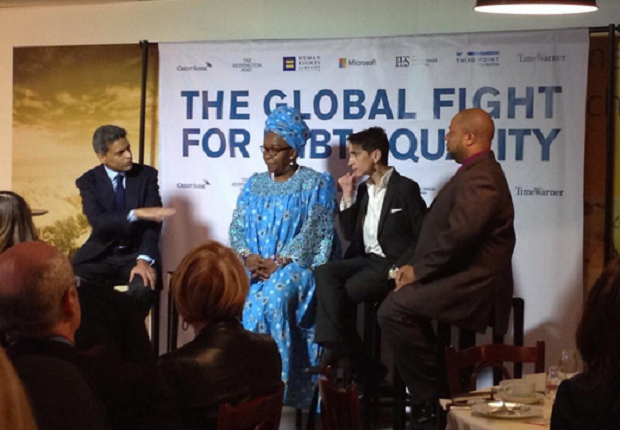
Fareed Zakaria (left) chaired two panels of LGBT activists at Davos. The first (above) consisted of Alice Nkom, Masha Gessen and Dane Lewis (Image: Twitter/@m_delamerced)
A panel of LGBT activists used the World Economic Forum last week to scrutinise recent homophobic laws passed by the Nigerian President, Goodluck Jonathan, despite rumours prior to the event suggesting it would be Putin who, for obvious reasons, would come under attack at the discussion.
Those taking part were flown into the event from around the world; Russian and American journalist Masha Gessen, Cameroonian lawyer Alice Nikom and J-FLAG Executive Director Dane Lewis were all present, as well as Human Rights Campaign President Chad Griffin, and Republican mega-donors Paul Singer and Dan Loeb.
Opening the breakfast discussion the UN High Commissioner for Human Rights Navi Pillay said: “Two weeks ago President Jonathan of Nigeria signed into law a bill that criminalises, among other things, gay wedding celebrations, any public display of any same-sex affection, as well as the operating of gay clubs, businesses or organisations, including human rights organisations that focus on protecting the rights of LGBT people.”
Held rather ironically across the street from a discussion the Nigerian President himself was currently attending, Griffin followed suit: “Just to be clear what he signed, so everyone understands it in this room, it was already illegal to be LGBT but he further legalised it. You can be in prison for 14 years for simply being a gay person.
“Each one of you here would be subject to arrest because you’re in this room today: you’d go to prison for ten years. That’s what’s happening right now in that country and I bet you most people in that room don’t know what he’s just done.”
Putin’s name did manage to crop up in conversation and, not surprisingly, it was Gessen who had something to say.
She believes the Kremlin legitimately felt the LGBT community was the one minority it could beat up without fearing a backlash from the rest of the world- how wrong they were. The international reaction may have been slow to take off, she said, but the strong global response has come as a real shock to the Russian government.
“There is a reason why we talk about human rights and there is a reason why we talk about the protection of minorities, because minorities often do have to be protected from the majority, that’s the point,” Gessen said.
The ski resort of Davos, Switzerland welcomes around 2,500 of the world’s top business leaders, politicians, intellectuals and journalists each year to talk business. The singling out of countries or politicians for criticism during the conference is unheard of, according to Politico, which referred to the forum as a “week of political calm”.
This year’s conference came under the banner The Reshaping of the World: Consequences for Society, Politics and Business. Singer and Loeb, who organised the panel, reshaped the theme into a discussion about global sexuality and equality.
Loeb said: “We’re at the World Economic Forum. They say we’re here to make the world a better place. I think we need to take care of the injustices imposed on others in our efforts to make the world a better place.”
Griffin closed the talk by looking at the future of LGBT discussions at Davos, emphasising what an incredible start the first attempt at grabbing the world’s attention at the World Economic Forum was. But there were wishes that the intimate breakfast event would one day “be in the building across the street”.
Watch the full video of the discussion here.
This article was published on 30 January 2014 at indexoncensorship.org
21 Jan 2014 | Belarus, Europe and Central Asia, News
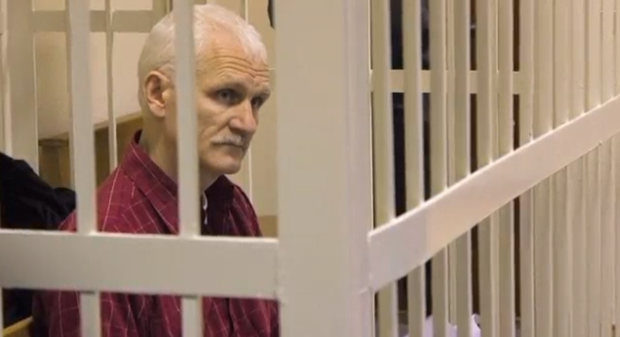
Ales Bialiatski has been imprisoned in Belarus since 2011 (Image: AmnistieWeb/YouTube)
Belarusian president Alexander Lukashenko has said in a press conference in Minsk today that human rights defender Ales Bialiatski could be released from prison soon. This came in response to Ales Lipay, editor of BelaPAN news agency, asking about the possibility of amnesty for Bialaitsky, who has been imprisoned since 2011. He is accused of evading taxes on 90,000 US dollars.
“That damage was repaid to the state long ago with citizens’ donations; there were cases in Belarus when business people who faced economic charges were released after repaying much bigger sums. In neighbouring Russia, President Putin released Mikhail Khodorkovsky who was charged with causing the state damage of 500 million US dollars,” Lipay suggested in his question.
“This is a serious argument,” Lukashenko replied. “This has nothing to do with politics or Biliatski’s views. I swear I have never known him personally […], but taxes are a sacred thing.”
According to Lukashenko, if the information about the damage allegedly caused by Bialiatski being repaid is true, amnesty can be considered. He also suggested other political prisoners, like former presidential candidate Mikalay Statkevich, can be released if they apply with a relevant plea for a presidential pardon.
“Lukashenko’s statement shows he thinks about the issue of political prisoners; he definitely aims at solving this problem without any damage to his image as a strong leader,” Tatsiana Raviaka, Bialiatsky’s colleague at the Human Rights Centre Viasna, told Index. “The reason Lukashenko might want to solve it now is reputational as well, because Belarus is hosting the Ice Hockey World Championship in 2014, and looks into ‘clearing’ its record on political prisoners.”
Raviaka says there could be a slight “warming” of the overall human rights situation in Belarus as the authorities tend to “play the liberalisation game a couple of years before the presidential elections.”
“That was the case in 2008, before the severe clampdown came in late 2010; now we can face the same period of relative easing of the situation before the 2015 campaign. I think the firm position of the EU on the release of political prisoners as a pre-condition for any dialogue with the Belarusian authorities has also played its role. Besides, I am sure Lukashenko is following the developments in Ukraine, and he sees that further ‘tightening the screws’ can lead to serious protests,” she adds.
According to Raviaka, it is possible Bialiatski could be released, as “it is entirely the issue of political will”.
Ales Bialiatski is the chair of the Human Rights Centre Viasna, and a vice president of the International Federation for Human Rights. He was arrested on 4 August 2011 and later sentenced to four-and-a-half years in prison. Despite charges of tax evasion, the country’s civil society and the international community see his prison sentence as punishment for his principled stance in support of human rights in Belarus.
This article was posted on 21 January 2014 at indexoncensorship.org
16 Jan 2014 | Europe and Central Asia, News, Ukraine
(Photo: Anatolii Stepanov / Demotix)
The Ukrainian parliament has adopted a new repressive law that seriously restricts freedom of expression and assembly, in a move the country’s civil society calls “a constitutional coup d’état”.
Law No. 3879, which enters into force tomorrow, criminalises libel (with a maximum sentence of two years of limited freedom), introduces criminal liability for “distribution of extremist materials”, allows blocking of websites and creates a Russian-style “foreign agent” definition for NGOs that use foreign funding.
Criminal liability for defamation and dissemination of extremist materials includes content posted online. The National Commission of State Regulation of Communication and Informatisation has the right to restrict access to websites “that are considered by experts to contain information that breaks the law.” Internet service providers will be obliged to buy special equipment to allow security services to monitor the internet and to restrict the access “to websites of information agencies that have no state registration.”
The law also requires mobile operators to identify SIM-cards owners; to buy a mobile contract one will have to present a passport and sign a formal contract.
The freedom of peaceful assembly is also threatened. In particular, the law forbids taking part in protests while wearing a helmet or a mask. Participating in a motorcade of five or more cars will lead to a fine and confiscation of the cars.
As the opposition tried to block the adoption of the draft law, the pro-government majority voted for the new legislative act with a simple show of hands, and without any discussion. The urgency of the law was explained by “a significant aggravation of [the] political and social crisis” in Ukraine.
“The law has been adopted by breaking all procedure rules. In fact it is a constitutional coup d’état that restricts fundamental freedoms and rights in Ukraine,” Olexandra Matviychuk, the chairperson of the Centre for Civil Liberties, told Index.
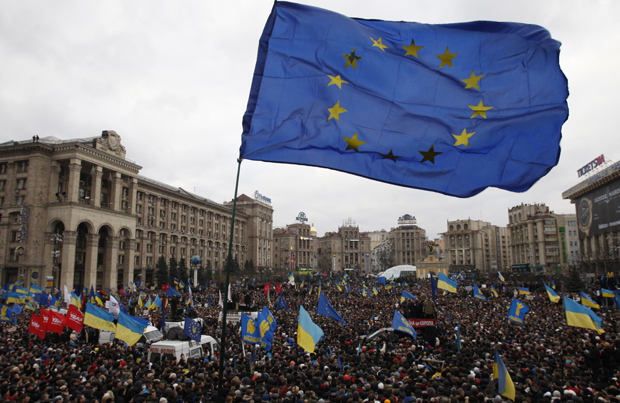
The restrictions outlined by the new law are aimed at civil society activists involved in the peaceful protests that started in Ukraine in November 2013 after the government refused to sign an association agreement with the EU.
This article was posted on 16 Jan 2014 at indexoncensorship.org
15 Jan 2014 | Europe and Central Asia, European Union, Index Reports, News, Politics and Society
This article is part of a series based on our report, Time to Step Up: The EU and freedom of expression
Beyond its near neighbourhood, the EU works to promote freedom of expression in the wider world. To promote freedom of expression and other human rights, the EU has 30 ongoing human rights dialogues with supranational bodies, but also large economic powers such as China.
The EU and freedom of expression in China
The focus of the EU’s relationship with China has been primarily on economic development and trade cooperation. Within China some commentators believe that the tough public noises made by the institutions of the EU to the Chinese government raising concerns over human rights violations are a cynical ploy so that EU nations can continue to put financial interests first as they invest and develop trade with the country. It is certainly the case that the member states place different levels of importance on human rights in their bilateral relationships with China than they do in their relations with Italy, Portugal, Romania and Latvia. With China, member states are often slow to push the importance of human rights in their dialogue with the country. The institutions of the European Union, on the other hand, have formalised a human rights dialogue with China, albeit with little in the way of tangible results.
The EU has a Strategic Partnership with China. This partnership includes a political dialogue on human rights and freedom of the media on a reciprocal basis.[1] It is difficult to see how effective this dialogue is and whether in its present form it should continue. The EU-China human rights dialogue, now 14 years old, has delivered no tangible results.The EU-China Country Strategic Paper (CSP) 2007-2013 on the European Commission’s strategy, budget and priorities for spending aid in China only refers broadly to “human rights”. Neither human rights nor access to freedom of expression are EU priorities in the latest Multiannual Indicative Programme and no money is allocated to programmes to promote freedom of expression in China. The CSP also contains concerning statements such as the following:
“Despite these restrictions [to human rights], most people in China now enjoy greater freedom than at any other time in the past century, and their opportunities in society have increased in many ways.”[2]
Even though the dialogues have not been effective, the institutions of the EU have become more vocal on human rights violations in China in recent years. For instance, it included human rights defenders, including Ai Weiwei, at the EU Nobel Prize event in Beijing. The Chinese foreign ministry responded by throwing an early New Year’s banquet the same evening to reduce the number of attendees to the EU event. When Ai Weiwei was arrested in 2011, the High Representative for Foreign Affairs Catherine Ashton issued a statement in which she expressed her concerns at the deterioration of the human rights situation in China and called for the unconditional release of all political prisoners detained for exercising their right to freedom of expression.[3] The European Parliament has also recently been vocal in supporting human rights in China. In December 2012, it adopted a resolution in which MEPs denounced the repression of “the exercise of the rights to freedom of expression, association and assembly, press freedom and the right to join a trade union” in China. They criticised new laws that facilitate “the control and censorship of the internet by Chinese authorities”, concluding that “there is therefore no longer any real limit on censorship or persecution”. Broadly, within human rights groups there are concerns that the situation regarding human rights in China is less on the agenda at international bodies such as the Human Rights Council[4] than it should be for a country with nearly 20% of the world’s population, feeding a perception that China seems “untouchable”. In a report on China and the International Human Rights System, Chatham House quotes a senior European diplomat in Geneva, who argues “no one would dare” table a resolution on China at the HRC with another diplomat, adding the Chinese government has “managed to dissuade states from action – now people don’t even raise it”. A small number of diplomats have expressed the view that more should be done to increase the focus on China in the Council, especially given the perceived ineffectiveness of the bilateral human rights dialogues. While EU member states have shied away from direct condemnation of China, they have raised freedom of expression abuses during HRC General Debates.
The Common Foreign and Security Policy and human rights dialogues
The EU’s Common Foreign and Security Policy (CFSP) is the agreed foreign policy of the European Union. The Maastricht Treaty of 1993 allowed the EU to develop this policy, which is mandated through Article 21 of the Treaty of the European Union to protect the security of the EU, promote peace, international security and co-operation and to consolidate democracy, the rule of law and respect for human rights and fundamental freedom. Unlike most EU policies, the CFSP is subject to unanimous consensus, with majority voting only applying to the implementation of policies already agreed by all member states. As member states still value their own independent foreign policies, the CFSP remains relatively weak, and so a policy that effectively and unanimously protects and promotes rights is at best still a work in progress. The policies that are agreed as part of the Common Foreign and Security Policy therefore be useful in protecting and defending human rights if implemented with support. There are two key parts of the CFSP strategy to promote freedom of expression, the External Action Service guidelines on freedom of expression and the human rights dialogues. The latter has been of variable effectiveness, and so civil society has higher hopes for the effectiveness of the former.
The External Action Service freedom of expression guidelines
As part of its 2012 Action Plan on Human Rights and Democracy, the EU is working on new guidelines for online and offline freedom of expression, due by the end of 2013. These guidelines could provide the basis for more active external policies and perhaps encourage a more strategic approach to the promotion of human rights in light of the criticism made of the human rights dialogues.
The guidelines will be of particular use when the EU makes human rights impact assessments of third countries and in determining conditionality on trade and aid with non-EU states. A draft of the guidelines has been published, but as these guidelines will be a Common Foreign and Security Policy document, there will be no full and open consultation for civil society to comment on the draft. This is unfortunate and somewhat ironic given the guidelines’ focus on free expression. The Council should open this process to wider debate and discussion.
The draft guidelines place too much emphasis on the rights of the media and not enough emphasis on the role of ordinary citizens and their ability to exercise the right to free speech. It is important the guidelines deal with a number of pressing international threats to freedom of expression, including state surveillance, the impact of criminal defamation, restrictions on the registration of associations and public protest and impunity against human right defenders. Although externally facing, the freedom of expression guidelines may also be useful in indirectly establishing benchmarks for internal EU policies. It would clearly undermine the impact of the guidelines on third parties if the domestic policies of EU member states contradict the EU’s external guidelines.
Human rights dialogues
Another one of the key processes for the EU to raise concerns over states’ infringement of the right to freedom of expression as part of the CFSP are the human rights dialogues. The guidelines on the dialogues make explicit reference to the promotion of freedom of expression. The EU runs 30 human rights dialogues across the globe, with the key dialogues taking place in China (as above), Kazakhstan, Kyrgyzstan, Tajikistan, Turkmenistan, Uzbekistan, Georgia and Belarus. It also has a dialogues with the African Union, all enlargement candidate countries (Croatia, the former Yugoslav republic of Macedonia and Turkey), as well as consultations with Canada, Japan, New Zealand, the United States and Russia. The dialogue with Iran was suspended in 2006. Beyond this, there are also “local dialogues” at a lower level, with the Heads of EU missions, with Cambodia, Bangladesh, Egypt, India, Israel, Jordan, Laos, Lebanon, Morocco, Pakistan, the Palestinian Authority, Sri Lanka, Tunisia and Vietnam. In November 2008, the Council decided to initiate and enhance the EU human rights dialogues with a number of Latin American countries.
It is argued that because too many of the dialogues are held behind closed doors, with little civil society participation with only low-level EU officials, it has allowed the dialogues to lose their importance as a tool. Others contend that the dialogues allow the leaders of EU member states and Commissioners to silo human rights solely into the dialogues, giving them the opportunity to engage with authoritarian regimes on trade without raising specific human rights objections.
While in China and Central Asia the EU’s human rights dialogues have had little impact, elsewhere the dialogues are more welcome. The EU and Brazil established a Strategic Partnership in 2007. Within this framework, a Joint Action Plan (JAP) covering the period 2012-2014 was endorsed by the EU and Brazil, in which they both committed to “promoting human rights and democracy and upholding international justice”. To this end, Brazil and the EU hold regular human rights consultations that assess the main challenges concerning respect for human rights, democratic principles and the rule of law; advance human rights and democracy policy priorities and identify and coordinate policy positions on relevant issues in international fora. While at present, freedom of expression has not been prioritised as a key human rights challenge in this dialogue, the dialogues are seen by both partners as of mutual benefit. It is notable that in the EU-Brazil dialogue both partners come to the dialogues with different human rights concerns, but as democracies. With criticism of the effectiveness and openness of the dialogues, the EU should look again at how the dialogues fit into the overall strategy of the Union and its member states in the promotion of human rights with third countries and assess whether the dialogues can be improved.
[1] It covers both press freedom for the Chinese media in Europe and also press freedom for European media in China.
[2] China Strategy Paper 2007-2013, Annexes, ‘the political situation’, p. 11
[3] “I urge China to release all of those who have been detained for exercising their universally recognised right to freedom of expression.”
[4] Interview with European diplomat, February 2013.
