3 Oct 2013 | Europe and Central Asia
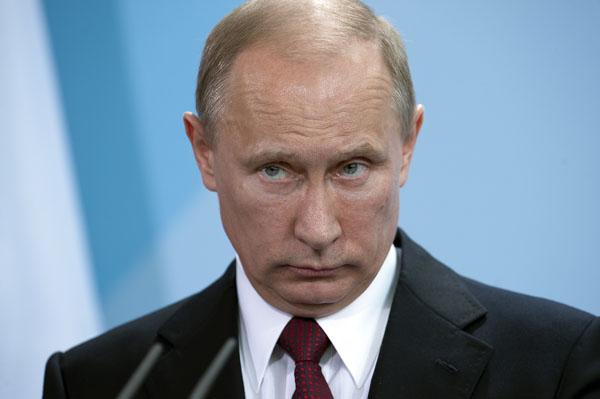
There was much raising of eyebrows yesterday when it was announced that Russia’s “International Academy of Spiritual Unity and Cooperation” are putting forward Vladimir Putin as a Nobel Peace Prize nominee. But who are the International Academy of Spiritual Unity and Cooperation.
A source suggests to Index that they are “a typical pseudo cultural organisation” that gets budgets for loyalty to Putin and is ruled by ex-Soviet nomenclature. But judging by this list of presidents, vice presidents, and Heroes of the USSR, they are very, very important people indeed. (Source)
Composition of the Management Board and the Academy
The President
Trepeznikov Shilov
First Vice-President
Gennady Zgersky,
First Vice-President
Alexander Leonidovich Manilow
First Vice-President
Topchiy Sergei Stepanovich
First Vice-President
Paul P. Petrik,
First Vice-President
Taras Shamba Myronovych,
The first vice-president
Sergei K. Kamkov.
Vice – President
Viktor Gorbatko – twice Hero of the Soviet Union (astronaut), B
Vice – President
Mikhail Tikhomirov – Advisor to the President of the Russian Olympic Committee
Vice – President
Aliyev Phase Gamzatovna folk poet of Dagestan,
Vice – President
Sergey Makarov
Vice – President
Malik – Ohanjanian Rafael Gegamovich – Branch Manager in Armenia
Vice – President
Todash Guinn, Head of the Representation in Japan
Vice – President
Yankovskaya Ludmila – Head of Representation in Ukraine
Vice – President
Bishop Vissarion – Head of Mission in Abkhazia, head of the Orthodox Church in Abkhazia,
Vice – President
Stoyan Topalov – Head of Representation in Bulgaria
Members of the Presidium
Sergei Shamba Tarasovich – Minister of Foreign Affairs of the Republic of Abkhazia.
Glebov Vladimir Vladimirovich – Academician of the Academy of Architecture.
Dadaev Gadzhievich Felix – People’s Artist of the USSR.
Antoshkin Nicholas T. – Hero of the Soviet Union.
Bepko Yegorov – Ambassador Extraordinary and Plenipotentiary (MFA).
Yuri Dubinin – Ambassador Extraordinary and Plenipotentiary (MFA).
Primakov Yevgeny Primakov – Ambassador Extraordinary and Plenipotentiary (MFA), President of the Chamber of Commerce of the Russian Federation.
Peter A. Makarov – Project Manager CNNS Russia.
Kabzon Iosif Davidovich – People’s Artist of the USSR.
Rogozhkin Nicholas E. – Deputy. Minister for the Interior Ministry, Interior Troops Commander of the Russian Federation.
Ivan Sergeyev – Ambassador Extraordinary and Plenipotentiary (MFA).
Alexander Golubev Titovich – Chairman of the RAF veterans’ organization.
Kuz’kina Galina – a journalist, deputy. chief editor of the magazine “Our Power.”
Valentin A. Prikhodko – gene. Director of the “Pride of Russia”.
Sergei Baburin, rector of the institute.
Novozhylov Valery Yu – Major – General of the Russian Federation Ministry of Internal Affairs of explosives.
Zalikhanov Michael Chukkaevich – Hero of the Soviet Union, deputy of the State. Duma
Samvel Samvel Grigoryan – Academician of the AHP.
Valentina Tereshkova – the pilot – cosmonaut.
Arthur N. Chilingarov – the hero of the Soviet Union, Hero of the Russian Federation, the deputy of the State. Duma.
Mesenzhnik Jacob Z. – Academician of the Academy of science and business.
Mikhail Vinogradov – Head of Federal Agency for Industry.
Aydarov Letcho Ayubovich – gene. manager of the “Larakas” in Moscow.
24 Sep 2013 | Campaigns, Press Releases
Nearly 40 free speech groups from across the world are calling on the European Union to take a stand against mass surveillance by the US and other governments. The groups have joined a petition organised by Index on Censorship, which has already been signed by over 3,000 people. Celebrities, artists, activists and politicians who have supported the petition include writer and actor Stephen Fry, activists Bianca Jagger and Peter Tatchell, writer AL Kennedy, artist Anish Kapoor, blogger Cory Doctorow and Icelandic politician Kolbrún Halldórsdóttir.
Actor and writer Stephen Fry said:
‘Privacy and freedom from state intrusion is important for everyone. You can’t just scream “terrorism” and use it as an excuse for Orwellian snooping.’
Chief Executive of Index on Censorship Kirsty Hughes said:
‘A few of Europe’s leaders have voiced their concerns about the NSA’s activities but none have acted. We are demanding all EU leaders condemn mass surveillance and commit to joint action stop it. People from around the world are signing this petition because mass surveillance invades their privacy and threatens their right to free speech.’
As well as calling for Europe’s leaders to put on the record their opposition to mass surveillance, the petition demands that mass surveillance is on the agenda at the next European Council Summit in October.
The petition is at: http://chn.ge/1c2L7Ty and is being promoted on social media with the hashtag #dontspyonme
The petition is supported by Index on Censorship, Amnesty International, English PEN, Article 19, Privacy International, Open Rights Group, Liberty UK, Reporters Without Borders, European Federation of Journalists, International Federation of Journalists, PEN International, PEN Canada, PEN Portugal, Electronic Frontier Foundation, PEN Emergency Fund, Canadian Journalists for Free Expression, National Union of Somali Journalists, Bahrain Centre for Human Rights, Catalan PEN, Centre for Independent Journalism (CIJ) – Malaysia, Belarusian Human Rights House, South East European Network for Professionalization of Media, International Partnership for Human Rights, Russian PEN Centre, Association of European Journalists, Foundation for the Development of Democratic Initiatives – Poland, Independent Journalism Center – Moldova, Alliance of Independent Journalists – Indonesia, PEN Quebec, Fundacja Panoptykon – Poland, International Media Support, Human Rights Monitoring Institute – Lithuania, Warsaw Branch, Association of Polish Journalists, The Steering Committee of the Civil Society Forum of the Eastern Partnership, South African Centre of PEN International, Estonian Human Rights Centre, Vikes Foundation, Finland
For further information, please contact [email protected]
6 Sep 2013 | News, Russia
Image Gonçalo Silva/Demotix
Russian president Vladimir Putin hit the headlines around the world after an interview with the Russian First Channel and the Associated Press on 4 September. His statements on Syria were given much attention, with early reports saying it meant Russia might support military intervention. In fact, Putin did not state that clearly, but pegged it to “conclusive evidence of the use of chemical weapons” by the Assad regime.
Close consideration of Putin’s recent public statements shows the same approach applied to other topics, including several human rights issues that Russia has been criticised about lately. Despite a noticeable change of the tone he prefers to give vague comments rather than well-articulated attitudes.
For instance, his reply to criticism on the law that bans “homosexual propaganda” was aimed to show Putin is tolerant to representatives of LGBT community, all the while referring to them as “such people”.
“I work with such people; sometimes I award them with medals and orders, we have absolutely normal relations, and I see nothing special about it,” said Putin in the interview without going into details on who “such people” are and what kind of “work” with Russia’s president they are involved in.
The same seemingly pleasant, but otherwise void impression was given by Putin during his meeting with a presidential Council on Development of Civil Society and Human Rights. During the meeting on 4 September Vladimir Putin put aside his macho-style image of a firm ruler.
“He suddenly appeared to be a different person, a constructive and attentive politician who is open to ideas and ready to consider them,” Andrey Yurov, a Russian human rights defender who is a member of the Council told Index. “He was listening carefully to suggestions about reforming of penal and judiciary systems, adjustments to internet regulations and public control of the state bodies, and reacted with comments like ‘Oh, this is interesting’, ‘We really need to look into that’ or ‘We might need to create a working group on this’. He did not say ‘yes, we will definitely do it’ to any of our suggestions, but at least he did not say a firm ‘no, we won’t do it’ to anything.”
Vladimir Putin even admitted the notorious NGO “foreign agents” law might need to be re-assessed. The law, adopted a year ago, forced all non-governmental organisations that receive funds from abroad to register as “foreign agents” if they are involved in “political activities”. The problem with the law, as many experts and civil society groups have pointed out, is its extremely broad definition of what constitutes a political activity. During the meeting with human rights defenders President Putin said it might be re-defined and narrowed.
“It is difficult to say if it marks a reboot of an attitude of the state towards the civil society and whether any real steps are to follow. But it was a constructive conversation between a rational politician and civil society. Perhaps it has to do with the G20 summit in St. Petersburg; Putin needs to show he is an open leader and he is in touch with civil society of his country,” recons Andrey Yurov.
Yury Dzibladze, the president of the Centre for the Development of Democracy and Human Rights, does not believe Putin’s statement signal any change.
“There are no signs of real improvement of the situation with human rights and civic freedoms inside the country. Criminal cases against political opponents are on-going; inspections of NGOs in line with the ‘foreign agents’ law continue. The rhetoric might change, but it only means the authorities want to improve their image abroad, not alter the situation in Russia itself. It might be connected with the G20 summit and up-coming winter Olympics they do not want foreign politicians to boycott,” said Yuri Dzhibladze.
5 Sep 2013 | Africa, Europe and Central Asia, France, Italy, News, Russia, South Africa, United States
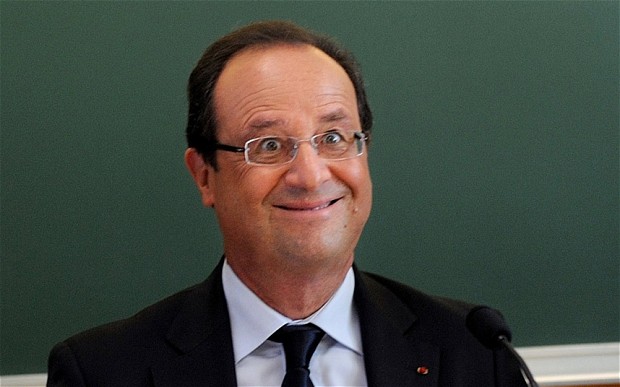 French news agency AFP has been caught up in a self-censorship row after attempting to retract a photo of President Francois Hollande flashing a gormless smile. The whole debacle has gone viral, forcing AFP to make a statement denying they had caved to government pressure. Rather, they cited internal editorial guidelines ‘not to transmit images that gratuitously ridicule people.’ However, politicians are not strangers to banning (or trying to ban!) images that makes them look a bit silly.
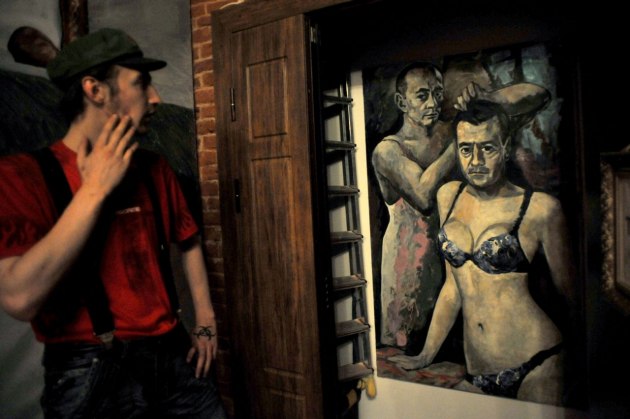 You’d think that Vladimir Putin, used to being in the public eye, captured in completely random and non-staged situations like this, wouldn’t mind being the inspiration for some fine art. That turned out not to be the case when a St Petersburg gallery exhibited a painting of Putin and PM Dmitry Medvedev – the former sporting a fetching pink negligee, the latter a black lace push-up bra. Russian police raised the gallery and removed the picture in question, as well as three others depicting Russian political leaders. The reason given was that the imagines ‘violate existing legislation’.
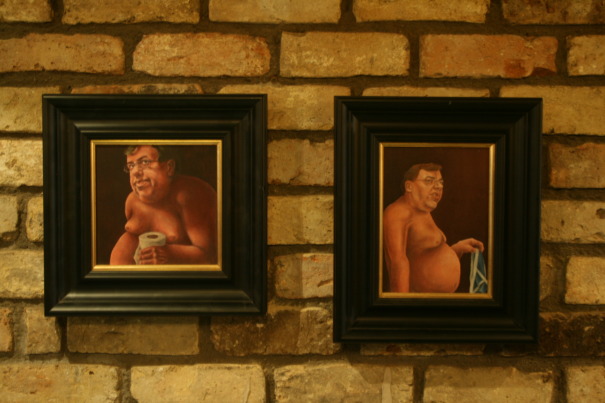 Back in 2009, artist Conor Casby painted two pictures of former Irish taoiseach Brian Cowen sitting on a toilet naked. He then hung them on the walls of the National Gallery and the Royal Hibernian Gallery in Dublin, and broadcaster RTE made a short piece about it. The outcome? RTE had to issue a formal apology and remove the item from its online archive. Meanwhile, the police launched a country wide manhunt for Casby. He had to hand over five more paintings to the police and faced potential charges of indecency, criminal damage and incitement to hatred. All for making a politician the butt of his joke.
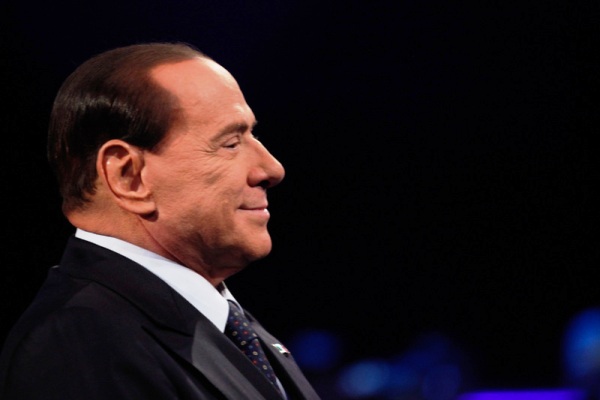 In 2002, former Italian Prime Minister Silvio Berlusconi was accused of censoring a play putting him and his compatriots in an unfavorable light. Renowned theatre director Luca Ronconi used caricature pictures of Berlusconi and two other ministers as props in his production of Greek comedy “The Frogs.” Ronconi said officials from ruling party Forza Italia tried to make him remove the pictures from stage. Berlusconi, on the other hand, stated that while the pictures ‘didn’t please him’: ‘The government, the whole government, doesn’t even know what censorship is.’
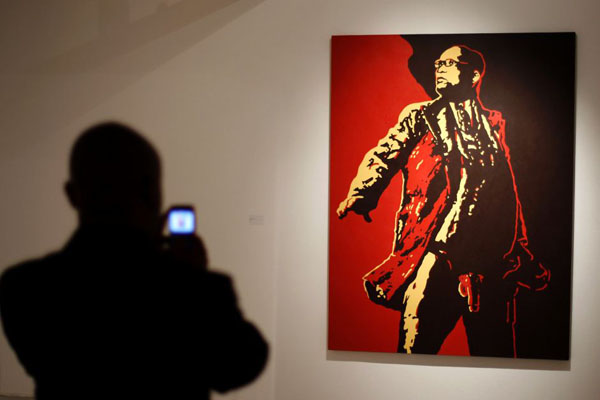 South African President Jacob Zuma caused quite a stir when he demanded that a painting of him be removed from Johannesburg’s Goodman Gallery. ‘The Spear’ was in the style of portraits of revolutionary leaders, but for small fact that his, um, spear, was hanging out. He also wanted City Press newspaper to remove a photo of it from their website. When both refused, Zuma’s party the ANC declared they would take the gallery to High Court and called for a boycott of City Press. Finally, a couple of ANC supporters were caught on tape defacing the painting. Taking the matter of The Spear into their own hands, some might say (sorry).
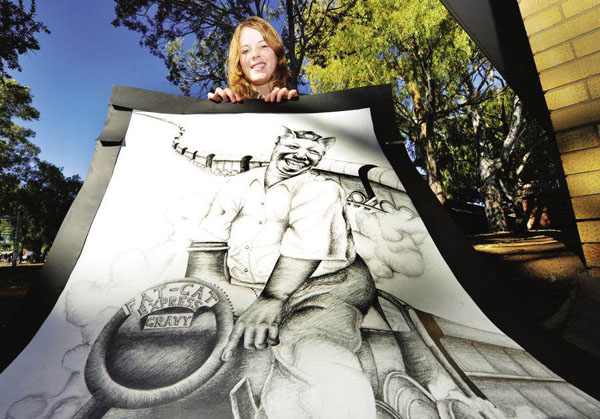 At least it seems the future leadership of the ANC is getting some training in dealing with awkward art-related stories of their own. Bloemfontein student Alta Bonnet (17) was told her painting depicting former ANC Youth leader Julius Malema ‘as a fat cat on a gravy train’ might not be exhibited at a city art show. The picture was deemed ‘too political’.
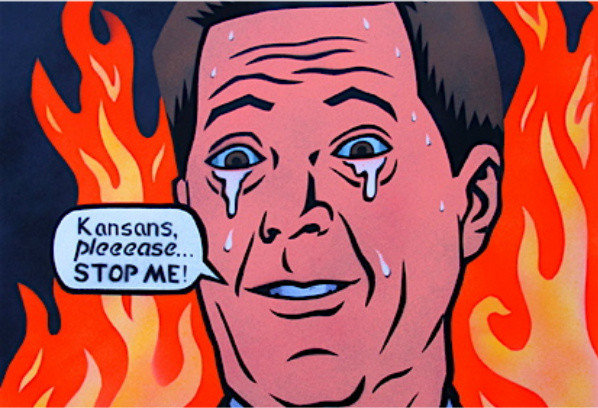 Kansas artist Dave Loewenstein last year had his picture of Governor Sam Brownback removed from a cafe in the state’s capital Topeka. The picture is a cartoon depiction of the governor, with the words ‘REJECT BROWNBACK’ printed on. Loewenstein said the picture was in protest at Brownback’s policies and not him personally. Greg Ready, the landlord of the building, said they had chosen to remove the painting because Brownback’s daughter worked at the cafe in question, adding ‘there was no political motivation for this action whatsoever.’
But you could understand Brownback being a little thin skinned – this wasn’t the first time he had been viciously attacked. In 2011, when his office took note of a tweet by High School student Emma Sullivan (18), her principal demanded she write an apology letter to the governor. The tweet? “Just made mean comments at gov. brownback and told him he sucked, in person (hash)heblowsalot.” Scathing.
Have we missed any? Let us know in the comments!
