29 Oct 2012 | Russia
MOSCOW. 29 October 2012 (INDEX).
Earlier this month a Moscow court freed Ekaterina Samutsevich, one of three imprisoned women from Russian punk band Pussy Riot but upheld the two-year jail term handed down to her bandmates. Samutsevich, Maria (Masha) Alekhina and Nadezhda (Nadya) Tolokonnikova were convicted of hooliganism in August after staging a “punk prayer” in a Moscow cathedral to protest the Russian Orthodox Church leader’s support for the president Vladimir Putin ahead of the Russian presidential election. The band’s conviction came amid a wider crackdown on dissent, which has included tighter controls on media, moves towards internet censorship and the harassment and arrest of opposition activists and civil society.

Freed Pussy Riot member Ekaterina Samutsevich
Samutsevich — also known as Katya — believes everyone has social and political responsibility, and that artists have the power to make “people understand problems they couldn’t see before.” And exercising that responsibility is how Katya got in trouble.
In a week where her comrades were sent to harsh prison camps in remote Russian regions, Samutsevich gave this exclusive telephone interview to Elena Vlasenko, Index on Censorship’s Russia correspondent, and assured her Pussy Riot is here to stay.
INDEX: You were given a suspended sentence on appeal after you alone switched lawyers. The judge’s decision hung on the fact you were ejected from the cathedral before being able to perform but your friends remain in prison. Are the rumours about a split in the group true?
Ekaterina Samutsevich: All the talk about divisions in Pussy Riot are the authorities’ attempt to spin the situation. We definitely didn’t expect my release on probation, [we] thought the sentence would not change. Anyway, this is a victory for all of us … one person out of three is released, or at least on a suspended sentence. Nadya and Masha hugged me and congratulated [me] on this.
INDEX: Why did you switch lawyers? Who disliked your previous lawyer Violetta Volkova most — you or the judge?
ES: Prisoners sometimes change lawyers several times per trial, and that’s ok. I don’t really want to emphasise it, like some media do, that is why I prefer not to comment on the issue.
INDEX: How did you say goodbye to Nadya and Masha? Are you managing to stay in touch?
ES: We wished all the best to each other. We used to write each other letters almost every day before their departure to the penal colonies, but now it’s hard to communicate.

Feminist punk band Pussy Riot
INDEX: You filed an appeal to European Court of Human Rights saying your prosecution and detention violated article 10 of the European convention — free expression — and article 3 — prohibition of torture. Why article 3?
ES: We consider ourselves innocent and the very fact of our detention illegal. The court obviously wanted us exhausted. We were woken up every day at 6am and taken to the court at about 9am, no matter what time the proceedings started. Sometimes we had to wait several hours in a room under convoy before we finally got to the courtroom. The same waiting happened after the proceedings. We spent several hours under convoy waiting for a car, and another hour — in front of the pretrial prison gate. We entered the cell at about 1am. The next day we had to get up at 6am; every day of the proceedings would be the same. Before the proceedings we had to come to the court every morning to familiarise ourselves with the case … We spent two and a half weeks on this schedule.
As a rule, if a case isn’t big — normally criminal cases run to tens of volumes, and ours was only seven — the court holds proceedings once a week. But not this time. From our perspective, the rush was deliberate so that we were too tired to understand what was going on during the proceedings. I was so exhausted once we had to call the ambulance. And the doctors had to give Masha an injection as her blood sugar level dropped dramatically and she was awfully dizzy.
It was torture for us.
INDEX: One could see how physical and rude the bailiffs were to you after the judge ruled. Why?
ES: They were extremely rude and very rough while escorting us to the car: they twisted our arms, for example, maybe so that we couldn’t wave to our supporters. This rudeness is typical towards any person in handcuffs in Russia.
INDEX: Other members of Pussy Riot who remain in hiding told Index on Censorship if they could turn back time they would still repeat the punk prayer. Would you?
ES: Nobody expected the arrests. Punk prayer is not a crime, besides, we successfully left the cathedral without being detained. Of course, we would repeat our prayer: we can’t stay silent … But we would definitely sing the song to the end, the guards didn’t let us that time. I personally would prefer to stay in the cathedral for all the song’s duration, not just 15 seconds.
INDEX: From your perspective what event changed Russia, making it once again the kind of country where controversial trials, like yours, are possible — Putin’s presidency, the Chechen war, the 1996 elections? What was the point of no return?
ES: I don’t think there was a point at all. There are many factors, and one of the most important one is the authorities’ policy towards culture and education. The prerequisites appeared long ago — there was no freedom of expression in the Soviet era — but the situation began worsening sharply when Putin came to power.
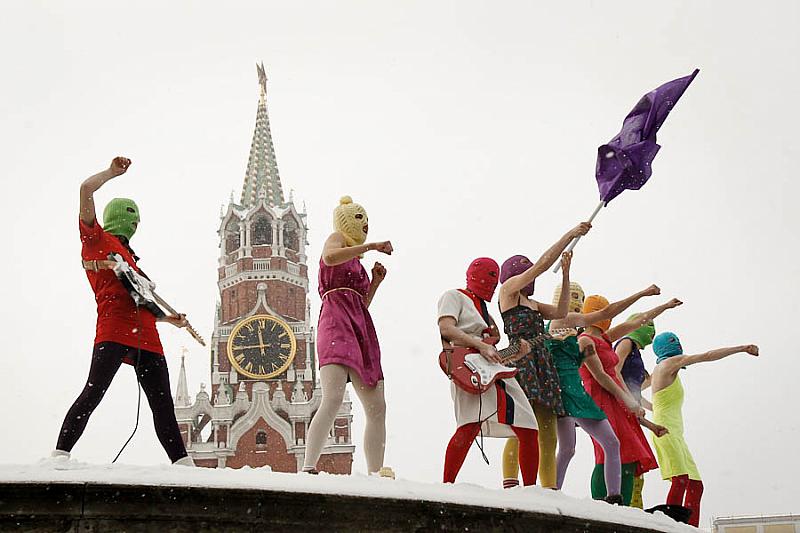
Members of Pussy Riot performing in Moscow’s Red Square
People don’t have opportunities to learn about modern art, culture and civil politics. They think politics is a number of high ranking people who sit in their offices. Citizens don’t see themselves as part of policy making, because they simply don’t know they have the right and means to become part of the process. The lack in education leads to the lack of civil protest culture. As a result they play by the rules dictated by authorities.
The only solution is education and self-education, which is becoming more possible because of the internet. The internet is indeed our rescue – as a source of education. The second most important thing is a will to unite, like the lesbian, gay, bisexual, and transgender activists or ecologists recently did. It is important not to count on one leader who will save everyone. There won’t be one, and there shouldn’t be. Pussy Riot is against leaders, we stand for more complex structures of civil communities.
INDEX: Western artists and intellectuals supported you more vocally than those in your own country. Has Pussy Riot suffered for the growing political indifference of Russia’s intellectuals and the artistic community?
ES: Pussy Riot does pay for this. But not only for intellectuals and people of art, but for the whole country’s political indifference. But we should take political pressure and censorship into account. We don’t have art communities which are 100 per cent independent of the authorities.
INDEX: Pussy Riot stands for political art. Does that mean you believe artists have a responsibility to speak out?
ES: Yes, of course, but it is not just artists that have social and political responsibility. Every person is responsible for seeing what surrounds them and for expressing concerns over it. Citizens are provided with power by the constitution and they have a right to influence the situation in a country. That’s what they should do, especially artists. They have the power and knowledge to communicate serious issues in clear, efficient ways which make other people understand problems they couldn’t see before.
INDEX: When will you achieve your goals and stop performing? What is the perfect future for Russia – one where Pussy Riot is no longer needed?
ES: This will happen years from now; now the government is only intensifying repressions. The current power should change the model of its behaviour. People should form a strong and active civil society, which will influence and dominate the authorities — the opposite of what we have now… So we will continue fighting.
29 Oct 2012 | Europe and Central Asia, News, Religion and Culture, Russia
MOSCOW. 26 October 2012 (INDEX).
Earlier this month a Moscow court freed Ekaterina Samutsevich, one of three imprisoned women from Russian punk band Pussy Riot but upheld the two-year jail term handed down to her bandmates. Samutsevich, Maria (Masha) Alekhina and Nadezhda (Nadya) Tolokonnikova were convicted of hooliganism in August after staging a “punk prayer” in a Moscow cathedral to protest the Russian Orthodox Church leader’s support for the president Vladimir Putin ahead of the Russian presidential election. The band’s conviction came amid a wider crackdown on dissent, which has included tighter controls on media, moves towards internet censorship and the harassment and arrest of opposition activists and civil society.

Pussy Riot member Ekaterina Samutsevich sits in a glass cage at a court room in Moscow, August 2012. Maria Pleshkova | Demotix
Samutsevich — also known as Katya — believes everyone has social and political responsibility, and that artists have the power to make “people understand problems they couldn’t see before.” And exercising that responsibility is how Katya got in trouble.
In a week where her comrades were sent to harsh prison camps in remote Russian regions, Samutsevich gave this exclusive telephone interview to Elena Vlasenko, Index on Censorship’s Russia correspondent, and assured her Pussy Riot is here to stay.
INDEX: You were given a suspended sentence on appeal after you alone switched lawyers. The judge’s decision hung on the fact you were ejected from the cathedral before being able to perform but your friends remain in prison. Are the rumours about a split in the group true?
Ekaterina Samutsevich: All the talk about divisions in Pussy Riot are the authorities’ attempt to spin the situation. We definitely didn’t expect my release on probation, [we] thought the sentence would not change. Anyway, this is a victory for all of us … one person out of three is released, or at least on a suspended sentence. Nadya and Masha hugged me and congratulated [me] on this.
INDEX: Why did you switch lawyers? Who disliked your previous lawyer Violetta Volkova most — you or the judge?
ES: Prisoners sometimes change lawyers several times per trial, and that’s ok. I don’t really want to emphasise it, like some media do, that is why I prefer not to comment on the issue.
INDEX: How did you say goodbye to Nadya and Masha? Are you managing to stay in touch?
ES: We wished all the best to each other. We used to write each other letters almost every day before their departure to the penal colonies, but now it’s hard to communicate.
INDEX: You filed an appeal to European Court of Human Rights saying your prosecution and detention violated article 10 of the European convention — free expression — and article 3 — prohibition of torture. Why article 3?
ES: We consider ourselves innocent and the very fact of our detention illegal. The court obviously wanted us exhausted. We were woken up every day at 6am and taken to the court at about 9am, no matter what time the proceedings started. Sometimes we had to wait several hours in a room under convoy before we finally got to the courtroom. The same waiting happened after the proceedings. We spent several hours under convoy waiting for a car, and another hour — in front of the pretrial prison gate. We entered the cell at about 1am. The next day we had to get up at 6am; every day of the proceedings would be the same. Before the proceedings we had to come to the court every morning to familiarise ourselves with the case … We spent two and a half weeks on this schedule.
As a rule, if a case isn’t big — normally criminal cases run to tens of volumes, and ours was only seven — the court holds proceedings once a week. But not this time. From our perspective, the rush was deliberate so that we were too tired to understand what was going on during the proceedings. I was so exhausted once we had to call the ambulance. And the doctors had to give Masha an injection as her blood sugar level dropped dramatically and she was awfully dizzy.
It was torture for us.
INDEX: One could see how physical and rude the bailiffs were to you after the judge ruled. Why?
ES: They were extremely rude and very rough while escorting us to the car: they twisted our arms, for example, maybe so that we couldn’t wave to our supporters. This rudeness is typical towards any person in handcuffs in Russia.
INDEX: Other members of Pussy Riot who remain in hiding told Index on Censorship if they could turn back time they would still repeat the punk prayer. Would you?
ES: Nobody expected the arrests. Punk prayer is not a crime, besides, we successfully left the cathedral without being detained. Of course, we would repeat our prayer: we can’t stay silent … But we would definitely sing the song to the end, the guards didn’t let us that time. I personally would prefer to stay in the cathedral for all the song’s duration, not just 15 seconds.
INDEX: From your perspective what event changed Russia, making it once again the kind of country where controversial trials, like yours, are possible — Putin’s presidency, the Chechen war, the 1996 elections? What was the point of no return?
ES: I don’t think there was a point at all. There are many factors, and one of the most important one is the authorities’ policy towards culture and education. The prerequisites appeared long ago — there was no freedom of expression in the Soviet era — but the situation began worsening sharply when Putin came to power.
Members of Pussy Riot performing in Moscow’s Red Square
People don’t have opportunities to learn about modern art, culture and civil politics. They think politics is a number of high ranking people who sit in their offices. Citizens don’t see themselves as part of policy making, because they simply don’t know they have the right and means to become part of the process. The lack in education leads to the lack of civil protest culture. As a result they play by the rules dictated by authorities.
The only solution is education and self-education, which is becoming more possible because of the internet. The internet is indeed our rescue – as a source of education. The second most important thing is a will to unite, like the lesbian, gay, bisexual, and transgender activists or ecologists recently did. It is important not to count on one leader who will save everyone. There won’t be one, and there shouldn’t be. Pussy Riot is against leaders, we stand for more complex structures of civil communities.
INDEX: Western artists and intellectuals supported you more vocally than those in your own country. Has Pussy Riot suffered for the growing political indifference of Russia’s intellectuals and the artistic community?
ES: Pussy Riot does pay for this. But not only for intellectuals and people of art, but for the whole country’s political indifference. But we should take political pressure and censorship into account. We don’t have art communities which are 100 per cent independent of the authorities.
INDEX: Pussy Riot stands for political art. Does that mean you believe artists have a responsibility to speak out?
ES: Yes, of course, but it is not just artists that have social and political responsibility. Every person is responsible for seeing what surrounds them and for expressing concerns over it. Citizens are provided with power by the constitution and they have a right to influence the situation in a country. That’s what they should do, especially artists. They have the power and knowledge to communicate serious issues in clear, efficient ways which make other people understand problems they couldn’t see before.
INDEX: When will you achieve your goals and stop performing? What is the perfect future for Russia – one where Pussy Riot is no longer needed?
ES: This will happen years from now; now the government is only intensifying repressions. The current power should change the model of its behaviour. People should form a strong and active civil society, which will influence and dominate the authorities — the opposite of what we have now… So we will continue fighting.
24 Oct 2012 | Digital Freedom, News
 The more we live our lives online, the greater the temptation for governments and private companies to spy on us. Padraig Reidy highlights the dark side of our increasing dependence on digital communications
(more…)
19 Oct 2012 | Uncategorized

A peaceful protest against the Innocence of Muslims in London – Brian Minkoff/Demotix
The Innocence of Muslims controversy put a spotlight on whether offensive online content should be censored or criminalised, as violence in Egypt, Libya and beyond meant many were tempted to argue for the removal of the video from the web.
Most states have laws to control clear and direct incitements to violence; but causing offence is neither an incitement to violence nor a reason to respond with violence. Yet since the initial protests, many countries have queued up to ask Google to block the offending video. Google initially blocked it in Egypt and Libya without even a government request, and then unblocked it.
Should companies, rather than governments, ever be the censors — arbiters of acceptability? Is it more palatable if companies are served with court orders to block access to Internet content? Or that, in keeping with its policy to abide by local laws, Google blocked the video in India and Indonesia because it was ruled illegal?
But more importantly, has a clear line been drawn between the direct incitement to violence (which should absolutely not be protected as free speech) and whether people choose to respond with violence to something they find offensive?
Rwanda is often cited as a case where the balance between safeguarding free speech and preventing violence is particularly relevant, given the severe ethnic conflicts resulting in the 1994 genocide following callings for violence. Local officials and government-sponsored radio incited ordinary citizens to kill their neighbours, and those who refused to kill were often murdered on the spot. The genocide-inciting radio broadcasts shouldn’t have been allowed. There is a clear dividing line.
But The Innocence of Muslims is not in the same category. And if Internet censorship is used because there is crowd violence — and in anticipation of violence, where does it end?
“The big story here is the crack-down on the Internet” William Echikson told me in a telephone interview from Brussels. “The pressures have grown dramatically. And we are doing our best to protect free expression. ”
Echikson is Head of Free Expression Policy and PR, Europe, Middle East & Africa at Google.
According to different reports, Innocence of Muslims was also blocked in India, Indonesia and Saudi Arabia as a result of court orders. Google also blocked the video in Malaysia after receiving an official complaint from the Communications and Multimedia Commission, according to AFP. Reporters without Borders said the video was also blocked in Kyrgyzstan, Kazakhstan and Russia via court orders on grounds of being “extremist”. And in Pakistan, it was blocked by the Prime Minister Raja Pervez Ashraf, who issued a directive to the Ministry of Information Technology.
The key, original censors here seem to be violent demonstrators and restrictive governments. Of the 150 countries where Google operates, in about 30 its service has been “affected one way or the other”, adds Echikson.
Governments are indeed cracking-down on the web, either because they already censor blasphemous and other offensive material (even without any likelihood of violence) or because they are giving in to actual or threatened violence. But if governments continue doing that, couldn’t it become an incentive for any fanatical group to threaten or act violently, and get censorship as a result? Isn’t this very similar to the mechanisms of terror: you terrorise or hurt one to scare a thousand?
That is why it is so vital that everyone understands the difference between incitement to violence, and violence in response to offense, an idea that, weeks after the video furore, has vanished from the agenda.
A country such as China may shed some light on where we are heading.
After a series of huge protests and ethnic riots (many of which were organised using instant messaging services, chat rooms, and text messages), China is reported to have intensified its efforts to neutralise online criticism. According to Amnesty, China has the largest number of imprisoned journalists and cyber-dissidents in the world, while the number of “Internet police” is rumoured to be higher than 30,000.
The reason for all this political censorship.
Many of the violent reactions to The Innocence of Muslims were for political reasons, using offence as an excuse. In fact, some analysts and US officials have reported that Benghazi attack of 11 September, which killed the US ambassador to Libya, appeared to have been planned in advance, and had nothing to do whatsoever with the video.
So for the Internet, where does all this end? With the annihilation of McLuhan’s global village and the beginning of a new era of of separate, isolated, over-scrutinised, parochial Internets.
Miren Guitierrez is editorial director of Index on Censorship
