26 Feb 2014 | Europe and Central Asia, News, Russia
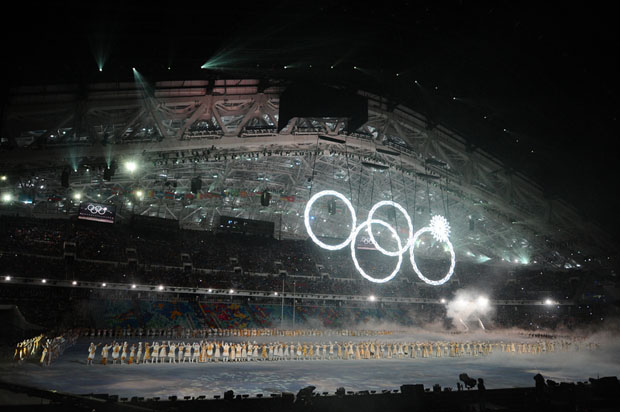
1. The fifth ring malfunction
(Image: Jaroslav Francisko/Demotix)
The lighting rig which proudly illuminated one less Olympic ring than it should have caused considerable embarrassment for the Russian organisers of the opening ceremony, as Sochi 2014 opened its gates to the athletes. Known as the “stubborn snowflake” Russian viewers at home were greeted with footage from the Opening Ceremony rehearsal, so they were none the wiser. The Russians later showed their funny side by only featuring four rings in the Closing Ceremony performance.
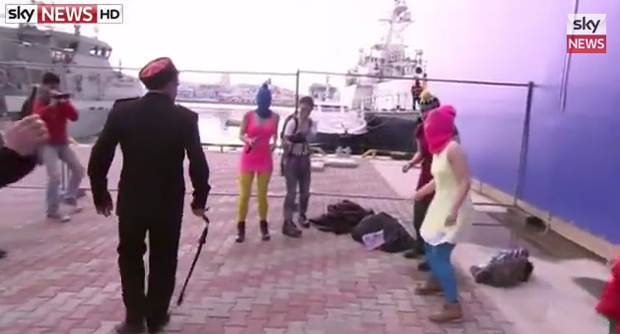
2. Pussy Riot getting whipped in the face
(Image: Sky News/YouTube)
While pre-emptive arrests meant many activists were unable to protest at all, five members of the punk group Pussy Riot and their cameraman were attacked by Cossack security patrols as they performed under a sign advertising the Winter Olympics.
Footage showed Cossack security staff whipping band members, pulling off their ski masks, and throwing them to the ground.
Russian deputy prime minister Dmitry Kozak dismissed the attacks: “The girls came here specifically to provoke this conflict,” he explained. “They had been searching for it for some time and finally they had this conflict with local inhabitants.”
While the international media covered the face-whipping incident in fairly minute detail, Russian press clippings about the arrest are hard to come by. Pussy Riot’s previous stunt in Moscow’s main cathedral, which landed them with a jail sentences and heavy fines, have already been scrubbed from the internet.
3. Justin Kripps’ website
(Image: @justinkripps/Twitter)
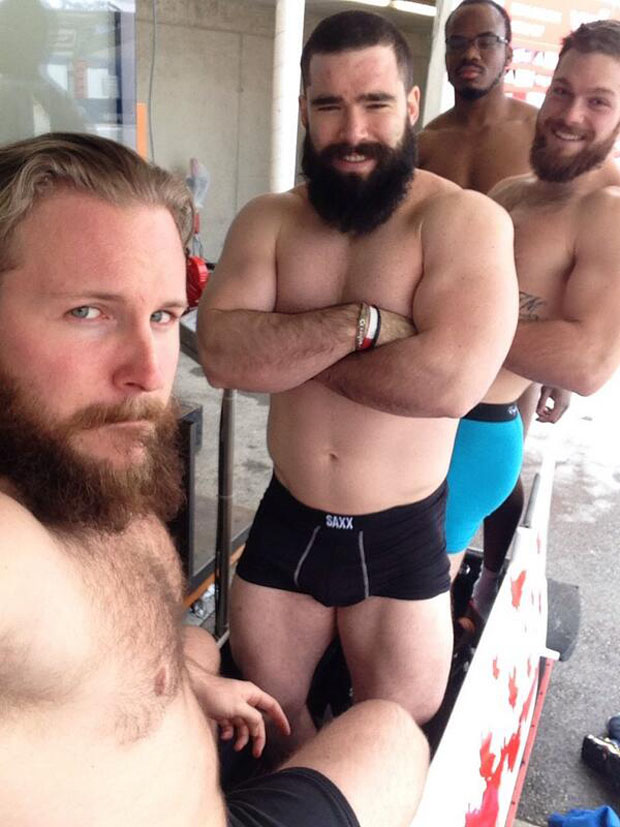
Russian fans hoping to keep updated by the Canadian bobsleigher’s website were disappointed, as Russian censorship authorities blocked access to it. It’s still unclear why, but it may be linked to a risque photo Kripps tweeted a month prior to the Games. The snap featured his burly four-man bobsled team in their underwear at a weigh in. The photo went viral, in particular within the gay community.
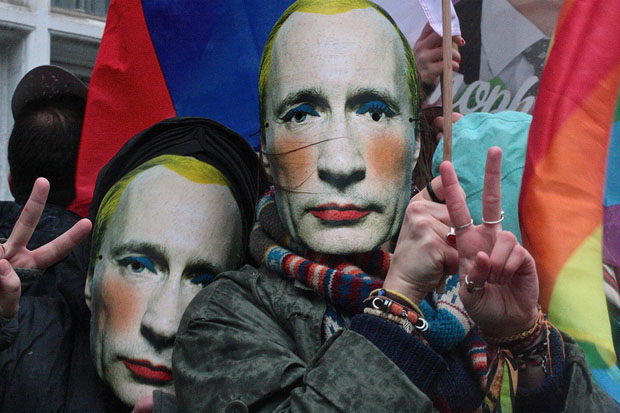
4. Almost every story about corruption, gay-bashing, forcible evictions and the environment
(Image: Heather Blockey/Demotix)
While the run-up to Sochi might have been dominated by negative stories in the Western media, with tales of homophobia, corruption and environmental destruction, local journalists had to be a lot more cautious when reporting the “true” face of Sochi. Strict surveillance measures were imposed on all journalists’ emails, social media and internet use – to keep any negative stories from breaking.
“It seems to me that some of these surveillance measures were conscientiously made public … to send a message,” commented investigative journalist and security services expert Andrei Soldatov while at the Games.
Self-censorship, he says, has become a “big problem” among local reporters and investigative journalists – who often felt scared to report on the wider political context of Putin’s games. “There are some fears that Sochi was a test ground … these kind of measures may be made commonplace in other parts of Russia,” he added.
BONUS: And…Russians accuse US of censorship and malicious media bias
(Image: Screenshot)
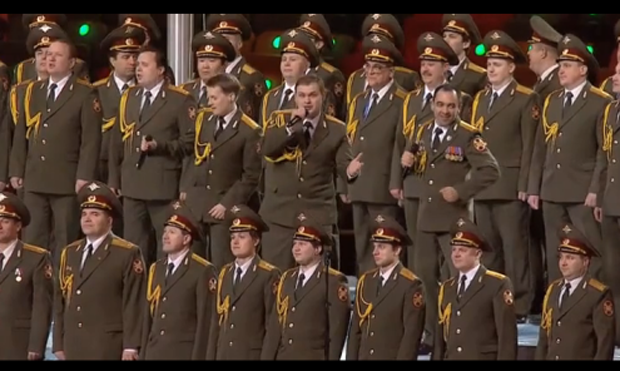
Censorship during NBC’s coverage of the Opening Ceremony included missing out a live performance by girlband t.A.T.u, omitting a Russian police choir performing Daft Punk’s “Get Lucky,” deleting Communist-themed vignettes, and failing to air a congratulatory speech by IOC chief Thomas Bach, praising the Russians. Russian media whooped with glee when the hashtag #NBCFail started trending on Twitter in response to the censorship.
American magazine The Nation published a rare honest analysis of the American media’s vitriol against Russia, noting that even before the Games began, the Washington Times had written off the venues as a “Soviet-style dystopia” and warned in a headline, “TERRORISM AND TENSION, NOT SPORTS AND JOY.”
Provocative BuzzFeed headlines like “Photographic Proof That Sochi Is A Godforsaken Hellscape Right Now” and the Twitter account @SochiProblems, provoked outrage in Russia. One Russian netizen took such offence with @SochiProblems that he travelled to London and created his own photo tour of the city “in Sochi style”. “The Other Side of London, where the guided tours don’t go” is a depressing trip through some of London’s worst outer districts. The results (translated from Russian) make for sombre viewing, tinged with humour.
The infamous double toilet in Sochi also has a doppelganger in London, as one Russian Instagram user, living in the capital, proved. The side-by-side facilities, identical to the toilets which athletes had endlessly mocked in the Olympic village, were installed in a typical upmarket hipster cocktail bar.
This article was posted on 25 February 2014 at indexoncensorship.org
6 Feb 2014 | News, Religion and Culture, Russia
Human Rights Watch released a video documenting the treatment of LGBT Russians on 3 February ahead of the opening of the Sochi Winter Olympics.
Drawing a screen around the realities of life for Russian gays and lesbians, Russian president Vladimir Putin and the organizers of the Sochi Winter Olympic games are presenting a decidedly friendly face to international visitors.
Even though Sochi’s mayor, Anatoly Pakhomov, would prefer to believe “there are no gays” in his city, the mayor of the Olympic village, Elena Isinbayeva, offered to make LGBT athletes to feel welcome — despite her earlier homophobic comments. The girl band Tatu, most popular during the early 2000s when they exploited homoeroticism in their live appearances and videos, will perform at the opening ceremonies.
The real Russia has turned ugly and brutish toward its LGBT citizens.
The recent spate of homophobic violence has its roots in a controversial law that bars the promotion of non-traditional relationships as being equal to traditional relationships. While the law’s backers say they are protecting children, the effect has been to silence the push for gay rights by threatening fines for “homosexual propaganda.”
While official Russia will be demonstrating what it sees as tolerance in Sochi, a court in the city of Nizhniy Tagil will issue a ruling on the case of Elena Klimova – a young journalist who created a group on Vkontakte – Russia’s answer to Facebook. Klimova’s group, Children 404, contains letters from young LGBT people, who have been subject to physical and psychological attacks. Their letters to each other, according to Klimova, have been helping them cope with the pressure and continuing struggle for their rights. Klimova’s efforts to ease the isolation of LGBT children has drawn the ire of United Russia’s Vitaly Milonov, a proponent of the gay propaganda law, who has sued Madonna and been exposed as a bigot by Stephen Fry.
Klimova has also been active in raising concerns about the plight of a teen girl in the Bryansk region who has been put under administrative control by a local juvenile commission. Her crime? The girl openly identified “herself as a person with non-traditional sexual orientation and promote[d] information which misinforms minors about social equality of traditional and non-traditional relationship”. She will be monitored as if she were a criminal.
According to the latest Levada-Centre research, some 43% of Russian citizens consider homosexuality a bad habit, 38% reckon LGBT people should be “cured”, 47% say LGBT and heterosexuals are not socially equal and 73% approve the state’s effort to prevent public professions of an LGBT orientation.
The Russian Orthodox Church has done a lot to maintain these numbers.
Patriarch Kirill has repeatedly condemned equal marriage, saying in late January that marriage is “between a man and a woman, based on love, aimed at having children”. Kirill asked law makers to reflect his belief in drafting laws. Moscow Patriarchate’s spokesman Vladimir Legoida called equal marriage and homosexuality a sin in an interview to RIA-Novosti – the former Russian state news agency. Not to be outdone, Ivan Okhlobystin, an actor and former priest, said “gays should be burnt in ovens”.
In the meantime, on 3 February, the regional court of Kamchatka sentenced three people to 9-12 years in prison for the murder of a gay acquaintance.
Homosexuality was decriminalized in Russia in 1993. In 1999 it finally was excluded from Russian official list of mental illnesses. The change in people’s mind is still yet to come.
This article was originally published on 6 February 2014 at indexoncensorship.org
5 Feb 2014 | News, Russia
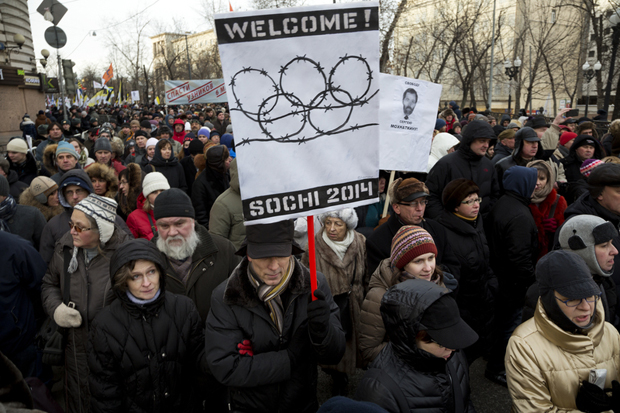
Several thousand protesters marched through central Moscow on 2 February 2014 to call for the release of 20 people who were arrested after clashes between police and demonstrators on 6th May of 2012. Photo: Nickolay Vinokurov / Demotix
Media will face increased restrictions in the build up to the Winter Games in Sochi as Russian president Vladimir Putin tries to rehabilitate a damaged domestic reputation, experts suggest.
Tighter controls on dissident media, more proactive use of state news outlets to mold public consensus, and obstacles to foreign reporters operating in the region can all be expected as the games begin on 7 February.
While Russian authorities have hailed the Games as a triumph, ongoing disputes over the payment of migrant workers, the environmental impact of Sochi’s intensive development, forced evictions of residents, intensive security measures, and Russia’s controversial gay propaganda law have all generated a domestic backlash that many believe is being deliberately ignored by state media. On 17 October, 2013, Roman Kuznetsov, a migrant worker from the Russian city of Orenburg who had helped build the Media Centre for the Sochi Olympic Games, sewed his lips shut with a needle and thread in protest against his employer’s failure to pay him several months of wages. He carried a sign that explained “Please help get reporters attention! I am not from around here”.
In an interview with select global media, Putin explained “I would like the participants, guests, journalists and all those who watch the Games on TV and learn about them from the mass media to see a new Russia, see its personality and its possibilities, take a fresh and unbiased look at the country”. Close restrictions recently imposed on press activity suggest otherwise. Only a small number of Olympic Events have been cleared for coverage by local journalists, including the arrival of IOC delegations and formal updates offered by federal officials. Access to government activities is granted only to the All-Russia State Television and Radio Broadcasting Company.
In a report produced by the Centre for the Protection of Journalists, a number of local journalists allege a more proactive media strategy in addition to direct censorship. Several reporters suggested that it was fairly common for media that receive funding to be directly censored by the administration. Local journalists also reported that the All-Russia State Television and Radio Broadcasting Company often stage interviews, and had been passing off closely scripted lines as dialogue with ordinary residents of Sochi. According to Russian Government website Zakupki, which details financial transactions at all levels of Russian government, the Sochi administration has distributed some 32,628.600 rubles (US$988,788) to 17 media organisations, including four television channels, six newspapers, one magazine, three radio stations, and one informational agency. It is not clear what form the funds took.
Aleksandr Valov, founder of BlogSochi, which seeks to document the impact of the Games on Sochi’s residents, explains “One begins to understand why Sochi media only talk about the government’s achievements and keep silent about the problems. The popular saying ‘He who pays the piper calls the tune’ comes to mind.”
International journalists covering Sochi have also been closely curtailed. Police from the Russian Republic of Adygea neighboring Sochi repeatedly stopped, detained, and threatened a two-person crew from Norway’s TV2- the country’s official broadcaster of the Olympic Games. At every stop and in detention, officials questioned the journalists aggressively about their work plans in Sochi and other areas, their sources, and in some cases about their personal lives, educational backgrounds, and religious beliefs. In several instances they denied the journalists contact with the Norwegian Embassy in Moscow. One official threatened to jail them both, the journalists told Human Rights Watch. Dutch photojournalist Rob Hornstra was denied a Russian visa in an apparent attempt to stop him from doing further work in the turbulent North Caucasus, and American journalist David Satter was forcibly expelled from the country in December.
Since beginning his first term as president in 2000, Vladimir Putin has carefully controlled his media presence, closing a number of independent media outlets and amalgamating others with state bodies, whilst tightly controlling the presence of foreign media. Professor Owen Johnson teaches at the School of Journalism at Indiana University, and has researched the role of media in Russia intensively. He offers a simple explanation for the recent expulsions ‘”While it would seem that this runs counter to other more positive actions by President Putin recently, this might be designed to make visiting journalists more cautious,” Johnson said. “Putin is less concerned about world public opinion than he is about his continued support in Russia.”
Domestic attitudes to Putin are changing fast, according to Mikhail Dmitriev, former director of Russia’s State Run Centre for Strategic Research. Over the past year discontent in the country at large has deepened and broadened, spreading across all social groups and ages. While support for Putin is stable in St. Petersburg and Moscow, where incomes remain high, fluctuating fortunes in Russia’s rural regions is starting to generate distrust. Dmitriev said the latest focus groups show that Putin is less associated with stability and more with uncertainty. His past achievements are becoming a distant memory, and his recent stunts, such as flying with cranes or diving for ancient amphorae, merely cause irritation.
The Sochi Games, Putin explained in a conference with journalists, will be an important global symbol of Russian achievement and resurgence. For Putin, well-managed domestic media coverage seems an important strategic component of his long term success and survival.
This article was originally posted on 5 February 2014 at indexoncensorship.org
22 Jan 2014 | Magazine, Volume 42.04 Winter 2013
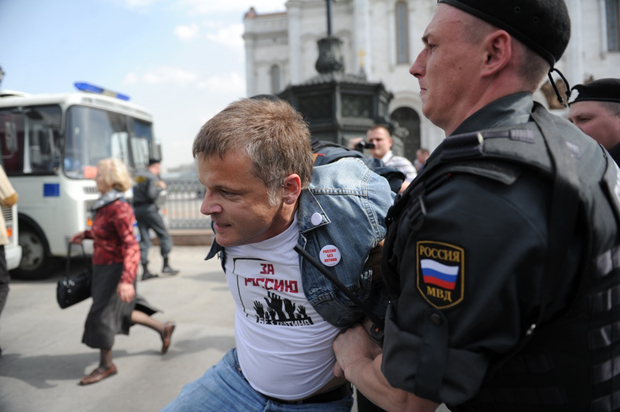
Pussy Riot supporters prevented from praying for Putin’s resignation outside the Cathedral of Christ the Saviour in Moscow (Image: Anton Belitskiy / Demotix)
Two issues preoccupying post- Soviet society are a wish to oppose outside influences (mainly from the West), and to resist aggressive behaviour in matters of religion. It is not difficult to point out inconsistencies and contradictions in these approaches, but more germane is the fact that both have survived, if in modified form, to the present day. When the possibility of further restrictions on freedom of conscience are being discussed, a key topic is invariably the need to protect society from the “expansionism” of new religious movements and radical Islam.
The arrests of members of the Pussy Riot punk band after their performance outside Moscow’s Cathedral of Christ the Saviour proved a powerful catalyst for both these concerns. The protest was seen as a frontal attack on “tradition” by “pro-Western forces” (the actual point Pussy Riot wanted to make was neither here nor there), and as an attack on the religious sensibilities of the “Orthodox majority”. The reaction was accordingly heavy-handed, including not only imprisonment of two members of the group, but also the passing of a law criminalising the “offending of believers’ religious sensibilities”, often referred to as the “blasphemy” law.
The legislative proposal was introduced in September 2012 and became law in August 2013 but has not yet been enforced anywhere. There may be at least two reasons for this. First, many laws that are aimed at NGOs, protesters or what is seen as the “opposition” have either been applied much less rigorously than expected or not at all. The authorities have chosen not to resort to wholesale repression, preferring intimidation. Second, the Russian state and its political elite are still very secular and feel uncomfortable about what is widely regarded as a law against blasphemy.
Strictly speaking, this is not a law against blasphemy, unlike, for example, similar legislation in Italy. The offence is not against religious doctrine, the deity, or things considered holy. Desecration of sacred objects is an offence not under the Russian Criminal Code, but under the code of administrative offences, which means it is seen as less serious. Offending religious sensibilities or beliefs is a crime in the penal codes of several European countries, but the European Court of Human Rights (and, following it, the Parliamentary Assembly of the Council of Europe) has consistently confirmed that a distinction needs to be made between offending sensibilities and inciting hatred.
In Russia today there are still attempts to bring charges of incitement to hatred under Article 282 of the criminal code in incidents that the law enforcement agencies, victims or others might reasonably have been expected to regard as mere offences against religious sensibilities. In a few cases, charges have been brought and, in fewer still, these charges have led to convictions. From interviews with law enforcement officers and representatives of various religious organisations, it is evident that numerous individuals and organisations that feel they have been offended on religious grounds appeal to the police and prosecutor’s office to institute criminal proceedings under Article 282. These requests are almost invariably turned down, and this is not a matter of officials taking sides: they are simply reluctant to institute proceedings on a shaky legal basis, except when that is in their own self-interest. They will do so if there is pressure on them from above, or if they face a pressing need to meet some target.
The addition of this new article to the criminal code, if it is not repealed, will lead sooner or later to its being enforced, and the main source of litigation will be complaints from numerous indignant parties. Demands for charges to be brought rained down upon the prosecutor’s office and police even before the amendments became law. It is important to recognise that the problem is not only repressive intentions on the part of the authorities, but also the repressive instincts of Russian citizens. Representatives of a wide range of community interest groups (though, thankfully, by no means all), including a number of minorities, constantly demand that criminal prosecution be the main way to influence those who cause them offence.
If the system does start enforcing this law, freedom of conscience will come under immense new pressure because of the likelihood of the sheer volume of litigation. Enforcement is likely to be highly selective, because a law of this kind can only be applied selectively. It will be manifestly discriminatory, in accordance with some individuals’ personal preferences and depending on the government’s latest priorities. Finally, it will be completely chaotic, because complaints will come in from all directions and there is nobody remotely qualified to assess their merits.
We can hope, of course, that the new article may yet be removed from the criminal code, but the chances of that are slim. The fact that it is there in the first place results from a consistent trend towards restricting freedom of expression in matters of religion, justified on the basis of the need to maintain “religious peace”. There are two main aspects to this laudable aim, and they enjoy widespread support. The first is safeguarding national security against the preaching of terrorism motivated by religion. The second is to safeguard national security against internal, particularly ethnic, conflicts, which are seen as often being fuelled by religion.
These two security aspects were major reasons for the introduction, in 2002-2007, of the current legislation to counteract “extremism”. This legislation is used extensively against violent racist groups, but also against sundry ideological minorities, which by no means espouse violence or pose a serious, or indeed any, threat to national security.
Abuse of this legislation is made possible by its imprecise wording, which we also find in respect to the new law to protect religious sensibilities. This inevitably leads to arbitrary application and, specifically, to exploitation for political purposes. There have been numerous instances of this, but let us focus on just three. Among the first major “anti-extremist” trials associated with religion were those targeting contemporary art exhibitions at the Andrey Sakharov Museum, which presaged the Pussy Riot case. Also, in 2011, a journalist was convicted for making rude remarks about believers in general, and the clergy in particular, even though his was not by any means a high profile protest and could not be represented as involving incitement to hatred against any group. Lastly, over several years there has been a serious campaign of criminal prosecution against people who read or distribute the works of a Sufi teacher, the late Said Nursi, even though neither he nor his Russian followers have links to terrorism, or engage in conduct which might constitute a threat to society.
In the case of the Sakharov museum exhibitions, the general public could at least understand more clearly what was going on. Some might consider the exhibition a profound artistic meditation on relations between the church and society; others might see the exhibits as an amusing send-up of the church and/or orthodoxy; some might consider it a send-up in bad taste or even an attack on the church, but within acceptable limits of freedom of expression; others, however, were determined to prove that the exhibition was a criminal incitement to hatred of orthodoxy and Orthodox Christians.
In the case of the persecution of followers of Said Nursi, the general public know nothing about the subject and must either just believe or disbelieve what they are told by the security services, believe or disbelieve what is said by Muslim leaders defending those being persecuted, or simply turn and look the other way. Most people choose the last option, including a majority of journalists,which means a majority of citizens, even those who take an interest in social matters, know nothing about these prosecutions.
Our citizens’ understanding of the issues around freedom of conscience is fragmentary. Most are far more concerned about conflicts over the balance between the slow-but-sure process of de-secularisation and the constitutionally guaranteed secular nature of the state. There are controversies over the presence of religion in schools, about the erection of Orthodox churches and mosques (although in the case of mosques the main cause of dissension is racism), and about various symbols of the cosy relationship between church and state. The real-life problems facing religious groups and, more generally, people expressing an opinion about religion, get forgotten.
These problems are legion. The most acute in recent years have arisen from improper application of anti-extremism legislation, but there are also the more “ordinary” problems, like refusals to release building land for places of worship and systematic campaigns of defamation. In a number of cases, like that of the Jehovah’s Witnesses, all these problems come together.
The Federal List of Extremist Materials has, however, excited the public’s interest by its scale and, even by Russian standards, sheer absurdity. The list can be found on the website of the Ministry of Justice and itemises materials banned from mass circulation. The ban is imposed by courts at the insistence of local prosecutors, who must satisfy the court that the material contains elements that can be construed as constituting “extremist activity”. This is usually incitement to hatred of some sort, impugning the dignity of a group, asserting the superiority or inferiority of a particular religion, and so forth. The whole process is quite remarkably ineffective and does not stand up to scrutiny. Most of the materials the list is seeking to ban cannot be identified from the titles given and, no less problematically, banning them does not in strictly legal terms mean they cannot be re-published, because a new court case would be needed to re-establish the identity of the materials.
A great many of the banned books, websites, videos and material involves religion in one way or another. Many are jihadist texts openly calling for terrorism or other forms of violence, but many have nothing prejudicial in them: perhaps at most a claim of the superiority of one set of beliefs over others, to which texts of Jehovah’s Witnesses are prone. There are works by Muslim authors well known for their contribution to jihadist ideology, but on topics that are of no concern to national security (most commonly, on aspects of Sharia law). Finally, a number of texts have found their way on to the list purely by chance, having been confiscated from some “wrong-thinking” individual. This explains the presence of medieval treatises by the likes of the Persian mystic al Ghazali. In 2013 there was even a ban imposed on one of the most popular translations of the Quran.
The absurdity of such methods of “fighting extremism” has obliged even President Putin, at a recent meeting with muftis in Ufa in Bashkortostan, to acknowledge that there are problems with the current approach to banning religious materials. Alas, there is no sign of willingness to review the methods of fighting extremism more generally, or those aspects of them that most blatantly violate freedom of conscience.
Translated by Arch Tait
This article appears in the Winter 2013 issue of Index on Censorship magazine.
