Journalists and photographers gathered near the Uzbekistan embassy in Moscow to protest against the deportation of their colleague Victoria Ivleva and Uzbekistan authorities’ policy towards foreign journalists.
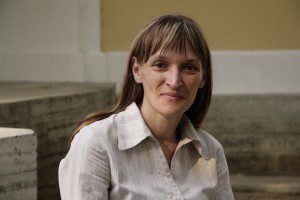
Ivleva, a photojournalist for Novaya Gazeta, was deported from Uzbekistan without explanation on 23 March. She arrived in the country’s capital Tashkent to hold free training courses for her Uzbek colleagues, but was refused permission to enter the country or contact Russian officials and then was put on a flight back to Russia.
Ivleva speculates that she was refused entry because the training was being organised by Umida Akhmedova — a notable local photographer who was charged on “insult and libel against Uzbek nation” after creating a documentary dedicated to women’s rights in Uzbekistan in 2010. But her expulsion could also be due to an article she wrote six years ago. Entitled The Country of Fish the article describes how Uzbek people were humiliated and silenced by the authorities.
Ivleva’s colleagues waited until the beginning of April to hold a protest sanctioned by Moscow’s authorities. They gathered in Uzbek national clothes, with placards saying “A man with a camera is no enemy to the state” and other slogans. They told journalists that people of two countries, that once were fellow citizens, “should not suffer from deportations”.
Uzbek embassy staff did not come out of the building to meet the protesters, but were seen videoing them through the window.
As one of the protesters, Daniil Kislov editor-in-chief of Fergana online media, told journalists that since 2005 Uzbek authorities have banished reporters from all the leading agencies, making the country a “burnt information field”.
The Federation Council of Russia has passed anti-extremism legislation which rights activists consider threatening to Kremlin’s public critics. It prohibits people who were charged with extremism to work with children in such fields as education, medical care, social security, sports and recreation.
According to lawmakers, the new legislation aims to protect children from radicalisation. But human rights activists and a number of trade union leaders have expressed their concerns over such law: together with drug and defamation legislation, anti-extremism laws in Russia are often used against Kremlin critics.
The term “extremism” is defined vaguely in Russian law, making it easy for judges to condemn innocent people. For example, if a person publicly criticises police for dispersal of peaceful protesters, he might then be charged with extremism for “incitement to social hatred” according to Russian law.
Another example of anti-extremism law misuse is seen through the prosecution of libraries staff and internet providers for allegedly promoting extremist literature. In practice, some libraries and providers do not have access to information from law enforcement authorities detailing which books are extremist. Examples of this were analysed in detail by SOVA Center for information and analysis, who described anti-extremist legislative measures in Russia as repressive.
Education union leader Andrey Demidov called the new legislation an “employment ban”, explaining that due to the vague definition of extremism and corrupted law enforcement and judicial systems, any teacher who openly criticises the government is likely to be charged on extremism and loose their job forever.
Elections in Russia are mostly held in schools, and most local election commission members are usually teachers. After allegedly fraudulent parliamentary elections, opposition activists appealed to teachers asking them not to participate in fraud. Many supported that request, which, together with high activity from election monitors, led to Vladimir Putin not winning presidential elections in March in Russia’s “two capitals,” Moscow and Saint-Petersburg.
Index singles out The Research and Information Centre Memorial, which logs the brutal repression suffered by millions in former Soviet countries, for their continued dedication to guaranteeing freedom of information. The centre has demonstrated a fierce commitment to protecting human rights. It not only chronicles the crimes of the Stalinist period, but monitors current threats against those who speak out against injustice. Memorial’s remarkable archive includes letters, diaries, transcripts, photographs, and sound files. Individuals with first-hand experience of Stalin’s terror and the Soviet gulag have donated documentation they had hidden during this brutal period.
The centre is a living tribute to the survivors of Soviet Russia, preserving documentation that many have tried to bury, and continue to conduct their work despite constant threats. In December 2009, a group of men from the Investigative Committee of the Russian General Prosecutor’s Office raided Memorial’s offices, confiscating hard drives and CDs containing its entire archive. The attack was condemned by activists and historians across the globe, and eventually all of the material was returned after a battle in local courts.
Memorial’s work is a vivid reminder of the vital and very real risk taken by those who speak out against repression. The award is particularly pertinent in Index’s 40th year. As we explore our own archive and its role in exposing international human rights violations, we are conscious of the often undervalued work of historians and archivists in keeping the memory of these violations alive.
The award was presented by Sir Evelyn De Rothschild, one of Index’s original trustees.
Irina Flige, Director of Research and Information Centre Memorial in St Petersburg accepting the award said:
I thank you in the name of all Russian researchers, writers, teachers and museum specialists who are working on the tragic topic of the Soviet past
I am grateful for this opportunity to thank Index on Censorship and all our friends for the honour bestowed on the archives of Memorial St Petersburg on the occasion of Index’s 40th anniversary.
I thank you in the name of the Research and Information Centre “Memorial” in St Petersburg, which has created these archives and worked with them for more than twenty years. I thank you in the name of the whole “Memorial” community in Russia and beyond. And I thank you in the name of all Russian researchers, writers, teachers and museum specialists who are working on the tragic topic of the Soviet past and facing obstacles in their day-to-day work that are unknown to their colleagues in other countries.
I understand this Award for “Memorial” as a recognition of the fact that truthful and exhaustive information about the past is just as essential to freedom as truthful and exhaustive information about the present day, and that the concealment of historical documents, the impediment of access to such documents, the persecution of those who try to make such documents freely accessible (and this still happens sometimes in Russia) are just as unacceptable as the concealment of topical information about human rights violations today.”

 Journalists and photographers gathered near the Uzbekistan embassy in Moscow to protest against the deportation of their colleague Victoria Ivleva and Uzbekistan authorities’ policy towards foreign journalists.