2 Mar 2022 | News, Russia, Ukraine
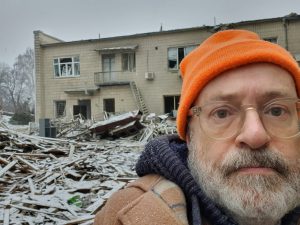
John Sweeney reporting from Ukraine for Index
Rost used to be a hot air balloon pilot before the war but now he’s a grim figure in dark hoodie, carrying a rifle, his face knotted with pressure because he is guarding Kyiv’s TV tower from Russian attack. But there is only so much that the Ukrainians can do and the previous night, Tuesday 2 March, at 1800 hours four Russian missiles punched through, hitting the tower’s control building by its base and knocking Ukrainian TV off the airwaves. The moment curfew lifted at 0800 hours Wednesday morning, I thumbed a lift to the TV tower and was the first reporter inside the complex. The more Rost showed me, the darker it got.
The tower itself disappeared into the early morning fog, not obviously touched but the control building near-by had taken a direct hit. Windows were smashed to smithereens, frames hanging loose, rubble crunching underfoot. Rost explained what had happened in Russian, a language I studied at school and then forgot. I filmed what he said and put it up on Twitter and someone translated: “The rockets flew in….they were laser-guided, they have good equipment, they came towards the building, four rockets came this way, naturally the people died here because of the explosions and I’m showing the gentleman from Britain, losses are serious, the building is ruined.”
He took me round the front of the control building and he stooped to give me a present, an evil butterfly wing of shrapnel, fired from Russia without love. On the ground was a puddle of blood one metre wide, still brightly red in the cold, snow still on the ground. A worker had been killed in the blast, his corpse removed but no-one had yet got around to washing away the blood.
That was the easy bit. We went out of a guardhouse and across a wide street, stepping over electricity cables that had fallen onto the tarmac, to the far side where there was a row of shops, some burnt out, still smoking from the attack the previous evening. On the ground was the corpse of an elderly man and, closer to the shops, the bodies of a mother and child. Ambulance workers or perhaps people from the morgue had come and were placing blankets over the dead before putting them in a dark green van for their last long journey through Kyiv.
The Russian state is saying that it is not killing civilians. That is a lie. I saw evidence of that with my own eyes this morning.
Censorship has many forms but knocking a TV station off air by firing missiles at the transmitting tower is perhaps as subtle as Vladimir Putin gets these days. Less brutal but perhaps more effective in shoring up his grip in power is switching off the last two independent media stations in Moscow, Ekho Moskvy and TV Rain. The last brave reporters with some licence to hit the airwaves have been silenced.
Moscow is fast becoming the new Pyongyang, one of the airports still open to Russian air traffic. Putin’s war is a thing of evil but it’s possible to see that he had made a miscalculation, that he has hopelessly misread the courage of ordinary, extraordinary Ukrainians from their comic turned President down to the florists now making Molotov cocktails, that the West – for once – has got its act together, that the old man in the White House has far more fight in him than the Kremlin could possibly have imagined.
So switching off sources of information, rough and ready though they may be, will become crucial as things get darker for Putin’s regime. Here in Kyiv, that is not an academic question. If the Russians do arrive here in force, then any Ukrainian journalist with a strong voice will be in trouble. Foreign journalists with big media houses at their back – CNN, ABC, Reuters – will have some protection. As a freelance, for the moment, I have my orange beanie hat. Still, telling truth to the Kremlin is a necessity in the twenty first century and it’s only just become fashionable.
The truth is that Vladimir Putin’s military machine is killing civilians in a country at peace until he invaded it. And however much the censor’s pen and switch and missiles command silence, the truth must be told.
24 Feb 2022 | Belarus, News, Russia, Ukraine
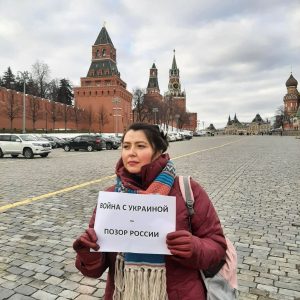 As Russia invaded Ukraine, a modest solo demonstration took place in the centre of Moscow. Sofya Rusova, co-chair of Russia’s trade union for journalists, stood holding a hand-printed sign reading “War with Ukraine is Russia’s disgrace”. The protest followed an open letter from Russian scientists and science journalists opposing the war. A coalition of independent media outlets has condemned the invasion. Photos of small groups of young protestors in Russian cities have also been appearing on social media. Activist Marina Livinovich called for a demonstration at Pushkin Square in central Moscow but was reported to have been arrested shortly afterwards. On the first evening of the invasion, protests appeared to be spreading across Russia.
These brave protesters can take inspiration from another era when Soviet tanks rolled into another sovereign nation to crush the democratic uprising known as the Prague Spring.
On 25 August 1968, the poet Natalya Gorbanevskaya joined seven others in Red Square to demonstrate against the invasion of Czechoslovakia that had taken place just days earlier. It was an extraordinary act of courage. They sat down and unfurled home-made banners with slogans that included: “We are Losing Our Friends,” “Shame on Occupiers!” and “For Your Freedom and Ours!” The slogans could just as easily apply to Putin’s Russia as Brezhnev’s Soviet Union.
Vaclav Havel, the dissident playwright and first president of the Czech Republic, later said: “For the citizens of Czechoslovakia, these people became the conscience of the Soviet Union, whose leadership without hesitation undertook a despicable military attack on a sovereign state and ally”.
The Soviet state reacted with characteristic brutality to the protestors. The activists were immediately beaten up, arrested and put on trial. Vadim Delaunay and Vladimir Dremlyuga were sent to a penal colony, Victor Fainberg was sent to a psychiatric facility. Konstantin Babitsky, Larisa Bogoraz and Pavel Litvinov were condemned to exile. Gorbanevskaya herself was initially released because she was pregnant but was later sent to a psychiatric prison.
Although these small individual protests were easily crushed by the Soviet authorities, they represented the beginnings of the dissident movement which became a direct challenge to the regime.
Index on Censorship owes its very existence to these brave dissidents. Earlier in 1968. two of the demonstrators, Pavel Litvinov and Larisa Bogoraz, had written an Appeal to World Public Opinion, alerting the international community to a show trial of a group of students accused of producing anti-Communist literature. “We appeal to everyone in whom conscience is alive and who has sufficient courage… Citizens of our country, this trial is a stain on the honour of our state and the conscience of every one of us”. The appeal attracted the support of the British poet Stephen Spender and Index was later founded as a direct response. The first edition published a number of Gorbanevskaya’s poems.
In the short term, the Russian authorities will likely be able to crush dissent just as they did in 1968. But it is impossible to completely snuff it out. As Pavel Litvinov wrote for Index on Censorship: “Only a few people understood at the time that these individual protests were becoming part of a movement which the Soviet authorities would never be able to eradicate.”
The story of Russian dissent since the Soviet era has always been one of brave individuals standing against overwhelming authoritarian power. Sofya Rusova is the latest to honour the tradition of Natalya Gorbanevskaya and those other Red Square protestors of 1968.
12 Jan 2022 | News, Russia, Ukraine
[vc_row][vc_column][vc_single_image image=”118142″ img_size=”full” add_caption=”yes”][vc_column_text]On 10 January 2022, Yuri Dmitriev, a historian prosecuted on disputed charges of paedophilia, and his lawyers lodged appeals with the Supreme Court of Karelia where he was prosecuted. Dmitriev’s case is part of a long-running battle between the authorities and the Memorial Human Rights Centre (MHRC), whose Karelia branch was led by the historian.
The battle may be drawing to a conclusion. Two weeks’ earlier, on 28 December 2021, Russia’s Supreme Court ordered the dissolution of MHRC, which was established in 1988 by young reformers and Soviet dissidents. It was accused of not using the “foreign agent” designation on all its material indicating that it was a body “receiving overseas funding and engaging in political activities”. Prosecutor Zhafyarov also denounced Memorial for painting “the USSR as a terrorist state”.
The decision indicates that Russian President Vladimir Putin is now blatantly rehabilitating the USSR. Dmitriev’s prosecution in 2016 dates from an era when the regime was more veiled in its attack on critics of the regime. Another historian Sergei Koltyrin, who also researched Stalinist crimes in Karelia, was arrested on disputed paedophilia charges in 2018. He died in a prison hospital on 2 April 2020; Dmitriev and his defence attorney fought several appeals but on 27 December 2021 he was sentenced to 15 years in a strict-regime penal colony.
“Their real crime,” says John Crowfoot of the Dmitriev Affair website, “was to commemorate the victims of Stalinism, in particular the thousands shot at Sandarmokh killing field during the Great Terror (1937-1938).” Sandarmokh is the last resting place for as many as 200 members of Ukraine’s Executed Renaissance, who were leading figures in the blossoming of Ukrainian culture during the 1920s.
The imminent closure of Memorial will sicken many in Ukraine, where an estimated 3.9 million people died in the Holodomor famine genocide, a topic which the organisation has also helped research. Similar concern will be felt in the Baltic States and Kazakhstan, where up to 1.5 million people died of a famine related to collectivisation in 1931-33 and where Russian troops have been involved in violently crushing protests since the beginning of January 2022.
Even before the dissolution of Memorial there were attempts to restrict the discussion around Soviet-era crimes in Russia. In 2011, for example, historians were instructed to compile archival documents to deny the unique character of famine in Ukraine during 1932-33 and instructed on how to write about the subject. Yet numerous documents indicate that Ukraine and ethnically Ukrainian areas of Russia were targeted (in particular the 23 January 1933 directive sealing the borders of these areas to stop peasants fleeing starvation). And in 2008 a letter from Russian president Dmitry Medvedev to Ukrainian president Viktor Yushchenko continued the line that it was simply a tragedy when he wrote that “the tragic events of the 1930s are being used in Ukraine in order to achieve instantaneous and conformist political goals.”
There are already laws outlawing comparisons of the Soviet Union to Nazi Germany as of June 2021. But how will the decision affect debate in Russia now? According to Memorial, who I contacted for this article, their dissolution means that now, “there is only one point of view that is acceptable in discussions on historical topics, that of the state”.
Putin is playing up nostalgia for the Soviet Union. He is even surrounding Ukraine with troops and possibly considering an invasion in an attempt to boost his flagging popularity. The closure of Memorial combined with troop movements is one of many signals that he is considering not only rehabilitating but even perhaps partly renewing the Soviet Union by annexing Ukraine.
However, rather than enthusiastically flocking to join the new union Ukrainians are enlisting in territorial defense units.
Thanks in part to the work of Memorial, and Russian and Ukrainian demographers and archivists, they know that millions of their family members died at the hands of the regime and they do not want to relive that experience. Putin may succeed in stifling debate in the media and in universities but he cannot stop people in a country as big as Russia from talking. The mass graves in the tundra and across many former Soviet countries cannot be censored off the map.
Steve Komarnyckyj an award-winning poet and translator. He works on Ukrainian literary translations and is currently producing a book by Lina Kostenko[/vc_column_text][/vc_column][/vc_row][vc_row][vc_column][/vc_column][/vc_row]
16 Apr 2021 | Media Freedom, News, Russia
[vc_row][vc_column][vc_column_text]
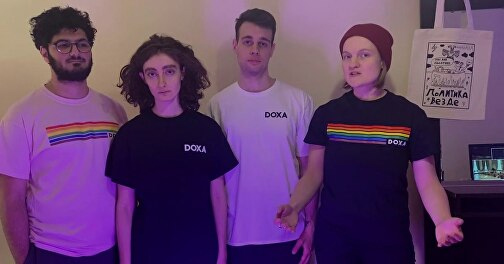
Student journalists at Doxa
Index on Censorship has expressed concern over four student journalists charged with allegedly inciting minors to take part in criminal activity.
Armen Aramyan, Alla Gutnikova, Vladimir Metelkin, and Natalia Tyshkevich, journalists at online magazine Doxa – an independent student magazine about the realities of modern university life – were arrested on 14 April. The arrest of the students – from the Higher School of Economics and Moscow State University of Civil Engineering – came after they reported on protests in support of opposition leader Alexei Navalny and publishing a video in which they argue that the expulsion of students from university for participating in actions in support of Navalny is illegal.
The video, published by Doxa on 22 January, prompted the Russian media watchdog Roskomnadzor to order its removal, a decision which Doxa subsequently challenged.
Roskomnadzor claimed the video was “persuading or otherwise involving minors in committing illegal actions that pose a threat to their life and health.”
The charges against the four are under 151.2 of the Russian criminal code, which carries a sentence of up to three years in prison for “involving a minor in committing acts that pose a danger to the life of a minor”.
Doxa’s offices were searched along with the homes of each of the four on trial, with their equipment seized.
The journalists are now under heavy pre-trial restrictions, which prevents them from leaving their homes, using the internet, or speaking to anyone except their close relatives and lawyers.
Since the arrests, more than 270 academics around the world have expressed their support for the four in an open letter, calling the charges “preposterous”.
Doxa said in a statement that the targeting of the student journalists is indicative of Russian authorities’ clamping down on free thought within universities.
They said: “In early 2021, we learned about the unprecedented pressure on students in Russian educational institutions. Schoolchildren, their parents, college and university students were threatened with possible problems, legal prosecution and expulsion due to participation in actions in support of Alexei Navalny, who was detained upon arrival in Russia.”
Protests in support of Navalny began in January, with over 5,000 people estimated to have been arrested across the country at the time amid some of the largest protests seen in opposition to President Vladimir Putin. In response, Russian authorities have since attempted to crack down on journalism and protests.
Index CEO Ruth Smeeth defended the rights of the Doxa four and described student journalism as “a building block of media freedom”.
“Repressive regimes silence opposition when they are scared of their populations and when they fear losing power. The Kremlin’s behaviour towards student journalists shows how fearful, yet again, they have become of their own people,” she said.
“Student journalism is a building block of media freedom, it educates and informs as well as ensuring the lifeblood that feeds the next generation of journalists. We are horrified at the targeting of the Doxa magazine and their student editors and we stand united in solidarity with them.”
Director of Global Youth & News Media, an organisation that aims to amplify youth journalism, Dr Aralynn Abare McMane said: “It shows just how desperate the Russian authorities are becoming that they persecute these student journalists, and we are gratified to see that the international press freedom community is taking this case very, very seriously.”[/vc_column_text][/vc_column][/vc_row][vc_row][vc_column][three_column_post title=”You may also want to read” category_id=”8996″][/vc_column][/vc_row]
