16 Sep 2016 | Bosnia, Europe and Central Asia, Greece, Italy, Mapping Media Freedom, mobile, Netherlands, News, Serbia
Each week, Index on Censorship’s Mapping Media Freedom project verifies threats, violations and limitations faced by the media throughout the European Union and neighbouring countries. Here are five recent reports that give us cause for concern.
Members of the Greek far-right Golden Dawn party assaulted a journalist at a protest against the presence of a refugee detention centre on the island of Chios on 14 September.
Editor-in-chief of Astrapari.gr, Ioannis Stevis, was covering the events at the entrance of the camp when a local representative of Golden Dawn, Mattheos Mermigousis, assaulted him and threw his camera on the ground where it broke.
Greek riot police were close by when the assault happened but refused to arrest Mermigkousi despite his request. Stevis has pressed charges against local Golden Dawn representatives.
Ismar Imamovic, an editor at local broadcaster RTV Visoko, was assaulted by a masked individual after he left the TV station on 14 September.
The incident occurred shortly after midnight. As Imamovic told Patria, a few seconds after he had left the building a masked man attacked him from behind. “First he struck me down and then beat me brutally,” Imamovic said.
The incident was reported to the police but so far there is no information regarding the culprits’ identity. Political parties have condemned the attack.
A Dutch-Turkish journalist for the Turkish pro-government newspaper Sabah was arrested in the city of Zaandam while reporting on a police operation on 12 September.
Fatih Ozyar was filming a police raid in an area of Zaandam when he was asked by the police to leave. He told the police that he was a journalist but was arrested with eight other people.
“I was treated roughly by four police officers and brought to a police cell where I was left for 15 hours,” he said. Ozyar was released the following day with a fine for not following police instructions.
The municipality of Amatrice announced on 12 September it plans to sue Charlie Hebdo magazine for a cartoon published about the 24 August earthquake that killed 295 people, Le Figaro reported.
The Amatrice municipal officials announced they were suing for libel.
“This is an unbelievable and senseless macabre insult made to victims of a natural disaster,” the municipality’s lawyer said.
Nedim Sejdinovic, the president of the Independent Journalist Association of Vojvodina, received death threats and threats of violence via Facebook on 12 September.
The threats came after Sejdinovic participated in a roundtable discussion about challenges in modern day Serbia. He compared Serbia in the 90s with the IS today. He also said that he believed Serbia’s ruling party was deeply corrupt and had destroyed society.
The Independent Association of Journalists in Serbia condemned the threats and urged a special prosecutor for cyber crime to identify those who are responsible.
22 Aug 2016 | Bosnia, mobile, News
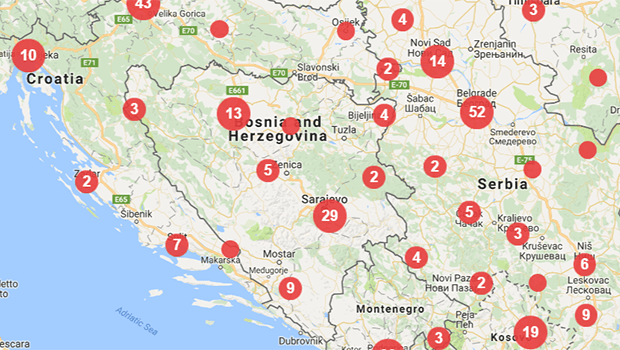
University professors, poets and artists signed an open letter in support of three media workers who were targeted with death threats and hate speech. The letter, which was published in the Sarajevo daily Oslobodjenje on 21 July, said that the journalists are “targeted just because they expressed their view which is different from the majority’s”.
“Regardless of whether one agrees or not with the above-mentioned views, instigation of death threats and public lynching through creating a modern day Bosnian Index Librorum Prohibitorum is unacceptable,” the letter said.
The cases were reported to Mapping Media Freedom over three days in July.
In the first incident, Vuk Bacanovic, a journalist for the Radio-Television of the Federation of Bosnia and Herzegovina, was fired for allegedly violating the internal rules and the ethical code of the television network. In a Facebook post on his personal page he criticised a public art installation that depicted the federal entity of Republika Srpska as a mass grave and concentration camp. Bacanovic wrote that he “hates the assholes from Sarajevo” who were “talking crap” by saying the city has a multi-ethnic spirit. After articles about the post were published, Bacanovic received numerous death threats via Facebook, regional TV outlet N1 reported.
Nenad Velickovic, editor-in-chief of educational career-oriented magazine Skolegijum, was then verbally harassed and threatened as a result of three articles written by Filip Mursel Begovic, editor-in-chief of the weekly Stav, which were published in June and July. Begovic described Velickovic as a “man with a hidden and dangerous agenda”, “a falsifier” and a “Serbian nationalist” while describing the magazine Skolegijum as “extended arm of Serbian chauvinism”, Analiziraj.ba reported.
The letter was also written in support of the secretary general of BH Journalists’ Association Borka Rudic, who was subjected to verbal harassment by unidentified men after a high-ranking member of the Party of Democratic Action, an ethnic Bosniak political party, described her, amongst other things, as a “lobbyist for Fethullah Gulen”, website media.ba, reports.
The three incidents reflect the ethnic divisions and stereotypes that were re-enforced by the 1992-1995 war in Bosnia. The post-conflict society is governed through a complex political system established by the 1995 Dayton Peace Accords. The power-sharing constitution recognises each of the three major ethnic groups – Bosniaks (Muslims), Serbs (Orthodox) and Croats (Catholics) – as the constituent peoples of Bosnia. In practice, the recognition means that anyone not identified as belonging to one of the three groups could not be elected to hold a public office, despite a 2009 European Court of Human Rights ruling ordering the constitution to be revised.
Following the formula set out in the Dayton Accords, Bosnia and Herzegovina is divided into two entities – the Federation of Bosnia and Herzegovina, with majority ethnic Bosniak and ethnic Croatian inhabitants, and the Republika Srpska, with majority ethnic Serbian population. Additionally there is the district of Brcko, which is separate enclave jointly administered by both.
The three groups also differ on the future of Bosnia. Some Bosniaks advocate for a more unitary state, while some Serbs want a more confederate arrangement or even dissolution of the state. At the same time there are Croats that want a separate ethnic entity. The competing visions of Bosnia’s future are heavily influenced by historic and recent incidents including charges of genocide, crimes against humanity and other atrocities that occurred during the 1992-95.
The Centre for Security Governance says that the governing structure “has discouraged inter-group cooperation and reconciliation. Political elites have pandered to ethnic fears, resulting in the electoral victories of ethnonational parties via the phenomenon of ‘ethnic outbidding’.”
Some politicians use friendly media to advocate for further strengthening of ethnic politics, while journalists and intellectuals that argue for strengthening civic identities and bridging ethnic hatred are usually vilified as traitors if they are from the same ethnic background, or enemies, if they are from another ethnicity. All of the cases addressed in the open letter originated in Bosniak nationalist media and were targeted at either another ethnicity or individuals who prefer civic above ethnic identity. Velickovic was described as a “man with a hidden and dangerous agenda” by a Bosniak journalist because he was advocating for non-nationalistic school curriculum.
“The importance of maintaining strong journalistic ethics cannot be underscored enough, especially given the country’s recent history. Members of the media profession must strive to be balanced, refrain from inflaming already tense inter-ethnic relations and guard against being used for political ends,” Hannah Machlin, project officer for Index on Censorship’s Mapping Media Freedom, said.
Dunja Mijatovic, OSCE Representative on Freedom of the Media, in an open letter also noted that the latest events open a very worrying chapter on the safety of journalists.
“People engaged in investigative reporting and expressing different opinions, even provocative ones, should play a legitimate part in a healthy debate and their voices should not be restricted,” Mijatovic said.
In the current climate, the open letter in support of and signed by people of different ethnicities is a small step forward. Signatory Asim Mujkic, a professor at the faculty of political sciences at the University of Sarajevo, said the cases were a call to action.
“My initial motive was to protest against the mainstream hegemonic ideological view that aggressively imposes itself upon independent and free-thinking intellectuals and public workers that, in the context of Bosnia and Herzegovina, usually targets vulnerable ethnicities for the purpose of its political mobilization,” Mujkic told Index on Censorship.“We need to fire back, especially in such circumstances.”
19 Aug 2016 | Azerbaijan, Azerbaijan News, Mapping Media Freedom, mobile, News, Russia, Serbia, Turkey
 Each week, Index on Censorship’s Mapping Media Freedom project verifies threats, violations and limitations faced by the media throughout the European Union and neighbouring countries. Here are five recent reports that give us cause for concern.
16 August, 2016 – IMC TV reporter Gulfem Karatas and cameraman Gokhan Cetin were assaulted and detained while covering the police raid on the daily Ozgur Gundem. Footage of the attack was shared via IMC TV Twitter account, showing police grabbing the camera and physically assaulting the reporter, who is heard screaming in the footage.
Karatas and Cetin were detained along with journalists Günay Aslan, Reyhan Hacıoğlu, Ender Öndeş, Doğan Güzel, Ersin Çaksu, Kemal Bozkurt, Sinan Balık, Önder Elaldı, Davut Uçar, Zana Kaya, Fırat Yeşilçınar and Mesut Karnak.
In an official statement IMC TV said: “During the live broadcast, the police prevented Gulfem Karatas and Gokhan Cetin from reporting and detained them violently along with at least 21 Ozgur Gundem employees. We condemn this unacceptable treatment to our colleagues who were on duty and ask for their immediate release.”
16 August, 2016 – Journalist Vladimir Zivanovic and photographer Boris Mirko, who work for the daily Serbian Telegraph were threatened and insulted while reporting on the illegal construction of an aqua park in the capital Belgrade.
The journalists were in an area of the city where former professional football player Nikola Mijailovic is building the controversial aqua park. Mijailovic approached the journalists and shouted a series of insults about them and their families. He reportedly told them that they should be put in a gas chamber together.
Mijailovic also reportedly tried to bribe them. The journalists have reported the threats to the police and Serbia’s Independent Association of Journalists has condemned the incident.
15 August, 2016 – A court in Baku ruled to uphold a travel ban against investigative reporter Khadija Ismayilova. “Binagadi Court told me because I have no husband, kids or property, I might not be able to return if I leave the country,” Ismayilova said following the hearing in Baku.
Ismayilova was released from prison on 25 May on a suspended three-and-a-half-year sentence.
Also read: Azerbaijan’s long assault on media freedom
16 August, 2016 – The eighth administrative court in Istanbul ordered the closure of the newspaper Ozgur Gundem on the grounds of “producing terrorist propaganda”.
The court order described the closure as “temporary” although no duration appears to be specified in the text of the decision.
Later that day, Ozgur Gundem’s offices were raided by the police.
According to P24, the 23 members of staff were taken into custody. They are: Editor-in-Chief Zana Kaya, journalists Zana Kaya, Günay Aksoy, Kemal Bozkurt, Reyhan Hacıoğlu, Önder Elaldı, Ender Önder, Sinan Balık, Fırat Yeşilçınar, İnan Kızılkaya, Özgür Paksoy (DİHA news agency) , Zeki Erden, Elif Aydoğmuş, Bilir Kaya, Ersin Çaksu, Mesut Kaynar (DİHA), Sevdiye Gürbüz, Amine Demirkıran, Baryram Balcı, Burcu Özkaya, Yılmaz Bozkurt (member of the press office of the Istanbu Medical Chamber), Gülfem Karataş (İMC), Gökhan Çetin (İMC) and Hüseyin Gündüz (Doğu Publishing House).
Also read: Turkey’s continuing crackdown on the press must end
11 August, 2016 – Dmitri Remisov, the Rostov-on-Don regional correspondent for Rosbalt news agency, told the agency that he was repeatedly assaulted by police officers while being questioned at the regional Center for Counteracting Extremism.
According to Remisov, he was asked to come to the CCE to answer questions related to a criminal case “on the preparation of a terrorist act” in Rostov, a city in south-west Russia.
He reported that two police officers asked him whether he knew certain individuals, where most of the people he was asked about were opposition activists.
“Then they asked me if I knew a certain Smyshlayev. I said that I didn’t remember such a person,” Remizov said.“One officer started saying I did know this person in 2009, after which he struck my head three times. Afterwards, he began threatening me, saying he could prosecute me under the criminal law or could have some Nazis punish me.”
After he was questioned another policeman threatened him with physical punishment, saying “we will meet [with you] once again”.
The Rosbalt correspondent received medical care after the questioning. He also filed a complaint against police officers, Rosbalt reported.
2 Aug 2016 | About Index, Index Reports, Press Releases
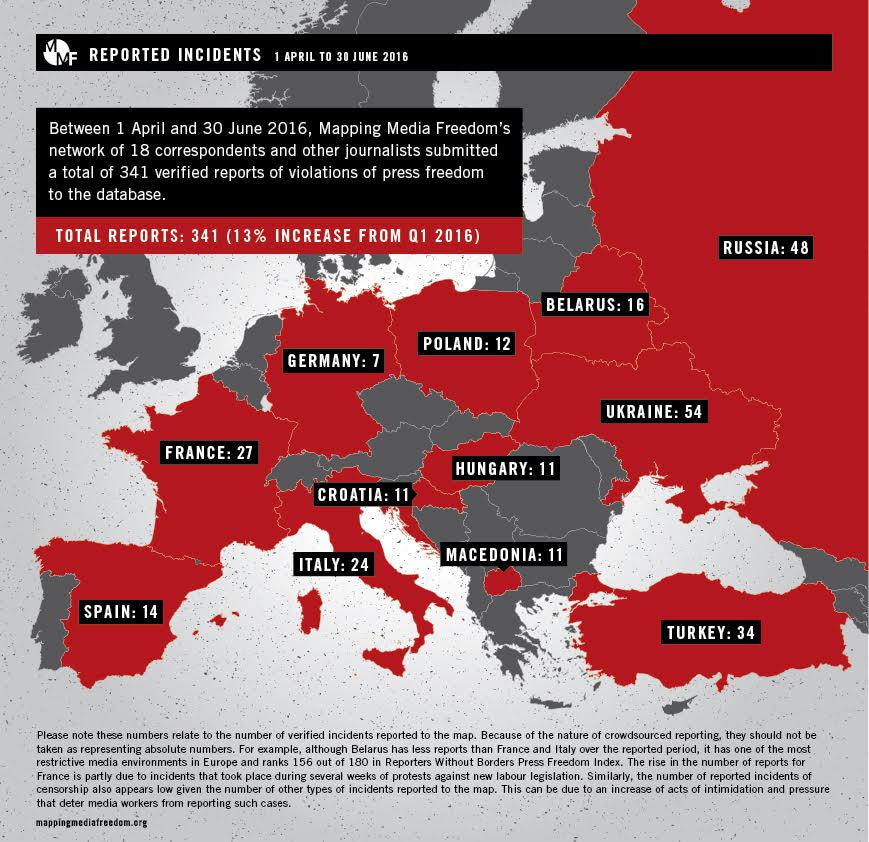
Violence against journalists in Europe increased in the second quarter of 2016, reports submitted to Index on Censorship’s Mapping Media Freedom platform show, as a government crackdown in Turkey intensified and protests turned violent in countries from France to Finland.
“Europe is considered one of the safest places for journalists in the world. However, increasing concerns about national security in the region – coupled with creeping authoritarianism – is making it an increasingly difficult place for the media to operate freely and safely,” said Hannah Machlin, project officer for Mapping Media Freedom. “And the threats are not just coming from the usual suspects: 12 incidents of injuries to journalists occurred in France and in a number of these cases journalists appear to have been directly targeted by police.”
Between 1 April and 30 June 2016, Mapping Media Freedom’s network of 18 correspondents and other journalists submitted a total of 341 violations of press freedom to the database, a 13% rise over the first quarter of 2016.
Key findings from the Q2 report
- Two journalists were killed. Mohammed Zahir al-Shergat died as a result of gunshot wounds in the city of Gaziantep, Turkey; journalist and radio host Luka Popov from northern Serbia was found dead in his home in Srpski Krstur
- 60 incidents of physical assault were confirmed
- 45 criminal charges and civil lawsuits were filed
- Media professionals were detained in 41 incidents
- 80 verified reports of intimidation, which includes psychological abuse, sexual harassment, trolling/cyberbullying and defamation were recorded
- Work was censored or altered 15 times
- Media professionals were blocked from covering a story in 73 incidents
“The fight for the abolition of prison sentences for offences committed through the press is unfortunately still relevant in Europe and neighboring countries,” Christophe Deloire, Reporters Without Borders secretary general said. “In a climate of growing fear and suspicion, judicial persecution of journalists takes more and more diversified forms. The Turkish authorities continue to invoke the anti-terrorism law, the protection of state secrets or insults to the head of state to prosecute and imprison more journalists.”
“Journalists are beaten, intimidated, imprisoned and killed in the pursuit of telling a story, exposing the truth and informing the public. These courageous men and women are the vanguard for free speech, freedom of expression and, ultimately, a free and democratic society. We need to come together and fight for journalists’ safety and end impunity for crimes committed against journalists,” said Dunja Mijatović, the OSCE Representative on Freedom of the Media.
The report is available now at https://mappingmediafreedom.org/plus/ or as a PDF.
For more information, please contact Hannah Machlin, Mapping Media Freedom project officer at [email protected]
About Mapping Media Freedom
Mapping Media Freedom – a joint undertaking with the European Federation of Journalists and Reporters Without Borders and partially funded by the European Commission – covers 42 countries with a network of correspondents, including all EU member states, plus Albania, Azerbaijan, Belarus, Bosnia, Iceland, Kosovo, Macedonia, Montenegro, Norway, Russia, Serbia, Turkey, Ukraine and Vatican City. In September 2015 the platform expanded to monitor Russia, Ukraine and Belarus and in February 2016 into Azerbaijan. Each report is fact checked with local sources before becoming available on the interactive map. Since launching in May 2014, the map has recorded over 2,000 incidents threatening media freedom.
