24 May 2016 | About Index, Azerbaijan News, Campaigns, Campaigns -- Featured, Europe and Central Asia, Mapping Media Freedom, mobile
Journalists have been murdered and burned in effigy. Reporters have been publicly discredited by government officials, prosecuted for under anti-terrorism laws and excluded from public meetings on the refugee crisis. We’ve even recorded journalists being menaced with mechanical diggers.
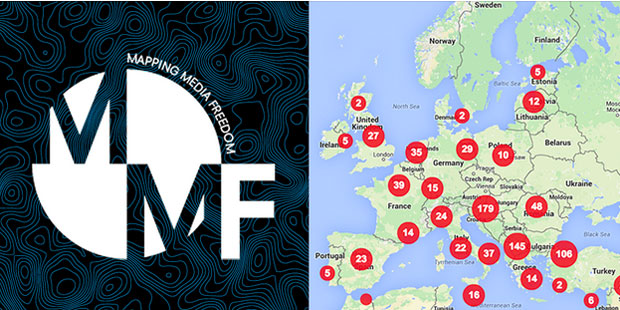
Mapping Media Freedom launched to the public on 24 May 2014 to monitor media censorship and press freedom violations throughout Europe. Two years on, the platform has verified over 1,800 incidents, ranging from insults and cyberbullying to physical assaults and assassination.
“The original impetus behind the project was to uncover everyday attacks on press freedom in Europe. The database has given Index, its partners and policy makers a highly unnerving look at the ways journalists are barred, attacked or even murdered simply for doing their jobs,” Hannah Machlin, project officer for Mapping Media Freedom, said.
The project has been granted renewed funding by the European Commission.
“The strength of Mapping Media Freedom is that it provides an ongoing narrative about the state of press freedom in the European region. It is gratifying that the European Commission values its contribution to the project by renewing its funding for a third year,” Melody Patry, senior advocacy officer, Index on Censorship said.
Over the period of coverage, Mapping Media Freedom has released periodic reports on the verified incidents. In the first quarter of 2016, the project received a total of 301 violations of press freedom to the database, a 30% rise over the fourth quarter of 2015. Earlier reports documented similar trends: February 2016, October 2015, May 2015 and December 2014.
The platform — a joint undertaking with the European Federation of Journalists and Reporters Without Borders and partially funded by the European Commission — covers 40 countries, including all EU member states, plus Albania, Belarus, Bosnia, Iceland, Kosovo, Macedonia, Montenegro, Norway, Russia, Serbia, Turkey, Ukraine and Azerbaijan. In September 2015 the platform expanded to monitor Russia, Ukraine and Belarus and in February 2016 into Azerbaijan. Since launching in May 2014, the map has recorded over 1,800 violations of media freedom, as 17 May 2016. Each report is fact checked with local sources before becoming publicly available on the interactive map.
Mapping Media Freedom works in conjunction with the Council of Europe’s platform about the safety and protection of journalists, provides resources for researchers and information for journalists. It is also affiliated with European Youth Press, Media Legal Defence Initiative, Human Rights House Kiev, Ossigeno per L’Informazione, Osservatorio Balconi e Caucaso and the European Centre for Press and Media Freedom.
22 Apr 2016 | Magazine, Volume 45.01 Spring 2016 Extras
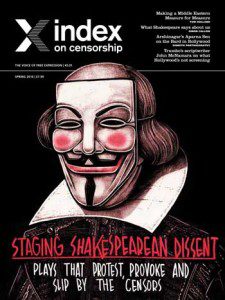
Order your copy of the spring issue of Index on Censorship here.
Saturday 23 April marks the 400th anniversary of Shakespeare’s death. The Bard’s work has long been used to tackle difficult or controversial issues; issues that most often only received an audience due to the cloak of his respectability. To honour the occasion Index has put together a list of all things Shakespeare.
Shakespeare and his role in protest and dissent is the theme of the spring 2016 issue of Index on Censorship magazine: Staging Shakespearean Dissent; Plays That Protest, Provoke and Slip by the Censors. The issue features pieces that explore how the bard’s plays have been used to circumvent censorship and tackle difficult issues around the world; from Bollywood adaptions to Othello in apartheid-era South Africa and a ground-breaking recent performance of Romeo and Juliet between Kosovan and Serbian theatres, along with reports on theatre upsetting people in the USA, and interviews with directors around the world
Index on Censorship magazine editor Rachael Jolley introduces our Shakespeare special issue with her editorial piece, How Shakespeare’s plays smuggle protest. In this piece Jolley discusses how the work of “established” or “historic” playwrights gave actors the chance to tackle themes that would otherwise never be allowed.
Shakespeare was no stranger to censorship, from the Elizabethan to Jacobean police states. In this extract actor and theatre director Simon Callow looks at how his plays amused monarchs and dictators but also prompted their anger.
My Mate Shakespeare recasts the playwright as a brandy loving bingo addict, struggling in a war zone. The poem, which was published in the spring issue of Index on Censorship magazine, was written by poet Edin Suljic following a visit to his home country, Former Yugoslavia. The issue also features an interview with the poet, who fled to London in 1991 ahead of the country’s impending war, discussing his inspiration for the poem and his involvement with theatre group Bards Without Borders.
How well do you know Shakespeare? Take our quiz and see how much you know about the Bard and his work.
The theatre and censorship reading list is a compilation of articles from the magazine archive covering theatre censorship across the world. From the censorship of Romeo and Juliet in US high school textbooks to Janet Suzman’s controversial production of Othello in apartheid-era South Africa, to the banning of performances of Macbeth in actors’ homes in Czechoslovakia.
In an interview with magazine editor Rachael Jolley an award-winning cartoonist, Ben Jennings, discusses his design for the latest Index on Censorship magazine cover on the 400th anniversary of William Shakespeare’s death.
Hitler was a Shakespeare fan; Stalin feared Hamlet; Othello broke ground in apartheid-era South Africa; and Brazil’s current political crisis can be reflected by Julius Caesar. Across the world different Shakespearean plays have different significance and power. In our global guide to using Shakespeare to battle power some of our writers talk about some of the most controversial performances and their consequences.
Order your full-colour print copy of our Shakespeare magazine special here, or take out a digital subscription from anywhere in the world via Exact Editions (just £18* for the year). Each magazine sale helps Index on Censorship fight for free expression worldwide.
*Will be charged at local exchange rate outside the UK.
Magazines are also on sale in bookshops, including at the BFI and MagCulture in London as well as on Amazon and iTunes. MagCulture will ship anywhere in the world.
18 Apr 2016 | Magazine, mobile, Volume 45.01 Spring 2016
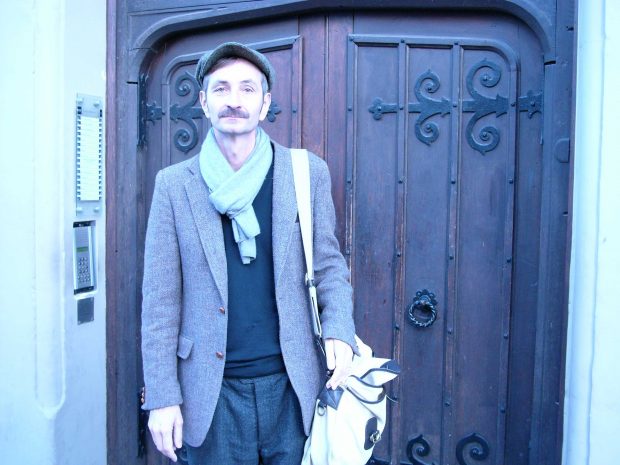
Poet Edin Suljic was inspired to write My Mate Shakespeare after a recent trip to his home country
My Mate Shakespeare
The first time I met Shakespeare, he looked nothing like himself, nothing like that
depiction of a poster boy with a hipster beard one comes across every so often.
No, he was tall, scrawny, flamboyant, thin-moustached and bespectacled, with large
hands into which his guitar almost disappeared as he sang perched on a low
stool, in the theatre’s green room, where we would occasionally be allowed to
sneak into as aspiring writers and actors, to join the post-press-night party.
In those days we shared many breakfasts, mainly a coffee and cigarettes, and
sometimes a boiled egg given to us by a kind cook in the theatre’s canteen.
And our fortunes took many turns …
Some claimed his work as if it was their own, they complained about too many foreigners
in his plays (As if we don’t have our own trulls – they’d say). Others even claimed he
never wrote anything, or worse, that he never existed. My mate Shakespeare …
Every so often he’d ask me if I am still writing, then say:
– Keep writing, keep writing, me duck …
But then, he ripped apart my first play.
That’s too serious boyo – he said, and inserted an innuendo into every second paragraph.
He was madly in love with this blonde, petite, round-eyed actress who was patiently
waiting for her lucky break on stage, and for him to come to her garret.
Almost addicted to bingo and drinking a lot of poor-quality brandy, he got himself into
many troubles by attacking so many kings, offending so many celebrities and ridiculing
politicians; and he wrote too many plays about deformity and cross dressing.
Even his small girlfriend turned out to be a man in disguise.
Then the war tore everything apart, and I haven’t seen him since.
The world entered into this never-ending war.
I heard the stories … He married a very different girl and they had two beautiful
children and they lived somewhere in the outskirts of the City.
He doesn’t go to the theatre anymore.
But then, like most stories about him, these too, turned out to be unreliable.
I saw him once more – in the East End. That last time I saw him, he
looked like a broken man. My friend. My indestructible friend.
Something or somebody managed to do it to him.
I suppressed a cry inside myself. What is left for the rest of us? What
will happen to us if people like him could be broken?
Then he leaned over his glass of cheap brandy and whispered
– Keep writing, keep writing, boyo …
Spring 2016 cover
Read an interview with Suljic in the latest magazine. This Saturday (April 23) marks the 400th anniversary of Shakespeare’s death. To commemorate this, the spring issue of Index on Censorship magazine is a Shakespeare and protest special, featuring pieces that explore how the bard’s plays have been used to circumvent censorship and tackle difficult issues around the world; from Bollywood adaptions to Othello in apartheid-era South Africa and a ground-breaking recent performance of Romeo and Juliet between Kosovan and Serbian theatres, along with reports on theatre upsetting people in the USA, and interviews with directors around the world. Historian Tom Holland writes about how a Middle Eastern performance of Measure for Measure would hit the spot, and playwright Elizabeth Zaza Muchemwa on how Shakespeare sneaks tricky debates into Zimbabwean culture.
Order your full-colour print copy of our Shakespeare magazine special here, or take out a digital subscription from anywhere in the world via Exact Editions (just £18* for the year). Each magazine sale helps Index on Censorship fight for free expression worldwide.
*Will be charged at local exchange rate outside the UK.
Magazines are also on sale in bookshops, including at the BFI and MagCulture in London, News from Nowhere in Liverpool and Home in Manchester; as well as on Amazon and iTunes. MagCulture will ship to anywhere in the world.
15 Apr 2016 | Croatia, Europe and Central Asia, Mapping Media Freedom
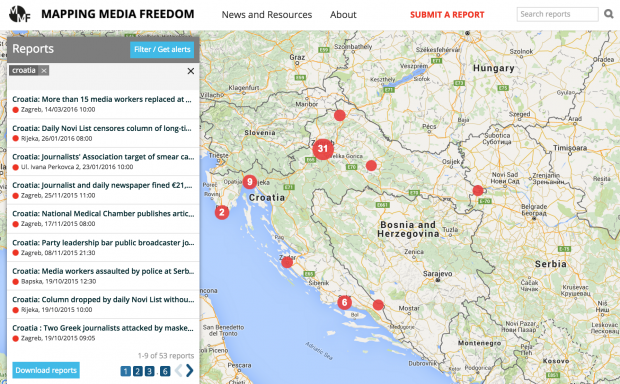
Walking around the Zagreb offices of the Electronic Media Council (AEM), Croatia’s broadcast regulator, must have had a distinctive feel to it on 26 January. According to Croatian media, outside the building stood about 5,000 demonstrators singing Croatian patriotic songs, calling for AEM chair Marjana Rakic’s resignation and carrying an effigy of her dressed as a Yugoslav Partizan and holding a machine gun. Some shouted “Za dom spremni” (“For the homeland, ready”), a Nazi-style salute used by the Ustaše regime that ruled Croatia during World War II.
The reason? An episode of Markov Trg, a TV show created by Marko Juric and broadcast by Z1 TV, which AEM punished by suspending its license for three days over claims it was “inciting hatred on the basis of race and ethnicity”.
On 19 January, Markov Trg reported that Zagreb’s Serb Orthodox clergy routinely sang “Chetnik” songs.
As Balkan Transitional Justice notes, the word “Chetnik” has a few different connotations in the former Yugoslavia. “Originally applied to Serbian royalist fighters in World War II, it later became a more pejorative expression, even more so during the wars of the 1990s when many Serbian paramilitary groups styled themselves ‘Chetniks’.”
At the end of the show, anchor and direkto.hr columnist Marko Juric said: “The message to residents of Zagreb, to all those taking a stroll in Cvjetni Trg [one of the squares in downtown Zagreb], is to be careful, given that this is where the [Serb Orthodox] church led by a Chetnik vicar is located.
“Beware when you are walking down Cvjetnik Trg, especially mothers with children, because one of those Chetnik vicars could run out of the church and commit a slaughter in Zagreb’s most beautiful square.
“Maybe ‘Beware of Chetnik’ signs should be put up there.”
The statement prompted a disagreement in Croatian media.
The Croatian Journalists Association (HND) was quick condemn the show, as on 21 January its president Sasha Lekovic said in a statement that the show hadn’t done any journalistic work, and was instead “irresponsible and alarming public appearance”.
“We believe that all media should keep in mind at all times that there is a fine line between verbal and actual violence,” his statement reads.
One day later, on 22 January, the AEM found that Juric had incited hatred, and suspended Z1 TV’s license for three days between 26 and 29 January.
The Association of Croatian Journalists and Publicists (HNiP), a new Croatian press association, strongly condemned the decision to suspend the broadcaster, calling it an “unprecedented, serious attack on the freedom of the media and freedom of expression”. Marko Juric is a member of the HNiP.
After that the 26 January protest, which was organised by civil war veterans, who also strongly condemned the HND’s statement, claiming they were “attacking freedom of expression, instead of protecting it”.
According to HDN reports, veterans have also sent the association a letter which “endangers the safety of journalists”, which pairs with “verbal harassment” via phone and “hate speech”. HND also criticised Croatia’s right-wing government for failing to condemn the protest and the country’s vice president for actually joining the demonstration against the regulator.
The protest is one of the episodes of an ongoing disagreement in Croatian media, where HND and HNiP have been accusing each other of suffocating media freedom and lowering journalistic standards.
HNiP was launched on 2 July 2015 by journalists dissatisfied with HND standards and “lack of democracy and world-view balance in the media”, and counts 45 members.
HND is the biggest and oldest journalists’ association in the country. It was founded in 1910, counts about 3,000 members and has joined the International Federation of Journalists in 1992. HND’s Lekovic is critical of the HNiP’s integrity. Speaking to Index on Censorship in August 2015, Lekovic said that lack of professional integrity was one of the primary threats in the Croatian media landscape.
“We have a number of media outlets, especially web portals, not following any professional standard; they are actually using media freedom against the media,” he said.
After the Z1 TV case and the protest that followed it, the dispute continued with exchanges of accusations, the HNiP said Lekovic is trying to discredit them, while HND said HNiP is part of Prime Minister Karamanko’s plan to take over the media.
At the beginning of March 2016, Croatia’s government appointed Sinisa Kovacic, president of the HNiP, as a new acting director general at the public broadcaster Croatian Radiotelevision (HRT). Since then, around 15 editors and programme directors have been replaced at HRT.
There are also now suggestions that the government is trying to replace Rakic as AEM’s president.
On 4 March, Lekovic said in a statement: “They [members of the HNiP] want to neutralise the HND and introduce unprofessional and unethical conduct in journalism, and servility to the incumbent government as a desirable model of journalist work.”
