10 Jan 2014 | Digital Freedom, Europe and Central Asia, European Union, News

(Illustration: Shutterstock)
This article is part of a series based on our report, Time to Step Up: The EU and freedom of expression
The EU has made a number of positive contributions to digital freedom: it plays a positive part in the global debate on internet governance; the EU’s No-Disconnect Strategy, its freedom of expression guidelines and its export controls on surveillance equipment have all be useful contributions to the digital freedom debate, offering practical measures to better protect freedom of expression. Comparatively, some of the EU’s member states are amongst the world’s best for protecting online freedom. The World Wide Web Foundation places Sweden at the top of its 2012 Index of internet growth, utility and impact, with the UK, Finland, Norway and Ireland also in the top 10. Freedom House ranks all EU member states as “free”, and an EU member state, Estonia, ranks number one globally in the organisation’s annual survey, “Freedom in the World”. But these indices merely represent a snapshot of the situation and even those states ranked as free fail to fully uphold their freedom of expression obligations, online as well as offline.
As the recent revelations by whistleblower Edward Snowden have exposed, although EU member states may in public be committed to a free and open internet, in secret, national governments have been involved in a significant amount of surveillance that breaches international human rights norms, as well as these governments’ own legal commitments. It is also the case that across the EU, other issues continue to chill freedom of expression, including the removal or takedown of legitimate content.
The EU’s position on digital freedom is analysed in more detail in Index on Censorship’s policy paper “Is the EU heading in the right direction on digital freedom?” The paper points out that the EU still lacks a coherent overarching strategy and set of principles for promoting and defending freedom of expression in the digital sphere.
Surveillance
Recent revelations by former US National Security Agency (NSA) whistleblower Edward Snowden into the NSA’s PRISM programme have also exposed that mass state surveillance by EU governments is practised within the EU, including in the UK and France.
Mass or blanket surveillance contravenes Article 8 (the right to respect for private and family life) and Article 10 (the right to freedom of expression) of the European Convention on Human Rights. In its jurisprudence, the European Court of Human Rights has repeatedly stated that surveillance, if conducted without adequate judicial oversight and with no effective safeguards against abuse, will never be compatible with the European Convention.[1]
This state surveillance also breaches pledges EU member states have made as part of the EU’s new cybersecurity strategy, which was agreed in February 2013 and addresses mass state surveillance. The Commission stated that cybersecurity is predominantly the responsibility of member states, an approach some have argued gives member states the green light for increased government surveillance. Because the strategy explicitly states that “increased global connectivity should not be accompanied by censorship or mass surveillance”, member states were called upon to address their adherence to this principle at the European Council meeting on 24th October 2013. The Council was asked to address revelations that external government surveillance efforts, such as the US National Security Agency’s Prism programme, undermining EU citizens’ rights to privacy and free expression. While the Council did discuss surveillance, as yet there has been no common EU position on these issues.
At the same time, the EU has also played a role in laying the foundations for increased surveillance of EU citizens. In 2002, the EU e-Privacy Directive introduced the possibility for member states to pass laws mandating the retention of communications data for security purposes. In 2006, the EU amended the e-Privacy Directive by enacting the Data Retention Directive (Directive 2006/24/EC), which obliges member states to require communications providers to retain communications data for a period of between six months and two years, which could result in member states collecting a pool of data without specifying the reasons for such practice. A number of individual member states, including Germany, Romania and the Czech Republic, have consulted the European Convention on Human Rights and their constitutions and have found that the mass retention of individual data through the Data Retention Directive to be illegal.
While some EU member states are accused of colluding in mass population surveillance, others have some of the strongest protections anywhere globally to protect their citizens against surveillance. Two EU member states, Luxembourg and the Czech Republic, require that individuals who are placed under secret surveillance to be notified. Other EU member states have expanded their use of state surveillance, in particular Austria, the UK and Bulgaria. Citizens of Poland are subject to more phone tapping and surveillance than any other citizens in the European Union; the European Commission has claimed the police and secret services accessed as many as 1,300,000 phone bills in 2010 without any oversight either by the courts or the public prosecutor.
Internet governance
At a global level the EU has argued for no top-down state control of internet governance. There are efforts by a number of states including Russia, China and Iran to increase state control of the internet through the International Telecommunication Union (ITU). The debate on global internet governance came to a head at the Dubai World Conference on International Telecommunications (WCIT) summit at the end of 2012 which brought together 193 member states. At the WCIT, a number of influential emerging democratic powers aligned with a top-down approach with increased state intervention in the governance of the internet. On the other side, EU member states, India and the US argued the internet should remain governed by an open and collaborative multistakeholder approach. The EU’s influence could be seen through the common position adopted by the member states. The European Commission as a non-voting WCIT observer produced a common position for member states that opposed any new treaty on internet governance under the UN’s auspices. The position ruled out any attempts to make the ITU recommendations binding and would only back technology neutral proposals – but made no mention of free expression. The absence of this right is of concern as other rights including privacy (which was mentioned) do not always align with free speech. After negotiations behind closed doors, all 27 EU member states and another 28 countries including the US abstained from signing the final treaty. That states with significant populations and rising influence in their regions did not back the EU and leant towards more top-down control of the internet should be of significant concern for the EU.
Intermediate liability, takedown and filtering
European laws on intermediate liability, takedown and filtering are overly vague in defining what constitutes valid and legitimate takedown requests, which can lead to legal uncertainty for both web operators and users. Removal of content without a court order can be problematic as it places the content host in the position of judge and jury over content and inevitably leads to censorship of free expression by private actors. EU directorate DG MARKT[2] is currently looking into the results of a public consultation into how takedown requests affect freedom of expression, among other issues. It is expected that the directorate will outline a directive or communication on the criteria takedown requests must meet and the evidence threshold required, while also clarifying how “expeditiously” intermediaries must act to avoid liability. A policy that clarifies companies’ legal responsibilities when presented with takedown requests should help better protect online content from takedown where there is no legal basis for the complaint.
The EU must take steps to protect web operators from vexatious claims from individuals over content that is not illegal. Across the EU, the governments of member states are increasingly using takedown requests. Google has seen a doubling of requests from the governments of Germany, Hungary, Poland and Portugal from 2010-2012; a 45% increase from Belgium and double-digit growth in the Netherlands, Spain and the UK. Governments are taking content down for dubious reasons that may infringe Article 10 rights of the ECHR. In 2010, a number of takedown requests were made in response to ‘”government criticism” and four in response to “religious offence”. A significant 8% of takedown requests were in response to defamation offences. With regard to defamation charges, it must be noted that the public interest is not protected equally across all EU countries (see Defamation above).
Although corporate takedown is more prevalent than state takedown, particularly in the number of individual URLs affected, the outcome of the DG MARKT consultation must be to address both vexatious state and corporate takedown requests. The new communication or directive must be clearer than the EU e-Commerce directive has been with respect to the responsibility of member states. While creating a legal framework that was intended to protect internet intermediaries, the EU e-Commerce directive has failed to be entirely effective in a number of high-profile cases. EU member states use filters to prevent the distribution of child pornography with questionable effectiveness. However, filters have not been used by states to block other content after a Court of Justice of the European Union ruling stated EU law did not allow states to require internet service providers to install filtering systems to prevent the illegal distribution of content. The Court made it clear at the time that such filtering would require ISPs to monitor internet traffic, an infringement under EU law. This has granted European citizens strong protections against systematic web filtering on behalf of states. There continue to be legal attempts to force internet intermediaries to block content that is already in the public domain. In a recent case, brought by the Spanish Data Protection authority on behalf of a complainant, the authority demanded that the search engine Google remove results that pointed to an auction note for a reposessed home due to social security debts. The claimant insisted that referring to his past debts infringed on his right to privacy and asked for the search results to be removed. In June 2013, the Advocate General of the European Court of Justice decided Google did not need to comply to the request to block “legal and legitimate information that has entered the public domain” and that it is not required to remove information posted by third parties. Google has estimated that there are 180 cases similar to this one in Spain alone. A final decision in the case is expected before the end of this year, which could have profound implications for intermediate liability.
[1] In Liberty v. UK (58243/00) the ECHR stated: “95. In its case-law on secret measures of surveillance, the Court has developed the following minimum safeguards that should be set out in statute law in order to avoid abuses of power: the nature of the offences which may give rise to an interception order; a definition of the categories of people liable to have their telephones tapped; a limit on the duration of telephone tapping; the procedure to be followed for examining, using and storing the data obtained; the precautions to be taken when communicating the data to other parties; and the circumstances in which recordings may or must be erased or the tapes destroyed”; A. v. France (application no. 14838/89), 23.11.1993: found a violation of Article 8 after a recording was carried out without following a judicial procedure and which had not been ordered by an investigating judge; Drakšas v. Lithuania, 31.07.2012, found a violation of Article 13 (right to an effective remedy) on account of the absence of a judicial review of the applicant’s surveillance after 17 September 2003.
[2] The Internal Market and Services Directorate General
7 Jan 2014 | Europe and Central Asia, European Union, News, Politics and Society, Religion and Culture
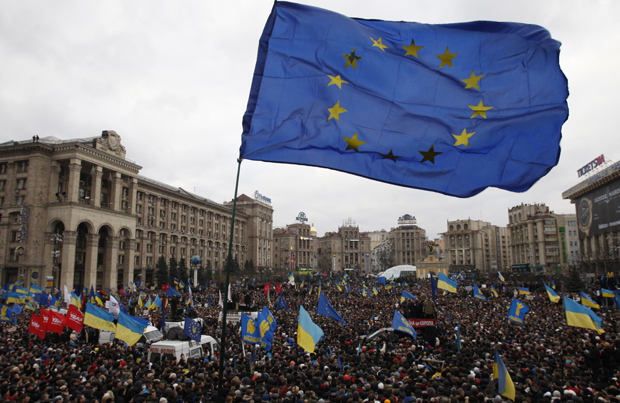
(Photo: Anatolii Stepanov / Demotix)
This article is part of a series based on our report, Time to Step Up: The EU and freedom of expression
Media concentration in the EU poses a significant challenge. The media in the EU is significantly more concentrated than in North America, even when taking into consideration explanations of population, geographical size and income. Even by global standards, media concentration in the EU is high.
Another challenge arises from national media regulation, which may both fail to protect plurality and, allow an unnecessary and unacceptable amount of political interference in the way the media works. While the EU does not have an explicit competency to intervene in all matters of media plurality and media freedom, it is not neutral in this debate. A number of initiatives are underway to help better promote media freedom, and in particular media plurality. Free expression advocates, including Index, welcome the fact that the EU is taking the issue of media freedom more seriously.
Media regulation
Across the European Union, media regulation is left to the member states to implement, leading to significant variations in the form and level of media regulation. National regulation must comply with member states’ commitments under the European Convention on Human Rights, but this compliance can only be tested through exhaustive court cases. While the European Commission has, in the past, tended to view its competencies in this area as being limited due to the introduction of the Charter of Fundamental Rights into EU primary law, the Commission is looking at its possible role in this area. In part, the Commission is acting upon the guidance of the European Parliament, which has expressed significant concerns over the state of media regulation, and in particular with regard to Hungary, where regulation has been criticised for curtailing freedom of expression.
The national models of media regulation across Europe vary significantly, from models of self-regulation to statutory regulation. These models of regulation can impact negatively on freedom of expression through the application of unnecessary sanctions, the regulator’s lack of independence from politicians and laws that create a burdensome environment for online media. Statutory regulation of the print and broadcast media is increasingly anachronistic, raising questions over how the role of journalist or broadcaster should be defined and resulting in a general and increasing confusion about who should be covered by these regulatory structures, if at all. Frameworks that outline laws on defamation and privacy and provide public interest and opinion defences for all would provide clarify for all content producers. In the majority of countries, the broadcast media is regulated by a statutory regulator (due to a scarcity of analogue frequencies that required arbitration in the past), yet, often, the print media is also regulated by statutory bodies, including in Slovenia, Lithuania, Italy; or regulated by specific print media laws and codes, for example in Austria, France, Sweden and Portugal. As we demonstrate below, many EU member states have systems of media regulation that are overly restrictive and fail to protect freedom of expression.
In many EU member states, the system of media regulation allows excessive state interference in the workings of the media. Hungary’s system of media regulation has been criticised by the Council of Europe, the European Parliament and the OSCE for the excessive control statutory bodies exert over the media. The model of “co-regulation” was set up in 2010 through a new comprehensive media law[1], culminating in the creation of the National Media and Infocommunications Authority, which was given statutory powers to fine media organisations up to €727,000, oversaw regulation of all media including online news websites, and acts as an extra-judicial investigator, jury and judge on public complaints. The president of the Media Authority and all five members of the Media Council were delegated exclusively by Hungary’s Fidesz party, which commanded a majority in Parliament. The law forced media outlets to provide “balanced coverage” and had the power to fine reporters if they didn’t disclose their sources in certain circumstances. Organisations that refused to sign up to the regulator faced exemplary fines of up to €727,000 per breach of the law. While the European Commission managed to negotiate to remove some of the most egregious aspects of the law, nothing was done to rectify the political composition of the media council, the source of the original complaint to the Commission.
Hungary is not the only EU member state where politicians have excessive influence over media regulators. In France, the High Council for Broadcasting (CSA), which regulates TV and radio broadcasting, has nine executives appointed by presidential decree, of which three members are directly chosen and appointed by the president, three by the president of the Senate, and three by the president of the National Assembly. According to the Centre for Media and Communication Studies, this system for appointing authorities has the fewest safeguards from governmental influence in the EU.
Many countries have statutory underpinning of the press, which includes the online press, including Austria, France, Italy, Lithuania, Slovenia and Sweden. Some statutory regulation can provide freedom of expression protections to those who voluntarily register with the regulatory body (for instance in Sweden), but in many instances, the regulatory burden and possibility of fines for online media can chill freedom of expression.
The Leveson Inquiry in the UK was established after the extent of the phone-hacking scandal was discovered, revealing how journalists had hacked the phones of victims of crime and high profile figures. Lord Justice Leveson made a number of recommendations in his report, including the statutory underpinning of an “independent” regulatory body, restrictions to limit contact between senior police officers and the press that could inhibit whistleblowing, and exemplary damages for publishers who remain outside the regulator. Of particular concern was the notion of statutory unpinning by what was claimed to be an “independent” and “voluntary” regulator. By setting out the requirements for what the regulator should achieve in law, it introduced some government and political control over the functioning of the media. Even “light” statutory regulation can be revisited, toughened and potentially abused. Combined with exemplary damages for publishers who remained outside the “voluntary” regulator (damages considered to be in breach of Article 10 of the European Convention of Human Rights by three eminent QCs), the Leveson proposals were damaging to freedom of expression. The situation was compounded by the attempt by a group of Peers in the House of Lords to exert political pressure on the government to regulate the press, potentially sabotaging much-needed reform of the archaic libel laws of England and Wales. This resulted in the government bringing in legislation through the combination of a Royal Charter (the use of the Monarch’s powers to establish a body corporate) and by adding provisions to the Crime and Courts Act (2013) that established the legal basis for exemplary damages. It is arguable that the Leveson proposals have already been used to chill public interest journalism.
In part a response to the dilemma posed by Hungary, but also to wider issues of press regulation raised by the Leveson Inquiry in the UK, vice president of the Commission Neelie Kroes has overseen renewed Commission interest in the area of media regulation. This interest builds upon the possibility of the Commission using new commitments introduced through the Charter of Fundamental Rights into EU primary law, such as Article 11 of the Charter, which states: “The freedom and pluralism of the media shall be respected.” The Commission is now exploring a variety of options to help protect media freedom, including funding the establishment of the Centre for Media Pluralism and Media Freedom and the EU Futures Media Forum. In October 2011, Kroes founded a High Level Group on Media Freedom and Pluralism to look at these issues in more detail. The conclusions were published in January 2013.
Many of the recommendations of the High Level Media Group are useful, in particular the first recommendation: “The EU should be considered competent to act to protect media freedom and pluralism at State level in order to guarantee the substance of the rights granted by the Treaties to EU citizens”. Yet some of the High Level Group’s conclusions do not provide a solution to questions of appropriate legislation within the EU. The group called for all member states to have “independent media councils” that are politically and culturally balanced with a socially diverse membership and have enforcement powers including fines, the power to order printed or broadcast apologies and, particularly concerning, the power to order the removal of (professional) journalistic status.[2] Political balance could be interpreted as political representation on the media councils, when the principle should be that the media is kept free from political interference. This was an issue raised in particular by Hungarian NGOs during the consultation. Also of particular concern is the suggestion that the European Commission should monitor the national media councils with no detail as to how the Commission is held to account, or process for how national media organisations could challenge bad decisions by the Commission. The Commission is awaiting the results of a civil society consultation. Depending on the conclusions of the Commission, stronger protections for media freedom may be considered when a state clearly deviates from established norms.
[1]Act on the Freedom of the Press and the Fundamental Rules on Media Content (the “Press Freedom Act”) and the Media Services and Mass Media Act (or the “Media Act”)
[2] p.7, High Level Media Group on Media Freedom and Pluralism
6 Jan 2014 | Europe and Central Asia, News
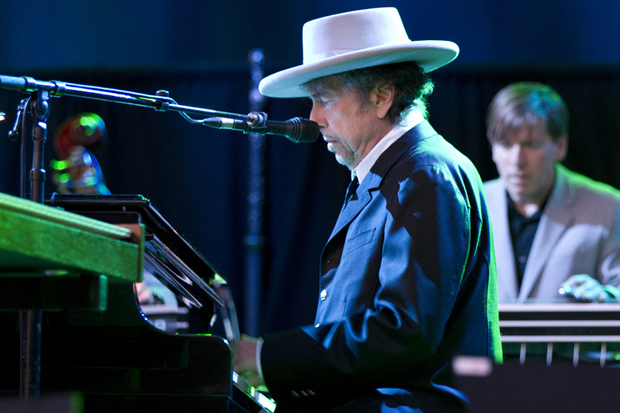
In France, Bob Dylan is being officially investigated for “incitement to hatred” against Croats for comparing their relationship to Serbs with that between Nazis and Jews in an interview.
This article is part of a series based on our report, Time to Step Up: The EU and freedom of expression.
Freedom of information
Freedom of information is an important aspect of the right to freedom of expression. Without the ability to access information held by states, individuals cannot make informed democratic choices. Many EU member states have failed to adequately protect freedom of information and the Commission has been criticised for its failure to adequately promote transparency and uphold its commitment to freedom of information.
When it comes to assessing global protection for access to information, not one European Union member state ranks in the list of the top 10 countries, while increasingly influential democracies such as India do. Two member states, Cyprus and Spain, are still without any freedom of information laws. Of those that do, many are weak by international standards (see table below).

In many states, the law is not enforced properly. In Italy, public bodies fail to respond to 73% of requests.
The Council of Europe has also developed a Convention on Access to Official Documents, the first internationally binding legal instrument to recognise the right to access the official documents of public authorities. Only seven EU member states have signed up the convention.
Since the Lisbon Treaty came into force, both member states and EU institutions are both bound by freedom of information commitments. Article 42 (the right of access to documents) of the European Charter of Fundamental Rights now recognises the right to freedom of information for EU documents as a fundamental human right Further, specific rights falling within the scope of freedom of information are also enshrined in Article 41 of the Charter (the right to good administration).
As a result, the European Commission has embedded limited access to information in its internal protocols. Yet, while the European Parliament has reaffirmed its commitment to give EU citizens more access to official EU documents, it is still the case that not all EU institutions, offices, bodies and agencies are acting on their freedom of information commitments. The Danish government used their EU presidency in the first half of 2012 to attempt to forge an agreement between the European Commission, the Parliament and member states to open up public access to EU documents. This attempt failed after a hostile response from the Commission. Attempts by the Cypriot and Irish presidencies to unblock the matter in the Council also failed.
This lack of transparency can and has impacted on public’s knowledge of how decisions that affect human rights have been made. The European Ombudsman, P. Nikiforos Diamandouros, has criticised the European Commission for denying access to documents concerning its view of the United Kingdom’s decision to opt out from the EU Charter of Fundamental Rights. In 2013, Sophie in’t Veld MEP was barred from obtaining diplomatic documents relating to the Commission’s position on the proposed Anti-Counterfeiting Trade Agreement (ACTA).
Hate speech
Across the European Union, hate speech laws, and in particular their interpretation, vary with regard to how they impact on the protection for freedom of expression. In some countries, notably Poland and France, hate speech laws do not allow enough protection for free expression. The Council of the European Union has taken action on combating certain forms and expressions of racism and xenophobia by promoting use of the criminal law within nation states in its 2008 Framework Decision. Yet, the Framework Decision failed to adequately protect freedom of expression in particular on controversial historical debate.
Throughout European history, hate speech has been highly problematic, from the experience and ramifications of the Holocaust through to the direct incitement of ethnic violence via the state run media during wars in the former Yugoslavia. However, it is vital that hate speech laws are proportionate in order to protect freedom of expression.
On the whole, the framework for the regulation of hate speech is left to the national laws of EU member states, although all member states must comply with Articles 14 and 17 of the ECHR.[1] A number of EU member states have hate speech laws that fail to protect freedom of expression –- in particular in Poland, Germany, France and Italy.
Article 256 and 257 of the Polish Criminal Code criminalise individuals who intentionally offend religious feelings. The law criminalises public expression that insults a person or a group on account of national, ethnic, racial, or religious affiliation or the lack of a religious affiliation. Article 54 of the Polish Constitution protects freedom of speech but Article 13 prohibits any programmes or activities that promote racial or national hatred. Television is restricted by the Broadcasting Act, which states that programmes or other broadcasts must “respect the religious beliefs of the public and respect especially the Christian system of values”. In 2010, two singers, Doda and Adam Darski, where charged with violating the criminal code for their public criticism of Christianity.[2] France prohibits hate speech and insult, which are deemed to be both “public and private”, through its penal code[3] and through its press laws[4]. This criminalises speech that may have caused no significant harm whatsoever to society, which is disproportionate. Singer Bob Dylan faces the possibility of prosecution for hate speech in France. The prosecutor’s office in Paris confirmed that Dylan has been placed under formal investigation by Paris’s Main Court for “public injury” and “incitement to hatred” after he compared the relationship between Croats and Serbs to that of Nazis and Jews.
The inclusion of incitement to hatred on the grounds of sexual orientation into hate speech laws is a fairly recent development. The United Kingdom’s hate speech laws contain specific provisions to protect freedom of expression[5] but these provisions are not absolute. In a landmark case in 2012, three men were convicted after distributing leaflets in Derby depicting a mannequin in a hangman’s noose and calling for the death sentence for homosexuality. The European Court of Human Rights ruled on this issue in its landmark judgment Vejdeland v. Sweden, which upheld the decision reached by the Swedish Supreme Court to convict four individuals for homophobic speech after they distributed homophobic leaflets in the lockers of pupils at a secondary school. The applicants claimed that the Swedish Supreme Court’s decision to convict them constituted an illegitimate interference with their freedom of expression. The ECtHR found no violation of Article 10, noting even if there was, the interference served a legitimate aim, namely “the protection of the reputation and rights of others”.
The widespread criminalisation of genocide denial is a particularly European legal provision. Ten EU member states criminalise either Holocaust denial, or the denial of crimes committed by the Nazi and/or Communist regimes. At EU level, Germany pushed for the criminalisation of Holocaust denial, culminating in its inclusion from the 2008 EU Framework Decision on combating certain forms and expressions of racism and xenophobia by means of criminal law. Full implementation of the Framework Decision was blocked by Britain, Sweden and Denmark, who were rightly concerned that the criminalisation of Holocaust denial would impede historical inquiry, artistic expression and public debate.
Beyond the 2008 EU Framework Decision, the EU has taken specific action to deal with hate speech in the Audiovisual Media Service Directive. Article 6 of the Directive states the authorities in each member state “must ensure by appropriate means that audiovisual media services provided by media service providers under their jurisdiction do not contain any incitement to hatred based on race, sex, religion or nationality”.
Hate speech legislation, particularly at European Union level, and the way this legislation is interpreted, must take into account freedom of expression in order to avoid disproportionate criminalisation of unpopular or offensive viewpoints or impede the study and debate of matters of historical importance.
[1] ‘Article 14 – discrimination’ contains a prohibition of discrimination; ‘Article 17 – abuse of rights’ outlines that the rights guaranteed by the Convention cannot be used to abolish or limit rights guaranteed by the Convention.
[2] The police charged vocalist and guitarist Adam Darski of Polish death metal band Behemoth with violating the Criminal Code for a performance in 2007 in Gdynia during which Darski allegedly called the Catholic Church “the most murderous cult on the planet” and tore up a copy of the Bible; singer Doda, whose real name is Dorota Rabczewska, was charged with violating the Criminal Code for saying in 2009 that the Bible was “unbelievable” and written by people “drunk on wine and smoking some kind of herbs”.
[3] Article R625-7
[4] Article 24, Law on Press Freedom of 29 July 1881
[5] The Racial and Religious Hatred Act 2006 amended the Public Order Act 1986 by adding Part 3A[12] to criminalising attempting to “stir up religious hatred.” A further provision to protect freedom of expression (Section 29J) was added: “Nothing in this Part shall be read or given effect in a way which prohibits or restricts discussion, criticism or expressions of antipathy, dislike, ridicule, insult or abuse of particular religions or the beliefs or practices of their adherents, or of any other belief system or the beliefs or practices of its adherents, or proselytising or urging adherents of a different religion or belief system to cease practising their religion or belief system.”
3 Jan 2014 | Digital Freedom, News, United States
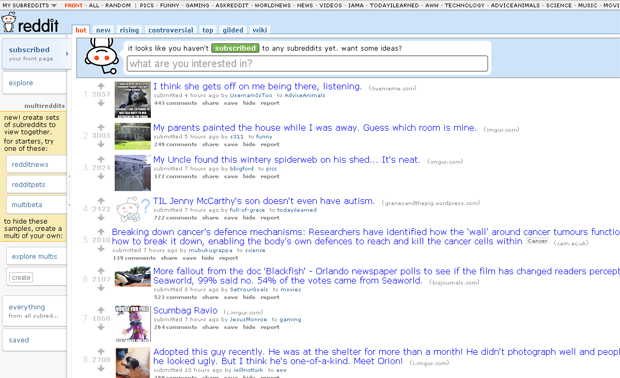
San Fransisco based Reddit.com made headlines when it allegedly banned climate change deniers from posting on the site.
UK-based freedom of speech advocate Brendan O’Neill, editor of Spiked magazine, claimed it had “shredded its own reputation” in a piece for The Telegraph, while James Delingpole, a right-wing commentator for The Spectator delivered a hot-blooded attack on the policy via Fox News website – “The greenies — and their many useful idiots in the liberal media — are terrified of open debate on climate-change because the real world evidence long ago parted company with their scientifically threadbare theory.”
Reddit is a huge online links directory and lively discussion board, with a reputation for scale, wit, lack of censorship and a strong sense of community. Over eighty million monthly unique visitors, two hundred and sixty million comments to date and a presence in one hundred and eighty countries are some of the stats that led Conde Nast to buy the company a year after it was launched in 2005. Last year, analysts valued it at over $200 million dollars. It’s no Facebook or Twitter in terms of publicity attracted, but it gets more traffic than CNN, and the Guardian.com’s monthly readership could fit into Reddit’s three times over.
It’s the famed lack of censorship that has lead opinion writers on both side of the Atlantic to point out this new policy on climate change denial.
For those who haven’t visited, the site is divided up into sub-reddits–links and discussions, which are classified according to themes, and run by unpaid volunteers.
“TIL,” shorthand for “Today I Learned,” offers obscure trivia and little known facts. “foreignpolicy” offers links and discussion on international relations, defence and diplomacy. “foodforthought” collates links to thought-provoking essays. There are subreddits for jokes, celebrity gossip, memes and funny videos – for agony aunts and video gaming.
In fact, rather than reddit.com having banned climate change skeptics, it’s the moderators of the “/r/science” reddit who have instigated the ban. Run by volunteers, it collects links about new research and scientific articles.
“/r/science is not the beginning or the end of internet discussion”, defends Carl Ellstrom from Sweden – a reddit user, scientist and moderator of the science subreddit. “Users who are banned from /r/science are not banned from reddit, and can discuss their opinions in other subreddits.”
While it’s not the beginning or the end, /r/science still attracts millions of visitors each month. So the decision to ban climate change scepticism is of note.
Typical of their profession–other moderators backed up the decision by citing research–97% of climate scientists agree that man is changing the planet, according to a report from the respected Institute of Physics.
The move principally revolved around aggressive and repeated comments, which a small group of malicious users were posting on every article or piece of research concerned with climate change. Their allegations generally focused on conspiracy theories, didn’t address the article with constructive, focused criticism, were repetitive and, critically, had a disproportionate silencing effect on any discussion.
“These problematic users were not the common ‘internet trolls’ looking to have a little fun upsetting people,” explains Nathan Allen, a PhD chemist with a major chemical company and reddit moderator who wrote for The Guardian.
“These people were true believers, blind to the fact that their arguments were hopelessly flawed, the result of cherry-picked data and conspiratorial thinking. They had no idea that the smart-sounding talking points from their preferred climate blog were, even to a casual climate science observer, plainly wrong. They were completely enamoured by the emotionally charged and rhetoric-based arguments of pundits on talk radio and Fox News.”
Expanding on that last point Allen says the same comparison could be made with the climate change denial lobby in general, and their disproportionate influence on the press.
“Like our commenters, professional climate change deniers have an outsized influence in the media and the public. And like our commenters, their rejection of climate science is not based on an accurate understanding of the science but on political preferences and personality.”
He ends his piece with a deliberate challenge to the editors of the world’s largest websites
“If a half-dozen volunteers can keep a page with more than 4 million users from being a microphone for the antiscientific, is it too much to ask for newspapers to police their own editorial pages as proficiently?”
If Allen’s suggestion was ever to be noticed and accepted by editors–he ramifications for freedom of speech and media censorship would be radical. Editors might be forced to ignore lobbying from certain spheres of belief, or might miss out on important stories.
But UK research published earlier in the year, shows the disproportionate effect on distorting the truth that having a free and open press creates.
On average, Brits think teenage pregnancies are twenty five times higher than official estimates. The public think 31% of the population are immigrants–the reality is closer to ten percent. Welfare benefit fraud is thought to be 34 times higher than it actually is.
All of the misconceptions covered by IPSOS Mori, the polling company that undertook the research, have been central to political party manifestos and been aggressively pushed by their PR companies.
Or that journalists are too readily being made tools of political parties who want to get elected, who want the issues that they care most about continually in the press, hotly discussed and “on the agenda.” Perhaps we, as journalists, need to remain ever vigilant to the briefing of misinformation and our responsibility to the truth.
This article was published on 3 Jan 2014 at indexoncensorship.org
