29 Nov 2013 | News, Uganda
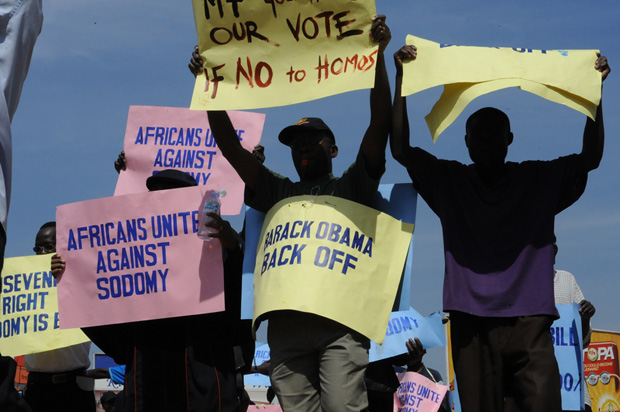
Hundreds of Ugandans took to the streets in support of the government’s proposed anti-homosexuality bill in 2009 (Image: Edward Echwalu/Demotix)
The Ugandan government’s position on homosexuality is considered one of the harshest in the world. The proposed Anti-Homosexuality Bill, seeks to, among other things, broaden the criminalisation of homosexuality so that Ugandans who engage in same-sex relations abroad can be extradited to Uganda and charged. Originally, some of the provisions in the law called for death penalties or life sentences for those convicted as homosexuals. It has since been amended to remove the proposal of death penalties, but the life sentences remain.
A special motion to introduce the legislation was passed only a month after a two-day conference where three American Christians asserted that homosexuality is a direct threat to the cohesion of African families. Indeed, the church — both Anglican and Catholic — plays a big role in shaping the government’s tough stance on homosexuality. New Pentecostal churches are also fuelling the anti-gay message, with firebrand crusaders like Pastor Martin Sempa at the forefront.
Together, the state and the church accuse the gay community of recruiting young people in schools. There have also been claims that gay people are recording sex videos with young Ugandans that they then sell abroad. It is said that young people are lured into this with promises of financial gains. Sixty-five-year-old Brit Bernard Randall is facing trial for engaging in gay sex, and for possession of videos of him engaging in gay sex.
Anti-gay legislation has been in place in Uganda for some time. Laws prohibiting same-sex sexual acts were first introduced under British colonial rule in the 19th century, and those were enshrined in the Penal Code Act 1950. Section 146 states that “any person who attempts to commit any of the offences specified in section 145 commits a felony and is liable to imprisonment for seven years.” On 29th September 2005, President Museveni also signed a constitutional amendment prohibiting same-sex marriages.
But the anti-gay bill is not the only story on this topic to come out of Uganda in recent times. In 2004, the Uganda Broadcasting Council fined Radio Simba $1,000 for hosting homosexuals on one of its shows, and the radio station was forced to make a public apology. In January 2011, LGBT activist David Kato was killed. Kato, together with Patience Onziema and Kasha Jacqueline, had successfully sued a Ugandan paper the Rolling Stone and its Managing Editor Giles Muhame. The paper had published their full names and photos, as well as those of a number of other allegedly gay people and called for the lynching of all homosexuals. The court issued a permanent injunction preventing the paper and the editor from publishing the identities of any other homosexuals. Kato’s murderer, Enoch Nsubuga, was handed down a 30-year prison sentence.
On 3 October 2011, a local human rights and LGBT activist challenged a part of the Equal Opportunities Commission Act in the Constitutional Court. Section 15(6)(d) prevents the Equal Opportunities Commission from investigating “any matter involving behaviour which is considered to be (i) immoral and socially harmful, or (ii) unacceptable by the majority of the cultural and social communities in Uganda.” The petitioner argued that this clause is discriminatory and violates the constitutional rights of minority populations. A decision has not yet been made on the petition.
The bill has, however, caused the most outrage. The Ugandan government and the evangelicals faced immense international criticism, and the bill was met with protests from LGBT, human rights and civil society groups. Countries including Sweden even threatened to stop their aid to Uganda in protest.
In response to the attention, the bill was revised to drop the death penalty, and President Yoweri Museveni formed a commission to investigate the possible repercussions of passing it. The Speaker of the Ugandan parliament promised in November 2012 the bill would pass by the end of the year as a Christmas gift for the group that supported it. It is, for now, still on hold. But while the Ugandan government has toned down its rhetoric against the gay community lately — this is believed to be due to international pressure — the persecution of gay people in the country persists.
This article was originally posted on 29 Nov 2013 at indexoncensorship.org
16 Oct 2013 | Belarus, European Union, News
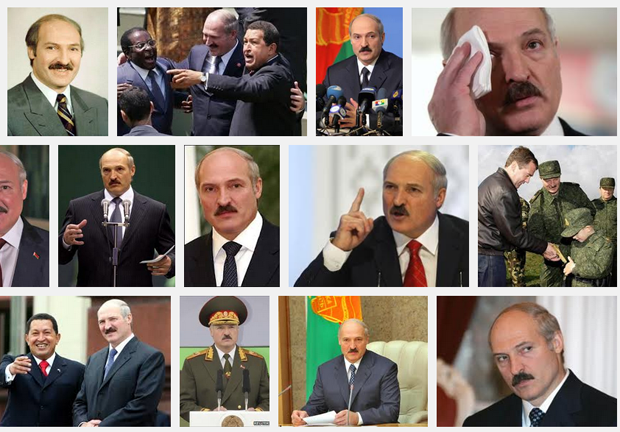
An old Belarusian joke suggests a simple way of improving one’s life. If you feel unhappy, just allow a goat in your house, live with it for some time, and then take the goat away. In principle, nothing changes – but you feel real relief and happiness! This is exactly the way the foreign policy of Belarus operates.
Close the Swedish embassy in Minsk, and then allow its re-opening. Arrest Vladislav Baumgertner, the CEO of the Russian potash giant Uralkaliy, and then set him free. In principle nothing changed, but each story ended with something like “an improvement in the situation” – or at least with an impression of such.
Last year EU-Belarus relations, already on the rocks, were further damaged by the infamous teddy-bear parachuting and subsequent diplomatic scandal with Sweden. In comparison with that period of “cold war” 2013 looks relatively moderate. For instance, the Belarusian foreign minister Uladzimir Makey was temporarily dropped from the EU travel ban list. Nonetheless, the overall temperature of relations is frosty.
Political prisoners remain jail in Belarus. The fact two of them were released recently had nothing to do with the authorities’ good will; it happened just because their prison terms expired. The decision to suspend the travel ban for Makey was also purely technical. The position of Foreign Minister from the very beginning wasn’t on the EU travel ban list in order to leave a channel for direct communication with Belarusian authorities. Makey, personally, is still on the black list and will not be allowed to enter the EU if he leaves his minister position.
NGOs and opposition excluded from talks?
Since the beginning of 2013 the number of contacts between the EU and the Belarusian Foreign Ministry has increased. EU diplomats call this process “consultations with the Belarusian government”. But it’s hard to say exactly what the content of these consultations is. It is known that the Belarusian side propose to re-organise the European Dialogue on Modernisation. This EU initiative would establish intergovernmental relations between the European Commission and the Belarusian authorities, including an annual meeting of presidents Lukashenka and Barroso. But they have also suggested excluding representatives of civil society and political opposition from the Dialogue.
According to Belarusian authorities’ rhetoric, any relations with the EU within the framework of the Dialogue on Modernisation or the Eastern Partnership should be built “on equal basis and should focus on mutually beneficial projects.” In translation from diplomatic to real language this is nothing but a request to lift all the conditions related to democracy, rule of law and human rights, and simply invest in Belarus’ economic and infrastructure development.
It comes as no surprise that the EU is not ready to fully support these proposals right now. That they’re ready to talk about it, however, does. The next phase of the European Dialogue on Modernisation is going to be limited to experts with a focus on the themes that only the Belarusian government is interested in. In fact, civil society has not been granted the status of full participants in the Dialogue – despite numerous statements and appeals about the vital necessity of this.
Opposition fractured, weakened and ineffectual
In 2014, the European Commission and the European External Action Service (EEAS) will change their staff, so they should be interested in showing some progress with regards to Belarus. In the absence of real progress, renewal of official contacts with the Belarusian authorities could be presented as an achievement.
It is not worth blaming the EU for such behaviour, though, all the while Belarusians themselves have not done much to change the situation. Neither autocrats or democrats have undertaken significant steps to resolve the current deadlock. The latter manage to disunite – without ever forming a real unity in the first place. Political opposition was formally divided into two parts; the “People’s Referendum” campaign and the “For free and fair elections” coalition. Real differences between the two are hard to explain. Both of them pray to the old God of “communication with ordinary people”. This is a noble task in any sense, but actions proposed are not significantly different from previous unsuccessful attempts to respond to the people’s needs. The oppositions’ slogans are not easy to understand even for their closest civil society allies. Sometimes it feels like these activities are implemented just for the sake of keeping political activists busy, gaining some media attention and getting some resources from donors in the process.
The main aim for the opposition forces is to remain on the political scene until the next presidential elections. Independent civil society organisations are also divided in different camps and have lost their positive dynamics of previous years; still they have much more potential than the weakened political opposition. As a result of disunity among democrats they cannot respond properly to the EU proposals or the challenges of the internal political situation. The EU is listening to the contradictory voices of various Belarusian activists without the possibility to coordinate with them on the main course of action.
Challenges in encouraging change
Thus, the EU policy faces a clear choice: either to wait for internal changes in Belarus or try to actively facilitate them. The recommendations of the European Parliament on the EU policy towards Belarus (the so-called Paleckis’ report), adopted on 12 September 2013, make step in the latter direction. The central idea of strengthening pro-European attitudes among different groups of actors from the civil society to open-minded civil servants via closer engagement in cooperation with the EU looks good. Civil society is seen as one of the key actors in political dialogue with the EU. It is also mentioned that “the National Platform of the Civil Society Forum of the Eastern Partnership is an important and reliable partner and a unique communication channel to the Belarusian people for the EU”. Actions aiming at communicating European policies to the Belarusian citizens, expanding education programs, development of scientific cooperation are also recommended.
The European Parliament doesn’t propose significant changes in the current EU policy, but the EU needs to go much deeper into the Belarusian political situation to insure even these slight changes. The new way lies between facilitation of public dialogue between the Belarusian authorities and civil society on the one hand, and playing the engagement game with nomenklatura on the other hand.
This is not an easy task, it needs a lot of reflectivity, good understanding of the field, strong diplomacy and coordination between various actors’ – civil society organizations, political opposition forces, donor structures, EU member states, and international organizations like Council of Europe, OSCE, UN.
While playing this complicated game in some cases the EU will have to back one internal actor and its strategies against others. And this is what the EU is not ready to do. The overall approach demands to support all the actors who proclaim pro-democratic and pro-EU values. As a result the EU policy creates a plurality and centrifugal trends within the civil society and political opposition that is the main obstacle for consolidation among democrats. Attempts of strategic unification immediately run into charges of “monopolization” and “privatization” of civil society voice. The EU needs a strong internal counterpart in Belarus, which never appears without civil society consolidation, but it is not ready to let this consolidation happen. This vicious circle must be broken to proceed with the Belarus situation.
Of course, there is another way: impose travel ban on Minister Makey, then lift it – and, according to the famous “goat principle”, feel relief…
This article was originally published on 16 Oct 2013 at indexoncensorship.org
24 Sep 2013 | Campaigns, Press Releases
What is actually happening?
Following initial revelations in The Guardian by whistleblower Edward Snowden, reports by international media organisations, including the New York Times and Washington Post, have revealed that the US, UK and other countries’ governments have been carrying out mass surveillance of both meta data and content by tapping into communications cables. This means that governments are gathering and storing data about your phone calls, emails, texts and search and browsing history. They have the ability to access passwords as well as the actual content of emails, text messages and online chats. It is still not known how long this data is being stored for. Gathering and storing information in this way and on this scale is an attack on our right to privacy and a threat to our right to free speech.
Which governments are carrying out mass surveillance?
Most newspaper reports have concentrated on mass surveillance by the US government’s National Security Agency (NSA) and the UK’s Government Communications Headquarters (GCHQ). However, there have also been revelations about France, Germany, Sweden and the Netherlands.
Why is mass surveillance wrong?
Mass surveillance of private communications is an attack on our right to privacy and our right to free speech. Gathering data from entire populations is unlawful under human rights law as it violates our right to privacy. It also threatens free speech. How can we speak freely if our confidential emails, texts and chats are being read?
Is all surveillance wrong?
No. Governments and the police may need to carry out targeted surveillance to try and prevent crimes, including terrorist attacks. However, there need to be legal safeguards to prevent abuses of power and to hold those gathering information to account. There should also be transparency about how data is gathered, stored and used.
Surveillance should be targeted towards people who are suspected of planning or committing a crime, not entire populations. Usually decisions about who should be targeted by surveillance should be made by an independent body or by judges.
I haven’t got anything to hide so why should I be worried about mass surveillance?
Governments say that if you aren’t doing anything wrong, you have nothing to worry about. In reality, restricting our human rights threatens the freedom and security that the same governments are claiming to protect.
Mass surveillance can be used to target activists, such as environmental groups, who are critical of government policies. Activists and opposition groups and the media should be able to hold governments to account without having their communications monitored.
Mass surveillance can also be used to monitor and threaten investigative journalism, threatening the anonymity of sources and potentially exposing lines of investigation. This in itself threatens the freedom of the press.
We all have a right to privacy and the state should not interfere in our private communications. After all, you wouldn’t want the government reading your letters, so why should they read your emails?
What can I do?
Sign our petition calling on the EU’s leaders to end mass surveillance. Share it with as many people as possible so that we can put pressure on the EU to take a stand.
What can the EU do about it?
Mass surveillance must be on the agenda when EU leaders meet in October. Firstly, the EU’s leaders need to condemn mass surveillance by the US, UK and other European governments. Secondly, they need to take joint action to stop the mass collection of data about European and other citizens.
Can I sign the petition if I am not an EU citizen?
Yes, and please share with friends outside the EU. We want people from around the world to come together to say no to mass surveillance.
This article was originally posted on 24 Sept 2013 at indexoncensorship.org
27 Jun 2013 | Digital Freedom, Europe and Central Asia
The EU needs to develop a coherent and comprehensive digital freedom strategy. Brian Pellot writes
Recent revelations from the US National Security Agency have shown that our fundamental rights to privacy and freedom of expression are being compromised on a global scale. This is true despite false assurances to the contrary and the US government’s consistent rhetoric celebrating digital freedom. Unfortunately, the US is far from alone in peddling such hypocrisy. The EU as a whole and its individual member states also promote digital freedom in press conferences yet often undermine positive words with contradictory policies at home and abroad.
(more…)
