2 Dec 2016 | Mapping Media Freedom
[vc_row][vc_column][vc_column_text]Each week, Index on Censorship’s Mapping Media Freedom project verifies threats, violations and limitations faced by the media throughout the European Union and neighbouring countries. Here are five recent reports that give us cause for concern.
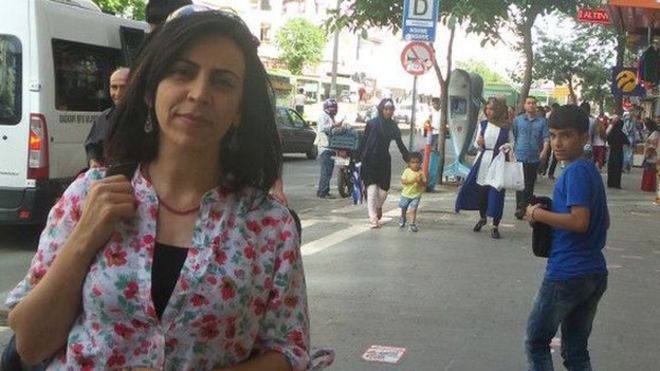
Hatice Kamer (Photo: BBC)
Hatice Kamer, also known as Khajijan Farqin, is a freelance journalist for BBC Turk and Voice of America. She was detained in Diyarbakir on 26 November while reporting on a landslide that killed at least ten workers in a copper mine.
Kamer was taken into custody in Siirt province at a police checkpoint; reasons for her detention remain unclear. Due to the state of emergency declared in Turkey, even the journalist’s attorney was unable to contact her.
On 27 November Kamer was released after spending a night in jail. She was told she would face charges of supporting the Kurdistan Workers Party (PKK) through her reporting. The journalist states there is no evidence of supporting the outlawed party through her work.
Dutch-American journalist Kevin Roberson, owner of the online news portal Roberson Report, was attacked at an anti-Black Pete demonstration in Utrecht.
Black Pete is a character in Dutch folklore said to be a servant to Saint Nicholas. The character is often portrayed by a white person in blackface and has become subject to controversy in the Netherlands, many claiming the inclusion of the character in Sinterklaas traditions is racist.
At the event, a group of Black Pete defenders emerged, identifying themselves as members of the alt-right movement Nederlandese Volks-Unie (NVU).
One of the members attacked Roberson from behind, hitting him on the head and neck then running away. Roberson posted the video online. The journalist told Mapping Media Freedom that he is fearing for his safety. “My home address is circulating in right-wing social media groups,” Roberson stated, “I don’t feel safe anymore.”
Roberson is pressing charges against the attacker.
On 25 November, Russian TV channel Dozhd reported that two of its correspondents, Sergei Polonsky and Vasiliy Yerzhenkov, were detained by intelligence agencies in the self-proclaimed Donetsk People’s Republic.
Dozhd reported that, “Three employees of the Ministry of State Security were involved in the interrogation. They watched videos and deleted them. They also blocked Polonsky’s phone, broke Yerzhenkov’s phone and destroyed his notebook.”
Polonsky stated that they did not receive physical abuse, only psychological. The reporters were told that the reason for their detention was “false information” in their accreditation, but Polonsky proved that the information was correct.
Yerzhenkov and Polonsky were in the region to interview Alexey Khodakovsky after receiving permission from the Security Service of Ukraine and the ministry of the Donetsk People’s Republic.
The two reporters are now banned from entering the area after giving “biased” and “provocative” reports on Donetsk.
At a rally for the main Macedonian opposition party, the Social Democratic Union of Macedonia (SDSM), a TV journalist and cameraperson for the Macedonian TV channel MTV 1 were insulted by party supporters.
In Tetovo, this was not the first time an incident like this occurred. “We would like to emphasise that this is not the first time our journalists have been insulted during an SDSM rally,” an MTV 1 report stated, “Our journalists are being blocked from fulfilling their professional duties.”
The reporters were harassed, insulted and spat on as they attempted to report from the rally. The SDSM condemned the incident, saying they were against any negative treatment of the media regardless of its beliefs.
A film crew for REN TV in Moscow was assaulted after investigating fraud at a candle company. According to the clients, the company was offering candle-making lessons which clients would pay for, but the company would take the money and leave the clients without lessons.
While speaking to the director of the company, the crew was attacked by him after he blocked one of the cameramen and pushed reporter Dariya Ermakova to the ground. The incident was caught on video by one of the other cameramen.
Ermakova filed a report to the police who are currently investigating. [/vc_column_text][/vc_column][/vc_row][vc_row][vc_column][vc_column_text]
Click on the bubbles to view reports or double-click to zoom in on specific regions. The full site can be accessed at https://mappingmediafreedom.org/
[/vc_column_text][vc_basic_grid post_type=”post” max_items=”4″ element_width=”6″ grid_id=”vc_gid:1480680872724-f03c210d-ad9e-2″ taxonomies=”6564″][/vc_column][/vc_row]
29 Nov 2016 | Campaigns, Campaigns -- Featured, Index Reports, Press Releases
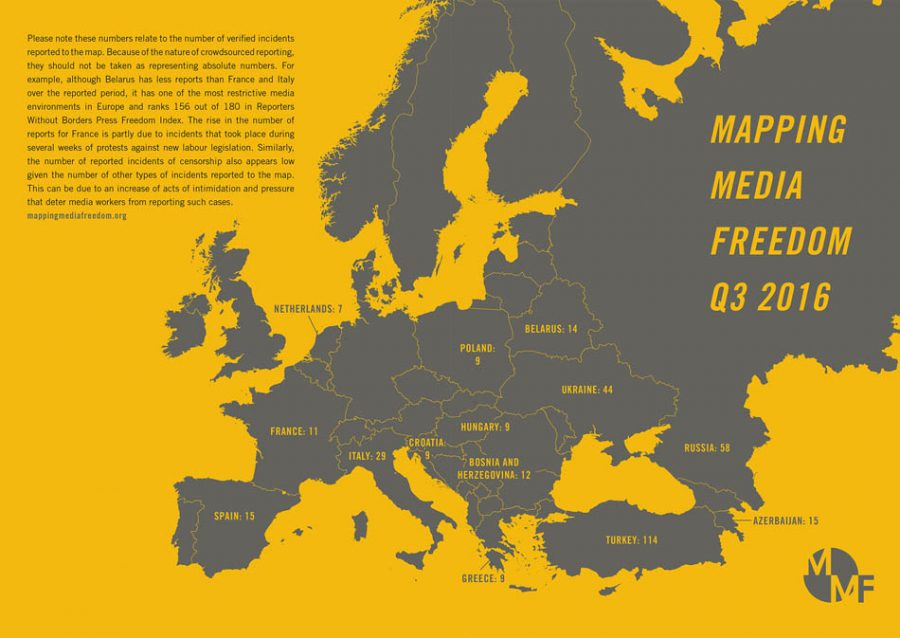
An unprecedented series of crackdowns on media professionals and news outlets took place in Europe and neighbouring countries during the third quarter of 2016, recorded by Index on Censorship’s Mapping Media Freedom project.
Between 1 July and 30 September MMF’s network of correspondents, partners and other sources submitted a total of 406 verified reports of threats to press freedom, a 19% rise from the second quarter of 2016.
An important factor in the rise in media violations was the attack on Turkey’s democratically-elected government on 15 July. Following the failed coup attempt, Turkish authorities forced more than 2,500 journalists out of their jobs, arrested and prosecuted 98 under trumped-up criminal charges, detained 133 and seized or shut down 133 media outlets. The post-coup environment in the country is explored in an extensive case study.
“The post-coup situation for media freedom in Turkey is dire. The sheer number of journalists arrested, detained and charged is without precedent in Europe. At the same time the reports collected by the map are pointing to other areas of concern in Russia and Ukraine,” Hannah Machlin, Mapping Media Freedom project officer, said.
Key findings from the third quarter 2016 report:
- Four journalists were killed: Two in Ukraine, one in Russia and one in Turkey
“With nine out of every 10 murders of journalists never solved, the vicious cycle of impunity still prevails. It has to be broken. There can be no exception to the very basic rule that all attacks on journalists must be investigated quickly and thoroughly. We should never give up the fight for journalists’ safety and the struggle to end impunity for crimes committed against journalists,” Dunja Mijatović, OSCE Representative on Freedom of the Media, said.
- 54 incidents of physical assault were reported
- 107 media professionals were arrested; 150 were detained and released
- 112 reports of intimidation, which includes psychological abuse, sexual harassment, trolling/cyberbullying and defamation, were made
“Reporters Without Borders is deeply concerned by the many cases of the use of violent intimidation tactics to silence journalists over the past few months. Acts of violence, and impunity for these acts, has a serious chilling effect on freedom of expression and freedom of information. The increasing use of violence to silence critical voices is part of a global trend of deteriorating press freedom, which must be addressed as a matter of urgent priority”, said Rebecca Vincent, UK Bureau Director for Reporters Without Borders (RSF)
- Journalistic work was censored or altered 29 times
- Media professionals were blocked from covering a story in 89 cases.
The report is available in web and pdf formats.
For more information, please contact Hannah Machlin, Mapping Media Freedom project officer at [email protected]
About Mapping Media Freedom
Mapping Media Freedom – a joint undertaking with the European Federation of Journalists and Reporters Without Borders, partially funded by the European Commission – covers 42 countries, including all EU member states, plus Bosnia, Iceland, Kosovo, Macedonia, Montenegro, Norway, Serbia, Turkey, Albania along with Ukraine, Belarus and Russia in (added in April 2015), and Azerbaijan (added in February 2016). The platform was launched in May 2014 and has recorded over 2,500 incidents threatening media freedom.
28 Nov 2016 | Campaigns, Campaigns -- Featured, Statements
[vc_row][vc_column][vc_column_text]Ladies and gentlemen, Rafto laureates. It is my pleasure to be asked to speak to you today on the occasion of the 30th anniversary of the Rafto Foundation.
I represent Index on Censorship, an organisation that was born, much like Rafto, to help give voice and support to dissidents behind the Iron Curtain but whose mission, like Rafto’s, quickly spread much wider. Index is a freedom of expression organisation that campaigns against censorship globally and promotes the value of free expression.
Today I will talk about what I think is the hardest of all issues for free speech activists: the question of hate speech. And the question of whether it is possible to balance a belief in true freedom of expression for all with the recognition that, in many instances, hateful speech is used in such a way that can suppress the voices of minority and oppress groups.
What I want to offer today is a provocation. I want to argue that it is only by allowing free speech – that is allowing all forms of speech, including those espousing hateful views – that we can ultimately protect minority and oppressed groups. That the answer to hateful speech is not more bans or ever widening laws or definitions of hate, but finding mechanisms that better allow the speech of all groups to flow.
If the market for free ideas and the free exchange of ideas and opinions does not yet work perfectly, the answer is not to ban people from having a voice
I want to start by going back to basics and asking the question, why is free speech important? For me, and for Index, freedom of speech is the most important freedom because it is the freedom on which all others rest. If one cannot express freely one’s desires, one’s political or religious views, how can we be truly free? Without free speech, how can one speak out against the oppressor. Without free speech, the oppressed and marginalised are forced to suffer in silence.
John Stuart Mill wrote: “It is on the freedom of opinion and the freedom of expression of opinion, that the well-being of mankind depends” but I think Shahzad Ahmad, the 2014 winner of Index on Censorship Freedom of Expression Awards said it better: “Freedom of expression. To me this is the ultimate freedom: it means the freedom to live, to think, to love, to be loved, to be secure, to be happy.”
Freedom of speech is enshrined in the UN Declaration of Human Rights, the European Convention on Human Rights, the First Amendment. It became a sort of mantra in the wake of the killings last year at French satirical magazine Charlie Hebdo. You would think this was a freedom and a value on which we could all agree. And yet. And yet. The question of where we draw the line on free speech drives a wedge through our apparent agreement that free speech is a universal good with parameters on which we can all agree. And it is this ‘I am in favour of free speech BUT’ question that I want to address today.
Most commonly articulated in the aftermath of Charlie Hebdo was the position “I am in favour of free speech” but not when it is targeted against minorities. Definitions of what constituted a minority in these instances differed – from the religious groupings to ethnic grouping to socio-economic groupings. This sense that speech should not be used to punch down found its most powerful manifestation in the objection to many members of the American PEN center to Charlie Hebdo receiving a courage award in the months after the killings. This led still more – including a number of governments – to suggest that in order to deal with the effects of offensive speech, what was needed were more hate speech laws, not fewer. Those who objected to the works of groups like Charlie Hebdo argued that this would help protect minorities from words and images that they believe leads directly to more aggressive forms of discrimination, but also protect communities from the burgeoning non-violent, but nevertheless extremist messaging that many nations see as the source of violent extremism.
In practice, this sounds fairly reasonable. Cut out the hateful words, eliminate the violent behaviours, the discrimination, the racism, the homophobia. Except this is not how it works. And those who advocate and wish for additional hate speech laws, which – increasingly – seem to mark the advent of a return to blasphemy laws in many places where we thought they had been eliminated – should be careful what they wish for.
As the US delegation noted in a Human Rights Council meeting last year: “legal prohibitions on incitement are often used to persecute members of minority groups and political opponents, raising serious freedom of expression concerns.
“Such laws, including blasphemy laws, tend to reinforce divisions rather than promote societal harmony. The presence of these laws has little discernable effect on reducing actual incidences of hate speech. In some cases such laws actually serve to foment violence against members of minority groups accused of expressing unpopular viewpoints.
“In addition, legal prohibitions can displace societal efforts to combat intolerance. This occurs because disputes over hate speech are then seen as matters for courts to decide rather than society at large. Combating hate speech requires a change in the societal attitudes that give rise to discriminatory views. Prohibiting speech is a poor, if not counterproductive, means of achieving that goal.”
You need look no further than the discussions within the same Human Rights Council for evidence of the way in which hate speech laws are easily manipulated to target those with opposing view rather than protect minorities. During the debate, Russia praised hate speech laws, talking of the need to monitor “hate speech“ in Ukraine so as not to ignite “nationalistic fires.”
China – not celebrated for its tolerance of free speech – praised hate speech legislation, saying speech on the internet needed to promote the “norms of civilisation” and “harmony.”
It is easy to feel, particularly in the wake of Brexit in the UK and the rise of the so-called alt-right in the US, and the apparent rise in hateful, racist and misogynistic speech, that the best solution to support those affected such speech is to ban it. But I want to argue strongly that any acts that actively seek to limit the speech of one group, is ultimately detrimental for all. I want to argue against the current meme I see particularly in American discourse that says free speech is a construct for privileged white men to argue that free speech – genuine free speech that includes the ability to say things others find offensive, hateful and hurtful – is what protects all our rights to speak. If the market for free ideas and the free exchange of ideas and opinions does not yet work perfectly, the answer is not to ban people from having a voice, it is to work even harder – as everyone of you here does on a daily basis – to raise up the voices of those who are still not being heard, to demand the right to speak.[/vc_column_text][/vc_column][/vc_row][vc_row][vc_column][vc_basic_grid post_type=”post” max_items=”4″ element_width=”6″ grid_id=”vc_gid:1480340935409-d0a11d11-e407-8″ taxonomies=”6534″][/vc_column][/vc_row]
28 Nov 2016 | Index in the Press
Journalists are facing an “unprecedented” wave of attacks around the world with increased hostility to the media leading to assaults on individuals as well as press freedom, according to a new report.
A series of crackdowns on media workers and news outlets in Europe as well as elsewhere has confirmed 2016 as one of the most dangerous times to be a journalist, according to the latest figures compiled by Index on Censorship. Read the full article
