17 Sep 2020 | Volume 49.03 Autumn 2020, Volume 49.03 Autumn 2020 Extras
[vc_row][vc_column][vc_custom_heading text=”The brave stand up when others are afraid to do so. Let’s remember how hard that is to do, says Rachael Jolley in the autumn 2020 issue of Index on Censorship magazine.”][vc_column_text]
 Ruth Bader Ginsburg is a dissenting voice. Throughout her career she has not been afraid to push back against the power of the crowd when very few were ready for her to do so.
The US Supreme Court justice may be a popular icon right now, but when she set her course to be a lawyer she was in a definite minority.
For many years she was the only woman on the court bench, and she was prepared to be a solitary voice when she felt it was vital to do so, and others strongly disagreed.
The dissenting voice and its place in US law is a fascinating subject. A justice on the court who disagrees with the majority verdict publishes a view about why the decision is incorrect. Sometimes, over decades, it becomes clear that the individual who didn’t go with the crowd was right.
The dissenting voice, it seems, can be wise beyond the established norms. By setting out a dissenting opinion, it gives posterity the chance to reassess, and perhaps to use those arguments to redraft the law in later times.
Bader Ginsburg was the dissenting voice in the case of Ledbetter v Goodyear – in which Lily Ledbetter brought a case on pay discrimination but the court ruled against her – and in Shelby County v Holder on voting discrimination, an issue likely to be hotly debated again in this year’s US presidential election. Bader Ginsburg’s opinions may not have been in the majority when those cases were heard but the passage of time, and of some legislation, proved her right.
The dissenting voice in law is a model for why freedom of expression is so vital in life. You may feel alone in your fight for the right to change something (or in your position on why something is wrong), but you must have the right to express that opinion. And others must be willing to accept that minority views should be heard – even if they disagree with them.
Fight for the principle, and when the time comes that you, your friends or your neighbours need it, it will be there for you.
Right now, writers, artists and activists are standing up for that principle, not necessarily for themselves but because they feel it is right.
Sometimes they also bravely dissent when most people are afraid to speak up for change, or to disagree with those who shout the loudest.
Being different and on the outside is a lonely place to be, but the pressure is even greater when you know opposing an idea, or law, could mean losing your home or your job, or even landing in prison.
[/vc_column_text][/vc_column][/vc_row][vc_row][vc_column width=”1/4″][vc_icon icon_fontawesome=”fas fa-quote-left” color=”custom” custom_color=”#dd0d0d”][/vc_column][vc_column width=”3/4″][vc_custom_heading text=”The dissenting voice in law is a model for why freedom of expression is so vital in life.”][/vc_column][/vc_row][vc_row][vc_column][vc_column_text]
As editor-in-chief at Index I have been privileged to work with extraordinary people who are willing to be dissenting voices when, all around them, society suggests they should be quiet. They smuggle out words because they think words make a difference. They choose to publish journalism and challenging fiction because they want the world to know what is going on in their countries. They often take enormous risks to do this.
For them, freedom of expression is essential. Murad Subay is a softly spoken Yemeni artist with a passion for pizza. He produced street art even as the bombs fell around him in Sana’a. Often called Yemen’s Banksy, Subay – an Index award winner – worked under unbelievably horrible conditions to create art with a message.
In an interview with Index in 2017, Subay told us: “It’s very harsh to see people every day looking for anything to eat from garbage, waiting along with children in rows to get water from the public containers in the streets, or the ever-increasing number of beggars in the streets. They are exhausted, as if it’s not enough that they had to go through all of the ugliness brought upon them by the war.”
Dissenting voices come from all directions and from all around the world.
From the incredibly strong Zaheena Rasheed, former editor of the Maldives Independent, who was forced to leave her country because of death threats, to regular correspondence from our contributing editor in Turkey, Kaya Genç, these are journalists who keep going against the odds. These are the dissenting voices who stand with Bader Ginsburg.
Over the years, the magazine has featured many writers who have stood up against the crowd. People such as Ahmet Altan, whose words were smuggled out of prison to us. He told us: “Tell readers that their existence gives thousands of people in prison like me the strength to go on.”
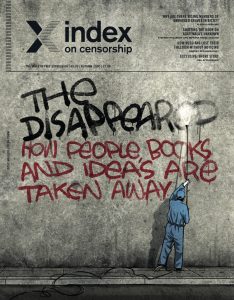
In this issue, we explore those whose ideas and voices – and sometimes, horrifically, bodies – are deliberately disappeared to muffle their dissent, or even their very existence.
Many people associate the term “the disappeared” with Argentina during the dictatorships, where we know about some of the horrific tactics used by the junta. Opposition figures were killed; newborn babies were taken from their mothers and given to couples who supported the government, their mothers murdered and, in many cases, dumped at sea to get rid of the evidence. The grandmothers of those who were disappeared are still fighting to bring attention to those cases, to uncover what happened and to try to trace their grandchildren using DNA tests.
Index published some of those stories from Argentina at the time because Andrew Graham-Yooll, who was later to become the editor at Index, smuggled out some of the information to us and to The Daily Telegraph, risking his life to do so.
We explore what and who are being disappeared by authorities that don’t want to acknowledge their existence.
Thousands of people who are escaping war and starvation try to flee across the Mediterranean Sea: hundreds disappear there. Their bodies may never be found.
It is convenient for the authorities on both sides of the sea that the numbers appear lower than they really are and the real stories don’t get out.
In a special report for this issue, Alessio Perrone reveals the tactics being used to cover up the numbers and make it appear there are fewer journeys and deaths than in reality.
The International Organisation for Migration’s Missing Migrants Project says that 20,000 people have died in the Mediterranean since records began in 2014, but many say this is an underestimation.
Certainly there are unmarked graves in Sicily where bodies have been recovered but no one knows their names (see page 30). The Italian government has, as we have previously reported, used deliberate tactics to make it harder to report on the situation and to stop the rescue boats finding refugees adrift near her boundaries.
[/vc_column_text][/vc_column][/vc_row][vc_row][vc_column width=”1/4″][vc_icon icon_fontawesome=”fas fa-quote-left” color=”custom” custom_color=”#2a31b7″][/vc_column][vc_column width=”3/4″][vc_custom_heading text=”It is convenient for the authorities on both sides of the sea that the numbers appear lower than they really are and the real stories don’t get out.”][/vc_column][/vc_row][vc_row][vc_column][vc_column_text]
Also in this issue, Stefano Pozzebon and Morena Joachín report on how Guatemala’s national police archives – which house information on those people who were disappeared during the civil war – is currently closed, and not for Covid-19 reasons (see page 27).
Fifteen years after the archive was first opened to the public, a combination of political pressure and a desire to rewrite history in the troubled nation has closed it. This is a tragedy for families still using it in an attempt to trace what happened to their families.
In Azerbaijan (see page 8), another tactic is being used to silence people – this time using technology. Activists are having their profiles hacked on social media and then posts and messages are being written by the hackers and posted under their names.
Their real identities conveniently disappear under a welter of false information – a tactic used to undermine trust in journalists and activists who dare to challenge the government so that the public might stop believing what they write or say.
This is my 30th and final issue of the magazine after seven years as editor (although I will still be a contributing editor), and it is another gripping one.
They smuggle out words because they think words make a difference.
Over the years, I am proud to have worked with the incredible, brave, talented and determined. We have published new writing by Ian Rankin, Ariel Dorfman, Xinran, Lucien Bourjeily, and Amartya Sen, among others. And it has been a privilege to work with the mindblowing, sharp, analytical journalism from the pens of our incredible contributing editors over the years, including Kaya Genç, Irene Caselli, Natasha Joseph, Laura Silvia Battaglia, Stephen Woodman, Duncan Tucker and Jan Fox, plus regular contributors Wana Udobang, Karoline Kan, Steven Borowiec, Alessio Perrone and Andrey Arkhangelsky.
These people do amazing work: their writing is ahead of the game and they bring together thought-provoking analysis and great human stories. Thank you to all of them, and to deputy editor Jemimah Steinfeld.
They have told me again and again why they value writing for Index on Censorship and the importance of its work.
And because we believe that supporting writers and journalists is also about them getting paid for their work, unlike some others we have always supported the principle of paying people for their journalism.
Over the years we have attempted to go above and beyond, providing a little extra training when we can, translating Index articles into other languages, inviting journalists we work with to events, and introducing them to book publishers.
But just like the first time I ventured into the archives of the magazine, I am still amazed by what gems we have inside. We have recently reached our biggest readership to date, with hundreds of thousands of articles being downloaded in full, showing an appetite for the kind of journalism and exclusive fiction we publish.
Thank you, readers, for being part of the journey, and please continue to support this small but important magazine as it continues to speak for freedom.
[/vc_column_text][/vc_column][/vc_row][vc_row][vc_column][vc_column_text]
Rachael Jolley is the former editor-in-chief of Index on Censorship magazine. She tweets @londoninsider. This article is part of the latest edition of Index on Censorship’s autumn 2020 issue, entitled The disappeared: how people, books and ideas are taken away.
Look out for the new edition in bookshops, and don’t miss our Index on Censorship podcast, with special guests, on Soundcloud.
[/vc_column_text][/vc_column][/vc_row][vc_row][vc_column width=”1/2″][vc_custom_heading text=”Listen”][vc_column_text]The autumn 2020 magazine podcast featuring Hong Kong-based journalist Oliver Farry, who discusses the crackdown on pro-democracy demonstrations in the region
LISTEN HERE[/vc_column_text][/vc_column][vc_column width=”1/2″][vc_custom_heading text=”Subscribe”][vc_column_text]In print, online. In your mailbox, on your iPad.
Subscription options from £18 or just £1.49 in the App Store for a digital issue.
Every subscriber helps support Index on Censorship’s projects around the world.
 SUBSCRIBE NOW[/vc_column_text][/vc_column][/vc_row][vc_row][vc_column][/vc_column][/vc_row]
15 Sep 2020 | Magazine, Magazine Contents, Volume 49.03 Autumn 2020
[vc_row][vc_column][vc_custom_heading text=”Special report”][vc_column_text]Government hits activists’ online profiles by Arzu Geybulla: Journalists and activists are finding their social media profiles hacked and sometimes deleted in a clear harassment campaign in Azerbaijan
Presiding over bloodshed by Issa Sikiti da Silva: The voice of the opposition is increasingly missing in action as Uganda approaches election day
“Silence got us nowhere. We need to speak up” by Rushan Abbas: One woman’s anguish and outrage over her sister’s disappearance and the millions of others into the concentration camp network in Xinjiang, China
“The idea is to kill journalism” by Bilal Ahmad Pandow: Kashmiri journalists on what it’s like working under lockdown, an internet blackout and a new draconian media law
What has the government got to hide? by Jessica Ní Mhainín: The new Irish government has to decide whether to block access to historic child abuse records
Don’t show and tell by Orna Herr: In a bid to avoid offence, TV shows are disappearing from the airwaves. Are we poorer for it?
Restaurants scrub off protest walls by Oliver Farry: All signs of the city’s recent protest past are being removed in Hong Kong’s restaurants, shops and even libraries following the new security law
Closure means no closure by Stefano Pozzebon and Morena Pérez Joachin: The library housing documents on the disappeared of Guatemala’s brutal civil war has been closed and with it the disappeared have disappeared further
The unknown quantity by Alessio Perrone: The Italian government is making efforts to cover up who and how many are trying to cross the Mediterranean
Tracing Turkey’s disappeared by Kaya Genç: A centre looks into the forced disappearances of Kurds in Turkey. Will they find answers or obstacles?
“There’s nobody left to speak” by Somak Ghoshal: First they came for the journalists. Then they came for the lawyers and activists. Who can speak out in today’s India?
Out of sight, but never out of mind by Laura Silvia Battaglia: Our interview with the director of a new documentary about the disappeared in Syria
Blogger flees Tunisia after arrest by Layli Foroudi: After telling a joke, one Tunisian blogger had to flee her country to avoid prison
Becoming tongue-tied by Sally Gimson: China is one country that is forcing people to give up their minority languages. Others have also attempted it
Spain’s lonely voices by Silvia Nortes: We trace the demise of many minority Spanish languages and look at whether others will survive[/vc_column_text][/vc_column][/vc_row][vc_row][vc_column][vc_custom_heading text=”Global view”][/vc_column][/vc_row][vc_row][vc_column][vc_column_text]Why Index has never been needed more by Ruth Smeeth: The world is witnessing an acceleration of illiberalism. We all need to be vigilant[/vc_column_text][/vc_column][/vc_row][vc_row][vc_column][vc_custom_heading text=”In focus”][/vc_column][/vc_row][vc_row][vc_column][vc_column_text]Ecce homo sovieticus by Andrey Arkhangelsky: Decades after the end of the Soviet Union, Russians are still plagued by totalitarianism. It’s getting worse
“I have suffered death threats and they killed my pet dogs” by Stephen Woodman: Mexican journalists work in war-like conditions. Many are suffering terrible mental illnesses because of it
Nonsense and sensibility by Jemimah Steinfeld: An interview with the bestselling author Dave Eggers about society’s slide into a total surveillance state
Fighting the laws that are silencing journalists by Jessica Ní Mhainín: Vexatious legal threats are part of the European media landscape. We need to take action against them, says a new Index report
2020 by Ben Jennings: Is Alexa censoring the news or is it just that bad? A new cartoon from the award-winning illustrator
Will the centre hold by Michella Oré? They voted for Trump in 2016 because their voices were not being heard. How does middle America feel today?
Who Speaks for Iowa by Jan Fox? The owner of a small-town radio station talks about feeling ignored in the rural USA[/vc_column_text][/vc_column][/vc_row][vc_row][vc_column][vc_custom_heading text=”Culture”][/vc_column][/vc_row][vc_row][vc_column][vc_column_text]Past imperfect by Lisa Appignanesi: The award-winning writer speaks to Rachael Jolley about the inspiration for her new short story, written exclusively for Index, which looks at the idea of ageing, and disappearing memories, and how it plays out during lockdown
The history man by Xue Yiwei: One of China’s most widely read writers discusses a childhood memory of being punished for singing, alongside his short story, published in English for the first time here
Four more years by Mark Frary? Analysis of the upcoming US election looking at the media, plus a new satirical short story by Kaya Genç in which a dog considers Trump’s re-election hopes
Speech patterns by Abraham Zere: The Eritrean writer on escaping one of the world’s most censored countries and now living in Trump’s USA. Plus a new short story of his[/vc_column_text][/vc_column][/vc_row][vc_row][vc_column][vc_custom_heading text=”Index around the world”][/vc_column][/vc_row][vc_row][vc_column][vc_column_text]New tactics to close down speech by Orna Herr: The news editor at Rappler speaks to Index about legal threats against the media outlet’s CEO, Maria Ressa, plus a report on Index’s recent work[/vc_column_text][/vc_column][/vc_row][vc_row][vc_column][vc_custom_heading text=”End Note “][/vc_column][/vc_row][vc_row][vc_column][vc_column_text]Spraying discontent by Jemimah Steinfeld: With museums closed some of the most powerful art is on the streets. Index speaks to the world’s street artists on why it is suddenly a popular form of protest[/vc_column_text][/vc_column][/vc_row]
29 Apr 2020 | News and features
[vc_row][vc_column][vc_column_text]Attacks on press freedom in Europe are at serious risk of becoming a new normal, 14 international press freedom groups and journalists’ organisations including Index on Censorship warn today as they launch the 2020 annual report of the Council of Europe Platform to Promote the Protection of Journalism and the Safety of Journalists. The fresh assault on media freedom amid the Covid-19 pandemic has worsened an already gloomy outlook.
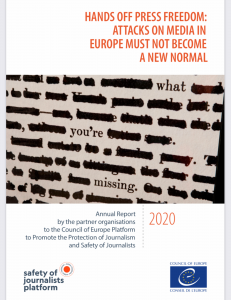 The report analyses alerts submitted to the platform in 2019 and shows a growing pattern of intimidation to silence journalists in Europe. The past weeks have accelerated this trend, with the pandemic producing a new wave of serious threats and attacks on press freedom in several Council of Europe member states. In response to the health crisis, governments have detained journalists for critical reporting, vastly expanded surveillance and passed new laws to punish “fake news” even as they decide themselves what is allowable and what is false without the oversight of appropriate independent bodies.
These threats risk a tipping point in the fight to preserve a free media in Europe. They underscore the report’s urgent wake-up call on Council of Europe member states to act quickly and resolutely to end the assault against press freedom, so that journalists and other media actors can report without fear.
Although the overall response rate by member states to the platform rose slightly to 60 % in 2019, Russia, Turkey, and Azerbaijan – three of the biggest media freedom violators – continue to ignore alerts, together with Bosnia and Herzegovina.
2019 was already an intense and often dangerous battleground for press freedom and freedom of expression in Europe. The platform recorded 142 serious threats to media freedom, including 33 physical attacks against journalists, 17 new cases of detention and imprisonment and 43 cases of harassment and intimidation.
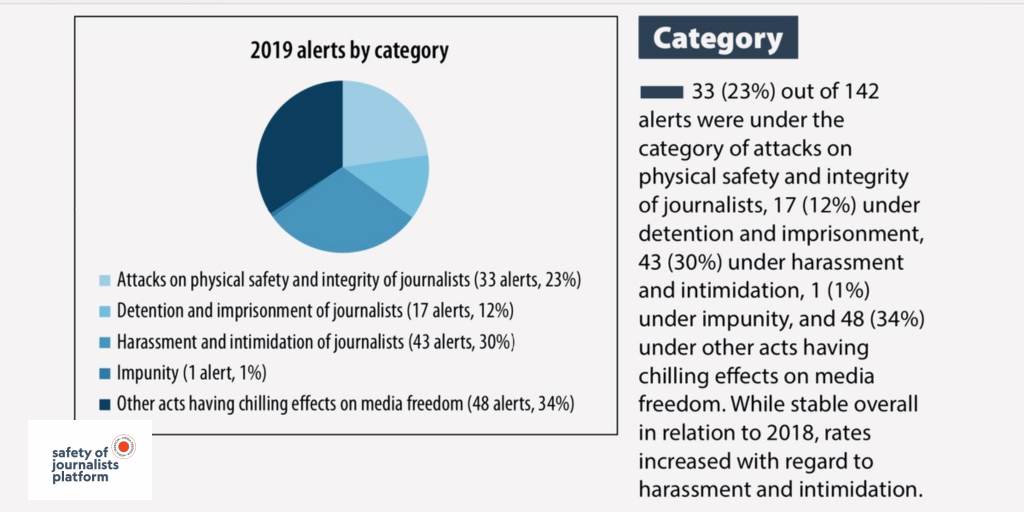
The physical attacks tragically included two killings of journalists: Lyra McKee in Northern Ireland and Vadym Komarov in Ukraine. Meanwhile, the platform officially declared the murders of Daphne Caruana Galizia (2017) in Malta and Martin O’Hagan (2001) in Northern Ireland as impunity cases, highlighting authorities’ failure to bring those responsible to justice. Only Slovakia showed concrete progress in the fight against impunity, indicting the alleged mastermind and four others accused of murdering journalist Ján Kuciak and his fiancée, Martina Kušnírová.
At the end of 2019, the platform recorded 105 cases of journalists behind bars in the Council of Europe region, including 91 in Turkey alone. The situation has not improved in 2020. Despite the acute health threat, Turkey excluded journalists from a mass release of inmates in April 2020, and second-biggest jailer Azerbaijan has made new arrests over critical coverage of the country’s coronavirus response.
2019 saw a clear increase in judicial or administrative harassment against journalists, including meritless SLAPP cases, and spurious and politically motivated legal threats. Prominent examples were the false drug charges filed against Russian investigative journalist Ivan Golunov and the continued imprisonment of journalists in Ukraine’s Russia-controlled Crimea. The Covid-19 crisis has strengthened officials’ tools to harass journalists, with dangerous new “fake news” laws in countries such as Hungary and Russia that threaten journalists with jail for contravening the official line.
Other serious issues identified by 2019 alerts included expanded surveillance measures threatening journalists’ ability to protect their sources, including in France, Poland and Switzerland, as well political attempts to “capture” media through ownership and market manipulation, most conspicuously of all in Hungary. These threats, too, are exacerbated by the actions taken by several governments under the health crisis, which further include arbitrary limitations on independent reporting and on journalists’ access to official information about the pandemic.
Jessica Ní Mhainín, Index’s policy research and advocacy officer, says, “There is a growing pattern of intimidation aimed at silencing journalists in Europe. The situation in Eastern Europe – especially in Hungary, Poland, and Bulgaria – is particularly concerning. But the killing of Lyra McKee shows that we cannot take the safety of journalists for granted anywhere – not even in countries that are seen to be safe for journalists. This report provides an opportunity for us all to come to grips with the serious situation that is facing European media and to remind ourselves of the vital role that the media play in holding power to account.”
Index and the other platform partners call for urgent scrutiny of action taken by governments to claim extraordinary powers related to freedom of expression and media freedom under emergency legislation that are not strictly necessary and proportionate in response to the pandemic. Uncontrolled and unlimited state of emergency laws are open to abuse and have already had a severe chilling effect on the ability of the media to report and scrutinise the actions of state authorities.
While the platform welcomes an increased focus on press freedom by European institutions, including both the Council of Europe and European Union institutions, the ongoing crisis demands more urgent and stringent responses to protect media freedom and freedom of expression and information, and to support the financial sustainability of independent professional journalism. In the age of emergency rule, protecting the press as the watchdog of democracy cannot wait.[/vc_column_text][/vc_column][/vc_row]
25 Mar 2020 | News and features, Press Releases, Statements
[vc_row][vc_column][vc_column_text]Index on Censorship and Justice for Journalists Foundation (JFJ) announce a joint global initiative to monitor attacks and violations against the media, specific to the current coronavirus-related crisis.
According to Rachael Jolley, Editor-in-Chief, Index of Censorship: “In times of extraordinary crisis, governments often take the opportunity to roll back on personal freedoms and media freedom. The public’s right to know can be severely reduced with the little democratic process. Index is already being alerted to attacks and violations against the media in the current coronavirus related crisis, as well as other alarming news pertaining to privacy and freedoms”.
“In our daily work in the post-Soviet region, Justice for Journalists Foundation experts and partners come across grave violations of media freedom and media workers’ human rights. Today, we are witnessing how the corrupt governments and businessmen in many of the regional autocracies are abusing the current limitations of public scrutiny. This major decrease in civil liberties makes pursuing their interests easier and even less transparent, whereas media workers striving to unveil murky practices are facing more risks than ever before”, said Maria Ordzhonikidze, JFJ’s Director.
Index draws on its experience running other mapping projects to enable easy comparisons of media violations in each country, and also so data can be collated and discussed when the global crisis is over.
Justice for Journalists Foundation will contribute to this monitoring effort by expanding cooperation with its existing regional partners who provide data and analysis for the series of Media Threats and Attacks Reports in Azerbaijan, Armenia, Belarus, Georgia, Kazakhstan, Kyrgyzstan, Moldova, Russia, Tajikistan, Turkmenistan, Ukraine and Uzbekistan.
The overall goal of the project is threefold: to increase awareness about the importance of media freedom and the existing state of press freedom at this particular point in history, to support journalists whose work is being impeded, by highlighting the challenges they face to an international audience and to continue to improve media freedom globally in the long run.
Anyone interested to learn more about or contribute to this initiative by providing information on incidents and/or translation, publicity and ideas, please get in touch:
[/vc_column_text][/vc_column][/vc_row]