20 Sep 2017 | Campaigns -- Featured, Press Releases
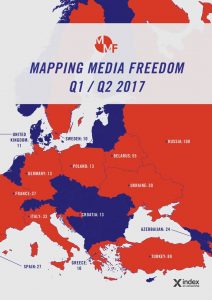 Index on Censorship’s database tracking violations of press freedom recorded 571 verified threats and limitations to media freedom during the first two quarters of 2017.
During the first six months of the year: three journalists were murdered in Russia; 155 media workers were detained or arrested; 78 journalists were assaulted; 188 incidents of intimidation, which includes psychological abuse, sexual harassment, trolling/cyberbullying and defamation, were documented; 91 criminal charges and civil lawsuits were filed; journalists and media outlets were blocked from reporting 91 times; 55 legal measures were passed that could curtail press freedom; and 43 pieces of content were censored or altered.
“The incidents reported to the Mapping Media Freedom in the first half of 2017 tell us that the task of keeping the public informed is becoming much harder and more dangerous for journalists. Even in countries with a tradition of press freedom journalists have been harassed and targeted by actors from across the political spectrum. Governments and law enforcement must redouble efforts to battle impunity and ensure fair treatment of journalists,” Hannah Machlin, Mapping Media Freedom project manager, said.
Q1 2017
During the first quarter the MMF database registered several trends that can be recognised as acute challenges to media freedom. A total of 299 incidents were reported to the project by MMF correspondents and other journalists between 1 January and 31 March 2017.
Some European governments clearly interfered with media pluralism. Other governments harassed, intimidated and detained journalists. The net effect of these interventions have been to debase and devalue the work of the press and undermine a basic foundation of democracy.
Throughout Q1: one journalist was murdered; 42 incidents of assault were confirmed; there were 89 verified reports of intimidation; media professionals were detained in 69 incidents; 38 criminal charges and civil lawsuits were filed; and journalists were barred from reporting in 54 verified incidents.
The full Q2 report is available on the web or in a combined Q1/Q2 PDF.
Q2 2017
The crackdown on media freedom throughout Europe — even within those countries perceived to be more democratic — continued in Q2 2017. A total of 272 incidents were reported to the project by MMF correspondents and other journalists between 1 April and 30 June 2017.
While the number of reports recorded during the second quarter declined nearly 10 per cent from the first quarter, this does not indicate an improvement in the overall state of media freedom. The situation for journalists across Europe remained extremely concerning. For example, the number of arrests decreased during the quarter, but hundreds of journalists were in detention or were forced into exile. In addition, based on the severity of the second quarter reports, inhumane treatment of media workers actually increased.
Throughout Q2: two journalists were killed; 36 incidents of physical assault and injury were reported; 53 criminal charges and civil lawsuits were filed; 99 instances of intimidation, which includes psychological abuse, sexual harassment, trolling/cyberbullying and defamation, took place; journalists were blocked from covering stories 54 times; 20 legal measures were passed that curtail press freedom; and 19 works were censored/altered by the state or editorial teams.
The full Q2 report is available on the web or in a combined Q1/Q2 PDF.
For more information, please contact:
For further information, please contact Hannah Machlin, project manager, Mapping Media Freedom on [email protected]
About Mapping Media Freedom
Mapping Media Freedom – an Index on Censorship-lead project with partner European Federation of Journalists and Turkey-based P24, Platform for Independent Journalism, partially funded by the European Commission – covers 42 countries, including all EU member states, plus Bosnia, Iceland, Kosovo, Macedonia, Montenegro, Norway, Serbia, Turkey, Albania along with Ukraine, Belarus and Russia and Azerbaijan. The platform was launched in May 2014 and has recorded over 3,300 incidents threatening media freedom by the end of Q2 2017.
Search reported incidents throughout Europe at https://mappingmediafreedom.org.
5 Sep 2017 | Campaigns -- Featured, Statements
[vc_row][vc_column][vc_column_text]
The Hague, 5 September 2017
Dear members of the International Association of Prosecutors members, executive committee and senate,
In the run-up to the annual conference and general meeting of the International Association of Prosecutors (IAP) in Beijing, China, the undersigned civil society organisations urge the IAP to live up to its vision and bolster its efforts to preserve the integrity of the profession.
Increasingly, in many regions of the world, in clear breach of professional integrity and fair trial standards, public prosecutors use their powers to suppress critical voices.
In China, over the last two years, dozens of prominent lawyers, labour rights advocates and activists have been targeted by the prosecution service. Many remain behind bars, convicted or in prolonged detention for legal and peaceful activities protected by international human rights standards, including the Universal Declaration of Human Rights. Azerbaijan is in the midst of a major crackdown on civil rights defenders, bloggers and journalists, imposing hefty sentences on fabricated charges in trials that make a mockery of justice. In Kazakhstan, Russia and Turkey many prosecutors play an active role in the repression of human rights defenders, and in committing, covering up or condoning other grave human rights abuses.
Patterns of abusive practices by prosecutors in these and other countries ought to be of grave concern to the professional associations they belong to, such as the IAP. Upholding the rule of law and human rights is a key aspect of the profession of a prosecutor, as is certified by the IAP’s Standards of Professional Responsibility and Statement of the Essential Duties and Rights of Prosecutors, that explicitly refer to the importance of observing and protecting the right to a fair trial and other human rights at all stages of work.
Maintaining the credibility of the profession should be a key concern for the IAP. This requires explicit steps by the IAP to introduce a meaningful human rights policy. Such steps will help to counter devaluation of ethical standards in the profession, revamp public trust in justice professionals and protect the organisation and its members from damaging reputational impact and allegations of whitewashing or complicity in human rights abuses.
For the second year in a row, civil society appeals to the IAP to honour its human rights responsibilities by introducing a tangible human rights policy. In particular:
We urge the IAP Executive Committee and the Senate to:
- introduce human rights due diligence and compliance procedures for new and current members, including scope for complaint mechanisms with respect to institutional and individual members, making information public about its institutional members and creating openings for stakeholder engagement from the side of civil society and victims of human rights abuses.
We call on individual members of the IAP to:
- raise the problem of a lack of human rights compliance mechanisms at the IAP and thoroughly discuss the human rights implications before making decisions about hosting IAP meetings;
- identify relevant human rights concerns before travelling to IAP conferences and meetings and raise these issues with their counterparts from countries where politically-motivated prosecution and human rights abuses by prosecution authorities are reported by intergovernmental organisations and internationally renowned human rights groups.
Supporting organisations:
Amnesty International
Africa Network for Environment and Economic Justice, Benin
Anti-Corruption Trust of Southern Africa, Kwekwe
Article 19, London
Asian Forum for Human Rights and Development (FORUM-ASIA)
Asia Justice and Rights, Jakarta
Asia Indigenous Peoples Pact, Chiang Mai
Asian Human Rights Commission, Hong Kong SAR
Asia Monitor Resource Centre, Hong Kong SAR
Association for Legal Intervention, Warsaw
Association Humanrights.ch, Bern
Association Malienne des Droits de l’Homme, Bamako
Association of Ukrainian Human Rights Monitors on Law Enforcement, Kyiv
Associazione Antigone, Rome
Barys Zvozskau Belarusian Human Rights House in exile, Vilnius
Belarusian Helsinki Committee, Minsk
Bir-Duino Kyrgyzstan, Bishkek
Bulgarian Helsinki Committee, Sofia
Canadian Human Rights International Organisation, Toronto
Center for Civil Liberties, Kyiv
Centre for Development and Democratization of Institutions, Tirana
Centre for the Development of Democracy and Human Rights, Moscow
China Human Rights Lawyers Concern Group, Hong Kong SAR
Civil Rights Defenders, Stockholm
Civil Society Institute, Yerevan
Citizen Watch, St. Petersburg
Collective Human Rights Defenders “Laura Acosta” International Organization COHURIDELA, Toronto
Comunidad de Derechos Humanos, La Paz
Coordinadora Nacional de Derechos Humanos, Lima
Destination Justice, Phnom Penh
East and Horn of Africa Human Rights Defenders Project, Kampala
Equality Myanmar, Yangon
Faculty of Law – University of Indonesia, Depok
Fair Trials, London
Federation of Equal Journalists, Almaty
Former Vietnamese Prisoners of Conscience, Hanoi
Free Press Unlimited, Amsterdam
Front Line Defenders, Dublin
Foundation ADRA Poland, Wroclaw
German-Russian Exchange, Berlin
Gram Bharati Samiti, Jaipur
Helsinki Citizens’ Assembly Vanadzor, Yerevan
Helsinki Association of Armenia, Yerevan
Helsinki Foundation for Human Rights, Warsaw
Human Rights Center Azerbaijan, Baku
Human Rights Center Georgia, Tbilisi
Human Rights Club, Baku
Human Rights Embassy, Chisinau
Human Rights House Foundation, Oslo
Human Rights Information Center, Kyiv
Human Rights Matter, Berlin
Human Rights Monitoring Institute, Vilnius
Human Rights Now, Tokyo
Human Rights Without Frontiers International, Brussels
Hungarian Civil Liberties Union, Budapest
IDP Women Association “Consent”, Tbilisi
IMPARSIAL, the Indonesian Human Rights Monitor, Jakarta
Index on Censorship, London
Indonesian Legal Roundtable, Jakarta
Institute for Criminal Justice Reform, Jakarta
Institute for Democracy and Mediation, Tirana
Institute for Development of Freedom of Information, Tbilisi
International Federation for Human Rights (FIDH)
International Partnership for Human Rights, Brussels
International Service for Human Rights, Geneva
International Youth Human Rights Movement
Jerusalem Institute of Justice, Jerusalem
Jordan Transparency Center, Amman
Justiça Global, Rio de Janeiro
Justice and Peace Netherlands, The Hague
Kazakhstan International Bureau for Human Rights and Rule of Law, Almaty
Kharkiv Regional Foundation Public Alternative, Kharkiv
Kosovo Center for Transparency, Accountability and Anti-Corruption – KUND 16, Prishtina
Kosova Rehabilitation Center for Torture Victims, Prishtina
Lawyers for Lawyers, Amsterdam
Lawyers for Liberty, Kuala Lumpur
League of Human Rights, Brno
Macedonian Helsinki Committee, Skopje
Masyarakat Pemantau Peradilan Indonesia (Mappi FH-UI), Depok
Moscow Helsinki Group, Moscow
National Coalition of Human Rights Defenders, Kampala
Netherlands Helsinki Committee, The Hague
Netherlands Institute of Human Rights (SIM), Utrecht University, Utrecht
NGO “Aru ana”, Aktobe
Norwegian Helsinki Committee, Oslo
Pakistan Rural Workers Social Welfare Organization (PRWSWO), Bahawalpur
Pensamiento y Acción Social (PAS), Bogotá
Pen International, London
People’s Solidarity for Participatory Democracy (PSPD), Seoul
Philippine Human Rights Advocates (PAHRA), Manila
Promo-LEX Association, Chisinau
Protection International, Brussels
Protection Desk Colombia, alianza (OPI-PAS), Bogotá
Protection of Rights Without Borders, Yerevan
Public Association Dignity, Astana
Public Association “Our Right”, Kokshetau
Public Fund “Ar.Ruh.Hak”, Almaty
Public Fund “Ulagatty Zhanaya”, Almaty
Public Verdict Foundation, Moscow
Regional Center for Strategic Studies, Baku/ Tbilisi
Socio-Economic Rights and Accountability Project (SERAP), Lagos
Stefan Batory Foundation, Warsaw
Suara Rakyat Malaysia (SUARAM), Petaling Jaya
Swiss Helsinki Association, Lenzburg
Transparency International Anti-corruption Center, Yerevan
Transparency International Austrian chapter, Vienna
Transparency International Česká republika, Prague
Transparency International Deutschland, Berlin
Transparency International EU Office, Brussels
Transparency International France, Paris
Transparency International Greece, Athens
Transparency International Greenland, Nuuk
Transparency International Hungary, Budapest
Transparency International Ireland, Dublin
Transparency International Italia, Milan
Transparency International Moldova, Chisinau
Transparency International Nederland, Amsterdam
Transparency International Norway, Oslo
Transparency International Portugal, Lisbon
Transparency International Romania, Bucharest
Transparency International Secretariat, Berlin
Transparency International Slovenia, Ljubljana
Transparency International España, Madrid
Transparency International Sweden, Stockholm
Transparency International Switzerland, Bern
Transparency International UK, London
UNITED for Intercultural Action the European network against nationalism, racism, fascism and in support of migrants, refugees and minorities, Budapest
United Nations Convention against Corruption Civil Society Coalition
Villa Decius Association, Krakow
Vietnam’s Defend the Defenders, Hanoi
Vietnamese Women for Human Rights, Saigon
World Organisation Against Torture (OMCT)
Zimbabwe Lawyers for Human Rights, Harare[/vc_column_text][/vc_column][/vc_row][vc_row][vc_column][vc_basic_grid post_type=”post” max_items=”4″ element_width=”6″ grid_id=”vc_gid:1504604895654-8e1a8132-5a81-8″ taxonomies=”8883″][/vc_column][/vc_row]
20 Jul 2017 | Campaigns, Campaigns -- Featured, Media Freedom, media freedom featured, Statements
[vc_row][vc_column][vc_column_text]Dear Mr. Désir
Index on Censorship welcomes your appointment as the Representative on Freedom of the Media by the OSCE member states. We would like to extend our congratulations to you.
Like you, we agree wholeheartedly that the role of RFoM is important. In fact it is more important today than when the office was founded 1997. Since then, the media has faced pressures from a changing financial environment and — in some nations — government interference.
Through its project Mapping Media Freedom, Index on Censorship monitors press freedom violations in 42 OSCE member states. In just the last three years, there have been 3,302 verified incidents. Sadly, the number of reports we investigate is increasing. Journalists are coming under pressure from the left and the right of the political spectrum, from governments and non-state actors, from organised crime and private citizens. These multidimensional threats demand a consistent and robust response that crosses international boundaries.
We ask that, on assuming your responsibilities, you urgently consider the following as your priorities:
- Focusing attention on how the independence of the public media in OSCE member states such as Poland and Hungary is being undermined
- Calling attention to a continent-wide drift toward tighter regulation of the media — whether online or off — in OSCE nations such as France, the UK and Germany
- Raising awareness of widespread interference with the professional duties of journalists through legal obstacles and demands for accreditation, most acutely in OSCE members Belarus, Russia and Azerbaijan
- Building on the record of the RFOM office by being a vocal and visible advocate for journalists
- Continuing a determined and consistent approach to cases of impunity
- Resisting ill-guided attempts to use legislation to further curtail the marketplace of ideas in the member states
- Call out use of terror legislation to silence media by member states
- Mount a sustained campaign against criminal defamation laws in member states
Index on Censorship stands ready to partner with you to protect the media’s right to report and the public’s right to information.[/vc_column_text][/vc_column][/vc_row][vc_row][vc_column][vc_column_text]
Mapping Media Freedom
Click on the bubbles to view reports or double-click to zoom in on specific regions. The full site can be accessed at https://mappingmediafreedom.org/[/vc_column_text][/vc_column][/vc_row]
29 May 2017 | Azerbaijan, Digital Freedom, Europe and Central Asia, France, Mapping Media Freedom, News and features, Russia, Spain, Turkey, Uncategorized
[vc_row][vc_column][vc_column_text]
Each week, Index on Censorship’s Mapping Media Freedom project verifies threats, violations and limitations faced by the media throughout the European Union and neighbouring countries. Here are five recent reports that give us cause for concern.
24 May, 2017 – The body of the well-known editor-in-chief and founder of local newspaper Ton-M was found in the sauna in his backyard on 24 May in the town of Minusinsk in the Krasnodarski province, Regional Investigative Committee reported.
Dmitri Popkov was shot five times by an unidentified perpetrator according to the Regional Investigative Committee.
Popkov funds Ton-M which includes commentary on police corruption, garnering significant public attention for the publication. In an interview with RFE/RL, Popkov claims his newspaper became “an obstacle” for local officials who are now “threatening and intimidating journalists”.
Popkov founded the publication after a court found him guilty of beating a child and he was stripped of his position on Minusinsk City Council in 2012, according to The Moscow Times. Popkov claimed the case was an excuse to fire him.
Outside of the newspaper business, Popkov is recognisable in his region as a regional parliament deputy for the Communist Party.
22 May, 2017 – An independent reporter was arrested and sentenced to 30 days in administrative detention for allegedly resisting police.
Nijat Amiraslanov is from the Gazakh region and his lawyer and friends say the charges are fictitious. They say he was arrested for his reporting and online posts.
19 May, 2017 – During a workers’ protest against market liberalisation, dock workers assaulted and intimidated reporters covering the event.
A cameraperson for Canal Sur Television and Antena 3 programme was injured requiring medical assistance at a local hospital after being punched and kicked.
19 May, 2017 – Four Sözcü employees received arrest warrants after being accused of “committing crimes on behalf of the Fetullahist Terrorist Organisation (FETÖ),” as well as assisting attempts to “assassinate and physically attack the president and armed rebellion against the Government of the Republic of Turkey”.
The issued warrants include the newspaper’s owner Burak Akbay, manager of the newspaper’s website Mediha Olgun, Financial Affairs Manager Yonca Kaleli and the İzmir correspondent Gökmen Ulu. Kaleli was included in the investigation for “suspicious money transfers” for the secular opposition publication.
The charges against the four stemmed from their 15 July 2016, publication of the address and photos of a hotel where President Recep Tayyip Erdogan was vacationing.
Yonca Kaleli, Gökmen Ulu and Mediha Olgun have since been detained. Akbay is currently abroad.
18 May, 2017 – Macron’s head of communication insulted journalist Yann Barthès of Quotidien on channel TMC during the presidential campaign and now at the Elysee by calling him a “dickhead” and a “mentally-retarded person”, according to Le Monde M magazine.
Macron’s Sylvain Fort commented in reaction to show host Barthè’s coverage of the first round of the presidential election. Fort denies he used the latter phrase.
Quotidien showed Macron celebrating his victory at La Rotonde. Quotidien journalist Paul Larouturou asked Macron whether this episode was the equivalent of Nicolas Sarkozy’s celebration of his presidential victory at Fouquet’s. Macron told the journalist “you don’t understand anything about life”, adding he had “no lesson to receive from a small Parisian milieu”.
The magazine reported that access was restricted to Quotidien team and that Fort contacted Barthès directly to insult him.[/vc_column_text][/vc_column][/vc_row][vc_row][vc_column][vc_column_text]
Mapping Media Freedom
Click on the bubbles to view reports or double-click to zoom in on specific regions. The full site can be accessed at https://mappingmediafreedom.org/[/vc_column_text][/vc_column][/vc_row]