15 Oct 2014 | Press Releases, Uncategorized
- Awards honour journalists, campaigners and artists fighting censorship globally
- Judges include journalist Mariane Pearl and human rights lawyer Sir Keir Starmer
- Nominate at www.indexoncensorship.org/nominations
Beginning today, nominations for the annual Index on Censorship Freedom of Expression Awards 2015 are open. Now in their 15th year, the awards have honoured some of the world’s most remarkable free expression heroes – from Israeli conductor Daniel Barenboim to Syrian cartoonist Ali Farzat to education activist Malala Yousafzai.
The awards shine a spotlight on individuals fighting to speak out in the most dangerous and difficult of conditions. As Idrak Abbasov, 2012 award winner, said: “In Azerbaijan, telling the truth can cost a journalist their life… For the sake of this right we accept that our lives are in danger, as are the lives of our families. But the goal is worth it, since the right to truth is worth more than a life without truth.” Pakistani internet rights campaigner Shahzad Ahmad, a 2014 award winner, said the awards “illustrate to our government and our fellow citizens that the world is watching”.
Index invites the public, NGOs, and media organisations to nominate anyone they believe deserves to be part of this impressive peer group: a hall of fame of those who are at the forefront of tackling censorship. There are four categories of award: Campaigner (sponsored by Doughty Street Chambers); Digital Activism (sponsored by Google); Journalism (sponsored by The Guardian), and the Arts. Nominations can be made online via http://www.indexoncensorship.org/nominations
Winners will be flown to London for the ceremony, which takes place at The Barbican on March 18 2015. In addition, to mark the 15th anniversary of the Freedom of Expression awards, Index is inaugurating an Awards Fellowship to extend the benefits of the award. The fellowship will be open to all winners and will offer training and support to amplify their work for free expression. Fellows will become part of a world-class network of campaigners, activists and artists sharing best practice on tackling censorship threats internationally.
Jodie Ginsberg, CEO of Index, said: “The Index Freedom of Expression Awards is a chance for those whom others try to silence to have their voices heard. I encourage everyone, no matter where they are in the world, to nominate a free expression hero.”
The 2015 awards shortlist will be announced on January 27th 2015. Judges include journalist Mariane Pearl and human rights lawyer Sir Keir Starmer. The public will be asked to participate in selecting the winner of the Google Digital Activism award through a public vote beginning January 27th 2015. Sir Keir said: “Freedom of expression is part of the bedrock of civilised, democratic society. The Index on Censorship Awards have a material influence on promoting such freedom and both celebrating and protecting those who fight against censorship worldwide. That’s why Doughty Street Chambers chooses Index as its principal charity.”
For more information please contact David Heinemann: [email protected]
_______________________________________________________________________
NOTES FOR EDITORS
About Index on Censorship:
Index on Censorship is an international organisation that promotes and defends the right to freedom of expression. The inspiration of poet Stephen Spender, Index was founded in 1972 to publish the untold stories of dissidents behind the Iron Curtain and beyond. Today, we fight for free speech around the world, challenging censorship whenever and wherever it occurs. Index believes that free expression is the foundation of a free society and endorses Article 19 of the Universal Declaration of Human Rights, which states: “Everyone has the right to freedom of opinion and expression.”
About The Index on Censorship Freedom of Expression Awards:
The Index Freedom of Expression Awards recognise those deemed to be making the greatest impact in tackling censorship in their chosen area.
Awards categories:
Journalism – for impactful, original, unwavering journalism across all media (sponsored by The Guardian).
Campaigner – for campaigners and activists who have fought censorship and who challenge political repression (sponsored by Doughty St Chambers).
Digital Activism – for innovative uses of new technology to circumvent censorship and foster debate (sponsored by Google).
Arts – for artists and producers whose work asserts artistic freedom and battles repression and injustice.
Previous award winners include:
Journalism: Azadliq (Azerbaijan), Kostas Vaxevanis (Greece), Idrak Abbasov (Azerbaijan), Ibrahim Eissa (Egypt), Radio La Voz (Peru), Sunday Leader (Sri Lanka), Arat Dink (Turkey), Kareen Amer (Egypt), Sihem Bensedrine (Tunisia), Sumi Khan (Bangladesh), Fergal Keane (Ireland), Anna Politkovskaya (Russia), Mashallah Shamsolvaezin (Iran)
Digital/New Media: Bassel Khartabil (Palestine/Syria), Freedom Fone (Zimbabwe), Nawaat (Tunisia), Twitter (USA), Psiphon (Canada), Centre4ConstitutionalRights (US), Wikileaks
Advocacy: Malala Yousafzai (Pakistan), Nabeel Rajab (Bahrain), Gao Zhisheng (China), Heather Brooke (UK), Malik Imtiaz Sarwar (Malaysia), U.Gambira (Burma), Siphiwe Hlope (Swaziland), Beatrice Mtetwa (Zimbabwe), Hashem Aghajari (Iran)
Arts: Zanele Muholi (South Africa), Ali Farzat (Syria), MF Husain (India), Yael Lerer/Andalus Publishing House (Israel), Sanar Yurdatapan (Turkey)
You have received this email because email address ‘[email protected]’ is subscribed to ‘AWARDS 2015 Call For Nominations’.
1 Oct 2014 | Magazine, News, Volume 43.03 Autumn 2014
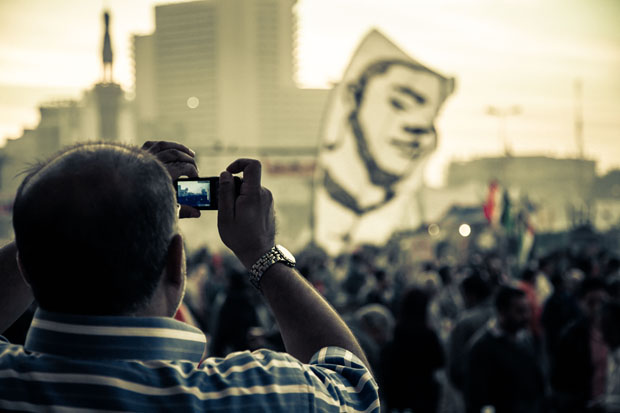
An Egyptian man takes a photo of a large anti-Morsi protest in Tahrir Square, Egypt (Photo: Phil Gribbon/Alamy)
Imagine this: a journalist with her own news drone camera that can be sent to any coordinates in the world to film what is going on. Imagine a world where you had the ability to programme a whole set of drone cameras to go and film a riot, a rally or a refugee camp.
Imagine being able to set off your smartphone down a dangerous river, encased in a plastic bottle, to take photos that might prove the water is carrying disease or is not safe to drink. How about drone cameras that you can leash to your GPS co-ordinates to follow and film you or someone else? Those worlds should not be hard to imagine as they exist already, and, in some cases, those facilities are already being used by journalists.
The future of journalism is going to build on technologies we already have. But we must remember it isn’t really about the technology, but about what it can help us deliver. When the subject of the future of journalism is discussed it often turns to whizzy gadgets but the debate about whether the public ends up being better informed and better equipped happens less often.
The information superhighway, as the internet was once called, was supposed to give individuals amazing access to knowledge that they couldn’t access before, from historical documents to live video footage. And it has.
But the thing that most of us didn’t bargain for was that it would mean we had so much stuff coming at us. We no longer knew where to turn, our eyes and ears were full, a welter of “news” snippets became impossible to absorb, and as for analysis, well, who had time for that?
The reality of exciting new technology is that it is coming to the market at a time when the public appears to value journalists less, and can turn to Twitter or Facebook or citizen journalists to find out what’s going on in the world. Journalists; who needs them when we can find out so much for ourselves? It’s a reasonable question, and of course good and determined researchers can find out plenty of information for themselves, if they have hours to spend. But then again journalists have a whole set of tools and training that should mean they are better than the average member of the public at finding out facts and analysing reports as well as presenting the end results.
Journalists are trained and practiced at interviewing, asking the right questions and drawing out relevant pieces of information. These are rarely acknowledged skills but you have only to switch on a phone-in programme or watch a set of parliamentarians try to quiz a witness at a committee to know asking a good question is not as easy as it might seem. Knowing where to look for evidence and sources is not always so simple as putting any old question into Google either. Then there is analysing charts, graphs and tables; this should be a particularly valued set of skills. When it comes to recognising a story, then the good old reporter’s nose comes in handy. And writing up and compiling a story so that it makes sense and tells the story well is perhaps the most underrated skill of all. Good writing is sadly underappreciated.
With a toolkit like that, it is not surprising that governments around the world would rather journalists weren’t at the scene of a demonstration, or sharpening up their introduction of a story about a government cover-up. Perhaps that’s why governments around the world from the USA to China make it especially difficult, or particularly expensive, for journalists to get a visa. And that’s why journalists are targeted, watched, held captive, and in some horrific cases, such as with US journalist James Foley, murdered. Increasingly journalists are working on a freelance basis from war zones and conflicts. As our writer Iona Craig reports from Yemen, this can leave you exposed on two levels – without the protection of being a staff member of a huge news organisation, and without any income if you can’t file stories. That exposure to pressure, and possible violence, also affects bloggers operating as reporters, and is something that worries OSCE’s Dunja Mijatovic (interviewed in our latest magazine), who brought journalists from different countries together in Vienna last month to discuss what needs to be done.
Journalists are still needed by societies, what they do can be very important (although sometimes very trivial too). At the same time that job is changing. In this issue Raymond Joseph’s fascinating article shows how African newsrooms with little money are able to use low-cost technology such as remote-controlled drone cameras to monitor oil spills, as well as less-sexy-sounding data analysis tools to help reporters find out what is going on. He also reports on how newsrooms are working closely with citizen reporters to bring news from regions that were previously unreported. Work being carried out by Naija Voices in Nigeria, and by our Index 2014 award winner Shu Choudhary in India, shows how technology can help augment old-fashioned reporting, getting news to and from remote areas.
News reporting is also taking different forms to reach different audiences, as was brought home to me at the Film Forward conference in Malmö, Sweden, this summer, when US journalist Nonny de la Peña and Danish journalist Steven Achiam showed the audience how interactive news “games” and cartoon-style films are new forms of reportage. Achiam’s Deadline Athen is a journalism game that allows the player to become a journalist in Athens, collecting information about a riot and shows the choices that are available; it gives the players options of where to find out and source the story. La Peña uses her journalistic skills to engage “players” in the experience of being imprisoned in Guantanamo Bay, using real news sources to inform what the “player” experiences so that it is similar to what prisoners experienced. Both Achiam and La Peña argue that these type of approaches will engage and inform different audiences in finding out about the world, audiences that would not be minded to read a newspaper or watch the TV news.
There’s not yet a journalism ethics handbook that covers these approaches. Both La Peña and Achiam are award-winning journalists and have merged their existing set of research skills with a different style. Both talk about sourcing information for their news films, and La Peña offers links to evidence for her virtual-reality storytelling.
These pioneering approaches so far only have small audiences compared to TV news, but will undoubtedly challenge journalists of the future to learn new skills (video and animation look increasingly like core modules).
Interviewing, research and legal knowledge are always going to part of the mix; they are the skills that give journalists the tools to find out what others would rather they didn’t. And that skill package is always going to be vital.
Read the contents of our future of journalism special here. You can buy the print version magazine or subscribe for £32 per year here, or download the app for just £1.79.
You can also join our magazine debate at London’s Frontline Club on 22 October (free entry, but please book).
This article was published on Wednesday 1 October at indexoncensorship.org
30 Sep 2014 | Egypt, News, Press Releases, Religion and Culture
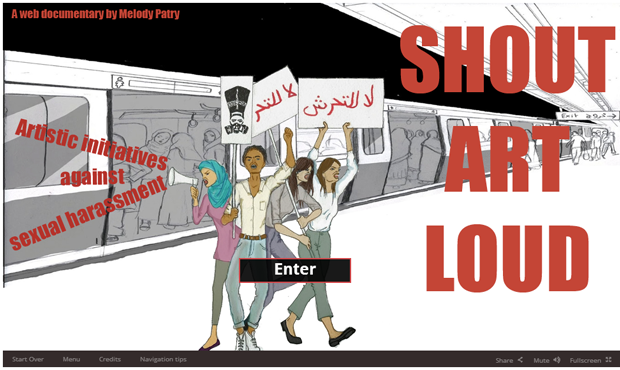
Index on Censorship’s Shout Art Loud, an interactive documentary highlighting how Egyptian graffiti artists, cartoonists, dancers and actors are fighting back against rising levels of violence and sexism on the streets of Cairo, has been named to the shortlist of the annual Amnesty International media awards.
Nominated in the Digital Innovation category, Shout Art Loud, created by Melody Patry, joins The Guardian’s The Shirt on Your Back and the Bureau of Investigative Journalism’s Covert Drone War on the short list.
Documentary maker Patry interviewed actors, dancers and other artists around Egypt, where 99% of women have experienced some form of sexual harassment, and 80% feel unsafe on the street. Sexual violence has risen sharply in Egypt in the past few years. During the period February 2011 to January 2014, Egyptian women’s rights groups documented thousands of cases of sexual harassment, as well as crimes of sexual violence against at least 500 women, including gang rapes and mob-sexual assaults with sharp objects and fingers.
With police, politicians and the judiciary seeming incapable of tackling the issue effectively, activists are turning to the arts to help lead the fight back. “Art is one of the most necessary mediums to impact society,” says Deena Mohamed who created a web-comic about a hijab-wearing superheroine who fights daily sexual harassment. “For people who are unaware of the issues women go through, I hope it helps them understand or at least give them something to think about.”
An interactive documentary intended as a “living report” that will be continuously updated, Shout Art Loud shows how Cairo residents are using different tactics to fight rising sexual harassment, including pro-women graffiti, drama workshops and street performances.
“We believe that spreading images, things that people are familiar with, women figures that people know and sayings that people know brings back some positivity about women in general,” says Merna Thomas, co-founder of a graffiti campaign to promote women’s rights in Cairo’s public spaces.
See how Egyptians are using theatre, dance, music and street art to tackle the issue of sexual harassment and violence against women in Egypt in this interactive documentary, which features interviews with artists, original artwork, videos and performances, including from Index’s 2014 Freedom of Expression Arts Award winner Mayam Mahmoud. You can access the documentary here: indexoncensorship.org/shoutartloud
“This innovative documentary is a reminder of the vital role artistic expression plays in tackling taboo subjects like sexual violence — in Egypt and beyond,” said Index CEO Jodie Ginsberg. “We want to bring this issue to a wider audience to show just how important artists and writers can be in bringing about change, and to tell the story in a new way.”
For further information and interview requests, please call +44 (0)207 260 2660
11 Sep 2014 | Draw the Line, Youth Board
Free expression and policing can have an antagonistic relationship. Recent events in Ferguson are demonstrative of the issues that arise as the demands for protest clash with those for civil safety.
The police are naturally drawn to the forefront of such a debate as they become the physical manifestation of a state’s commitment to free expression and the right to protest. Thus, as the Obama administration launches a federal investigation into whether the Missouri police systematically violated the civil rights of protesters, it is prescient to ask whether one can demand more of the police to protect free expression.
Undoubtedly, enforcement agencies across the world play a tricky role in facilitating expression while protecting the legitimate safety concerns of the local community. Between 2009 and 2013, police in England spent £10 million on security arrangements for EDL marches. There can also be a huge social cost to galvanic protest and the director of Faith Matters, Fiyaz Mughal, has called for a ban on such marches, claiming that “[We] know there is a corrosive impact on communities, it creates tensions and anti-Muslim prejudice in areas. I think enough is enough. I think a banning order is necessary with the EDL”.
What the recent altercations in Ferguson illustrates is that the role of the police in safeguarding free expression must not be overlooked. More importantly, this is a global issue and as six activists being retried for breaching Egypt’s protest law have started an open-ended sit-in and hunger strike it must be remembered that this debate truly gets to the heart of the basic demands of any civic society.
As scenes from Ferguson have at times resembled the images of police crackdowns in Cairo it is clear that complacency about such issues can prove disastrous. It therefore seems vital to drawn certain lines as to where we feel the police should stand when it comes to creating the basis of a safe but also free society.
This article was posted on 11 Sept 2014 at indexoncensorship.org
